
Home loan balance transfer: move to a lower rate
Still paying 8.5% or more? Rates for strong credit profiles start around 7.50%*. We compare 50+ lenders, count every charge, and tell you straight if a transfer is worth it.
*Rates checked 20 to 27 October 2026, for borrowers with a strong credit profile. Your rate depends on your credit score, income and property.
Is a balance transfer worth it?
The rule we use: the charges should come back in under 24 months, and you should keep the loan at least twice that long.
A transfer usually pays. Get two written offers.
₹50 lakh, 8.50% to 7.50%: charges back in 18 to 25 months.
Ask your own bank first. Transfer only if the fees are waived and you will keep the loan 4 more years or longer.
8.00% to 7.50%: charges back in 35 to 50 months.
Skip it. Ask your bank to cut your rate instead.
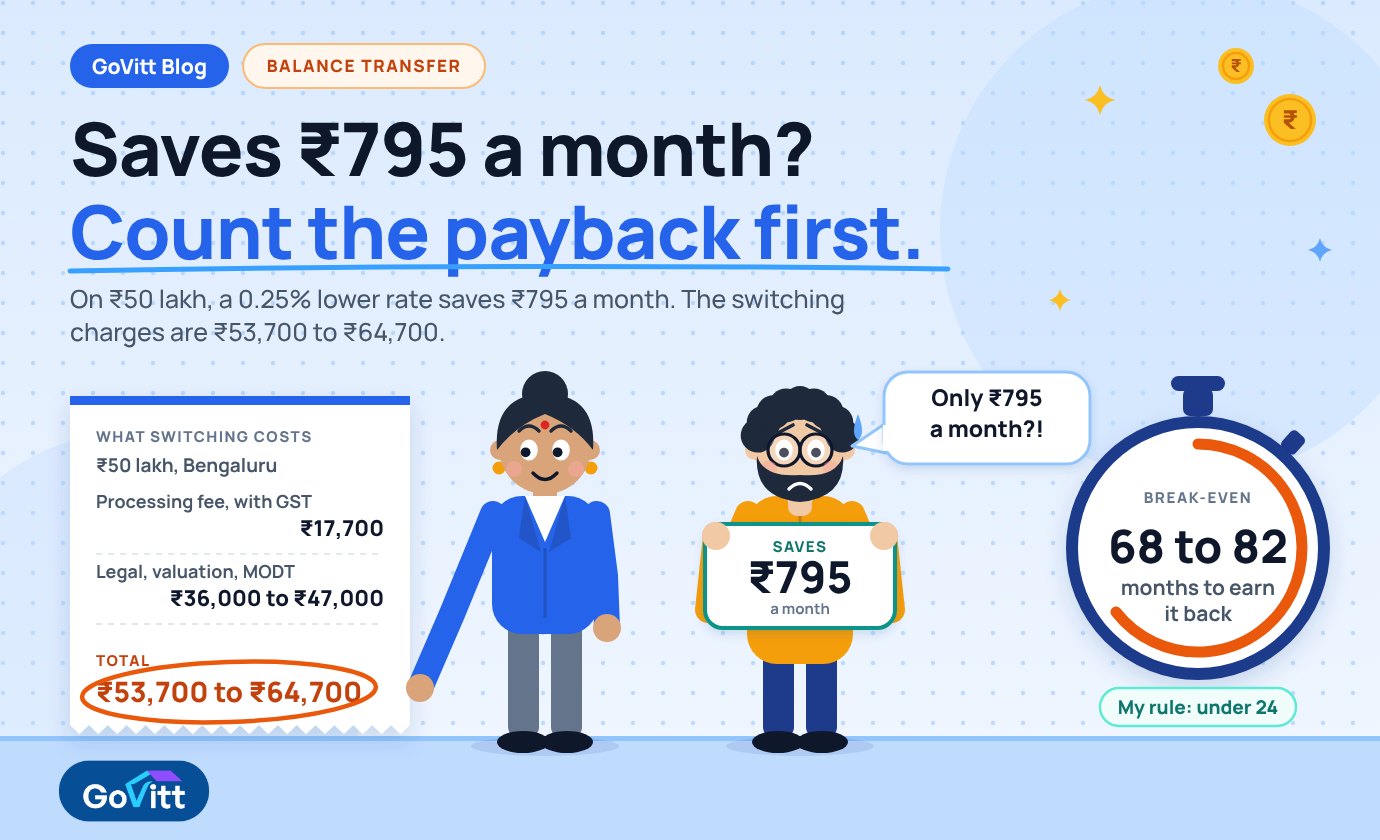
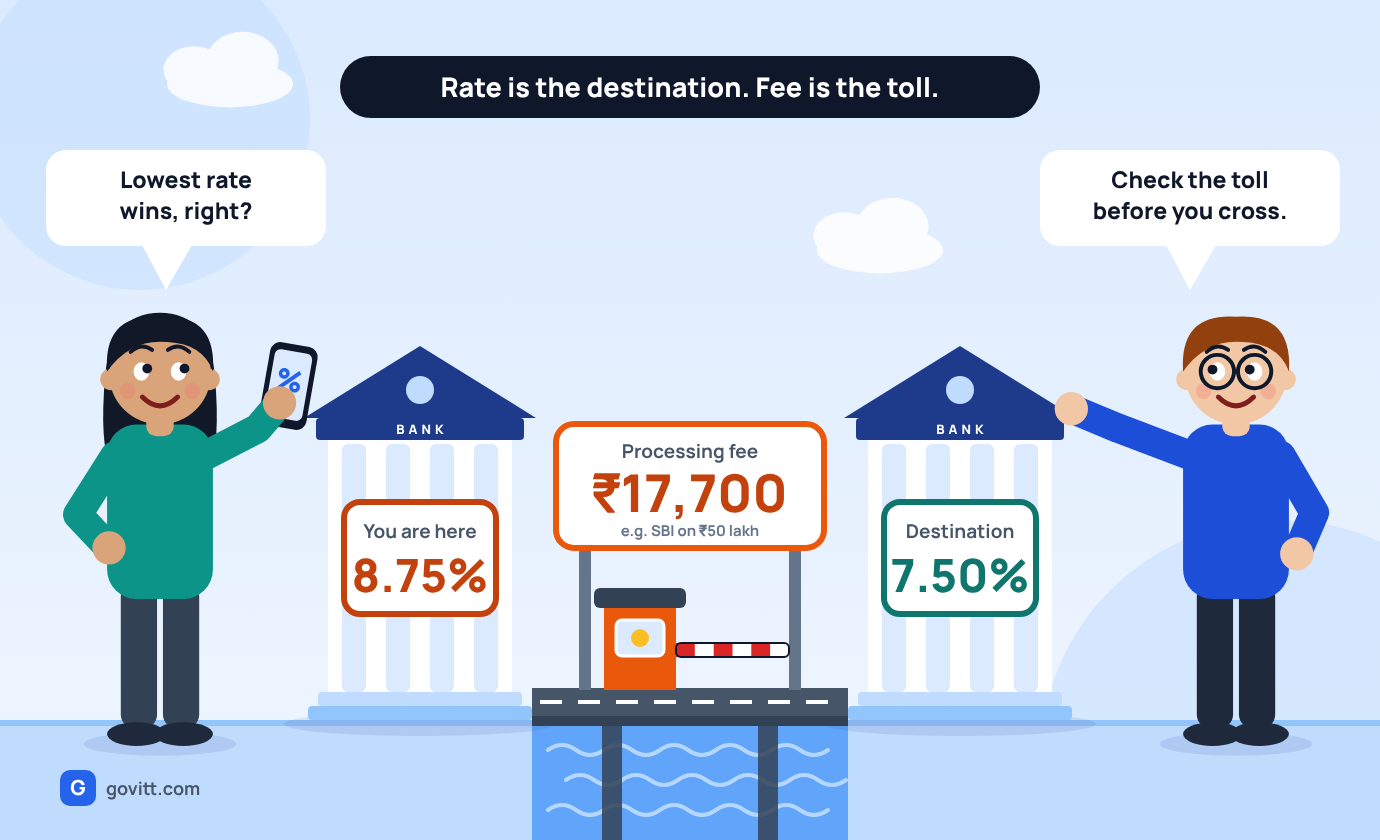
8.75% to 8.50%: charges back in 68 to 97 months.
Your gap is your current rate minus the rate a lender quotes you in writing, not the rate on a poster. Not sure of yours? Send us your rate, outstanding amount and years left
What a balance transfer saves on ₹50 lakh
Example: ₹50 lakh outstanding, 20 years left, moving to 7.50%. Bengaluru charges of ₹53,700 to ₹76,500 already taken off.
| You pay now | Gap | EMI lower by | Charges back in | Saved over 20 years, after charges |
|---|---|---|---|---|
| 8.00% | 0.50% | ₹1,542 | 35 to 50 months | ₹2.94 to ₹3.16 lakh |
| 8.25% | 0.75% | ₹2,323 | 24 to 33 months | ₹4.81 to ₹5.04 lakh |
| 8.50% | 1.00% | ₹3,111 | 18 to 25 months | ₹6.70 to ₹6.93 lakh |
| 8.75% | 1.25% | ₹3,906 | 14 to 20 months | ₹8.61 to ₹8.84 lakh |
| 9.00% | 1.50% | ₹4,706 | 12 to 17 months | ₹10.53 to ₹10.76 lakh |
| 9.50% | 2.00% | ₹6,327 | 9 to 13 months | ₹14.42 to ₹14.65 lakh |
| You pay now | Gap | Loan ends earlier by | Interest saved | Saved after charges |
|---|---|---|---|---|
| 8.00% | 0.50% | 1 year 7 months | ₹8.06 lakh | ₹7.30 to ₹7.53 lakh |
| 8.25% | 0.75% | 2 years 3 months | ₹11.82 lakh | ₹11.06 to ₹11.28 lakh |
| 8.50% | 1.00% | 2 years 11 months | ₹15.44 lakh | ₹14.67 to ₹14.90 lakh |
| 8.75% | 1.25% | 3 years 6 months | ₹18.93 lakh | ₹18.17 to ₹18.39 lakh |
| 9.00% | 1.50% | 4 years 1 month | ₹22.31 lakh | ₹21.55 to ₹21.77 lakh |
| 9.50% | 2.00% | 5 years 1 month | ₹28.81 lakh | ₹28.05 to ₹28.27 lakh |
Not everyone gets 7.50%. If your score only gets you 8.00%, moving from 8.50% saves ₹1,569 a month and the charges take 35 to 49 months to come back.
Months are rounded up. Savings are an upper bound, because both loans float with the repo rate.
What a balance transfer costs in Bengaluru
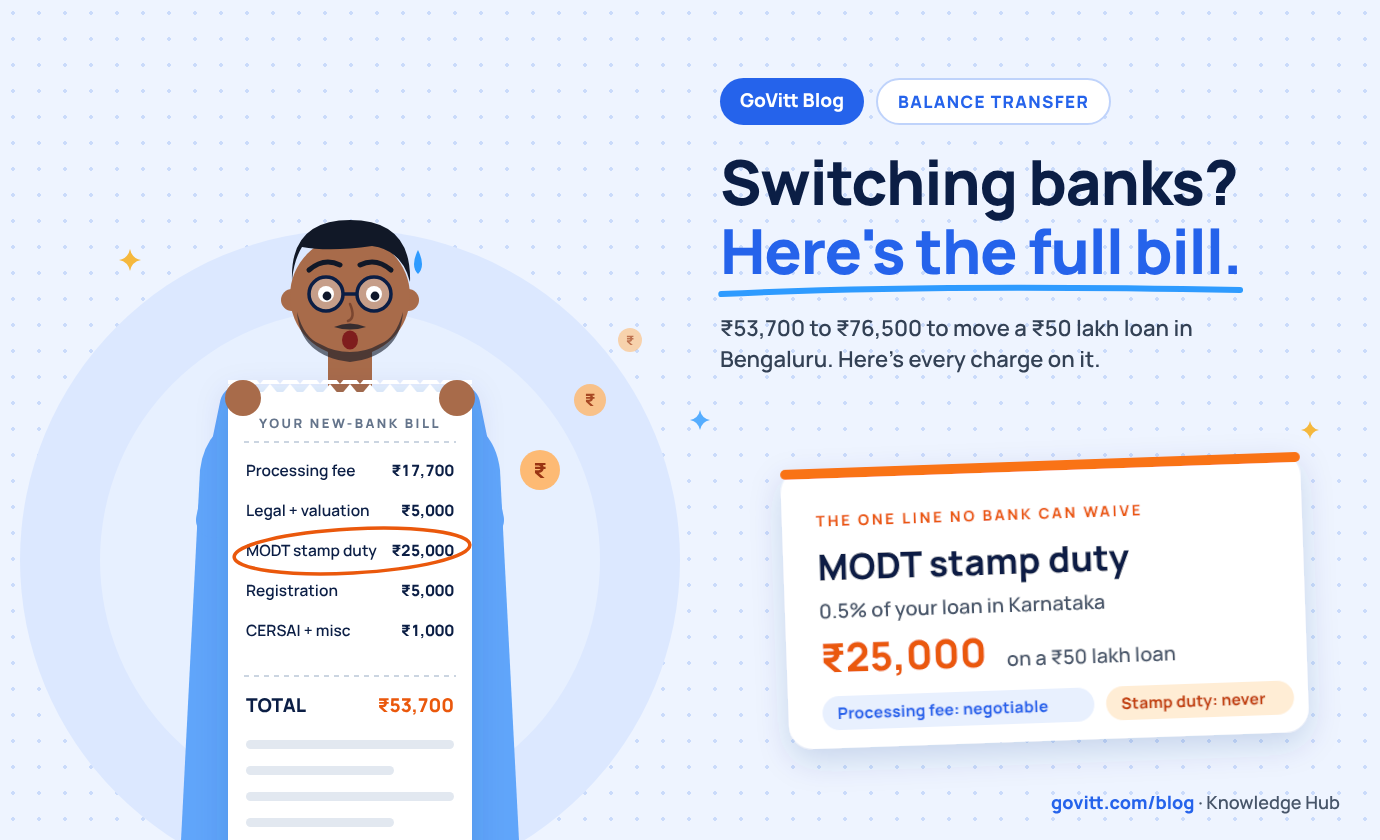
Most ads skip this part. On a ₹50 lakh loan, expect ₹53,700 to ₹76,500.
| Charge | Amount on ₹50 lakh | Can you negotiate it? |
|---|---|---|
| Processing fee (incl. 18% GST) | ₹17,700 to ₹29,500 | Yes. Ask for a waiver or a cap |
| Legal and technical valuation | ₹5,000 to ₹15,000 | Sometimes |
| MODT stamp duty (0.5% of loan, Karnataka) | ₹25,000 | No. Government charge |
| MODT registration (about 0.1%) | ₹5,000 | No. Government charge |
| CERSAI, scanning, small charges | ₹1,000 to ₹2,000 | No, but small |
| Foreclosure charge at old bank (floating rate) | ₹0 | RBI does not allow it |
| Total | ₹53,700 to ₹76,500 |
Fixed rate loans can carry a prepayment charge. HDFC Bank, for example, charges 2% plus taxes, which is ₹1,18,000 on ₹50 lakh. Check your loan agreement before you apply.
What no bank can waive
MODT stamp duty and registration are government charges. The new lender registers a fresh mortgage in its own name, so you pay both again. Festive offers can cover the processing fee and sometimes the legal and valuation charges, never these two.
Two costs no quote shows
Interest runs on both loans until the new lender's money reaches your old bank, about ₹1,200 a day on ₹50 lakh at 8.75%. And anything added into the loan pays stamp duty too: a ₹10 lakh top-up adds about ₹5,000 of stamp duty and ₹1,000 of registration.
Every charge, line by line: Home loan balance transfer charges · Why stamp duty is charged again: MODT charges in Karnataka
When a transfer makes sense, and when it doesn't
Usually worth it
- Your rate is 1% or more above the rate a lender quotes you in writing
- The charges come back in under 24 months
- You will keep the loan at least 4 more years
- Your loan is on a floating rate, or a fixed rate loan past its exit charge
- Your CIBIL score is 750 or above and your last 12 EMIs were on time
Usually not worth it
- The gap is under 0.50%. At 0.25%, the charges take 68 to 97 months to come back
- Under about 4 years are left, or under 5 years on a loan below ₹20 lakh
- Your own bank cuts you to about 7.80% when the best outside rate is 7.50%
- You are on a fixed rate with an exit charge (2% plus taxes at HDFC Bank)
- You plan to sell the house in 2 to 3 years
- Your score has slipped, or the property papers have an issue (khata not updated, no OC)
Not sure? Send us your rate, outstanding amount and years left. We'll tell you straight, even if the answer is "stay where you are".
The numbers behind each case: When a balance transfer is not worth it: 5 cases
Try this before you switch
Write to your current bank and ask for the rate it gives new customers. Many banks do this for a small fee: ₹3,540 at ICICI Bank and ₹5,900 at HDFC Bank on ₹50 lakh, with GST, as of October 2026. SBI charges ₹5,900 to move an old MCLR or base rate loan to its repo-linked rate. There is no new MODT, no valuation and no legal fee. Ask in writing for the new rate, the new spread and the date it starts. If your bank brings you to about 7.80% when the best outside rate is 7.50%, staying roughly matches a transfer over five years. If it doesn't, you have your answer.
You'll probably like working with GoVitt if...
- You want your savings shown after every charge, not a headline number
- You'd rather hear "stay where you are" than get pushed into a transfer that doesn't pay off
- You want one person to compare 50+ lenders and chase both banks for you
- You want to know your real payoff date, not just the EMI count your bank shows
- You don't want to pay a commission for any of it
We're probably not the right fit if...
- You only want the lowest rate on a poster and won't look at the fees
- You want your file pushed through no matter what the paperwork says
- You need the transfer done in a few days. A proper one takes 2 to 4 weeks
Deepesh Jangid, CA · Founder, GoVitt
How a balance transfer works
Check you can move
Most lenders want 12 months of on-time EMIs. HDFC Bank asks for 12, ICICI Bank for 12 to 18. Check your CIBIL score first.
Get two written quotes
Ask for the spread, the processing fee and every other charge. Don't apply to five lenders: each application adds an enquiry to your credit report.
Get the foreclosure letter
Your current lender gives the amount needed to close the loan and the list of original documents it holds.
Apply
The new lender's lawyer checks your property papers and its valuer visits. You pay for this again, even though your old bank did it once.
Read the Key Fact Statement and sign
Check that the rate, spread, fees and tenure match the quote. Keep your current EMI if you can afford it.
Payout
The new lender pays your old lender directly. Interest runs on both loans until the money lands, about ₹1,200 a day on ₹50 lakh at 8.75%, so push both sides to move fast.
Papers and new mortgage
RBI requires your old lender to return your original documents within 30 days of closure, or pay you ₹5,000 for each day of delay that is its fault. They go to the new lender, the new MODT is registered and EMIs start.
In Bengaluru this usually takes 2 to 4 weeks. GoVitt handles the follow-ups with both lenders.
Where transfers get stuck: Home loan transfer process, step by step
Documents you'll need
What to ask your old bank for, and the full checklist: Documents required for a home loan balance transfer
Find out what you'd actually save
Free. No commission. No impact on your credit score.
Home loan balance transfer: common questions
What is a home loan balance transfer?
How many EMIs should I pay before a balance transfer?
Will my current bank charge a foreclosure fee?
What are the charges for a balance transfer in Karnataka?
Does a balance transfer affect my CIBIL score?
Should I reduce my EMI or my tenure after switching?
Does GoVitt charge anything?
How much rate gap do I need for a balance transfer to be worth it?
When is a balance transfer not worth it?
Should I ask my own bank to cut my rate before I transfer?
Can I take a top-up with a balance transfer?
Will a balance transfer protect me from the next RBI rate hike?
How late in the loan is it too late to transfer?
Deepesh is a Chartered Accountant who helps Bengaluru borrowers compare home loans and balance transfers across 50+ lenders.
Figures checked 20 to 27 October 2026. Next review after the RBI decision on 4 December 2026.
About GoVitt →Guides for your situation
Deciding whether to switch
- Rates just went up. Does switching your home loan still make sense?The October hike moved every rate, not your gap.
- How soon can you transfer a home loan?When the window opens and when it closes.
- I did the math on shifting ₹50 lakh from 8% to 7.20%A full worked example.
- You think 15 years are left. The math says 18.Check your real payoff date first.
Costs and paperwork
- MODT charges in KarnatakaWhy you pay stamp duty again.
- Documents required for a home loan balance transferThe checklist banks use.
- Home loan transfer process, step by stepWhere it gets stuck.
- Home loan in BangaloreLocal paperwork that trips people up.
Which lender
- Still on MCLR? Move to a repo-linked rateThe switch inside your own bank.
- Moving from a housing finance company to a bankWhat changes and what it saves.
- Home loan refinance in IndiaWhat it means and the rates you can get.
- Compare rates from 50+ banksLender rates side by side.
Special cases
- Does a balance transfer hurt your CIBIL score?What lands on your report.
- Balance transfer plus top-upWhen extra money while you switch makes sense.
- Transfer on an under-construction flatWhat lenders allow.
- Tax benefits after a balance transferWhat carries over.
- Loan against property balance transferMoving a LAP to a cheaper lender.
Deciding whether to switch
Costs and paperwork
Which lender
Special cases
Figures are for a ₹50 lakh loan on a Bengaluru property, as published between 20 and 27 October 2026. EMIs use the standard monthly reducing balance method, rounded to the nearest rupee. Lender rates and fees change often; we update this page after each RBI policy decision (next: 4 December 2026). Confirm every figure with the lender in writing before you act. This is general information, not financial advice.
Sources: RBI (Pre-payment Charges on Loans) Directions, 2025, in force for loans sanctioned or renewed from 1 January 2026; RBI circular on release of property documents, 13 September 2023; SBI, HDFC Bank and ICICI Bank rate, conversion fee and balance transfer pages, checked 20 to 27 October 2026; GoVitt calculations.