
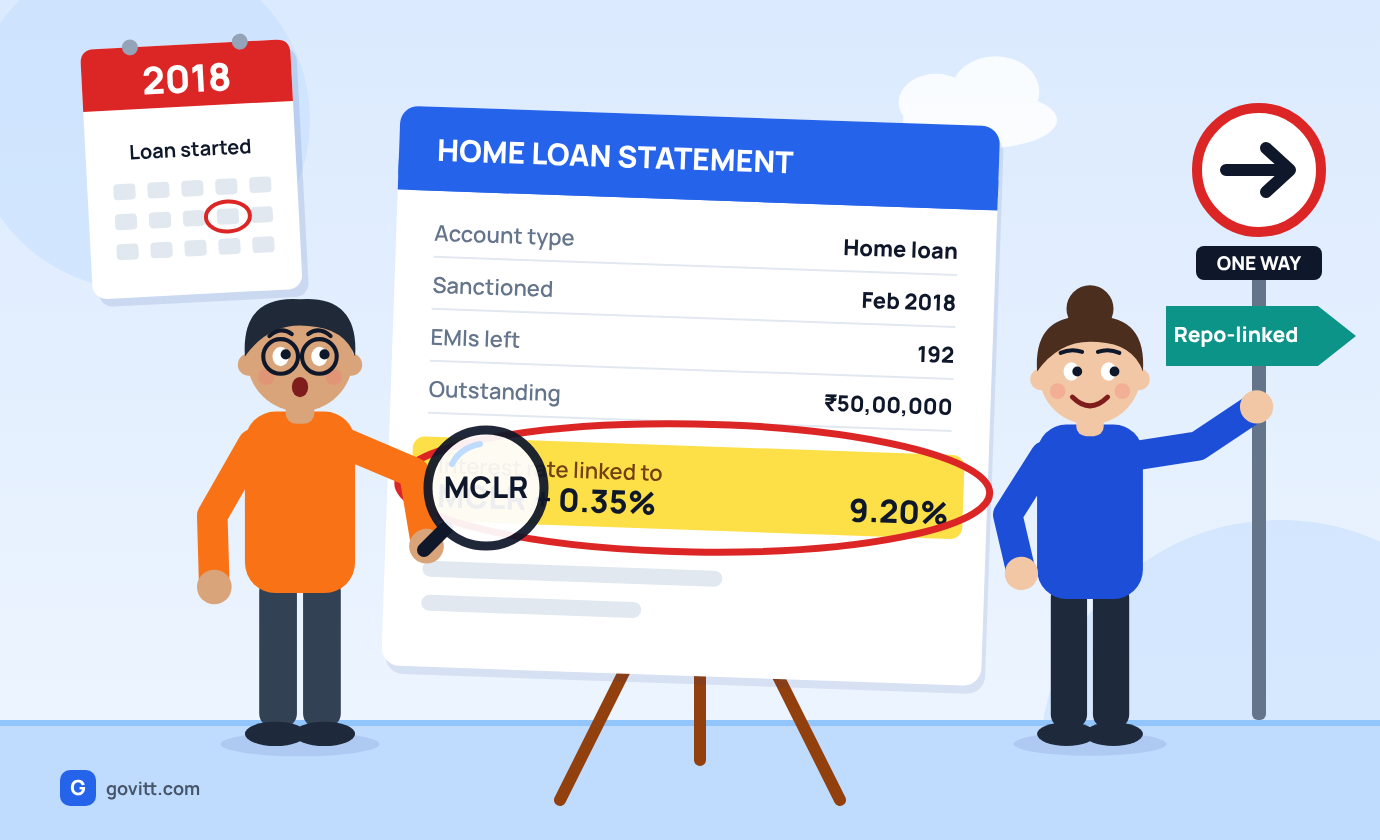
If your home loan started before October 2019, there's one line on your statement worth checking today: the one that names your benchmark.
If it says MCLR, or Base Rate, your loan was never moved to a repo-linked rate. Nobody did it for you. RBI's rules left old loans where they were, and the bank has no reason to move you on its own.
See your real payoff date in 60 seconds
Banks calculate remaining EMIs by simple subtraction. See your actual payoff date and discover how much interest a balance transfer can save.
Moving from MCLR to a repo linked home loan is a request you make to your bank, in writing. The fee runs from nothing to about ₹11,800 on a ₹50 lakh loan. What you get depends on one number: the all-in rate the bank offers you after the switch. A switch that leaves your rate where it is saves you nothing today. A switch that cuts it by 0.60% saves about ₹3.4 lakh over 16 years on the example below.
I covered what SBI's 15 October change means for your EMI in SBI raised its MCLR on 15 October. This post is the how-to: how to check, what each bank charges, what to ask for, and when to skip the switch and transfer instead.
Check the line on your statement (30 seconds)
Open your latest loan statement or the loan page in net banking. Find the line called "benchmark", "linked to" or "rate type".
| What the line says | What it means | What to do |
|---|---|---|
| EBLR, RLLR, or Repo + spread | Already repo linked | Skip the switch. Ask for a lower spread instead. |
| MCLR (1 year or 6 month) + spread | Linked to your bank's own cost based rate | This post is for you |
| Base Rate | An older benchmark, used before April 2016 | This post is for you. The gap to today's rates is often bigger. |
| PLR, or the lender's "prime rate" (housing finance companies) | Linked to the lender's own rate, not repo | The same request works. The fee will be in the lender's schedule of charges. |
Banks had to price new floating rate home loans off an external benchmark from 1 October 2019. Loans that began before that stayed on MCLR or Base Rate until they were repaid or renewed. RBI left one door open: you can ask to switch, on terms you and the bank agree, with only reasonable administrative and legal charges.
MCLR vs EBLR: what actually changes
| MCLR loan | Repo-linked loan (EBLR or RLLR) | |
|---|---|---|
| Benchmark | Set by your bank from its own cost of funds | Linked to RBI's repo rate, or another external benchmark, plus a spread |
| EMI is revisited | On your loan's reset date, usually every 6 or 12 months | At least every 3 months |
| When RBI moves the repo rate | Reaches you only at your next reset | Reaches you at your next quarterly reset |
| Your spread | Set in your loan contract | Can change only if your credit assessment changes substantially, as agreed in your loan contract |
Don't compare the two benchmarks directly. SBI's one-year MCLR is 8.85% and its EBLR is 8.15% since 15 October. That 0.70% gap does not mean you'd save 0.70%. Your rate is the benchmark plus your own spread, and the spreads are not the same. Compare the final rate on your statement with the final rate in the bank's offer. Nothing else.
The real difference is speed.
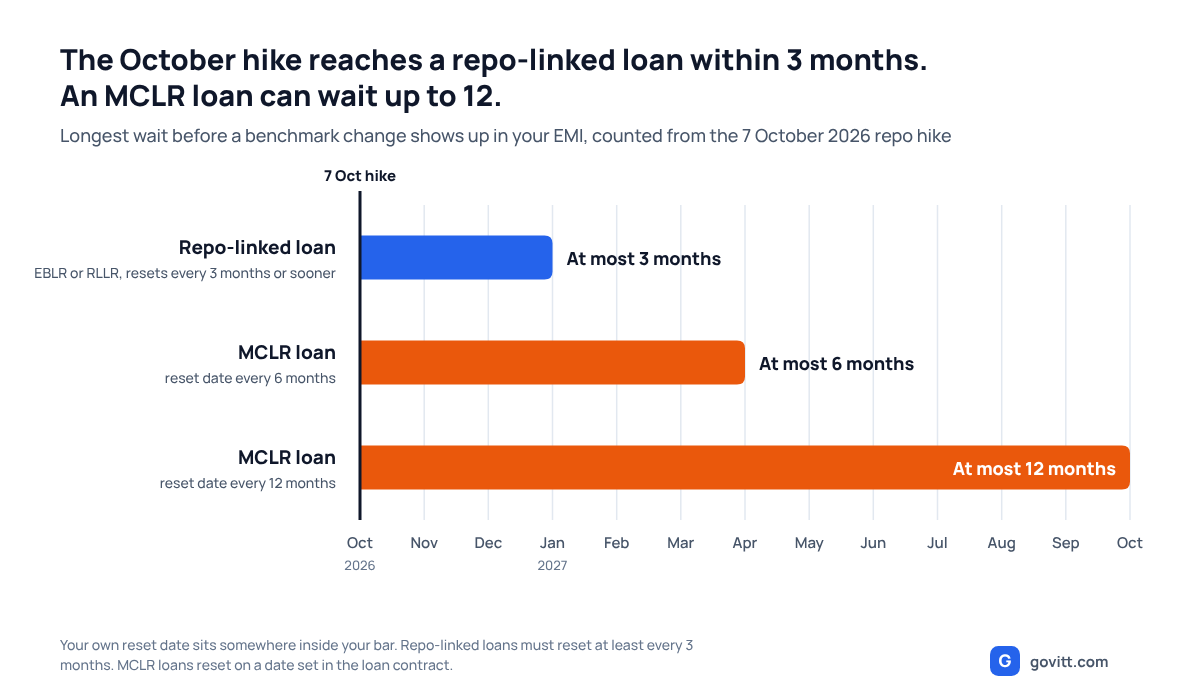
RBI raised the repo rate to 5.50% on 7 October. A repo-linked loan feels that within three months. An MCLR loan feels it only at its reset date, which could be many months away. Right now, that delay is working in your favour. In a cutting cycle, it works against you.
And a cutting cycle is not what RBI is signalling. Its own resolution says the next move can only be a hike or a pause, and I went through what the minutes mean for your December EMI in RBI MPC minutes, October 2026. So a switch that leaves your rate unchanged moves you onto a loan that feels hikes sooner. On ₹50 lakh with 16 years left, each 0.25% hike adds about ₹763 a month.
That's the rule for the whole post: switch only if the new all-in rate is lower.
What banks charge to switch
These are each bank's published charges, checked between 20 and 23 October 2026. GST at 18% applies on top.
| Bank | Fee | All-in on ₹50 lakh (with GST) | Note |
|---|---|---|---|
| SBI | ₹5,000 per account | ₹5,900 | MCLR to EBLR |
| HDFC Bank | Nil for the benchmark switch on its fee page. 0.25% of principal outstanding or ₹5,000, whichever is lower, if the spread is cut too | Nil to ₹5,900 | Ask which one applies to your loan |
| ICICI Bank | ₹3,000 | ₹3,540 | Its fee for moving to a lower floating rate. I couldn't find an MCLR specific fee. |
| Axis Bank | ₹3,000 for outstanding up to ₹75 lakh | ₹3,540 | Same caveat as ICICI |
| Kotak Mahindra Bank | 0.5% of outstanding, capped at ₹10,000 | ₹11,800 | Quoted for a switch to the repo linked rate |
| HSBC | Up to ₹2,500 | Up to ₹2,950 | — |
| PNB, Canara Bank, Bank of Baroda | Not published on the pages I checked | Ask the branch | Get the number in writing |
Two things to keep in mind:
- RBI's August 2023 circular on floating rate resets requires lenders to disclose switching charges upfront, including in the sanction letter. If the branch quotes a number you can't find in your papers, ask them to show you where it's written.
- Fee schedules change. Check your bank's current page on the day you send the request.
Run the maths before you ask
Here's a worked example. Say this is you:
- Outstanding principal: ₹50 lakh
- Remaining tenure: 16 years (192 EMIs)
- Your statement says MCLR + 0.35%. With the one-year MCLR at 8.85%, that's 9.20%
- Current EMI: ₹49,833
- Switching fee: ₹5,000 + GST = ₹5,900
The bank's offer decides everything. Here's what each possible offer is worth:
| Rate the bank offers | New EMI | Saves a month | Fee paid back in | Net saved over 16 years | Or keep paying ₹49,833: loan ends |
|---|---|---|---|---|---|
| 9.20% (no cut) | ₹49,833 | ₹0 | Never | Minus ₹5,900 | No change |
| 8.90% | ₹48,924 | ₹909 | Within 7 months | ₹1.69 lakh | About 8 months early |
| 8.60% | ₹48,023 | ₹1,810 | Within 4 months | ₹3.42 lakh | About 14 months early |
| 8.30% | ₹47,130 | ₹2,703 | Within 3 months | ₹5.13 lakh | About 20 months early |
| 8.00% | ₹46,246 | ₹3,587 | Within 2 months | ₹6.83 lakh | About 26 months early |
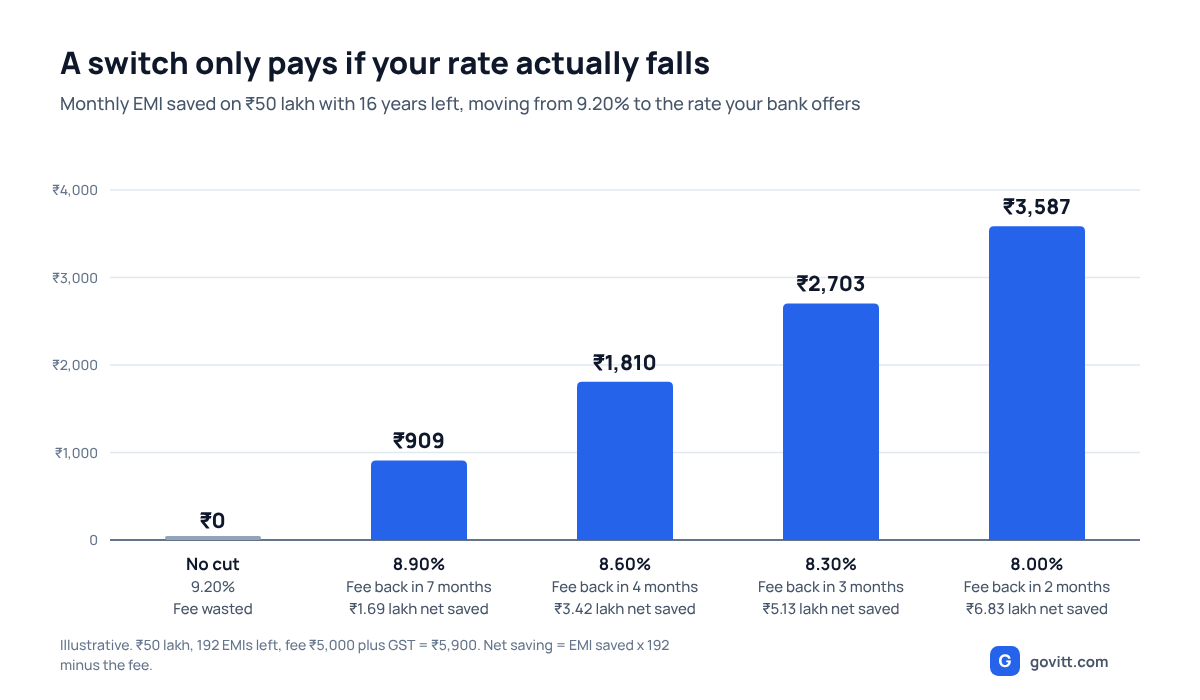
Look at the first row. A switch that doesn't cut your rate costs you ₹5,900 and changes only how fast future hikes reach you. It's the most common way people pay a fee for nothing.
Look at the 8.60% row. The fee is back in about four months, and if you keep paying your current EMI instead of the lower one, the loan ends about 14 months early and you save ₹7.02 lakh in interest after the fee.
Switch with your bank, or transfer to another lender?
A transfer can get you a lower rate than your own bank will. It also costs more, because you pay for a new mortgage, valuation, legal check and processing. I've broken down every line in home loan balance transfer charges. For ₹50 lakh in Bengaluru it comes to ₹53,700 to ₹76,500.
Say another lender is offering 7.50% on the same loan. Here's how the routes compare:
| Route | Rate | Cost | Net saving over 16 years | Cost paid back in |
|---|---|---|---|---|
| Switch with your own bank | 9.20% to 8.60% | ₹5,900 | ₹3.42 lakh | Within 4 months |
| Balance transfer | 9.20% to 7.50% | ₹53,700 to ₹76,500 | ₹8.92 lakh to ₹9.14 lakh | 11 to 16 months |
The transfer saves more in total, because 7.50% is a lower rate than your bank offered. The better question is what the transfer adds after your bank has already cut your rate:
| Your bank stops at | Extra saved a month by transferring to 7.50% | Charges paid back in | Extra saved over 16 years, after charges |
|---|---|---|---|
| 8.60% | ₹3,232 | 17 to 24 months | ₹5.44 lakh to ₹5.67 lakh |
| 8.30% | ₹2,339 | 23 to 33 months | ₹3.73 lakh to ₹3.95 lakh |
| 8.00% | ₹1,455 | 37 to 53 months | ₹2.03 lakh to ₹2.26 lakh |
What this tells you:
- Ask your own bank first. It's cheap, quick, and there's no new mortgage to register.
- If your bank's best offer still leaves a gap of 0.50% or more to another lender, price a transfer. With 16 years left, even a 0.50% gap pays back in three to four and a half years.
- If your bank refuses to cut your rate, run the transfer numbers. You've lost nothing by asking.
The exact request to send
Send this by email to your branch or your bank's home loan service address, and keep the reply. Fill in the brackets.
Subject: Request to switch my home loan from MCLR to your repo-linked rate, loan account [number]
Dear Sir or Madam,
My home loan [account number] was sanctioned in [month and year] and is linked to MCLR. As per RBI's guidelines on external benchmark linked lending, I request you to switch this loan to your repo-linked benchmark rate, on mutually agreed terms.
Please confirm in writing:
- The new benchmark, the spread, and the all-in rate from the effective date.
- The effective date, and the date of my first rate reset.
- The switching fee and any other charge, including GST.
- That my remaining tenure stays at [years and months] and only the EMI changes. If the rate falls, I want to continue paying my current EMI of ₹[amount] and shorten the tenure instead.
- That no other term of my loan changes.
My CIBIL score is [score]. Please share the rate you currently offer new borrowers with this profile, and say whether my rate can match it.
Regards, [Name, registered mobile number]
What to check before you say yes
- The all-in rate. Benchmark plus spread, against your current rate. If it isn't lower by at least 0.25%, don't pay the fee.
- The first reset date. After the switch, your EMI is revisited at least every three months.
- EMI or tenure. When the rate changes, the bank's default is often to keep your EMI and change the tenure. When the rate falls, that's fine. When it rises, you end up paying longer. Choose in writing.
- The spread. It should be written down, and fixed unless your credit assessment changes substantially.
- That it's one way. Once your loan moves to a repo-linked rate, you can't go back to MCLR.
If your bank says no, or the quote is poor
Housing finance company borrowers (LIC HFL, Bajaj, PNB Housing and others) are priced off the lender's own prime rate. The same request works, and the fee will be in their schedule of charges.
RBI's 12 August 2026 draft on loan pricing would set a three-month reset for floating rate loans from 1 April 2027, and move existing loans over by 1 April 2029, with your consent. It's still only a draft. I broke it down in RBI's new loan pricing draft. Waiting for it means paying your current rate for years.
What I'd do this week
- Check the line. If it says EBLR, RLLR or Repo, you're done. If it says MCLR or Base Rate, keep going.
- Note four numbers. Your current rate, your outstanding principal, EMIs left, and your next reset date.
- Look up what your bank charges new borrowers. Your credit score decides the band. Our rate comparison page has the current numbers for 50+ lenders.
- Send the email above.
- Compare the reply with the table. If the all-in rate falls by 0.25% or more, take it. If not, say no to the fee.
- If a gap of 0.50% or more is left to other lenders, price a transfer.
See your own numbers
Put your outstanding amount, current rate and years left into our free Payoff & Transfer Calculator. It shows what a lower rate does to your EMI and your payoff date, and what a transfer would add. GoVitt works with 50+ banks and housing finance companies and charges you 0% commission. More on how a transfer works on our home loan balance transfer page.
FAQ
What is the difference between MCLR and EBLR? MCLR is a benchmark your bank sets from its own cost of funds, and your loan is revisited on a reset date, usually every 6 or 12 months. EBLR is linked to an external benchmark, usually RBI's repo rate, and has to be reset at least every 3 months. Your actual rate is the benchmark plus your spread in both cases.
How do I switch my home loan from MCLR to a repo-linked rate? Send your bank a written request, ask for the new benchmark, spread, effective date and fee in writing, and accept only when the all-in rate is lower than your current one. The switch is usually done on the same loan account.
Does a bank charge for moving from MCLR to a repo-linked rate? RBI allows only reasonable administrative and legal charges. As of 23 October 2026, SBI charges ₹5,000 plus GST, Kotak 0.5% of outstanding capped at ₹10,000, and HSBC up to ₹2,500. HDFC Bank lists nil for the benchmark switch. Get your own bank's fee in writing.
Is switching from MCLR to EBLR a good idea right now? Only if your all-in rate falls. RBI raised the repo rate on 7 October and says the next move can only be a hike or a pause. A repo-linked loan feels hikes within three months, while an MCLR loan feels them at its next reset. Switching to the same rate means you pay a fee and get hikes sooner.
Can I switch back to MCLR later? No. The switch is one way.
Do I need fresh property papers to switch? Usually not. A switch with your own bank changes the rate terms on the same loan. A transfer to another lender needs a new mortgage, valuation and legal check.
Examples as of 23 October 2026. EMIs use the standard monthly reducing balance method. Net saving is the EMI saved multiplied by 192, minus the switching fee. MCLR and EBLR rates are SBI's, used as an example. Fees come from each bank's published pages and change often. Confirm every number in writing before you agree.
Ready to take the next step?
Find out your loan options and check your eligibility with GoVitt today.