
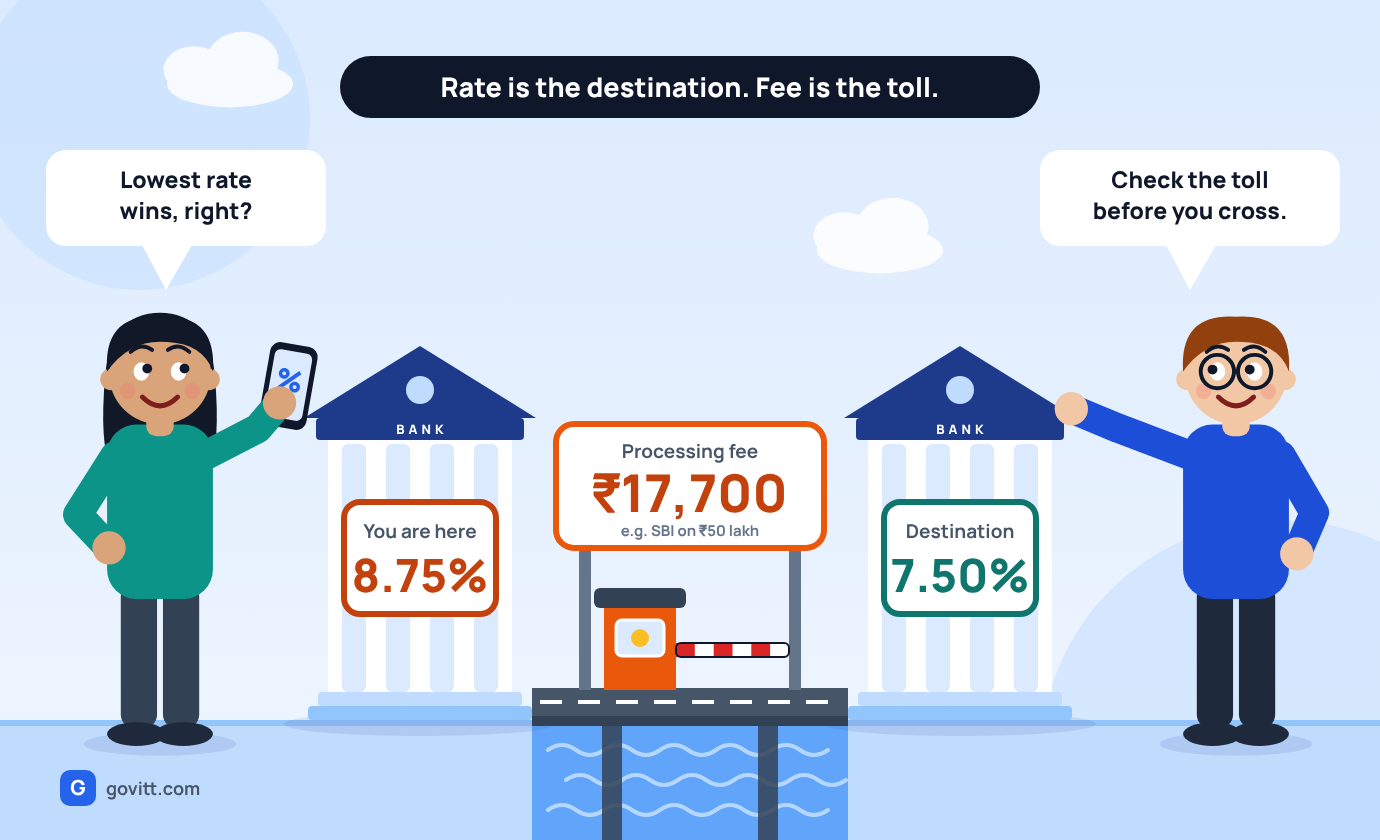
There is no single best bank for home loan balance transfer. There is the bank that quotes you the lowest rate, the bank that charges the least to move you, and the bank that still looks good five years from now. They are often three different banks.
Here is what's at stake. Take ₹50 lakh with 20 years left, at 8.75% today. Moving to 7.50% saves ₹3,906 a month. Moving to 8.00% saves ₹2,364. And the lender's own fee for taking you on runs from ₹0 to ₹59,000, depending on who you pick.
So the lowest advertised rate is rarely the cheapest switch. The spread you are actually quoted and the fees decide it. Below, seven lenders compared on what each one publishes (rates as of 15 to 26 October 2026), what each charges, what each offers on a top-up, and which borrower each one suits.
See your real payoff date in 60 seconds
Banks calculate remaining EMIs by simple subtraction. See your actual payoff date and discover how much interest a balance transfer can save.
The short answer
For a salaried borrower with a score above 750, SBI, PNB, Canara Bank and LIC Housing Finance publish the lowest rates, and the fee decides between them. HDFC Bank and Axis Bank start at 8.00%. They make sense when your own lender won't budge, you want a top-up, or your profile doesn't fit the public sector banks. ICICI's table rate of 8.75% rarely beats what you already pay, unless you hold a pre-approved offer.
What each lender publishes
| Lender | Lowest rate shown | What it takes | Runs up to | Benchmark |
|---|---|---|---|---|
| LIC Housing Finance | 7.15% | Score 825 and above, loan up to ₹50 lakh (7.35% at 775 to 799) | 9.55% below 600 | Its own prime lending rate |
| SBI | 7.50% | Strongest profiles; no public score grid | About 8.80% (my estimate) | EBLR 8.15% plus premiums |
| PNB | 7.45% | Score 800 and above (7.50% at 750 to 799) | 9.25% at 600 to 699 | Not stated (rate card of 12 October) |
| Canara Bank | 7.55% | Top credit grade, loan up to ₹50 lakh | 10.25% (lowest grade) | RLLR 8.25% |
| HDFC Bank | 8.00% | Strongest profiles; card rate 8.50% at 800 and above | 13.45% | Repo plus 2.50% to 7.95% |
| Axis Bank | 8.00% | Score 751 and above (8.20% at 750 and below) | 8.85% for 751 and above; 9.10% below | Repo plus 2.50% to 3.35% |
| ICICI Bank | 8.75% (7.80% pre-approved, digital only) | Score 750 and above, salaried | 9.90% for salaried | Repo-linked |
Two notes on this table. LIC is a housing finance company, so its rate follows its own prime lending rate and it decides when to move. That is covered in LIC Housing Finance home loan interest rate (October 2026). And PNB's figures come from its 12 October rate card, which I could not recheck on PNB's own page today.
Now look at the HDFC and Axis rows together. They share the same lowest spread, 2.50% over repo. What differs is how far each is willing to go. For a score of 751 or more, Axis stops at repo plus 3.35%, which is 8.85%. HDFC's range runs to repo plus 7.95%. Under RBI's rules for repo-linked loans, the spread you sign for stays put unless your credit assessment changes substantially. So the day you get sanctioned is the day to negotiate.
The rate you see is the best case, not your case
Every lender advertises the rate for its best profile. Your rate sits somewhere between that floor and the top of your band, and that distance is worth more than you'd expect.
Axis shows 8.00% to 8.85% for the same score band (751 and above). On ₹50 lakh over 20 years, that is ₹2,683 a month, or ₹32,196 a year. In one year, that gap alone is more than the processing fee at SBI, LIC or HDFC.
So don't ask "who has the lowest rate?" Ask "what spread will you give me, in writing?" Do that before you pay for a valuation. I made the same point about score bands in RBI moved your home loan rate by 0.25%. Your CIBIL score can move it by 1.80%.
What each lender charges to take you on
The processing fee is the one cost that changes from lender to lender, and it is the one you can negotiate. As listed by each lender:
| Lender | Processing fee as listed | On ₹50 lakh, with GST | On ₹1 crore, with GST |
|---|---|---|---|
| PNB | Waived under its festive offer till 31 December; it also bears legal, valuation and NEC charges up to ₹15,000 plus GST on takeovers of ₹25 lakh and above | ₹0 | ₹0 |
| Canara Bank | 0.50%, minimum ₹1,500, maximum ₹10,000; waived till 31 December | ₹0 now (₹11,800 normally) | ₹0 now (₹11,800 normally) |
| LIC Housing Finance | 0.25% up to ₹1 crore, capped at ₹15,000 | ₹14,750 | ₹17,700 |
| SBI | 0.35% for salaried borrowers, capped at ₹15,000 | ₹17,700 | ₹17,700 |
| HDFC Bank | Up to 0.50%, minimum ₹4,000 (self-employed non-professionals: up to 1.50%) | Up to ₹29,500 | Up to ₹59,000 |
| ICICI Bank | 0.50%, plus an administrative charge of 0.25% or ₹5,000, whichever is lower | ₹35,400 | ₹64,900 |
| Axis Bank | Up to 1% or ₹10,000, whichever is higher | Up to ₹59,000 (minimum ₹11,800) | Up to ₹1,18,000 |
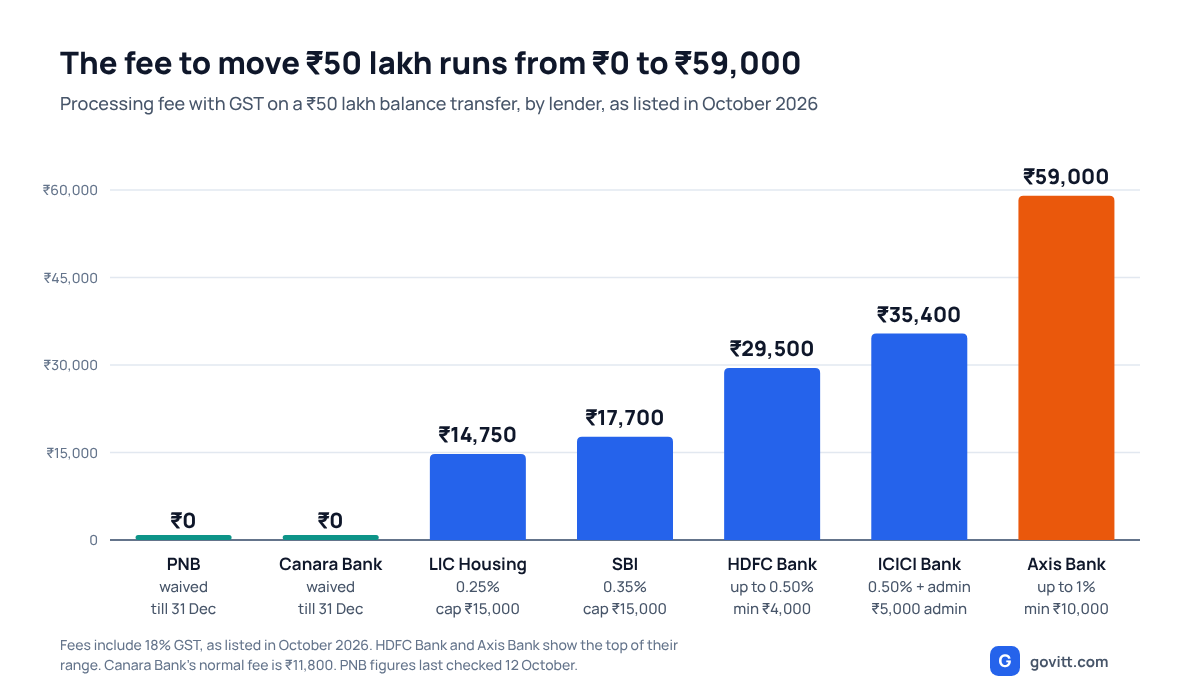
On ₹1 crore, the SBI and LIC caps do real work. The same loan costs ₹17,700 at SBI and up to ₹1,18,000 at Axis. That is a gap of ₹1 lakh for the same paperwork.
Everything else you pay is the same whichever lender you pick: legal and valuation (₹5,000 to ₹15,000), MODT stamp duty (0.5% in Karnataka, ₹25,000 on ₹50 lakh), registration (about ₹5,000) and small charges (₹1,000 to ₹2,000). That is ₹36,000 to ₹47,000 on a ₹50 lakh loan, line by line in home loan balance transfer charges.
The five year scoreboard
To rank them, I took a borrower with ₹50 lakh outstanding, 20 years left and a current rate of 8.75% (EMI ₹44,186). For each lender I used the lowest rate it publishes for a strong salaried profile, added its fee to the shared Bengaluru charges, and counted the saving over five years.
| Lender | Rate used | New EMI | Saving a month | Lender fee | All-in cost | Pays back in | 5 year net saving |
|---|---|---|---|---|---|---|---|
| LIC Housing Finance | 7.35% | ₹39,822 | ₹4,364 | ₹14,750 | ₹50,750 to ₹61,750 | 12 to 15 months | ₹2.00 to ₹2.11 lakh |
| PNB | 7.50% | ₹40,280 | ₹3,906 | ₹0 | ₹31,000 to ₹32,000 | 8 to 9 months | ₹2.02 to ₹2.03 lakh |
| SBI | 7.50% | ₹40,280 | ₹3,906 | ₹17,700 | ₹53,700 to ₹64,700 | 14 to 17 months | ₹1.70 to ₹1.81 lakh |
| Canara Bank | 7.55% | ₹40,433 | ₹3,753 | ₹0 | ₹36,000 to ₹47,000 | 10 to 13 months | ₹1.78 to ₹1.89 lakh |
| ICICI (pre-approved) | 7.80% | ₹41,202 | ₹2,984 | ₹35,400 | ₹71,400 to ₹82,400 | 24 to 28 months | ₹0.97 to ₹1.08 lakh |
| HDFC Bank | 8.00% | ₹41,822 | ₹2,364 | ₹29,500 | ₹65,500 to ₹76,500 | 28 to 33 months | ₹0.65 to ₹0.76 lakh |
| Axis Bank | 8.00% | ₹41,822 | ₹2,364 | ₹59,000 | ₹95,000 to ₹1,06,000 | 41 to 45 months | ₹0.36 to ₹0.47 lakh |
| ICICI (table rate) | 8.75% | ₹44,186 | ₹0 | ₹35,400 | ₹71,400 to ₹82,400 | Never | A loss of ₹71,400 to ₹82,400 |
HDFC and Axis rows use the maximum fee they list, and both say "up to". At Axis's minimum fee of ₹11,800, the five year saving would be ₹0.83 to ₹0.94 lakh. PNB's row assumes its offer covers legal and valuation, so only stamp duty, registration and small charges remain. Your rate will differ. These are the best published rates, not promises.
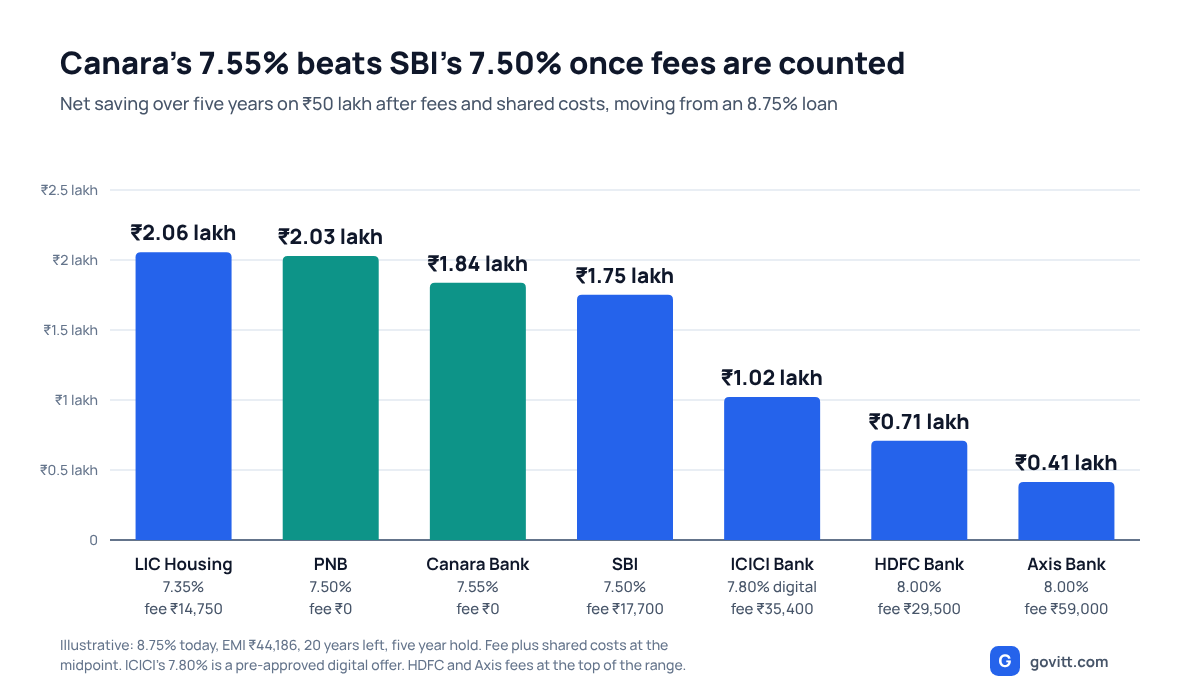
Four things stand out:
- A lower fee can beat a lower rate. PNB and SBI are both at 7.50%, and PNB's zero fee puts it ₹27,700 ahead after five years, once you add the legal and valuation it covers. Canara's rate is 0.05% higher than SBI's, which costs ₹153 a month. SBI's extra ₹17,700 fee takes about 116 months to earn back. So while Canara's waiver lasts, Canara is ahead for any hold under 9 years and 8 months.
- That waiver has a deadline. Canara and PNB waive fees only until 31 December 2026, and it's worth asking the branch what "sanctioned" means for the waiver. Once Canara's normal fee of ₹11,800 is back, SBI pulls ahead after about 39 months.
- At 8.00%, fees eat the first two to four years. HDFC's maximum fee alone is about 12 months of your saving, and Axis's maximum is 25 months.
- ICICI's table rate does nothing for this borrower. At 8.75% it is the rate you already pay. Only a pre-approved digital offer near 7.80% changes that, and even then the fee takes 24 to 28 months to earn back.
What if you're at 8.25% today?
The gap shrinks, and so do the savings. Moving from 8.25% to 7.50% saves ₹2,323 a month at SBI or PNB, and pays back in 14 months at PNB or 24 to 28 months at SBI. Moving to an 8.00% lender saves only ₹781 a month. At HDFC that takes 84 to 98 months to pay back, and at Axis 122 to 136 months. That is seven to eleven years. If your rate is already 8.25%, a lender whose floor is 8.00% is a fee transfer from you to them. I covered the gap-versus-hike logic in Rates just went up. Does switching your home loan still make sense?
Top-up with a transfer: who offers what
| Lender | Top-up with a transfer | Rate | What to know |
|---|---|---|---|
| HDFC Bank | Yes, at the time of the transfer | Repo plus 2.75% to 8.45%, which is 8.25% to 13.95% (checked 20 October) | Up to 15 years. Its page gives two different caps (₹50 lakh and ₹1 crore), so confirm the limit in writing |
| ICICI Bank | Up to 100% of the original sanctioned amount, for up to 20 years | Not published | Get the rate in writing (checked 21 October) |
| LIC Housing Finance | Griha Vikas Top Up | From 7.65%; average 8.27% on loans signed July to September 2026 | The rate follows LIC's own prime lending rate |
| Axis Bank | Yes, "based on your eligibility" | Not published separately; transfer rates "align with" its standard home loan rates | Confirm the top-up rate before you sign |
| Canara Bank | Ask the branch | Not published separately | Check the rate on its own |
| SBI | The pages I checked don't give top-up terms for a transfer | Not published | Ask for it in writing |
Three rules for any top-up:
- It costs more than the transfer. HDFC's top-up starts 0.25% above its main rate. Compare the top-up rate on its own.
- Stamp duty applies to the whole sanctioned amount. In Karnataka, a ₹10 lakh top-up adds about ₹5,000 in stamp duty and ₹1,000 in registration.
- Don't stretch it. A top-up over 15 or 20 years can cost more than it looks. I worked through that in home loan top-up: interest rate, eligibility and the tax rule most people get wrong, and the transfer side is in balance transfer plus top-up.
Which lender suits which borrower
| Your situation | Start with | Watch out for |
|---|---|---|
| Salaried, score 775 or more, no top-up | PNB, SBI, Canara; LIC if you accept a rate that isn't repo-linked | Canara and PNB waivers end 31 December; PNB figures last checked 12 October |
| Score 700 to 749 | LIC's grid (7.65% to 7.95%), PNB (8.05%), Axis (8.20% and up) | Where in the band you land; get the spread in writing |
| Want a top-up with the transfer | HDFC (published top-up spread), LIC Griha Vikas, ICICI | Stamp duty on the top-up; a long top-up tenure |
| Self-employed | Axis (one table for both), ICICI (8.75% to 10.05%), LIC (about 0.10% more than salaried) | HDFC's fee for non-professionals, up to 1.50% |
| Gap to the best rate under 0.50% | Stay and ask your own bank to reprice | The next section |
A few eligibility rules to know before you apply. HDFC asks for at least 12 months of regular repayments on your current loan. ICICI asks for a score of 700 or more on a transfer. Axis takes salaried borrowers aged 21 to 60 and self-employed borrowers aged 21 to 65, with a minimum loan of ₹3 lakh. And if you've just had a late payment, fix that first. How a transfer touches your score is in does a home loan balance transfer hurt your CIBIL score?
Before any of this, ask your own bank
The cheapest transfer is the one you don't make. Most big lenders will move an existing floating rate loan to a lower rate for a small fee, with no new stamp duty and no valuation.
| Your lender | Fee to move to a lower rate | On ₹50 lakh outstanding, with GST |
|---|---|---|
| ICICI Bank | ₹3,000 plus taxes | ₹3,540 |
| Axis Bank | ₹3,000 plus GST for ₹30 lakh to ₹75 lakh outstanding (₹1,000 to ₹5,000 by loan size) | ₹3,540 |
| SBI | ₹5,000 plus GST, for old MCLR or base rate loans | ₹5,900 |
| HDFC Bank | The lower of 0.25% of the outstanding principal or ₹5,000, plus taxes | ₹5,900 |
Axis's figure comes from its fees and charges schedule, which is undated, so confirm it. At 8.75% to 8.25%, the saving is ₹1,583 a month on ₹50 lakh. That pays back a ₹5,900 fee in 4 months and a ₹3,540 fee in 3. If your bank refuses, you've lost nothing, and you now have a written offer to compare against.
What I'd do this week
- Find your gap and your band. Take the rate on your latest loan statement and your current CIBIL score. A gap under 0.50% usually isn't worth a transfer.
- Ask your own bank to reprice, in writing, quoting the lower rates in the tables above.
- Get two or three written quotes from lenders that fit your band. Ask for the spread and the processing fee, not the headline rate. Don't apply to five lenders at once.
- Add up every charge. Put your outstanding amount, rate and years left into the balance transfer calculator and read the break-even.
- If a waiver is in play, ask what counts as "sanctioned" and by what date. Canara and PNB waivers end 31 December 2026.
- Decide on a top-up separately. Take one only if you need the money, and keep its tenure short.
FAQ
What is the best bank for home loan balance transfer? There isn't one for everybody. For a salaried borrower with a score above 750, SBI, PNB, Canara and LIC Housing Finance publish the lowest rates (7.35% to 7.55%), and the fee decides between them. HDFC and Axis start at 8.00% and suit borrowers who want a top-up or who don't fit the public sector banks.
Which bank has the lowest home loan balance transfer rate? As of 15 to 26 October 2026, LIC Housing Finance shows 7.15% (score 825 and above, loans up to ₹50 lakh), PNB 7.45% (score 800 and above, last checked 12 October), SBI 7.50% and Canara 7.55%. These are best-case rates. Your quote depends on your score, income and loan size.
Which bank charges the lowest processing fee for a balance transfer? PNB and Canara are waiving processing fees until 31 December 2026. Otherwise, on ₹50 lakh, LIC Housing Finance charges ₹14,750 and SBI ₹17,700, while HDFC charges up to ₹29,500, ICICI ₹35,400 and Axis up to ₹59,000.
Can I get a top-up with a balance transfer? Yes, at HDFC, ICICI, LIC Housing Finance and Axis, subject to your eligibility. HDFC lists a top-up rate of 8.25% to 13.95%. A top-up costs more than the transfer rate, and stamp duty applies to the full sanctioned amount.
Should I transfer to a bank or stay with my current one? Ask your current bank to reprice you first. If the gap to the best rate you can get is under 0.50%, staying is usually cheaper. Above 1%, with several years left, a transfer usually pays for itself within two years.
Run your own numbers. Run the Payoff & Transfer Calculator to see the break-even for your loan. Our home loan balance transfer page shows how the process works. GoVitt compares 50+ banks for you at 0% commission.
Rates and fees as of 26 October 2026 for SBI, HDFC Bank and Axis Bank, 24 October for Canara Bank, 22 October for LIC Housing Finance, 21 October for ICICI Bank and 12 October for PNB. EMIs use the standard monthly reducing balance method and are rounded to the nearest rupee. The scoreboard uses the lowest rate each lender publishes for a strong salaried profile, assumes a property in Bengaluru and a five year hold, and counts shared charges of ₹36,000 to ₹47,000. Your actual rate, fee and costs will differ. Festive waivers change often. Get every figure in writing before you sign.
Ready to take the next step?
Find out your loan options and check your eligibility with GoVitt today.