
Balance transfers rarely get stuck on the rate. They get stuck on paper. A letter from your old bank that expired, a property document nobody can find, a khata that isn't on the new system.
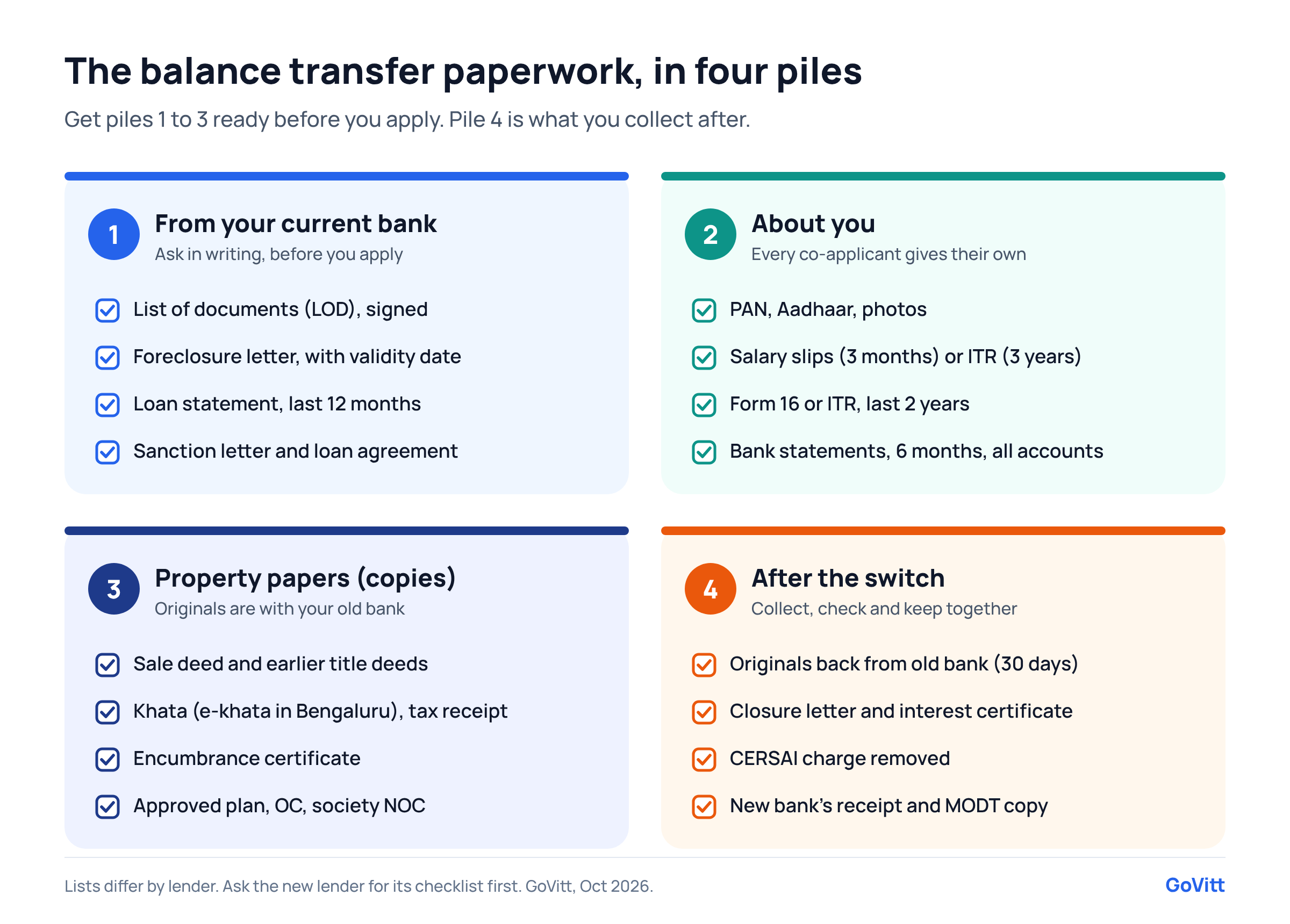
So here's the full list of documents required for a home loan balance transfer, sorted into four piles: what you get from your current bank, what you give about yourself, your property papers, and what you collect after the switch. Get the first three ready before you apply and the transfer moves in weeks, not months.
Pile 1: From your current bank, before you apply
These are the documents most people don't know to ask for. Request them in writing, through the loan service portal or by email, so you have a date and a reference number.
See your real payoff date in 60 seconds
Banks calculate remaining EMIs by simple subtraction. See your actual payoff date and discover how much interest a balance transfer can save.
| Document | What it is | Why it matters |
|---|---|---|
| List of documents (LOD) | A signed list of every original property paper the bank holds | The new lender checks it page by page. Anything missing here is a problem later |
| Foreclosure letter | The amount needed to close your loan on a given date, with interest per day after that | The new lender pays your old bank this amount. Check the validity date printed on it |
| Loan account statement, last 12 months | Your repayment record | Lenders want to see regular EMIs. HDFC Bank, for example, asks for 12 months |
| Sanction letter and loan agreement | Your original loan terms | You probably have copies. The new lender wants them too |
Some lenders also ask for a consent letter or NOC from your current bank. Ask the new lender for their list first, so you request everything from your old bank in one go.
Check the LOD against your own copies. If you handed over a document at the time of the original loan and it's not on the list, raise it now, not after closure. A missing page discovered later can hold up the whole transfer.
Pile 2: About you
The same set as a new home loan. Every co-applicant gives their own.
Everyone:
- PAN and Aadhaar
- Address proof, if different from Aadhaar
- Passport size photographs
- Bank statements for the last 6 months, for all accounts (SBI asks for every account, not just the salary one)
Salaried:
- Salary slips for the last 3 months
- Form 16 or ITR for the last 2 years
- Employment letter, if you've been in your current job for less than a year
Self-employed:
- ITR for the last 3 years, with income computation
- Balance sheet and profit and loss account for 3 years, certified by a CA
- Business address proof and registration (GST, licence or partnership deed)
- Professional qualification certificate, if you're a doctor, CA or similar
Pile 3: Property papers (copies)
Your originals are with your old bank, so the new lender's lawyer works from copies first. Keep a clean, complete set ready.
| Property paper | Notes |
|---|---|
| Sale deed or registered sale agreement | Plus the chain of earlier deeds, so the title can be traced back |
| Khata certificate and extract | In Bengaluru, expect the lender to ask for the e-khata |
| Latest property tax receipt | Must be paid up |
| Encumbrance certificate (EC) | Shows the property has no other loans or claims on it |
| Approved building plan and occupancy certificate | For flats, the builder's approvals |
| Society or builder NOC | Usually needed for apartments |
| Maintenance and electricity bills | SBI lists these for a takeover |
Under-construction flat? You'll also need the builder's permission to mortgage, the tripartite agreement, payment receipts and the latest demand letter. Some lenders don't take over loans on under-construction property at all, so ask first.
Bengaluru: check these before you start
- e-khata. A valid e-khata has been needed to register property deals within Bengaluru city limits since late 2024. If your property doesn't have one yet, apply on the e-Aasthi portal before you start the transfer.
- B-khata. Most banks, and almost all public sector banks, won't lend against a B-khata property. If yours is B-khata, your transfer options are limited to lenders who take it, usually at a higher rate.
- Occupancy certificate. Missing OCs are a common reason for legal queries on older apartments.
I've explained khata types in detail in buying a resale flat in Bengaluru: check the khata first.
Pile 4: What to collect after the switch
The transfer isn't finished when the new loan is disbursed. Collect these, and keep them together.
From your old bank:
- All original property documents, as per the LOD. Check every page before you sign the receipt.
- Loan closure letter or no dues certificate
- Final account statement and interest certificate up to the closure date. You'll need it for your tax return.
- Confirmation that the bank's charge on your property has been removed from the central registry (CERSAI)
From your new bank:
- A signed acknowledgement listing every original document they've received from you
- Sanction letter and Key Fact Statement
- A copy of the registered mortgage document (MODT)
- Your repayment schedule
Your rights on the originals. Under RBI rules in force since December 2023, your old lender must return your original property documents within 30 days of the loan being fully repaid. For every day of delay caused by the lender, it owes you ₹5,000. You can choose to collect them from the branch where your loan was serviced or any other office where the documents are kept. If the bank has lost any, it must help you get certified copies at its own cost, within a further 30 days.
Which document, when
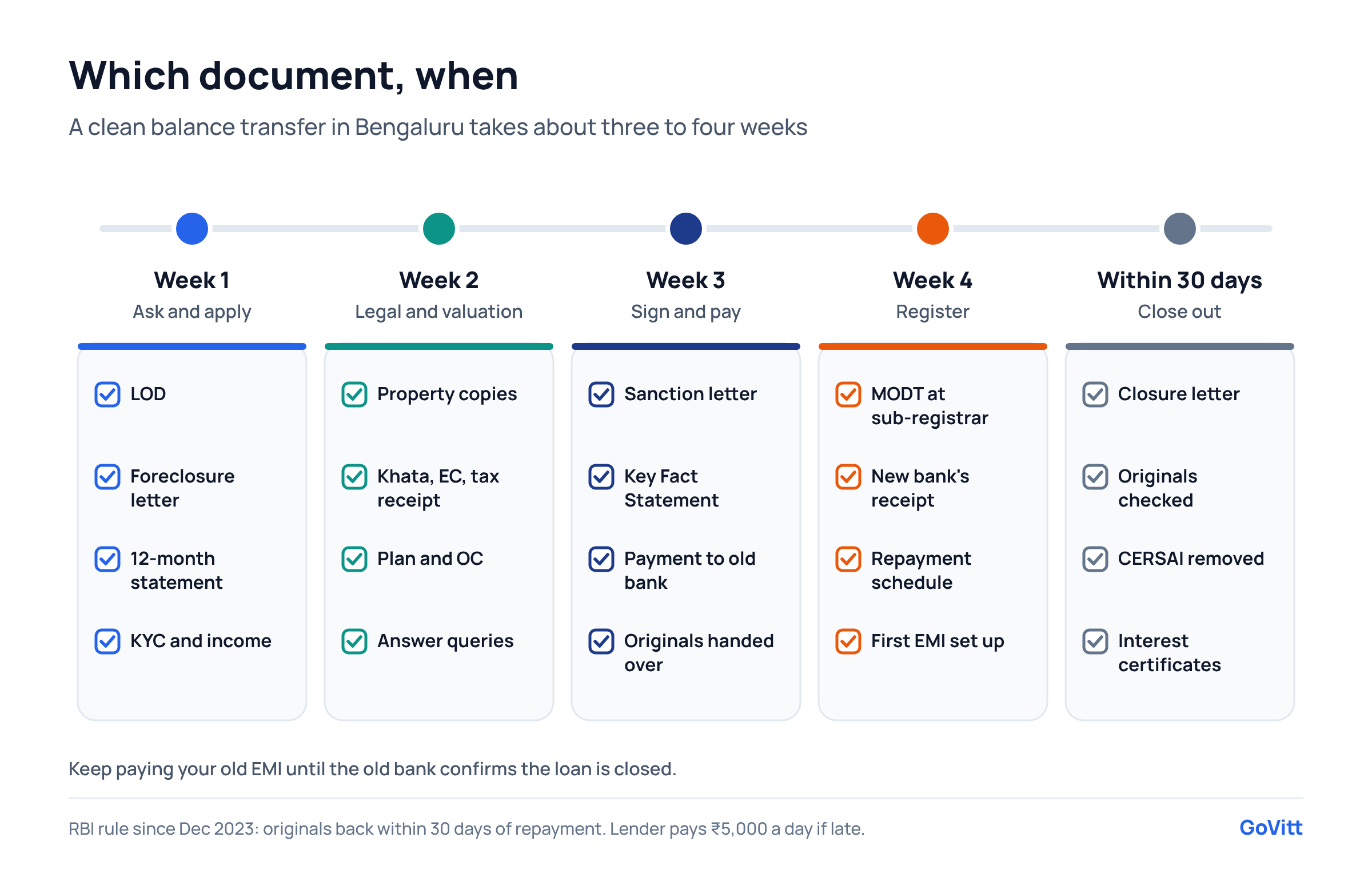
A clean transfer in Bengaluru takes about three to four weeks. The documents you need change as it moves. The full step by step, including where it gets stuck, is in what actually happens in a home loan transfer.
Six document mistakes that stall a transfer
- Letting the foreclosure letter expire. If the payment reaches your old bank after the validity date, the amount changes and you need a fresh letter.
- Not checking the LOD. A missing document found after closure can take weeks to trace.
- Stopping your old EMI too early. Keep paying until your old bank confirms the loan is closed. A missed EMI hits your credit score.
- Handing originals over without a signed list. Always get an acknowledgement from the new lender.
- Leaving khata or OC issues for the lawyer to find. Fix them first, or pick a lender who accepts them.
- Forgetting the tax papers. Get interest certificates from both banks for the year you switch.
Before you collect any of this
Make sure the switch is worth it. Every charge you'll pay is broken down in home loan balance transfer charges, and you can see your own break-even month on the Payoff & Transfer Calculator.
Want someone to check your papers first? Message us on WhatsApp and we'll tell you what's missing before any lender sees your file. GoVitt works with 50+ banks and charges you 0% commission. More on the process on our home loan balance transfer page.
FAQ
What documents are required for a home loan balance transfer? Four sets: from your current bank, the list of documents (LOD), foreclosure letter and 12-month loan statement; about you, KYC and income proof; property papers such as the sale deed, khata, tax receipt and encumbrance certificate; and, after the switch, your originals and closure letter from the old bank.
What documents do I need from my existing bank for a balance transfer? The list of original documents it holds (LOD), a foreclosure letter showing the amount to close the loan, your loan account statement for the last 12 months, and copies of your sanction letter and loan agreement. Some lenders also ask for a consent letter or NOC.
What is a foreclosure letter for a home loan? A letter from your current lender stating the exact amount needed to close your loan on a given date, plus the interest per day after that. The new lender uses it to pay off your old loan. It has a validity date, so time the payment within it.
How long does my old bank have to return my property documents? 30 days from full repayment, under RBI rules in force since December 2023. If the delay is the lender's fault, it must pay you ₹5,000 for each day. If documents are lost, it must help you get certified copies at its cost.
Do I need the e-khata for a home loan balance transfer in Bengaluru? Expect to. A valid e-khata has been needed to register property deals within Bengaluru city limits since late 2024, and the new lender registers a fresh mortgage on your property. Apply on the e-Aasthi portal before you start if you don't have one.
Document lists differ by lender, property and borrower type. Always ask the new lender for its checklist first. As of 21 October 2026.
Ready to take the next step?
Find out your loan options and check your eligibility with GoVitt today.