
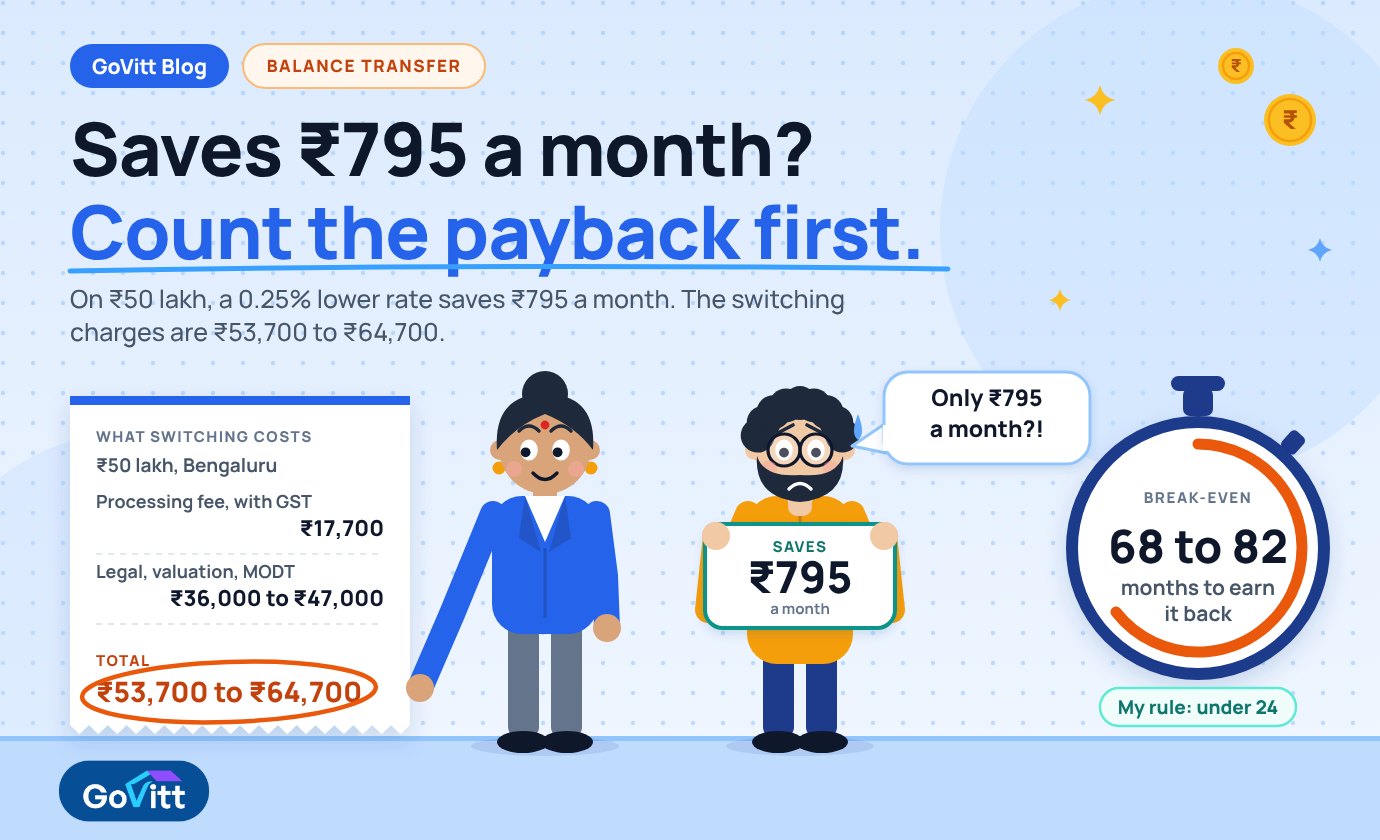
I help people move home loans, and I still tell some of them to stay. Knowing when not to do home loan balance transfer is worth more than any rate quote, because a transfer is a purchase. On a ₹50 lakh loan in Bengaluru you pay about ₹53,700 to ₹64,700 up front (more at some lenders) and wait for the saving to pay you back.
Here is how that goes wrong. Take ₹50 lakh with 20 years left at 8.75%. A lender offering 8.50% saves you ₹795 a month. The charges take 68 to 82 months to come back. That is five and a half to nearly seven years, for a rate you may not even be quoted.
Below are five cases where I'd say stay, each with the numbers. Unless I say otherwise, I use ₹50 lakh, 20 years left and a current rate of 8.75% (EMI ₹44,186). Rates and fees are as published between 15 and 26 October 2026.
See your real payoff date in 60 seconds
Banks calculate remaining EMIs by simple subtraction. See your actual payoff date and discover how much interest a balance transfer can save.
The short answer
| # | Case | The test | What I'd do instead |
|---|---|---|---|
| 1 | The gap is small | Under 0.50% with normal charges | Ask your bank to reprice |
| 2 | You have little runway | Under about 4 years left, or under 5 years on a loan below ₹20 lakh | Part-prepay instead |
| 3 | Your own bank will match | It offers about 7.80% or lower when the best outside rate is 7.50% | Take the repricing |
| 4 | You're on a fixed rate | A foreclosure charge of 2% plus GST at some lenders | Read the agreement, wait for the reset |
| 5 | Your score or papers slipped | The quote you get is at or above what you pay now | Fix the report first |
How I count "worth it"
The test is one line: total charges, divided by how much your EMI falls each month, gives the months to break even. I want that under 24 months, the same rule I use in MODT charges in Karnataka and why you pay them again when you switch banks.
The ₹53,700 to ₹64,700 I use below is SBI's fee of ₹17,700 with GST, plus the shared Bengaluru charges of ₹36,000 to ₹47,000 (legal and valuation, MODT stamp duty and registration, small charges). Every line of it is in home loan balance transfer charges.
Case 1: the rate gap is small
Same loan, moving from 8.75% to a lower rate. The table shows the saving each month and how long the charges take to come back.
| Gap | New rate | New EMI | Saves a month | Back in, at ₹53,700 | Back in, at ₹64,700 | Back in, at ₹31,000 |
|---|---|---|---|---|---|---|
| 1.25% | 7.50% | ₹40,280 | ₹3,906 | 14 months | 17 months | 8 months |
| 1.00% | 7.75% | ₹41,047 | ₹3,139 | 18 months | 21 months | 10 months |
| 0.75% | 8.00% | ₹41,822 | ₹2,364 | 23 months | 28 months | 14 months |
| 0.50% | 8.25% | ₹42,603 | ₹1,583 | 34 months | 41 months | 20 months |
| 0.25% | 8.50% | ₹43,391 | ₹795 | 68 months | 82 months | 39 months |
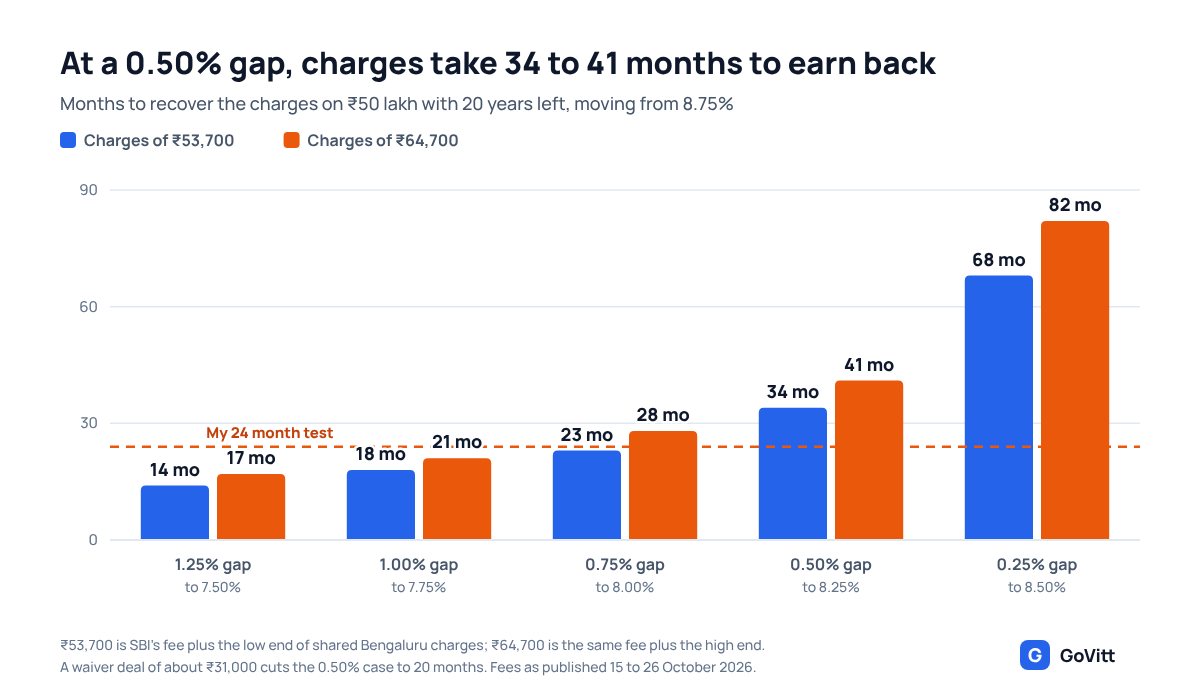
The last column is a fee waiver deal. PNB's festive offer, which runs to 31 December, brings the all-in cost of a ₹50 lakh move to about ₹31,000. I could not recheck PNB's own page for this post, so confirm it. Without a waiver, a gap of 0.50% fails my 24 month test, and a gap of 0.75% passes only at the low end of the charges. At 1.00% and above, it clears.
Check the rate you are actually quoted, not the one on the poster. Axis shows 8.00% to 8.85% for a score of 751 and above. If you pay 8.75% and land at 8.60%, you save ₹478 a month, and the charges take 113 to 136 months to come back. If you land at the top of the band, 8.85%, your EMI goes up by ₹319. You've paid ₹53,700 or more to pay more. That is why I ask lenders for the spread in writing before I pay for a valuation. Which lender wins once you count fees over five years is worked out in best home loan in India for 2026: how to pick beyond the headline rate, and the transfer lenders are compared in best banks for home loan balance transfer in 2026.
What I'd do instead: ask your own bank to reprice, which is case 3. And if rates have just risen, Rates just went up. Does switching your home loan still make sense? shows how the gap and the hike interact.
Case 2: you have little runway
A transfer saves interest, and interest is front-loaded. With a few years left, most of each EMI is already principal, so there is less interest left to save. The charges don't shrink to match. I show the shape of an EMI in how to read your home loan amortisation schedule.
Here is the net saving from moving 8.25% to 7.50% (a 0.75% gap) over the years left, after the lowest charges from my charges post. A negative result means you lose money.
| Outstanding | 2 years left | 3 years left | 5 years left | 10 years left |
|---|---|---|---|---|
| ₹10 lakh | Loses ₹7,926 | Loses ₹3,682 | Saves ₹5,372 | Saves ₹31,293 |
| ₹20 lakh | Loses ₹9,858 | Loses ₹1,383 | Saves ₹16,735 | Saves ₹68,503 |
| ₹30 lakh | Loses ₹11,780 | Saves ₹940 | Saves ₹28,100 | Saves ₹1,05,839 |
| ₹50 lakh | Loses ₹12,683 | Saves ₹8,509 | Saves ₹53,798 | Saves ₹1,83,375 |
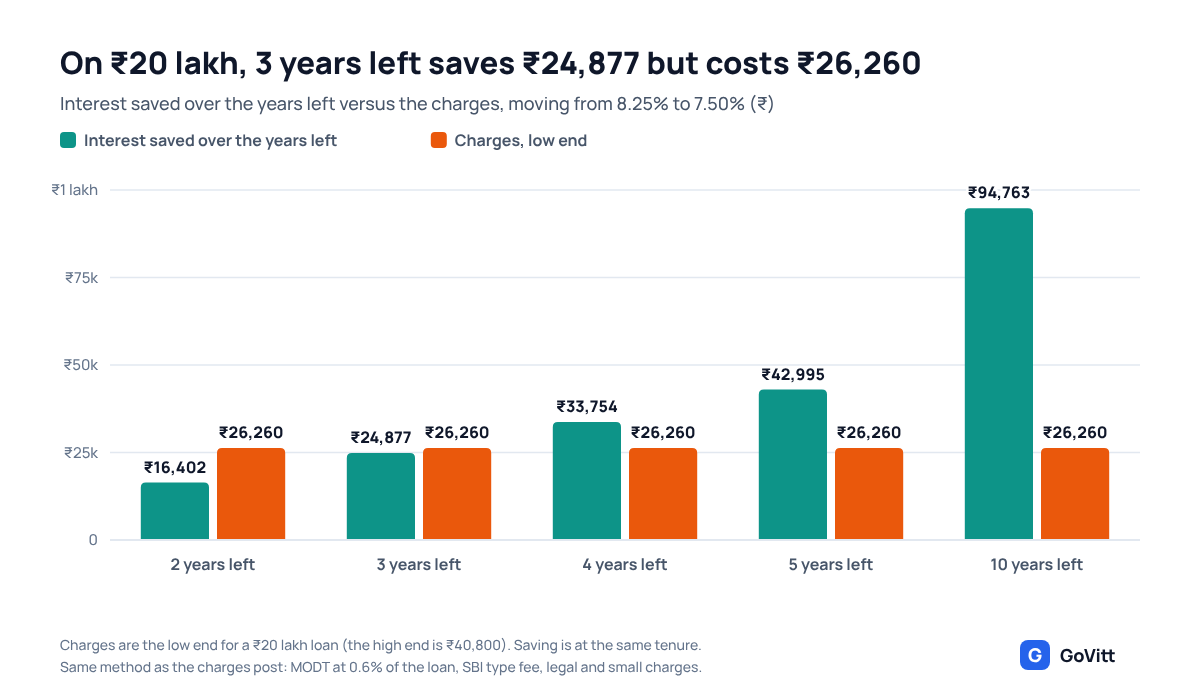
Those use the lowest charges. At the highest, a ₹10 lakh loan with 5 years left loses ₹7,398 and a ₹20 lakh loan with 5 years left saves only ₹2,195. So on a loan under ₹20 lakh, I'd want more than 5 years left before I put it through the paperwork.
Watch the tenure the new bank quotes
A new lender may offer a much lower EMI by restarting the clock. That isn't a lower rate. Take ₹20 lakh with 8 years left at 8.75%. Your EMI is ₹29,042 and you have ₹7.88 lakh of interest still to pay.
- Move to 7.50% and keep 8 years: EMI ₹27,768, and you save ₹1.22 lakh of interest. That is a real saving.
- Move to 7.50% and restart 20 years: EMI ₹16,112, which is ₹12,930 a month lower. But you now pay ₹18.67 lakh of interest, which is ₹10.79 lakh more than if you'd stayed.
Look at the total interest and the end date, not just the EMI.
What I'd do instead: if you have spare cash and a short runway left, part-prepaying does more than a transfer. The math on EMI versus tenure is in part-prepaying your home loan: reduce the EMI or the tenure.
Case 3: your own bank will match
The cheapest transfer is the one you don't make. Most big lenders will move an existing floating rate loan to a lower rate for a small fee, with no new MODT and no valuation. As I read their pages between 21 and 26 October, ICICI and Axis charge ₹3,540 on ₹50 lakh (₹3,000 plus GST), and SBI and HDFC charge ₹5,900 (SBI's is for old MCLR or base rate loans). Axis's schedule is undated, so confirm it.
Here is the same ₹50 lakh loan over a five year hold, with every path counted after its own charges:
| Option | Rate | One time cost | Saves a month | Five year saving |
|---|---|---|---|---|
| Do nothing | 8.75% | ₹0 | ₹0 | ₹0 |
| Own bank reprices | 8.25% | ₹5,900 | ₹1,583 | ₹89,080 |
| Own bank reprices | 7.80% | ₹5,900 | ₹2,984 | ₹1,73,140 |
| Transfer to 7.50% | 7.50% | ₹53,700 to ₹64,700 | ₹3,906 | ₹1.70 to ₹1.81 lakh |
So there is a clear line. If your bank brings you to about 7.80% or lower, staying matches a transfer to 7.50% over five years (the exact tipping point is 7.76% to 7.82%, depending on the charges). If it stops at 8.25%, a transfer still wins on a five year hold, though from 8.25% its charges take 24 to 28 months to come back.
What I'd do instead: ask your own bank to reprice, in writing, quoting the lower rate you've been offered elsewhere. If they refuse, you've lost nothing and you have a written offer to compare against.
Case 4: you're on a fixed rate loan
This one catches people. Since 1 January 2026, RBI's pre-payment directions say a lender can't charge you to close a floating rate loan that you took as an individual. That is why the old bank's foreclosure charge is ₹0 in every table above.
A fixed rate loan is different. HDFC Bank, for example, charges 2% plus taxes on a fixed rate home loan closed with money from another lender. On ₹50 lakh that is ₹1,18,000. Kotak's rate page also says switch and foreclosure charges apply on fixed rate loans. Add that to the normal charges and a 7.50% move costs ₹1,71,700 to ₹1,82,700. At ₹3,906 a month, that takes 44 to 47 months to earn back.
What I'd do instead: read your loan agreement first. Find out whether your loan is fixed, floating or a hybrid that is still in its fixed period, and ask your lender for the foreclosure amount in writing. If the fixed period ends soon and your agreement says the loan then turns floating, confirm that with the lender, because waiting a few months could remove the charge.
Case 5: your score or papers slipped
The rate you get today depends on your score today, not the score you had when you took the loan. If it has slipped, your quote can land at or above what you already pay. Here is the ₹50 lakh loan at 8.75%, against what two lenders publish for each score band:
| Your score now | Lender | Rate | EMI on ₹50 lakh | Against your 8.75% (EMI ₹44,186) |
|---|---|---|---|---|
| 750 to 774 | LIC Housing Finance | 7.45% | ₹40,127 | Saves ₹4,059 |
| 700 to 724 | LIC Housing Finance | 7.95% | ₹41,667 | Saves ₹2,519 |
| 600 to 699 | LIC Housing Finance | 8.75% | ₹44,186 | Saves ₹0 |
| 600 to 699 | PNB | 9.25% | ₹45,793 | Costs ₹1,607 more |
LIC's grid was checked on 22 October and PNB's on 27 October. PNB's figures are festive campaign rates that run to 31 December, for loans above ₹30 lakh and up to 80% of value. A score in the 600s turns a 1.25% gap into nothing.
A few rules sit on top of the score. HDFC asks for at least 12 months of regular repayments on your current loan. ICICI asks for a score of 700 or more on a transfer. So a recent late EMI can stop a transfer before it starts at that lender. And if your flat is still under construction, a transfer has its own rules: can you transfer a home loan on an under construction flat? has them.
What I'd do instead: pull your free credit report (RBI's directive of 1 September 2016, in force from 1 January 2017, says each bureau must give you one free full report a year), fix anything wrong, and leave 30 to 45 days for the fix to show. How a transfer touches your score is in does a home loan balance transfer hurt your CIBIL score?, and the steps for a score in the 600s are in can I get a home loan with a 650 CIBIL score?
The disadvantages, in one place
These are the costs that make the five cases above bite. Every row is explained in the charges post.
| Disadvantage | What it costs, on ₹50 lakh | Can you avoid it? |
|---|---|---|
| One time charges | ₹53,700 to ₹76,500 in Bengaluru | Processing fee and legal, sometimes. Stamp duty, never |
| Fresh MODT stamp duty | 0.5% of the sanctioned amount, ₹25,000 | No, it is a government charge |
| Overlap interest | About ₹1,199 a day at 8.75%, between the new lender paying out and the old bank receiving | Partly, by pushing both banks to move fast |
| Fixed rate foreclosure | ₹1,18,000 at HDFC (2% plus GST) | Only by waiting out the fixed period |
| A credit enquiry | A few points for a short while | Apply to two lenders, not five |
| Time and paperwork | A fresh legal check on your property and a new set of documents | No |
| Spread fixed at sanction | RBI says the spread stays unless your credit assessment changes substantially | Negotiate it on the sanction day |
When I'd say go
A transfer passes my test when the charges come back in under 24 months. On ₹50 lakh that usually means a gap of 1.00% or more, a floating rate loan, a clean score and at least five years left. If that is you, the process is in the home loan balance transfer page, and the full savings math for a real case is in I did the math on shifting ₹50 lakh from 8% to 7.20%.
What I'd do this week
- Write down three numbers: your outstanding principal from the latest statement, your current rate and the years left.
- Ask your own bank to reprice, in writing. If it comes to about 7.80% or lower on a ₹50 lakh loan, stay.
- Get two written quotes from other lenders. Ask for the spread and the processing fee, not the headline rate.
- Run the break-even. Put the numbers into the calculator. If the charges don't come back in 24 months, don't move.
- Check three blockers first: a fixed rate, a score that has slipped and a late EMI in the last year.
FAQ
When is a home loan balance transfer not worth it? It isn't worth it when the charges take longer than about 24 months to earn back. That usually means a rate gap under 0.50%, a few years left on the loan, a bank that will reprice for a small fee, a fixed rate loan with a foreclosure charge, or a score that has slipped and will price you at or above what you pay now.
What are the disadvantages of a home loan balance transfer? You pay one time charges of ₹53,700 to ₹76,500 on a ₹50 lakh loan in Bengaluru, including a fresh MODT stamp duty of ₹25,000 that no bank can waive. You may also pay overlap interest of about ₹1,199 a day, a foreclosure charge on a fixed rate loan, and you'll go through a fresh legal check and a credit enquiry.
Is a balance transfer worth it for a 0.5% lower rate? Usually not. On ₹50 lakh with 20 years left, 0.50% saves ₹1,583 a month, and charges of ₹53,700 to ₹64,700 take 34 to 41 months to come back. With a fee waiver that brings the total to about ₹31,000, it takes 20 months, which does pass.
Is it worth transferring a home loan with only a few years left? Rarely. Moving 8.25% to 7.50% on ₹20 lakh with 3 years left saves ₹24,877 of interest against charges of at least ₹26,260. You need more than 3 years left on that loan just to cover the lowest charges.
Can my old bank charge me to close my home loan if I transfer it? Not on a floating rate loan taken by an individual, under RBI's directions from 1 January 2026. A fixed rate loan can carry a charge. HDFC Bank, for example, charges 2% plus taxes, which is ₹1,18,000 on ₹50 lakh.
Should I ask my bank to reduce my rate before I transfer? Yes, always. Repricing costs ₹3,540 to ₹5,900 on ₹50 lakh at the lenders I checked, with no new MODT and no valuation. If your bank brings you to about 7.80% or lower, staying matches a transfer to 7.50% over five years.
Not sure which side of the line you're on? Run the Payoff & Transfer Calculator with your outstanding amount, rate and years left, and read the break-even month. GoVitt compares 50+ banks for you at 0% commission. If a transfer isn't worth it for you, we'll say so.
Rates and fees are as published between 15 and 26 October 2026 and change often. EMIs use the standard monthly reducing balance method and are rounded to the nearest rupee. Charges assume a property in Bengaluru and use the low and high ends in my charges post. The net savings in case 2 count interest saved over the years left, at the same tenure, minus those charges. Your actual rate, fee and costs will differ. This is general information, not financial advice. Get every figure in writing before you sign.
Ready to take the next step?
Find out your loan options and check your eligibility with GoVitt today.