
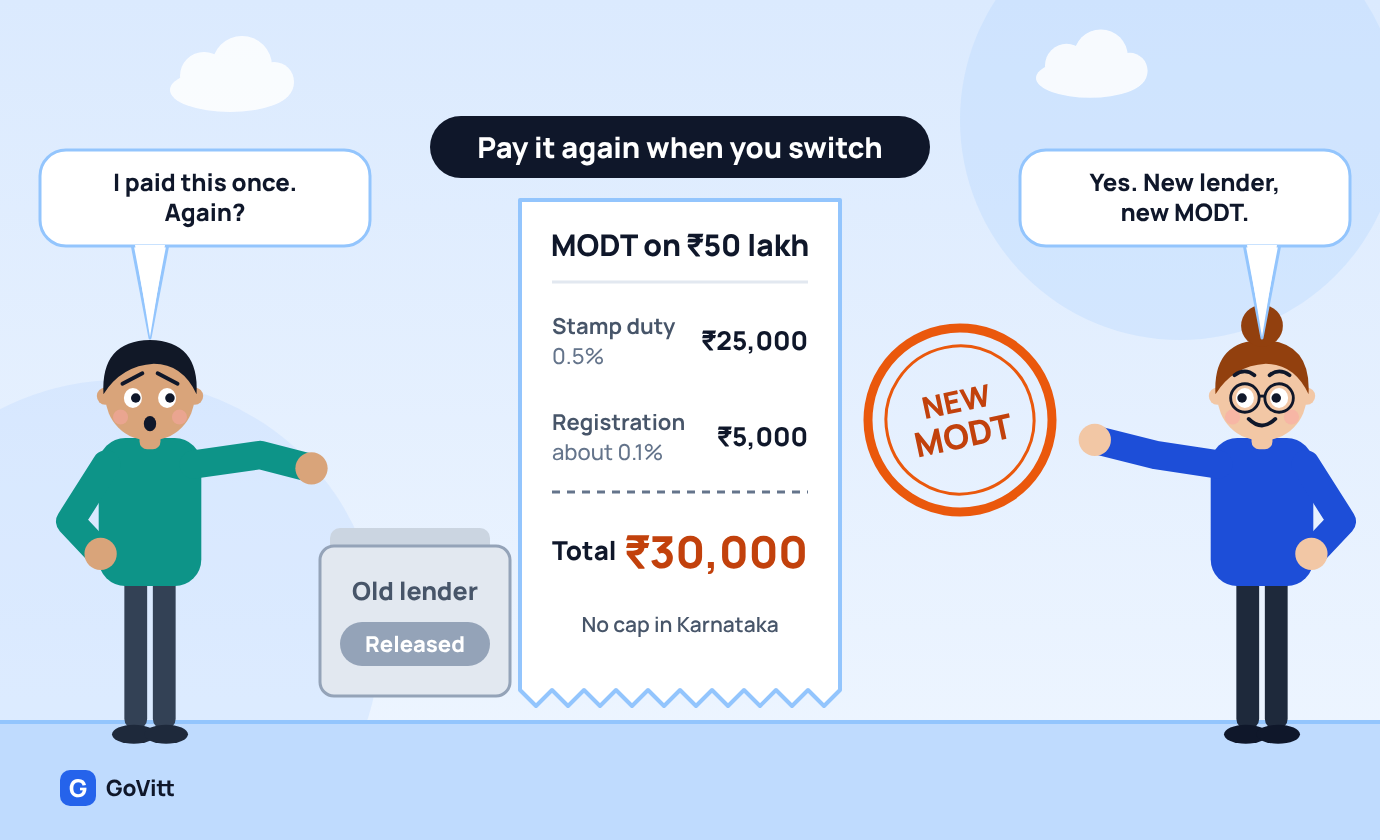
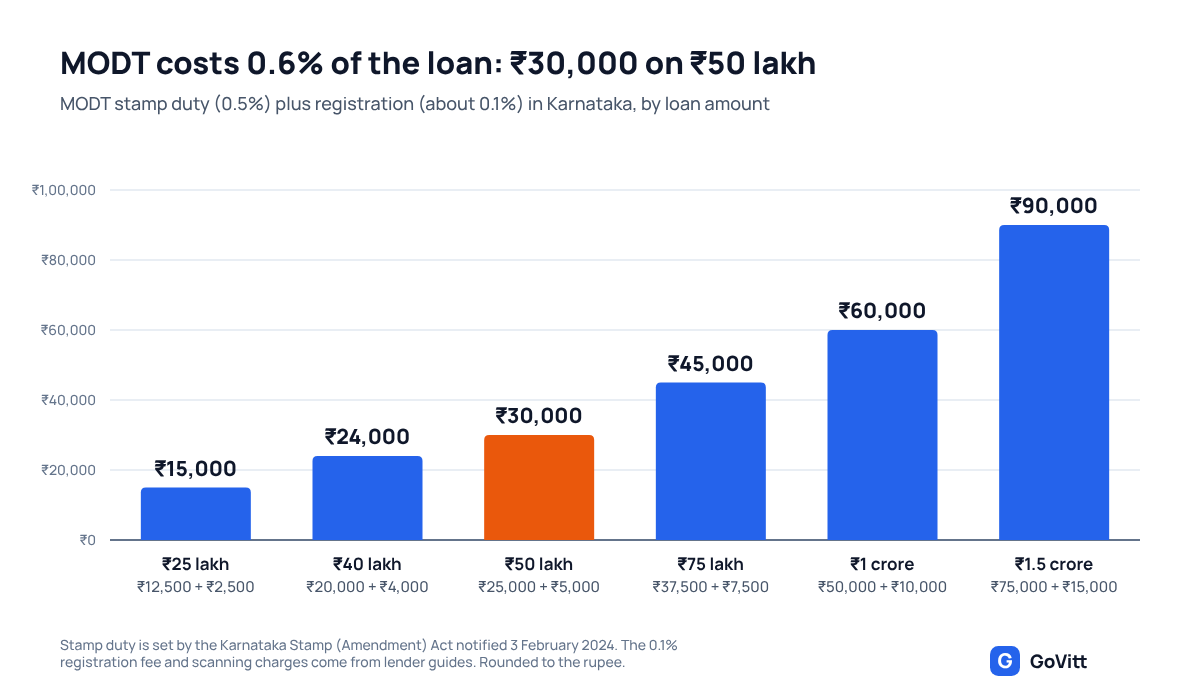
MODT charges in Karnataka are 0.5% of the loan as stamp duty plus about 0.1% as registration, with no cap. On a ₹50 lakh loan that is ₹30,000, and on ₹1 crore it is ₹60,000. When you move your loan to another bank you pay it again, because the new lender registers its own MODT on its own loan, and the old one has to be released first. On a ₹50 lakh switch, that ₹30,000 is bigger than the processing fee at SBI, Bank of Baroda or Canara, and it takes 8 to 19 months of savings just to earn it back.
Below: what MODT is, what it costs, why a switch triggers it again, how big a bite it takes, and how to keep it down.
First, the honest part
Three limits on what I could check:
See your real payoff date in 60 seconds
Banks calculate remaining EMIs by simple subtraction. See your actual payoff date and discover how much interest a balance transfer can save.
- The stamp duty rate. Law-firm notes on the Karnataka Stamp (Amendment) Act, notified on 3 February 2024 (Menon Verma and JSA Prism), say the duty on a deposit of title deeds is now 0.5% of the loan, and that the old ₹10 lakh ceiling is gone. I could not read the Act itself, and neither note gives a start date.
- The registration fee. The 0.1% and the scanning charge of ₹35 to ₹50 a page come from lender and property-services guides (Bajaj Finserv, NoBroker, PropNewz, all read in 2026), not from the registration department's fee schedule, which I could not read.
- Pricing on a transfer. No page I found prices MODT on a balance transfer. The "pay it again" part is how a transfer works, per two Bengaluru legal guides, applied to the rate. Ask your new lender for the exact figure before you pay anything.
What MODT is: the memorandum of deposit of title deeds
MODT stands for memorandum of deposit of title deeds. When you take a home loan, you hand the original property papers to the lender and sign a memorandum that records it. That creates what is called an equitable mortgage: the lender holds your papers as its security. In Karnataka the lender registers the memorandum at the sub-registrar's office, so the charge shows up on the property's encumbrance certificate (EC).
So MODT is two things. It is a document, and it is a government bill: stamp duty plus a registration fee, worked out on the loan amount, not on the value of the flat.
What MODT costs in Karnataka
| Loan amount | Stamp duty before the 2024 change (0.2%, capped at ₹10 lakh) | Stamp duty now (0.5%) | Registration (about 0.1%) | Total now |
|---|---|---|---|---|
| ₹25 lakh | ₹5,000 | ₹12,500 | ₹2,500 | ₹15,000 |
| ₹40 lakh | ₹8,000 | ₹20,000 | ₹4,000 | ₹24,000 |
| ₹50 lakh | ₹10,000 | ₹25,000 | ₹5,000 | ₹30,000 |
| ₹75 lakh | ₹15,000 | ₹37,500 | ₹7,500 | ₹45,000 |
| ₹1 crore | ₹20,000 | ₹50,000 | ₹10,000 | ₹60,000 |
| ₹1.5 crore | ₹30,000 | ₹75,000 | ₹15,000 | ₹90,000 |
Two things to notice.
- The old ceiling hardly mattered. At 0.2%, the ₹10 lakh cap only bit above a ₹5 crore loan. Removing it changes little for a home loan. The rate change is what matters.
- If you borrowed before 2024, your first MODT cost less than your next one will. Assuming the old rate applied when you borrowed, the stamp duty part is now 2.5 times as much. On ₹50 lakh that is ₹25,000 against ₹10,000.
Why you pay it again when you switch
A MODT secures one lender's loan. A balance transfer does not edit your old loan. The new lender gives you a new loan against the same property and uses it to close the old one. A new loan needs its own security. Here is the order of events, as two Bengaluru legal guides (Legal Brigade, 15 July 2026, and PGN Property Management) describe it:
- The new lender sanctions the loan and checks the property papers. Documents required for a home loan balance transfer has the list.
- Your old lender gives a closure letter and a release deed. The old charge stays on the EC until a release deed is registered at the sub-registrar, and until then it blocks the new MODT.
- The release deed is registered. PGN lists the government fees as ₹200 stamp duty, ₹200 registration and ₹50 a page, so about ₹450 for a one page deed. That firm also says an e-khata is mandatory for it, which is why the khata post matters even if you already own the flat.
- The new MODT is registered on the new sanctioned amount, at 0.6%.
- You pull a fresh EC. It should show the old bank gone and only the owner left.
Legal Brigade puts the whole transfer at two to four weeks in Bangalore, with two sub-registrar visits and at least a week for each registration. The transfer process post shows where it usually gets stuck.
MODT charges on a balance transfer: how big a bite?
Take ₹50 lakh with 20 years left. The MODT is ₹30,000 whichever lender you pick. What changes is the lender's own fee:
| Lender | Processing fee it publishes | MODT | Total of the two | MODT share of the total |
|---|---|---|---|---|
| Canara Bank | ₹0 (waived on takeovers until 31 December 2026) | ₹30,000 | ₹30,000 | 100% |
| Bank of Baroda | ₹10,030 (flat ₹8,500 plus GST) | ₹30,000 | ₹40,030 | 75% |
| SBI | ₹17,700 (0.35%, capped at ₹15,000, plus GST) | ₹30,000 | ₹47,700 | 63% |
Legal and valuation charges are on top, at actuals. Canara's waiver is on its own processing fee. The state's stamp duty still applies. The balance transfer charges post has every line of the bill.
Now the part that decides whether a switch is worth it. Say your rate is 8.75%:
| New rate | Gap | Monthly saving | Months to cover the MODT alone | Months to cover MODT plus SBI's fee |
|---|---|---|---|---|
| 8.25% | 0.50% | ₹1,583 | 19 | 31 |
| 8.00% | 0.75% | ₹2,364 | 13 | 21 |
| 7.75% | 1.00% | ₹3,139 | 10 | 16 |
| 7.50% | 1.25% | ₹3,906 | 8 | 13 |
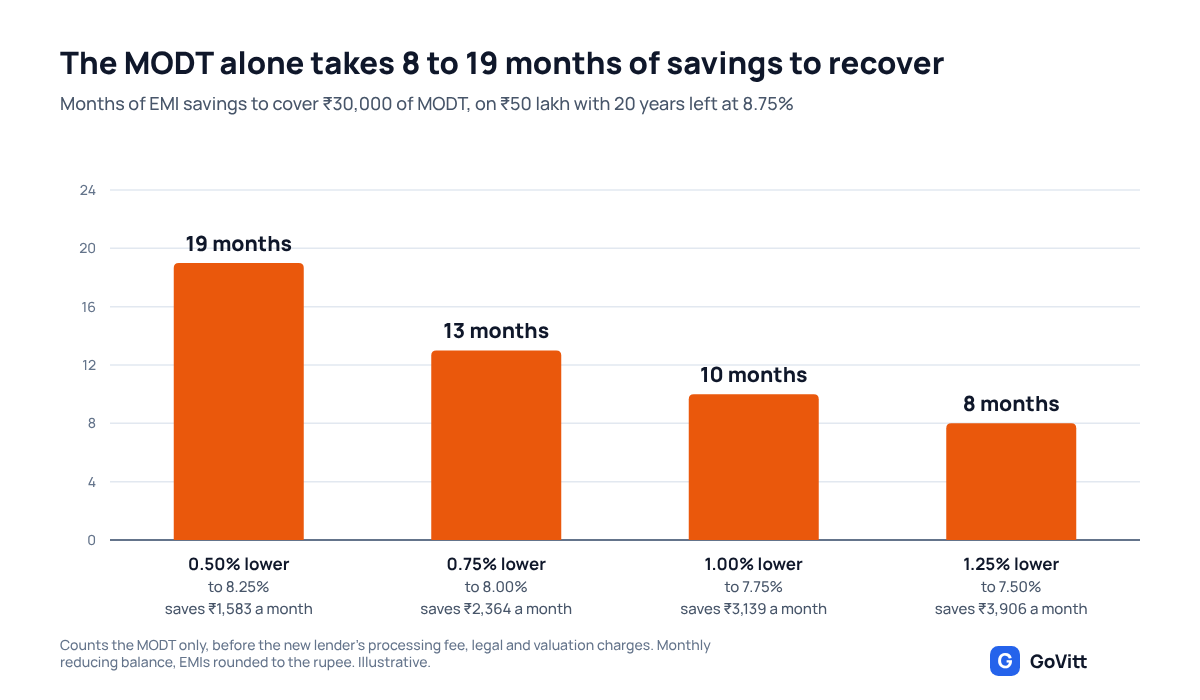
My rule is that the costs should come back in under two years, and you should expect to keep the loan at least twice that long. On a 0.50% gap, the MODT alone takes 19 months, and with SBI's fee it takes 31. That is a "stay put" in my book. From a 0.75% gap, the numbers work. The best banks post compares lenders on spread, fees and top-up, and the calculator does the sum for your own loan.
A top-up makes the MODT bigger
The MODT follows the sanctioned amount. Move ₹50 lakh and add a ₹10 lakh top-up, and the new loan is ₹60 lakh. The MODT is ₹36,000 instead of ₹30,000. The extra ₹6,000 is 0.6% of the top-up, paid up front, on money you may not need for years. Take the top-up if you have a use for it. Don't take it "just in case". The top-up post covers when one makes sense.
When you don't pay it again
If you stay with your own lender and ask it to cut your rate, the existing mortgage normally stays in place, so there is nothing new to register. I found no lender page that says a same lender rate cut needs a fresh MODT. The published fees for it are far smaller than 0.6% of the loan:
- SBI: ₹5,000 plus GST, so ₹5,900.
- HDFC Bank: the lower of 0.25% of the principal or ₹5,000, so ₹5,900 on ₹50 lakh.
- ICICI Bank: ₹3,000 plus GST, so ₹3,540.
Against ₹30,000 of MODT, that is between a fifth and an eighth. It is also why I tell people to ask their own bank first, before they ask anyone else to take the loan over.
How to keep the bill down
- Get the MODT figure in writing before you pay any application or processing fee. It should be the sanctioned amount times 0.6%, so any other number needs an explanation.
- Skip the top-up you don't need. Each ₹1 lakh adds ₹600.
- Ask which document the lender will use. This post prices a MODT. I could not confirm the rate for any other instrument, so don't assume it is the same.
- Judge a switch on the total bill, MODT included, not on the headline rate.
- Register the release deed on time. PGN says it should be done within 90 days of receiving it from the bank. You will need it again if you ever sell.
What I'd do this week
- Find your gap. Take the rate on your latest loan statement and compare it with what you could get.
- Ask your own lender to reprice, and ask for the fee in writing.
- If the gap is 0.75% or more, ask two other lenders for a sanction quote that shows the MODT line.
- Add it up. MODT, processing fee, legal and valuation. Divide by the monthly saving.
- Check your khata. If it is a B-khata or still a draft e-khata, sort that first. It can hold up the release deed.
- Decide on the payback. Under two years, go. Over two years, wait or stay.
FAQ
What are MODT charges in Karnataka? Stamp duty of 0.5% of the loan amount plus a registration fee of about 0.1%, so about 0.6% in all, with no cap. That is ₹30,000 on ₹50 lakh and ₹60,000 on ₹1 crore. Scanning charges of ₹35 to ₹50 a page are extra.
Do I pay MODT charges on a balance transfer? Yes, in the usual case. The new lender registers a MODT on its own loan, and the old lender's charge is released first. The duty is worked on the new sanctioned amount, so a top-up raises it. Confirm the exact figure with the lender.
Is there a cap on MODT charges in Karnataka? Not now. Before the 2024 amendment, the stamp duty was 0.2% with a ceiling of ₹10 lakh, which only mattered above a ₹5 crore loan. The sources I read say the ceiling has been removed.
Does the bank or the borrower pay MODT? I found no source that says lenders absorb it. It is government duty and registration, and in practice it lands on the borrower unless your sanction letter says something different. Read the letter.
How long does MODT registration take? Legal Brigade says to plan for at least a week per registration, and two to four weeks for a whole balance transfer in Bangalore. A transfer needs two registrations: the release of the old charge and the new MODT.
Want the MODT counted in your own switch? Run the Payoff & Transfer Calculator with your outstanding loan, your rate and the new lender's fee, then add the MODT line. GoVitt compares 50+ banks and charges you 0% commission.
Guides and lender pages read on 2 November 2026. The stamp duty rate is as reported in law-firm notes on the Karnataka Stamp (Amendment) Act notified on 3 February 2024; I did not read the Act. The 0.1% registration fee, scanning charges and release deed fees come from lender and property-services guides and may differ from the registration department's schedule. EMIs use the standard method and are rounded to the nearest rupee; the example assumes ₹50 lakh with 20 years left at 8.75%. Processing fees are those in GoVitt's rate posts, dated 24 to 29 October 2026. Legal and valuation charges are not included. Your lender's rules and charges will differ. Check your sanction letter and ask for every figure in writing.
Ready to take the next step?
Find out your loan options and check your eligibility with GoVitt today.