
"Save lakhs with a balance transfer." You've seen that ad. What it doesn't show is the bill you pay to get there.
So here it is. Every charge, roughly what it costs, which ones you can get waived, and which ones you can't.
See your real payoff date in 60 seconds
Banks calculate remaining EMIs by simple subtraction. See your actual payoff date and discover how much interest a balance transfer can save.
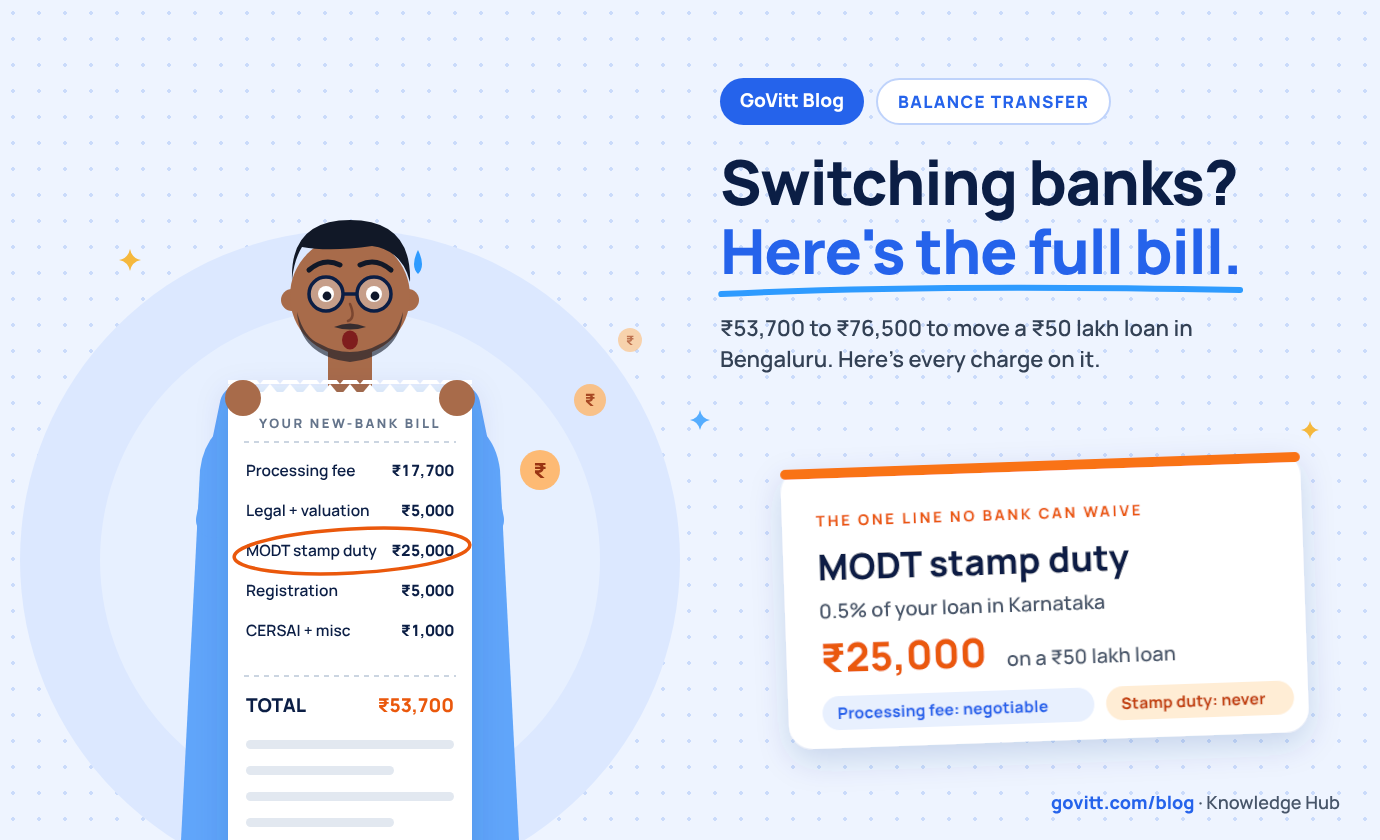
Short answer: in Bengaluru, moving a ₹50 lakh home loan to a new lender costs roughly ₹53,700 to ₹76,500. With a good festive offer, it can come down to about ₹31,000. The biggest single item is a stamp duty that no bank can waive.
What a transfer costs, by loan size
| Charge | ₹30 lakh | ₹50 lakh | ₹1 crore |
|---|---|---|---|
| Processing fee (incl. 18% GST) | ₹12,390 to ₹17,700 | ₹17,700 to ₹29,500 | ₹17,700 to ₹59,000 |
| Legal and technical valuation | ₹5,000 to ₹15,000 | ₹5,000 to ₹15,000 | ₹5,000 to ₹15,000 |
| MODT stamp duty (0.5%) | ₹15,000 | ₹25,000 | ₹50,000 |
| MODT registration (about 0.1%) | ₹3,000 | ₹5,000 | ₹10,000 |
| CERSAI, scanning, small charges | ₹1,000 to ₹2,000 | ₹1,000 to ₹2,000 | ₹1,000 to ₹2,000 |
| Foreclosure at old lender (floating rate) | ₹0 | ₹0 | ₹0 |
| Total | ₹36,390 to ₹52,700 | ₹53,700 to ₹76,500 | ₹83,700 to ₹1.36 lakh |
The low end assumes a processing fee like SBI's, 0.35% capped at ₹15,000. The high end assumes 0.50% with no cap. On a ₹1 crore loan, that cap alone is worth ₹41,300. So on bigger loans, the processing fee is worth comparing properly.
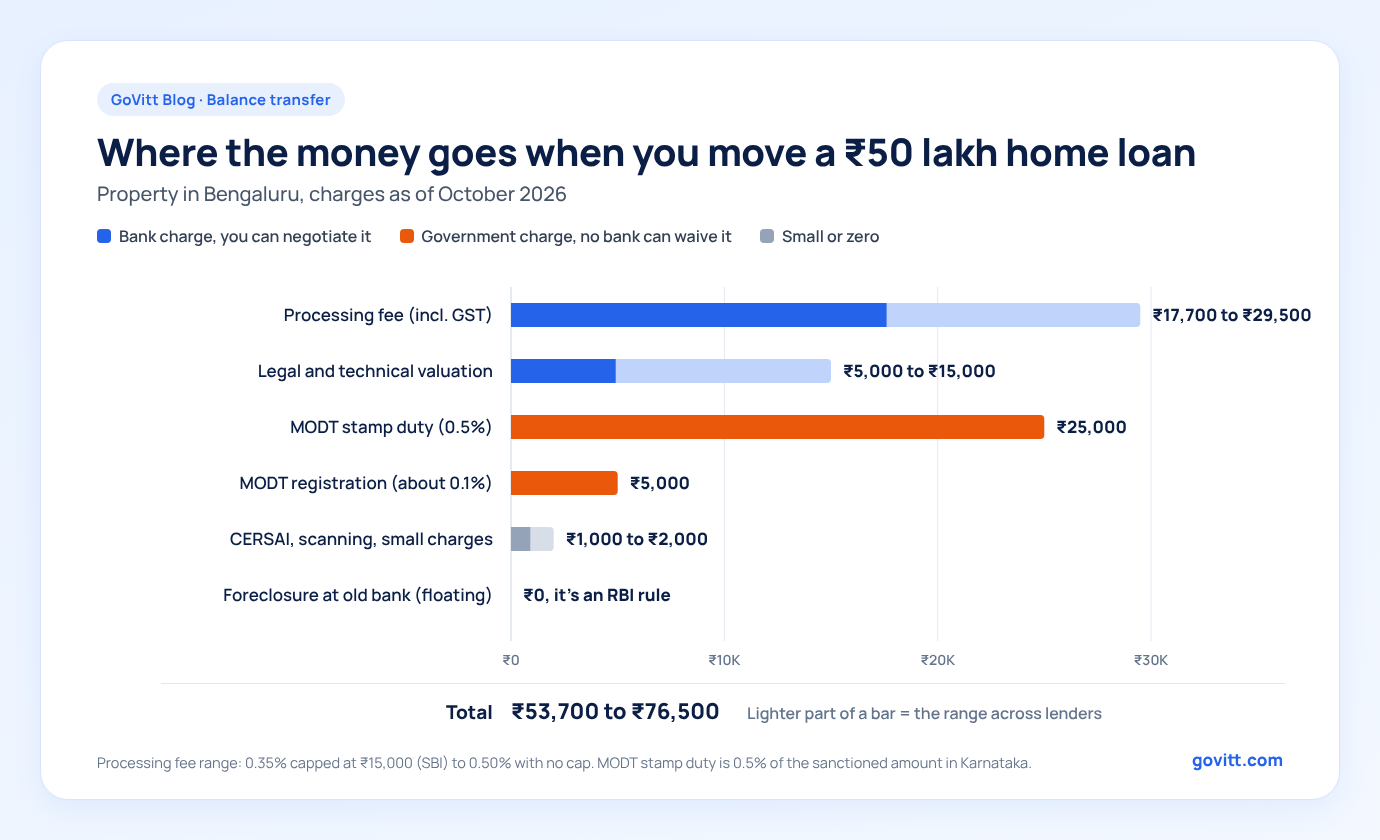
The blue lines are where you can bargain. The orange ones are fixed by the state.
Charge by charge
1. Processing fee
The new lender charges this for handling your application. It's the only big charge that's genuinely negotiable.
| Lender | Processing fee |
|---|---|
| SBI | 0.35% for salaried borrowers, capped at ₹15,000 plus GST |
| HDFC Bank | Up to 0.50% plus taxes |
| ICICI Bank | 0.50% plus taxes |
| Punjab National Bank | Fully waived under its festive offer, till 31 December |
| Kotak Mahindra Bank | 50% off under its festive offer |
| Some NBFCs and HFCs | Can go up to 2% or 3% |
GST at 18% goes on top. Ask for a waiver or a cap, especially between now and December when festive offers are running. Worst case, they say no.
2. Legal and technical valuation
The new lender sends its lawyer through your property papers and its valuer to see the flat. Yes, your old bank already did all of this when it gave you the loan. You pay for it again anyway.
Expect ₹5,000 to ₹15,000, a bit more for an independent house or papers that go back a long way. Some festive offers cover it. PNB, for example, says it bears legal, valuation and NEC charges up to ₹15,000 (plus GST) on home loan takeovers of ₹25 lakh and above.
3. MODT stamp duty (the big one)
MODT stands for Memorandum of Deposit of Title Deeds. It's the document that records your original property papers are with the bank as security. When you switch, the new lender registers a fresh MODT in its own name, and you pay stamp duty on it again.
In Karnataka, this is 0.5% of the sanctioned loan amount, with no upper cap since the 2024 amendment. On ₹50 lakh, that's ₹25,000. It's a government charge, so no festive offer touches it, and you don't get it back when the loan closes.
Two things push it up without you noticing:
- A top-up taken with the transfer. Stamp duty is charged on the full sanctioned amount. A ₹10 lakh top-up adds ₹5,000 in stamp duty and around ₹1,000 in registration.
- An insurance premium added into the loan. Same logic. If it's part of the loan, you pay stamp duty on it.
If your property is outside Karnataka, check your state's rate. Some states charge less, and some have a cap.
4. Registration fee
Around 0.1% of the loan amount, for registering the MODT at the sub-registrar's office. About ₹5,000 on ₹50 lakh.
5. CERSAI, scanning and the small stuff
CERSAI registration (a central registry of mortgages), document scanning at the sub-registrar's office (roughly ₹35 to ₹50 a page), courier and so on. Keep ₹1,000 to ₹2,000 aside.
6. Foreclosure charges at your old lender
If your current loan is on a floating rate and taken by you as an individual, your old lender can't charge you anything to close it. That's an RBI rule.
Fixed rate loans are a different story. HDFC Bank, for example, charges 2% plus taxes on fixed rate home loans that are closed with money from another bank or HFC. On ₹50 lakh, that's ₹1.18 lakh, which can wipe out years of savings. Kotak's rate page also says switch and foreclosure charges apply on fixed rate loans. If you're on a fixed or hybrid loan that's still in its fixed period, read your agreement before doing anything else.
7. What your old lender may still charge
The foreclosure letter and the closure NOC are usually free. Some lenders charge a small fee for a list of documents or for retrieving them. Ask before you request anything.
Once the loan is paid off, RBI requires your old lender to return your original property documents within 30 days. If they don't, they owe you ₹5,000 for every day of delay.
The costs nobody puts in a table
Overlap interest. The new loan starts charging interest from the day the new lender issues the payment. Your old loan keeps charging interest until that payment actually reaches your old bank. On ₹50 lakh at 8.75%, every day in between costs about ₹1,200. Push both sides to move quickly.
Bundled insurance. Many lenders push a home loan protection plan at sanction. It isn't compulsory. If a ₹50,000 premium goes into your loan, you pay interest on it for 20 years, plus stamp duty on it in Karnataka. Say no unless you actually want it.
Your credit score. The new loan enquiry can dip your score a few points for a short while. That's no reason to avoid switching. Just don't apply to five lenders at once.
What you can negotiate and what you can't
| Charge | Negotiable? |
|---|---|
| Processing fee | Yes. Ask for a waiver, a cap or a festive offer |
| Legal and valuation | Sometimes. Some lenders bear it on takeovers |
| Insurance | Yes. It's optional |
| Overlap interest | Partly. Depends on how fast both banks move |
| MODT stamp duty and registration | No. Government charge |
| CERSAI and small charges | No, but they're small |
| Foreclosure on a fixed rate loan | Rarely. Check your agreement |
Will you earn it back?
The simple way to check: total charges ÷ how much your EMI drops each month = months to break even.
Take ₹50 lakh with 20 years left, moving to 7.50%:
| Rate you pay now | EMI drops by | Break-even with normal charges | Break-even with a festive waiver (about ₹31,000) |
|---|---|---|---|
| 8.75% | ₹3,906 | 14 to 20 months | about 8 months |
| 8.25% | ₹2,324 | 23 to 33 months | about 13 months |
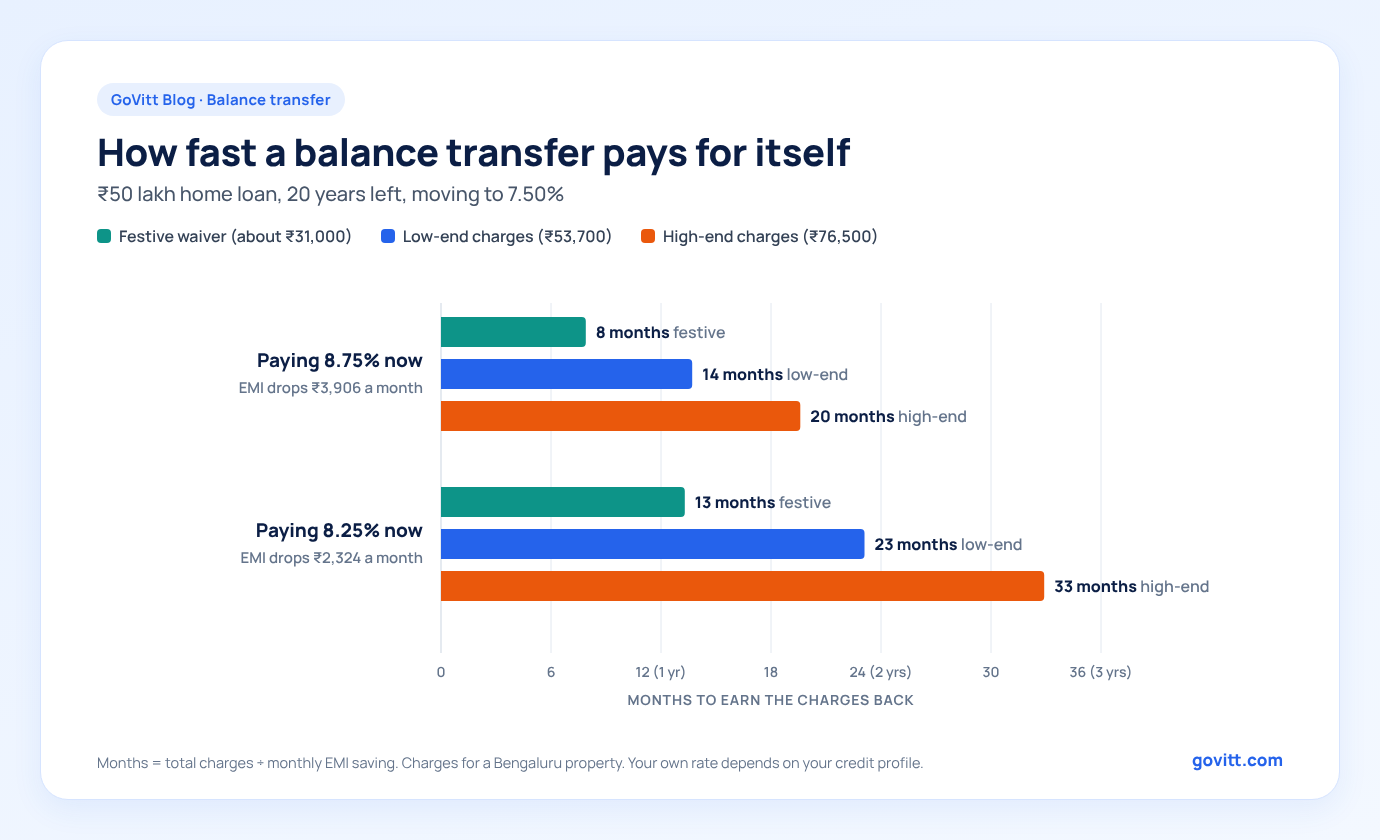
The smaller your rate gap, the longer the charges take to come back.
If you're at 8.75% or more and plan to keep the house for a few more years, the charges come back to you quickly. Once the gap drops below 0.75%, it gets slow.
On small loans it barely works. ₹15 lakh with 5 years left, moving from 8.75% to 7.50%, saves about ₹54,000 in total interest. The charges would be ₹21,000 to ₹35,000. That's a lot of running around for very little.
I did the full savings math, both the lower EMI and the shorter tenure options, in this post on moving ₹50 lakh from 8% to 7.20%. And if you want to know what the process actually looks like, here's the step by step.
Before you pay any of this, ask your own bank
The cheapest transfer is the one you don't have to make. Ask your current lender, in writing, to bring your rate down to what it offers new customers. Many banks will do it for a small conversion fee. SBI, for example, charges ₹5,000 plus GST to move an old MCLR or base rate loan to its repo-linked rate. No new MODT, no lawyer, no valuer.
If they don't match, you'll know a transfer is worth pricing out properly.
Want your exact number?
Put your outstanding amount, current rate and years left into our free Payoff & Transfer Calculator. Or WhatsApp us on +91 70194 17854 and we'll send you the full cost and break-even for your loan, including which of these charges you can get waived right now. GoVitt works with 50+ banks and housing finance companies, and we don't charge you any commission. More on how it works on our balance transfer page.
Charges are as of 16 October 2026 and only for illustration. They assume a property in Bengaluru, and differ by lender, state and property. Processing fees and festive offers change often. Please confirm every charge with the new lender in writing, and check your Key Fact Statement, before you sign.
Questions people usually ask
What are the charges for a home loan balance transfer? You pay the new lender's processing fee, legal and technical valuation fees, stamp duty and registration on the new mortgage (MODT), and small charges like CERSAI and scanning. For a ₹50 lakh loan on a Bengaluru property, that's roughly ₹53,700 to ₹76,500.
Is MODT charged again on a balance transfer? Yes. The new lender registers a fresh MODT in its own name, so you pay the stamp duty again. In Karnataka it's 0.5% of the sanctioned loan amount, which is ₹25,000 on a ₹50 lakh loan, plus about 0.1% registration.
Can the processing fee be waived on a balance transfer? Often, yes, especially during festive offers. In October 2026, PNB is waiving processing charges on home loans and takeovers till 31 December, and Kotak Mahindra Bank is offering 50% off. You can also ask any lender for a waiver or a cap.
Will my old bank charge foreclosure charges if I transfer my home loan? Not on a floating rate home loan taken by an individual, as per RBI rules. Fixed rate loans can carry a prepayment charge. HDFC Bank, for example, charges 2% plus taxes when a fixed rate home loan is closed using money from another lender.
How long does it take to recover balance transfer charges? Divide the total charges by how much your EMI drops each month. On ₹50 lakh with 20 years left, moving from 8.75% to 7.50% cuts the EMI by about ₹3,906, so ₹53,700 to ₹76,500 in charges comes back in 14 to 20 months.
Do I pay stamp duty on a top-up taken with a balance transfer? Yes. Stamp duty on the MODT is calculated on the full sanctioned amount. In Karnataka, a ₹10 lakh top-up adds about ₹5,000 in stamp duty and ₹1,000 in registration.
Ready to take the next step?
Find out your loan options and check your eligibility with GoVitt today.