
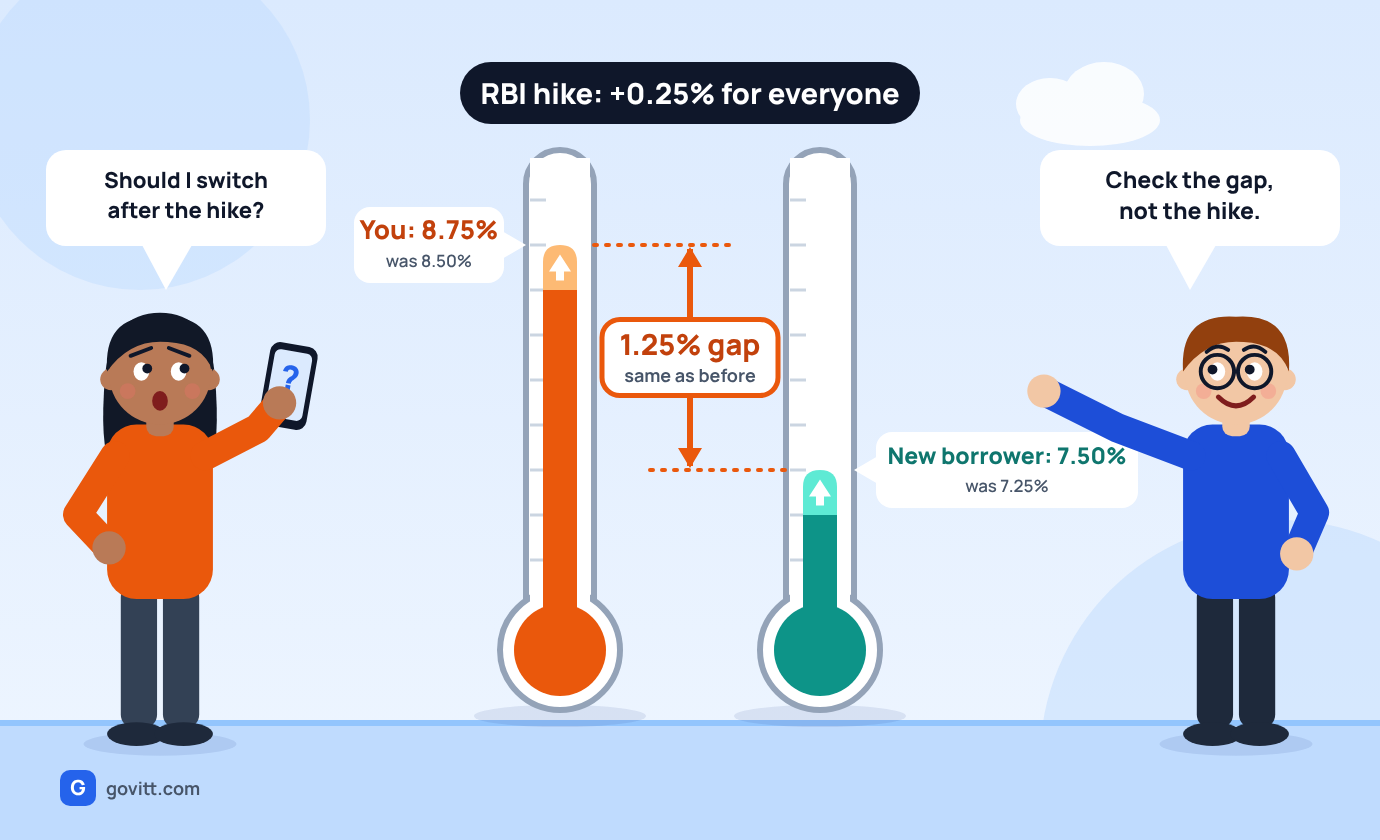
RBI raised the repo rate by 0.25% on 7 October. On ₹50 lakh with 20 years left, that took the EMI of someone paying 8.50% from ₹43,391 to ₹44,186, which is ₹795 a month more. So is switching your loan still worth it, or will every lender charge you more too?
Here is the math on a home loan balance transfer after rate hike, with real fees and break-even months.
See your real payoff date in 60 seconds
Banks calculate remaining EMIs by simple subtraction. See your actual payoff date and discover how much interest a balance transfer can save.
The short version: a hike raises everyone's rate. It does not close the gap between what you pay and what new borrowers pay. That gap, not the hike, decides whether a transfer pays.
Same hike, same gap
Banks passed the October hike on over the following week. SBI's benchmark moved on 15 October. Both the rate you pay and the rate a new borrower gets went up by the same 0.25%. Here is what that looks like for a borrower paying 8.50% before the hike:
| Before the hike | Now | |
|---|---|---|
| What you pay (example) | 8.50% | 8.75% |
| SBI's lowest rate | 7.25% | 7.50% |
| HDFC Bank's lowest rate | 7.75% | 8.00% |
| Your gap to SBI | 1.25% | 1.25% |
| Your gap to HDFC Bank | 0.75% | 0.75% |
The hike moved everything up together. Nothing moved the gap.
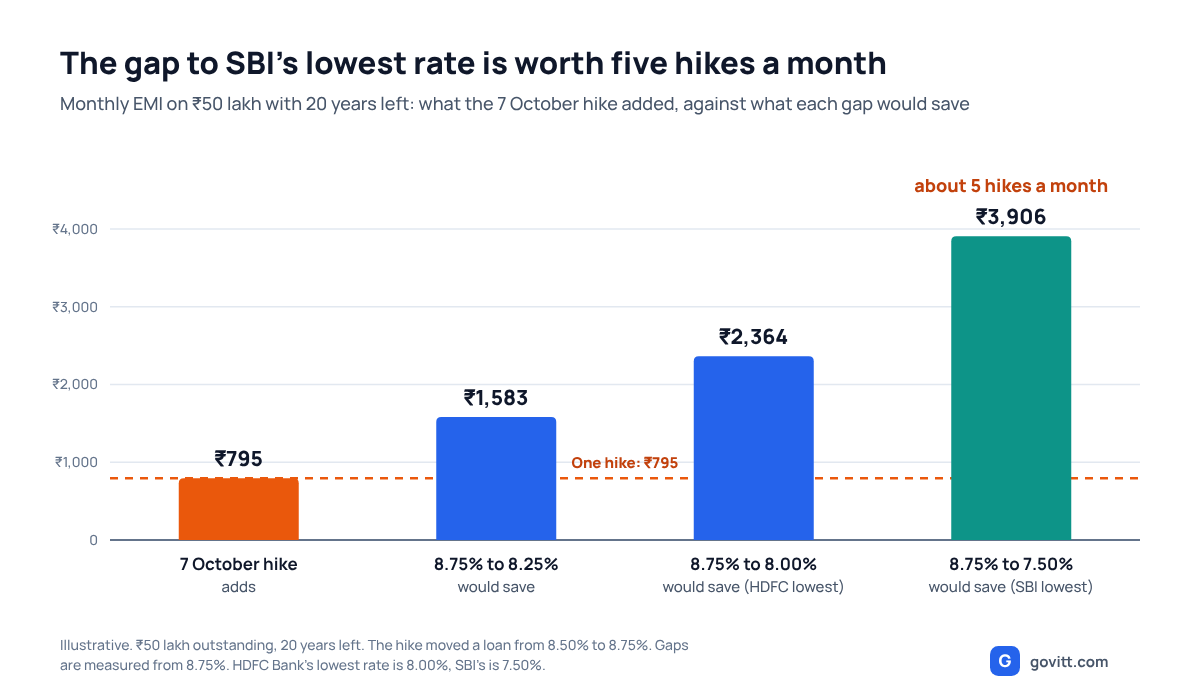
And look at what the gap is worth. On ₹50 lakh with 20 years left, the October hike added ₹795 to your EMI. Moving from 8.75% to SBI's 7.50% would cut it by ₹3,906. That's about five hikes' worth, every month.
Three things the hike does change
1. If you're on MCLR, your gap looks smaller than it is. The hike may not have reached your EMI yet, because MCLR loans reset on a date set in your loan contract. But today's rates for new borrowers already include it. So the gap looks 0.25% narrower than before the hike, and it is likely to widen again when your loan resets. The reset rules are in still on MCLR? how to move to a repo-linked rate.
2. Your bank may have stretched your tenure instead of raising your EMI. On ₹50 lakh with 20 years left, a 0.25% hike is worth about 12 extra months if the bank keeps the EMI the same. Check the EMIs left on your latest statement before you run any numbers. Here's how to see what your bank did: banks took one day to pass on the hike.
3. Housing finance companies move on their own dates. They price off their own benchmark, not repo. As of 22 October, LIC Housing Finance had not announced a change and still showed 7.15% for a CIBIL score of 825 and above. That can change on any day, so ask any lender how long a quoted rate stays valid.
Should you wait for 4 December?
RBI's next decision is on 4 December. The MPC minutes say the next move can only be a hike or a pause, and I've covered what each member said in RBI MPC minutes, October 2026. Waiting to see feels safe. It isn't, for two reasons.
- The spread you'd get doesn't depend on the meeting. A floating rate is a benchmark plus a spread. The benchmark moves with repo for every borrower, before and after you switch. The spread is the only part you're shopping for.
- Waiting costs you the saving. At 8.75% moving to 7.50%, that's ₹3,906 for every month you wait. Three months is ₹11,718.
A transfer will not shield you from the next hike either. Another 0.25% adds about ₹800 a month to this loan, and 0.50% adds about ₹1,607, whichever lender holds it. If you want protection from hikes, prepay what you can. Fixed rates cost more today (LIC Housing Finance's start at 8.50%, and ICICI Bank's full-term fixed rate is 10.90%), and fixed loans usually carry charges if you leave early.
What a transfer costs
On ₹50 lakh in Bengaluru, a balance transfer costs about ₹53,700 to ₹76,500 all in. That covers the new lender's processing fee, legal and valuation charges, Karnataka MODT stamp duty (0.5%) and registration (about 0.1%). That's the range I use below. Every line is in home loan balance transfer charges.
Two notes. Floating rate home loans taken by individuals carry no foreclosure charge, but a fixed rate loan may, so check your agreement. And costs don't double when the loan does: on ₹1 crore the all-in cost is about ₹83,700 to ₹1.36 lakh, so bigger loans break even a little faster.
Break-even: how big a gap do you need?
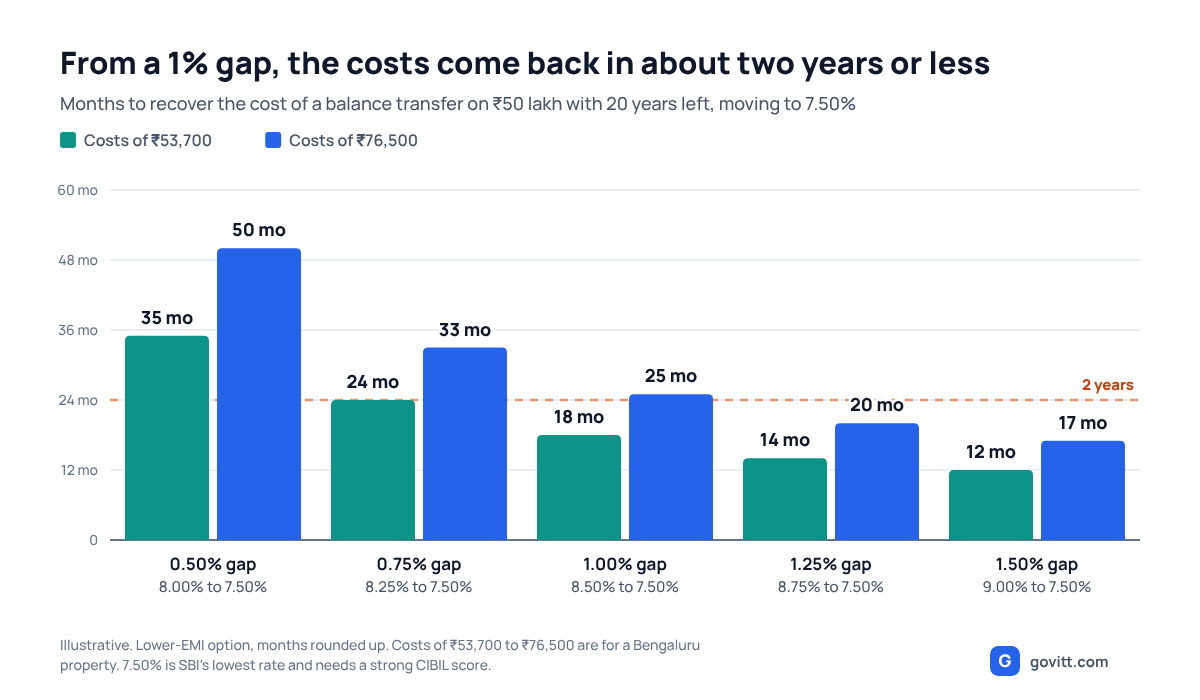
Here's the same ₹50 lakh loan with 20 years left, moved to 7.50%, SBI's lowest rate. You'll only get close to it with a strong CIBIL score. The rate you actually get depends on your score, so check yours first (see how your CIBIL score moves your rate).
| You pay now | Gap | EMI saving a month | Costs paid back in | Net saving over 20 years, after costs |
|---|---|---|---|---|
| 8.00% | 0.50% | ₹1,542 | 35 to 50 months | ₹2.94 to ₹3.16 lakh |
| 8.25% | 0.75% | ₹2,323 | 24 to 33 months | ₹4.81 to ₹5.04 lakh |
| 8.50% | 1.00% | ₹3,111 | 18 to 25 months | ₹6.70 to ₹6.93 lakh |
| 8.75% | 1.25% | ₹3,906 | 14 to 20 months | ₹8.61 to ₹8.84 lakh |
| 9.00% | 1.50% | ₹4,706 | 12 to 17 months | ₹10.53 to ₹10.76 lakh |
| 9.50% | 2.00% | ₹6,327 | 9 to 13 months | ₹14.42 to ₹14.65 lakh |
Not everyone qualifies for 7.50%. If your score only gets you 8.00%, which is HDFC Bank's lowest rate, the table shrinks:
| You pay now | Gap | EMI saving a month | Costs paid back in | Net saving over 20 years, after costs |
|---|---|---|---|---|
| 8.25% | 0.25% | ₹781 | 69 to 98 months | ₹1.11 to ₹1.34 lakh |
| 8.50% | 0.50% | ₹1,569 | 35 to 49 months | ₹3.00 to ₹3.23 lakh |
| 8.75% | 0.75% | ₹2,364 | 23 to 33 months | ₹4.91 to ₹5.14 lakh |
| 9.00% | 1.00% | ₹3,164 | 17 to 25 months | ₹6.83 to ₹7.06 lakh |
| 9.50% | 1.50% | ₹4,785 | 12 to 16 months | ₹10.72 to ₹10.95 lakh |
Months are rounded up. Net savings are an upper bound, because both loans float and the lenders' rates will keep moving with repo.
The rule I use: the costs should come back in under two years, and you should expect to hold the loan at least twice that long. Here's how I'd read the tables:
| Gap to the best rate you qualify for | What I'd do |
|---|---|
| Under 0.50% | Skip the transfer. The costs take 4 to 8 years to come back. Ask your own bank for a lower rate instead. |
| 0.50% to 0.75% | Ask your own bank first. Transfer only if you'll keep the loan 4 more years or longer, and the processing fee is waived or negotiated down. |
| 1.00% or more | Price a transfer this week. Get two written offers. |
A worked example: 8.75% to 7.50%
₹50 lakh outstanding, 20 years left, a Bengaluru property, costs of ₹53,700 to ₹76,500:
| Stay at 8.75% | Switch, lower EMI | Switch, keep your EMI | |
|---|---|---|---|
| EMI | ₹44,186 | ₹40,280 | ₹44,186 |
| Loan ends in | 20 years | 20 years | About 16 years 5 months |
| Interest left to pay | ₹56.05 lakh | ₹46.67 lakh | ₹37.12 lakh |
| Net saving after costs | None | ₹8.61 to ₹8.84 lakh | ₹18.17 to ₹18.39 lakh |
If you can afford your current EMI, keep paying it. Same payment, but the loan ends about 3 years and 7 months early. That's more than double the saving of taking the lower EMI.
Ask your own bank first
Before you pay ₹53,700 or more to move, ask your current bank to give you its rate for new borrowers. Most banks sell this as a conversion. The fees I found on each bank's own pages, with GST on top:
| Bank | Conversion fee to a lower floating rate | All-in on ₹50 lakh, with GST |
|---|---|---|
| SBI | ₹5,000 | ₹5,900 |
| HDFC Bank | The lower of 0.25% of principal outstanding or ₹5,000 | ₹5,900 |
| ICICI Bank | ₹3,000 | ₹3,540 |
At 8.75%, if your bank cuts you to 8.25%, you save ₹1,583 a month and a ₹5,900 fee is back in 4 months. Ask in writing, and ask for the new rate, the new spread and the date it starts. If your bank refuses, or matches only part of the gap, you have a written number to compare against a transfer.
When I wouldn't switch
- The gap is under 0.50%. The costs take years to come back.
- You may sell or close the loan within 2 to 3 years. You won't reach break-even.
- You have only a few years left, or a small balance. The saving is too small to cover the fixed costs.
- Your loan is fixed rate. Check the foreclosure charge first. It can wipe out the gain.
- Your property papers aren't clean. The new lender's legal check can stall or fail the whole move.
- Your score is below 700. Your new rate may be much higher than the headline rates above, so the real gap is smaller.
What I'd do this week
- Find your gap. Take the rate on your latest loan statement. Then look up the best rate for your CIBIL score on two or three lenders' pages. Our rate comparison page lists them side by side.
- Check your real tenure. Count the EMIs left on your statement. Don't use the tenure you signed up for.
- Ask your own bank first, in writing, for its current rate for your profile.
- If the gap is 0.75% or more, get two written transfer offers. Each should state the benchmark, the spread and every fee.
- Run the numbers on the Payoff & Transfer Calculator. It shows your break-even month and your real payoff date.
- If it passes, ask the new lender to keep your EMI. Then plan the handover so you don't miss an EMI. Here's the process: home loan transfer, step by step.
If your gap is 1% or more and you'd like a second opinion, our home loan balance transfer page shows how it works. GoVitt compares 50+ banks and charges you 0% commission.
FAQ
Is a home loan balance transfer still worth it after the RBI rate hike? Yes, if the gap between your rate and the best rate you qualify for is 1% or more and you expect to hold the loan for at least 3 or 4 more years. The hike raised your rate and new borrowers' rates by the same 0.25%, so it doesn't change the gap. On ₹50 lakh with 20 years left, a 1% gap pays back the transfer costs in about 18 to 25 months.
Should I transfer my home loan now or wait for the December RBI decision? Don't wait for the decision. A floating rate moves with repo whichever lender you're with, and the spread you'd get doesn't depend on the meeting. Waiting just costs you the monthly saving. On a ₹50 lakh loan moving from 8.75% to 7.50%, that's ₹3,906 a month.
How much rate gap do I need to switch? At least 0.75%, and I'd want 1% or more. At a 0.50% gap on ₹50 lakh, the costs take 35 to 50 months to come back. At 1.00% it's 18 to 25 months, and at 1.50% it's 12 to 17 months.
Will a balance transfer protect me from the next rate hike? No. The new loan is a floating rate loan too, so it moves with repo. A transfer lowers your spread. It doesn't lock in your rate. Prepaying is the better protection.
What does a home loan balance transfer cost in Bengaluru? About ₹53,700 to ₹76,500 on a ₹50 lakh loan, and about ₹83,700 to ₹1.36 lakh on ₹1 crore. That includes the processing fee, legal and valuation charges, MODT stamp duty and registration.
Ready to see your number? Run the Payoff & Transfer Calculator. It takes two minutes and shows your break-even month, your saving, and your real payoff date.
Rates are as of 20 to 24 October 2026. EMIs use the standard monthly reducing balance method, rounded to the nearest rupee. Transfer costs are for a Bengaluru property. Months to break even are rounded up. Net savings assume the lower rate is available to you and that rates move together. Check your own sanction letter and each lender's current page before you act.
Ready to take the next step?
Find out your loan options and check your eligibility with GoVitt today.