
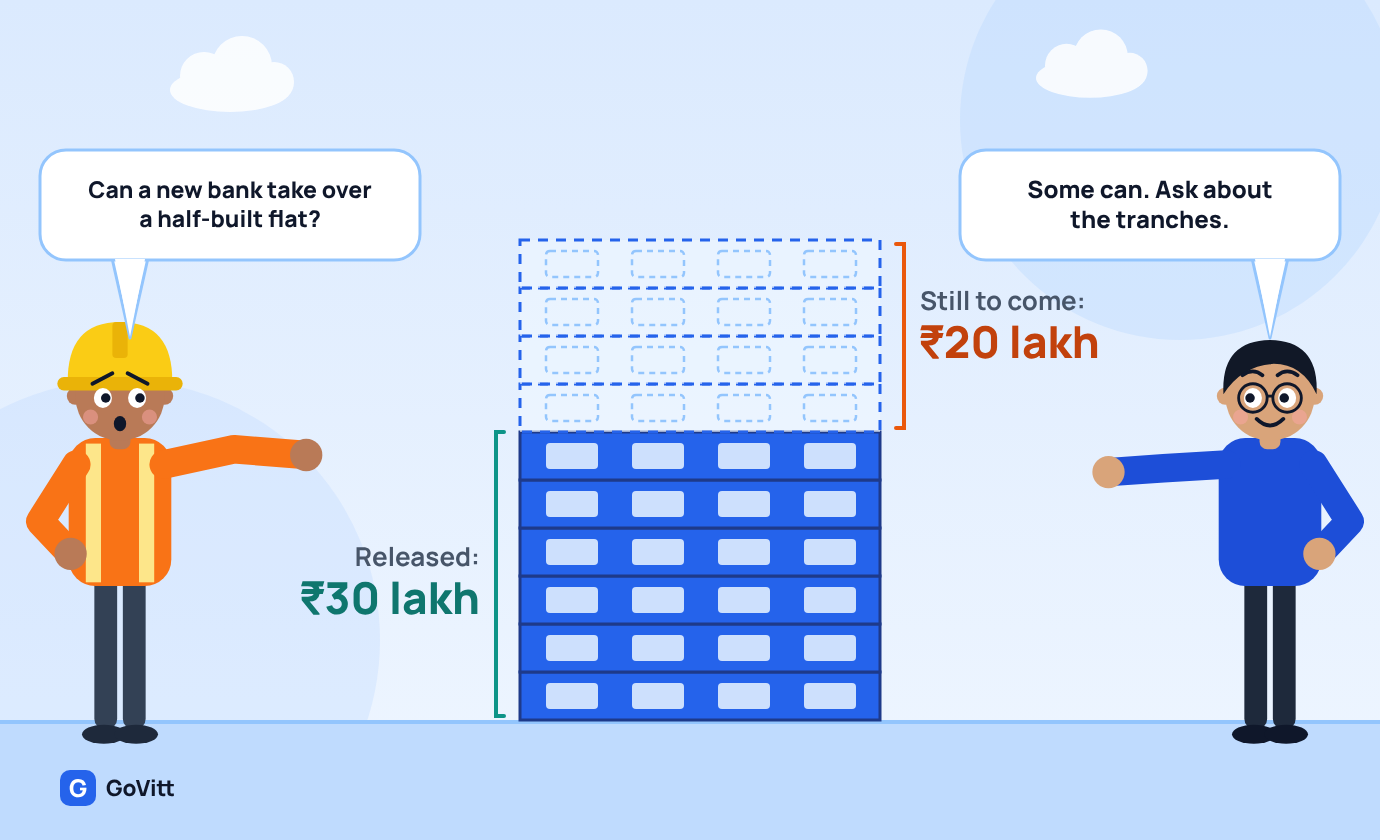
Sometimes. A balance transfer on an under-construction property is allowed by some lenders and not by others, and nearly all decide it case by case. HDFC Bank's FAQ says yes. L&T Finance says borrowers with under-construction properties are eligible, subject to approval. IIFL wants the approved plan and won't take a loan that has been disbursed while the registration is pending. ICICI Bank says eligibility depends on its policies and an evaluation of the property.
Say you have a ₹50 lakh sanction with ₹30 lakh drawn at 8.75%. You pay ₹21,875 a month in interest-only EMI today. At 7.50% it would be ₹18,750, and the saving grows to ₹3,906 a month once the full ₹50 lakh is out. Below: what each lender says, why a part-built flat is harder to move than a ready one, how a transfer would work, what it costs, and when to wait.
First, the honest part
I found no lender page that sets out the steps for taking over a part-disbursed loan. The "how it would work" section below is the lenders' own statements plus how tranche lending works, and I mark it as my reading. Two more limits:
See your real payoff date in 60 seconds
Banks calculate remaining EMIs by simple subtraction. See your actual payoff date and discover how much interest a balance transfer can save.
- The lender pages are undated. I read them on 1 November 2026. Treat each as a prompt to ask, not a promise.
- My one news source is old. Business Standard's piece on switching an under-construction loan is from 19 August 2013. It explains the risks well, and I use it only for that.
I also found nothing that says whether pre-EMI months count toward a lender's repayment rule. That's a question for the lender, and it's on the list near the end.
What lenders say about under-construction transfers
| Lender | What its page says | Repayment record asked |
|---|---|---|
| HDFC Bank | Its FAQ says yes to a balance transfer on a property that is still being built | "Consistent repayment record for a minimum of 12 months" |
| L&T Finance | "Borrowers owning under-construction properties are eligible", subject to approval and policy | Not stated; "good repayment history" |
| IIFL Home Finance | Needs a copy of the approved plan. If the loan is disbursed and the property registration is pending, "you will not be eligible" | At least 12 months of EMIs, with no defaults |
| ICICI Bank | "Eligibility depends on ICICI Bank's policies and property evaluation" | Not stated in months |
I haven't checked every lender. SBI, Axis, Canara, PNB and LIC are not in the table because I didn't find the question answered on the pages I used for my best banks post. Ask them in writing.
Why a half-built flat is harder to move than a ready one
- The security isn't finished. The new lender would be lending against a building that doesn't exist yet. ICICI's FAQ says its under-construction loans are disbursed as per the builder's construction milestones.
- A third party sits in the middle. Lenders often require a tripartite agreement between buyer, lender and builder when they finance an under-construction purchase (L&T Finance's guide, August 2026). In a transfer I'd expect the builder to be part of the new agreement. Business Standard (2013) says the builder's NOC may or may not be given, and that a builder may charge for a second one.
- The project matters, not just you. Business Standard reported in 2013 that a bank which hasn't approved the project may not allow the switch, and that an approved project running more than two years behind schedule may not qualify. An SBI official said the decision depends on the developer, the stage of construction and whether the project is on schedule. That is a 2013 view and I found nothing newer, so take it as a reason to ask, not as today's rule.
- Your repayment record is thin. HDFC Bank and IIFL both ask for 12 months. A private banker told Business Standard that borrowers who had paid only a fixed minimal amount may be turned away as high risk.
How it would work: my reading
No lender page lays this out for a transfer. Put together from what they do say, it would look like this:
- Ask first. Ask the new lender whether it has approved your project and takes part-disbursed transfers at all. Do this before you pay anything. L&T Finance lists a non-refundable login fee of up to ₹5,000 on its transfer page.
- Get the old lender's papers. You need a statement of what has been disbursed and a foreclosure letter. IIFL lists a foreclosure letter from the previous lender among its documents. The usual list is in documents required for home loan balance transfer.
- Get the builder's side. ICICI lists a builder NOC and a construction progress status letter among its disbursement documents.
- Wait for the valuation. The new lender values the flat at its stage of construction and checks the approved plan.
- Money moves in two steps. The new lender clears what the old lender has already released, then pays the rest in tranches as the builder sends demand letters at each stage (ICICI's description of how tranches work). The ready flat version of the process is in home loan transfer process: what actually happens, step by step.
Pre-EMI or full EMI: what your record shows
Until possession you pay either pre-EMI, which is interest only on what has been released, or a full EMI. HDFC Bank's page describes a "tranche based EMI" for under-construction purchases in the same way: interest only on the amount drawn until the final disbursement. What each choice costs you over 20 years is in pre-EMI or full EMI on your under-construction flat? Here's what that choice costs over 20 years.
For a transfer the question is the record. Both choices show on your statement. Ask the new lender, in writing, whether pre-EMI months count toward its 12 months.
The numbers: what a transfer saves, now and later
Base case: ₹50 lakh sanctioned, ₹30 lakh drawn, 8.75%, 20 years of EMI after the last tranche, Bengaluru. Before the final disbursement you pay interest only on the ₹30 lakh drawn.
| Stay at 8.75% | Move to 8.00% | Move to 7.50% | |
|---|---|---|---|
| Interest-only payment on ₹30 lakh drawn | ₹21,875 | ₹20,000 | ₹18,750 |
| Saving a month now | Nothing | ₹1,875 | ₹3,125 |
| EMI once the full ₹50 lakh is out | ₹44,186 | ₹41,822 | ₹40,280 |
| Saving a month then | Nothing | ₹2,364 | ₹3,906 |
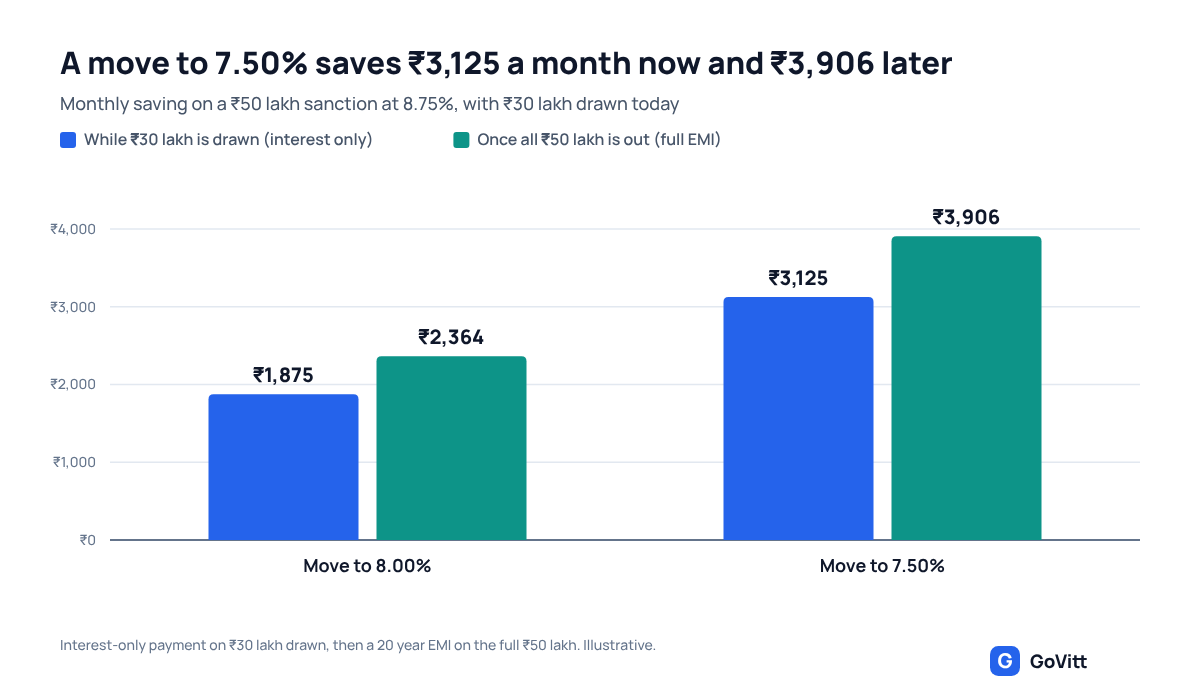
The saving starts smaller and grows with every tranche, because the interest-only payment follows what's drawn and not the ₹50 lakh sanctioned.
What the move costs, and when it pays back
On ₹50 lakh in Bengaluru, the shared charges come to ₹36,000 to ₹47,000: legal and valuation, mortgage stamp duty of 0.5%, registration and small charges. That is the same list as in home loan balance transfer charges. Mortgage stamp duty is worked on the sanctioned amount, so assume ₹25,000 of it falls on the full ₹50 lakh even though only ₹30 lakh is drawn, and confirm that with your lender. The lender's own fee comes on top, and that is where lenders differ most.
| Lender fee | All-in cost | Pays back at 7.50% | Pays back at 8.00% |
|---|---|---|---|
| A capped fee like SBI's (₹17,700) | ₹53,700 to ₹64,700 | 14 to 21 months | 23 to 35 months |
| HDFC Bank's maximum (₹29,500) | ₹65,500 to ₹76,500 | 17 to 25 months | 28 to 41 months |
| L&T Finance's ceiling: up to 3% of the sanctioned amount plus taxes (₹1,77,000) | ₹2,13,000 to ₹2,24,000 | 55 to 72 months | 91 to 120 months |
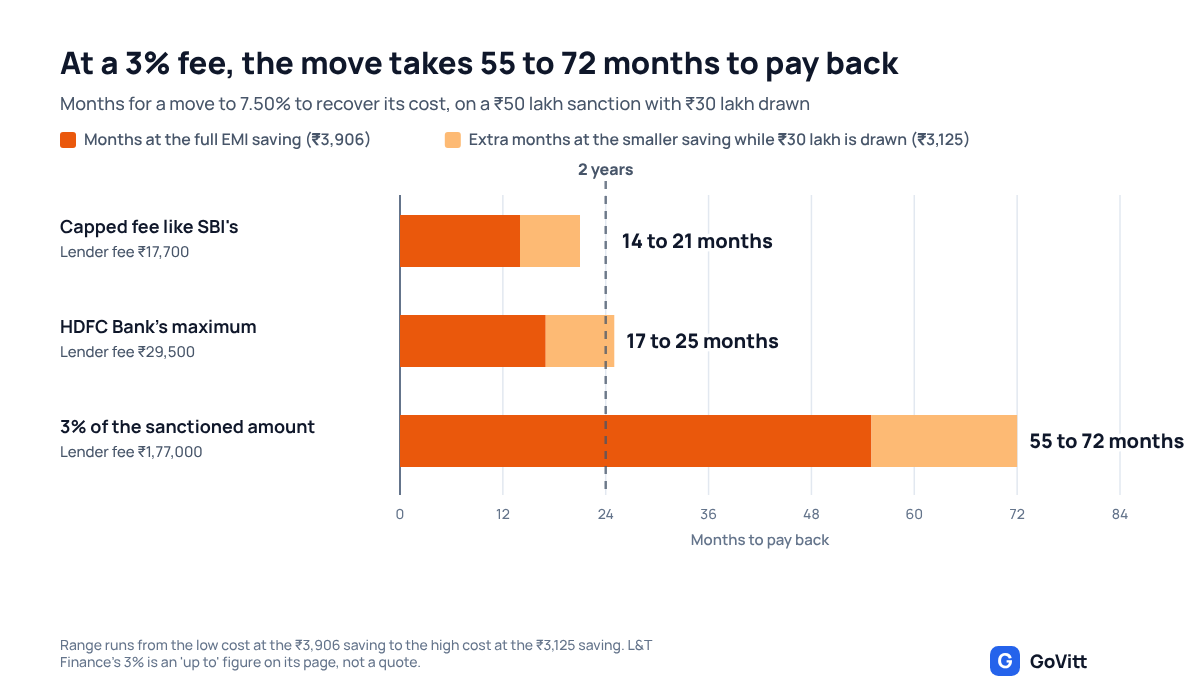
The payback range runs from the low cost at the full EMI saving to the high cost at the smaller saving you get while only ₹30 lakh is drawn. L&T's 3% is the "up to" figure on its page, before a login fee of up to ₹5,000 and a documentation fee of up to ₹2,000. A negotiated fee will be lower. It shows why you ask for the fee in rupees, and ask whether it's charged on the sanctioned amount or the disbursed amount, before you apply.
My two year rule from the other posts holds here: the costs should come back inside two years. At 7.50% the first two rows do. The third row doesn't come close. At 8.00%, only the cheapest fee gets near, at 23 to 35 months.
Ask your own lender first
Before any of this, ask your lender to reprice. The conversion fees in my best banks post are ₹3,540 at ICICI Bank and Axis Bank and ₹5,900 at SBI and HDFC Bank. I found no page that says whether a part-disbursed loan qualifies, so ask. From 8.75% to 8.25% the saving is ₹1,250 a month on the ₹30 lakh drawn and ₹1,583 on the full EMI. A ₹5,900 fee comes back in 5 months. If the lender refuses, you hold a written no to put next to a new lender's offer.
Wait, or move now?
- If the last tranche is a few months away, price the wait. Each month costs ₹3,125 in the 7.50% case. Waiting also gets you a completed, registered flat. IIFL says a loan with registration pending isn't eligible, and the ready flat route is the one in the BT process post.
- If you've paid fewer than 12 months, wait. HDFC Bank and IIFL both ask for 12. The timing question is in how soon can you transfer a home loan, and when is it too late to bother?
- If the project is already late, move soon or not at all. A lender can refuse a project that is far behind schedule, per the 2013 article.
- If the gap is under 0.50%, skip the transfer and ask your own lender.
What to ask the new lender, in writing
- Do you take part-disbursed under-construction loans, and is my project approved?
- Is the processing fee charged on the sanctioned amount or on the amount disbursed?
- Do my pre-EMI months count toward your repayment record?
- Which documents do you need from the builder, and who pays for the new tripartite agreement?
- How are the undisbursed tranches released, and how long does each take?
- What rate and spread will you give me for my score, and when does the quote expire?
What I'd do this week
- Pull your loan statement. Note the sanctioned amount, what has been disbursed, the months paid and your rate.
- Find your gap. Compare your rate with what you could get. The Payoff & Transfer Calculator gives the break-even once you have a quote.
- Ask your own lender to reprice, and ask what the fee is.
- If the gap is 0.75% or more, send the six questions above to two lenders.
- Ask the builder whether they will sign with another lender, and what they charge for an NOC.
- Decide on the payback. If the costs take more than two years to come back, wait or stay.
FAQ
Can you do a balance transfer on an under-construction property? Sometimes. HDFC Bank and L&T Finance say yes in their FAQs, IIFL considers it with an approved plan, and ICICI Bank says it depends on its policies and an evaluation of the property. Each decides case by case.
Can I transfer a home loan if the flat isn't registered? IIFL says a loan that has been disbursed with the property registration pending is not eligible for a transfer. Other lenders don't spell it out. Ask whether registration has to be done before you apply.
How long must I have paid EMIs before a transfer? HDFC Bank asks for a consistent record for at least 12 months, and IIFL for at least 12 months of EMIs with no defaults. I found no page that says whether pre-EMI months count.
What does a home loan transfer on an under-construction flat cost? The same charges as any transfer, ₹53,700 to ₹76,500 on ₹50 lakh in my examples, and more if a lender's fee is high. Mortgage stamp duty is worked on the sanctioned amount, so confirm it with the lender. L&T Finance's page lists a fee of up to 3% of the sanctioned amount.
Does the builder have to agree to a transfer? Lenders often require a tripartite agreement and a builder NOC for an under-construction loan. A builder can refuse, or charge for a second NOC, as Business Standard noted in 2013. Ask your builder early.
Not sure whether your lender will take it? Talk to an advisor on WhatsApp with your sanctioned amount, the amount disbursed, your rate and your builder's name. GoVitt compares 50+ banks and charges you 0% commission.
Lender pages read on 1 November 2026; none of them carries a date. EMIs and interest-only payments use the standard method and are rounded to the nearest rupee; the example assumes ₹30 lakh drawn of a ₹50 lakh sanction at 8.75% and a 20 year EMI after the last tranche. Cost ranges use the shared charges in GoVitt's balance transfer charges post and the lender fees named in the table. L&T Finance's 3% is the "up to" figure on its page, not a quote. Business Standard's article is from 2013. Your lender's rules, rate and charges will differ. Check your sanction letter and ask for every figure in writing.
Ready to take the next step?
Find out your loan options and check your eligibility with GoVitt today.