
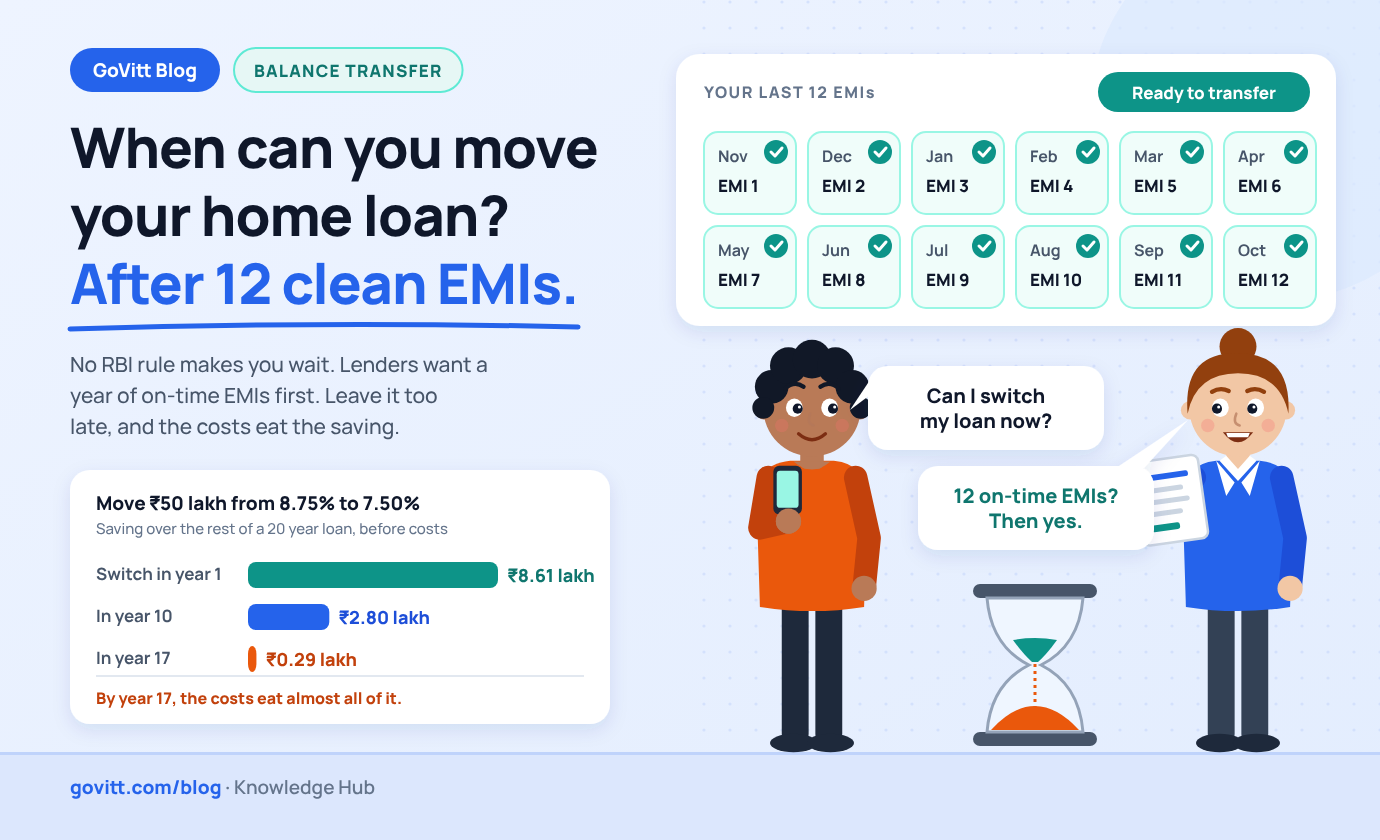
When can I transfer my home loan? In practice, after about 12 months of on-time EMIs. No RBI rule makes you wait, and your old bank can't charge you for leaving a floating rate loan. The waiting rule comes from the new lender, which wants to see a year of clean repayments before it takes you on. HDFC Bank asks for 12 months. ICICI Bank says 12 to 18.
The other half of the question matters more. Take ₹50 lakh over 20 years at 8.75%. Move it to 7.50% after year 1, and you save about ₹8.61 lakh over the rest of the loan. Wait until year 15, and the saving is ₹77,000 before costs, which take ₹28,000 to ₹39,000 of it. Wait until year 17, and you roughly break even.
So the window opens at month 12 and slowly closes after that. Below: what lenders ask for, what your old bank can and can't do, and the point where a transfer stops being worth the paperwork.
See your real payoff date in 60 seconds
Banks calculate remaining EMIs by simple subtraction. See your actual payoff date and discover how much interest a balance transfer can save.
The short answer
| Question | Answer |
|---|---|
| Is there an RBI minimum period? | I couldn't find one. The rule comes from the lender you're moving to |
| What most lenders want | 12 months of regular EMIs. HDFC Bank: 12 months. ICICI Bank: 12 to 18 months |
| Pre-approved transfer offers | ICICI asks for a 24 month repayment record |
| Can your old bank charge you for leaving? | Not on a floating rate home loan taken by you as an individual |
| Smallest loan worth moving | ICICI's minimum transfer is above ₹15 lakh. Others vary |
| When it's usually too late | With a 1.25% gap, when fewer than about 5 years are left. With a 0.50% gap, the costs never come back inside two years, at any stage |
Why lenders want 12 months first
A new lender taking over your loan is buying your repayment record. Your old loan statement is the main evidence it has. So the rule is about proof, not about time:
- HDFC Bank says you qualify for a transfer if you have a consistent repayment record of at least 12 months on your existing loan.
- ICICI Bank says you can apply after paying EMIs for 12 to 18 months, with a minimum CIBIL score of 700 if you're salaried and 750 if you're self-employed. For its pre-approved transfer offer, it asks for 24 months.
- L&T Finance puts it plainly on its own guide: lenders typically want at least 12 months of repayment, with no missed EMIs.
"Regular" means no bounced EMI, no late payment and no overdue in that period. One bounce in month 10 can push you back to month 22. If that's you, wait for a clean 12 months rather than apply and collect a rejection. A rejected application still leaves an enquiry on your report, which I explained in does a home loan balance transfer hurt your CIBIL score?
The paperwork also needs those months. Most lenders ask for your loan account statement covering the last 12 months. The full list is in documents required for home loan balance transfer.
Home loan transfer after 1 year: what you've already lost
Nothing you can get back, and nothing that should stop you. The processing fee you paid on the first loan is gone either way. What you pay again on a transfer is the new lender's fee, legal and valuation charges, and stamp duty on the new mortgage. On ₹50 lakh in Bengaluru that's about ₹53,700 to ₹64,700 with a lender that caps its fee at ₹15,000, line by line in home loan balance transfer charges.
That's why year 1 to year 3 is the best time to move, if the gap is real. You pay the costs once and collect the saving on almost the whole balance, for almost the whole tenure.
Can your old bank stop you?
It can't charge you. Under RBI's Pre-payment Charges on Loans Directions, 2025, lenders cannot levy a pre-payment charge on a floating rate loan given to an individual for a non-business purpose, whatever the source of the money and whatever lock-in the agreement mentions. That applies to loans sanctioned or renewed from 1 January 2026. Floating rate home loans taken before that were already covered by RBI's earlier circulars.
Some lender pages still talk about a "lock-in" of 6 to 12 months. ICICI's balance transfer page does. On a floating rate home loan in your own name, that can't mean a fee for leaving. What it means in practice is the new lender's track record rule.
Two exceptions to watch:
- A fixed rate loan, or a loan in a fixed phase, can carry a foreclosure charge. Read your sanction letter.
- A loan taken for business purposes follows different rules. A home loan for the home you live in isn't one.
What the old bank can do is be slow. The foreclosure letter, the list of original documents and the hand-over of papers are where transfers stall. Once you've paid off the loan, RBI requires the lender to return your original property documents within 30 days, or pay you ₹5,000 for each day of delay that's its fault. Where each step tends to get stuck is in home loan transfer process: what happens, step by step.
When is it too late?
Here's why the window closes. Early EMIs are mostly interest. On ₹50 lakh at 8.75% over 20 years, your first EMI of ₹44,186 is ₹36,458 interest and ₹7,727 principal. By EMI number 181, the interest part is down to ₹15,612. A lower rate only saves you money on the interest part, so the later you move, the less there is to save. The costs don't shrink nearly as fast.
Here's the same loan, moved from 8.75% to 7.50% at different points, keeping the remaining tenure the same:
| Years already paid | Balance left | Months left | Saving a month | Total saving, rest of loan | All-in cost | Pays back in | Net saving |
|---|---|---|---|---|---|---|---|
| 1 | ₹49.03 lakh | 228 | ₹3,777 | ₹8.61 lakh | ₹53,121 to ₹64,121 | 15 to 17 months | ₹7.97 to ₹8.08 lakh |
| 3 | ₹46.83 lakh | 204 | ₹3,502 | ₹7.14 lakh | ₹51,799 to ₹62,799 | 15 to 18 months | ₹6.52 to ₹6.63 lakh |
| 5 | ₹44.21 lakh | 180 | ₹3,202 | ₹5.76 lakh | ₹50,226 to ₹61,226 | 16 to 20 months | ₹5.15 to ₹5.26 lakh |
| 8 | ₹39.31 lakh | 144 | ₹2,703 | ₹3.89 lakh | ₹45,822 to ₹56,822 | 17 to 22 months | ₹3.32 to ₹3.43 lakh |
| 10 | ₹35.26 lakh | 120 | ₹2,336 | ₹2.80 lakh | ₹41,715 to ₹52,715 | 18 to 23 months | ₹2.28 to ₹2.39 lakh |
| 12 | ₹30.43 lakh | 96 | ₹1,938 | ₹1.86 lakh | ₹36,825 to ₹47,825 | 19 to 25 months | ₹1.38 to ₹1.49 lakh |
| 15 | ₹21.41 lakh | 60 | ₹1,283 | ₹0.77 lakh | ₹27,689 to ₹38,689 | 22 to 31 months | ₹0.38 to ₹0.49 lakh |
| 17 | ₹13.95 lakh | 36 | ₹805 | ₹0.29 lakh | ₹20,127 to ₹31,127 | 26 to 39 months | A loss of ₹2,000 to a gain of ₹9,000 |
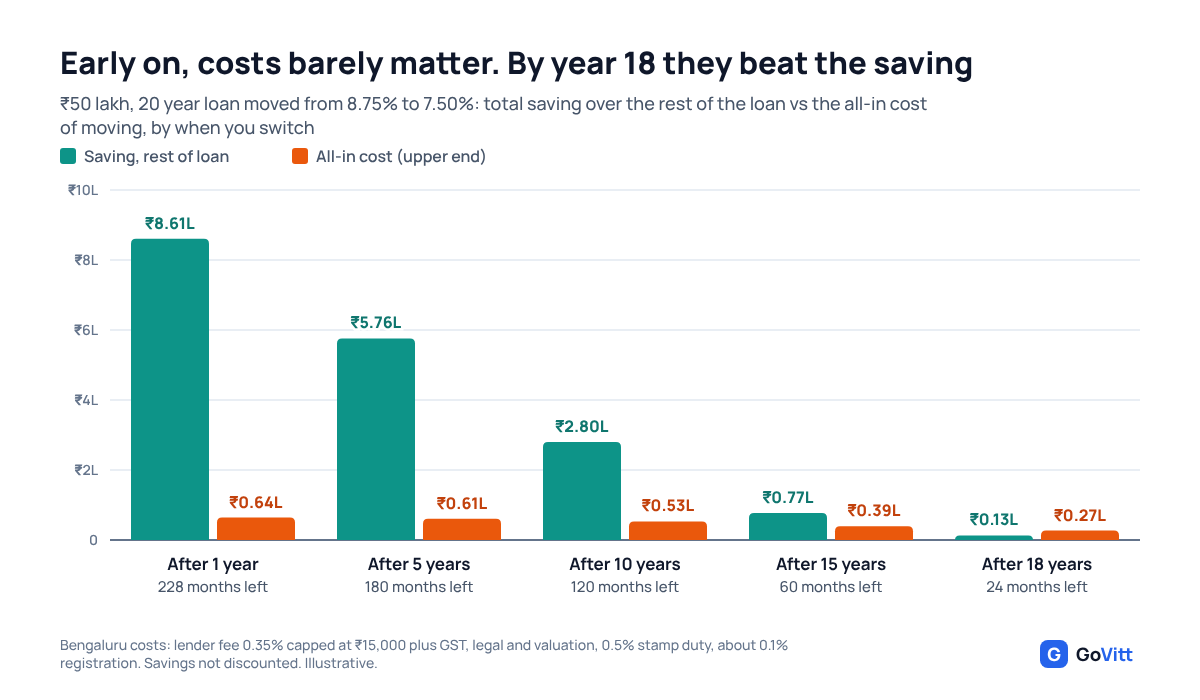
Costs here are a Bengaluru transfer: the new lender's fee at 0.35% capped at ₹15,000 plus GST, legal and valuation of ₹5,000 to ₹15,000, Karnataka stamp duty of 0.5% on the mortgage, registration of about 0.1% and ₹1,000 to ₹2,000 of small charges. The example assumes your rate stayed at 8.75% the whole time, which real loans rarely do. Use it for the shape, then run your own numbers.
And with a smaller gap
Most people asking this question aren't 1.25% above the market. They're 0.50% above it. Same loan, moved from 8.75% to 8.25%:
| Years already paid | Saving a month | Total saving, rest of loan | Pays back in | Net saving |
|---|---|---|---|---|
| 1 | ₹1,530 | ₹3.49 lakh | 35 to 42 months | ₹2.85 to ₹2.96 lakh |
| 5 | ₹1,296 | ₹2.33 lakh | 39 to 48 months | ₹1.72 to ₹1.83 lakh |
| 10 | ₹943 | ₹1.13 lakh | 45 to 56 months | ₹0.60 to ₹0.71 lakh |
| 12 | ₹781 | ₹0.75 lakh | 48 to 62 months | ₹0.27 to ₹0.38 lakh |
| 15 | ₹516 | ₹0.31 lakh | 54 to 75 months | A loss of ₹8,000 to a gain of ₹3,000 |
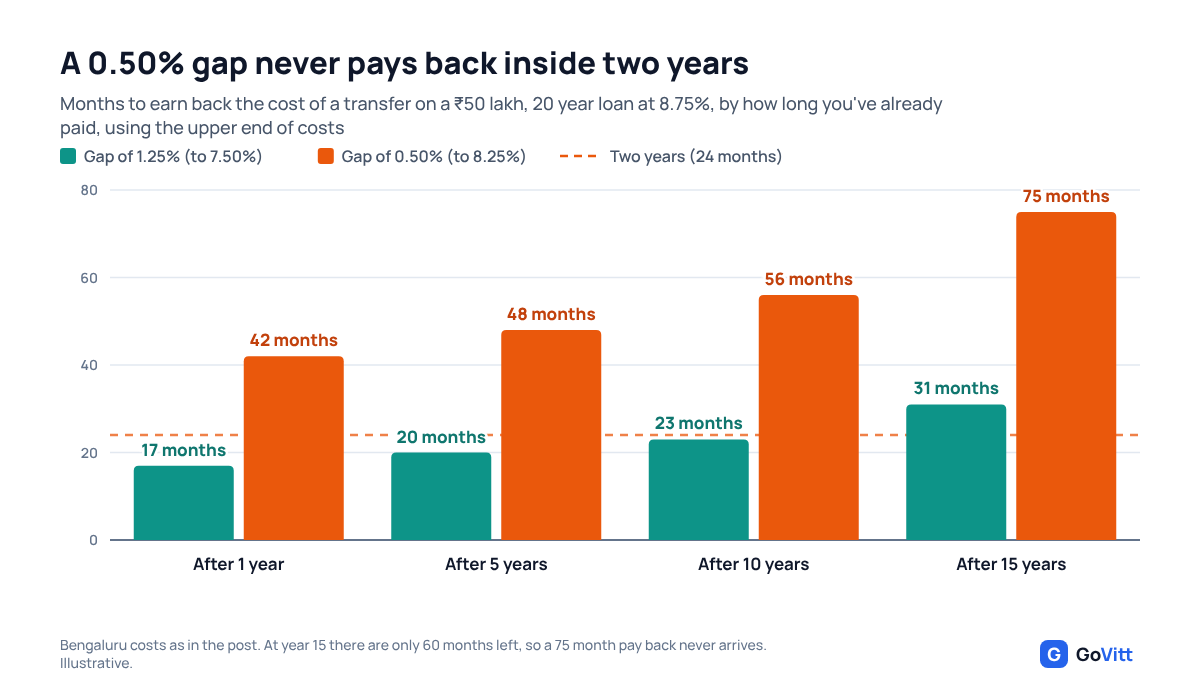
Even in year 1, a 0.50% gap takes three years or more to pay back the costs. That's a long time to bet on rates and on not moving house.
The rule I use
The costs should come back in under two years, and you should have at least twice that long left on the loan. Applied to the tables:
- Gap of 1% or more: worth moving from month 12 until roughly year 12 of a 20 year loan. After year 15, it isn't.
- Gap of about 0.75%: borderline. In year 1 the costs take 24 to 29 months to come back on this loan, so it only works if your costs land at the low end and you'll keep the loan for years.
- Gap of 0.50% or less: don't transfer. Reprice with your own bank instead.
If you're not sure how many years you really have left, check before you decide. Past rate hikes may have stretched your tenure, which I showed in you think 15 years are left on your home loan, the math says 18.
When it's too late to transfer, reprice instead
Late in a loan, the cheap move is to ask your own bank to put you on its current rate. There's no new mortgage, so no stamp duty, no valuation and no legal fee. ICICI and Axis charge ₹3,540 with GST for this on a ₹50 lakh loan, and SBI and HDFC ₹5,900.
At year 15 in the example, with ₹21.41 lakh left, moving from 8.75% to 7.50% saves ₹1,283 a month. A ₹5,900 fee is back in 5 months. The same move as a transfer takes 22 to 31 months to pay back. Same saving, a fraction of the cost.
And whatever stage you're at, prepaying works too. A floating rate home loan has no prepayment charge, and every rupee you prepay late in the loan cuts interest at your full rate.
Special cases
- Your flat is still under construction. If the loan isn't fully disbursed, ask the new lender first whether it takes over partly disbursed loans and how it handles the remaining payments to the builder. Don't assume the 12 month rule is the only hurdle.
- You've already transferred once. ICICI says a borrower can transfer a home loan more than once. Expect the next lender to look at the record on your current loan, so a second move soon after the first is harder. Ask before you apply.
- Your balance is small. Below about ₹15 lakh, some lenders won't take it (ICICI's minimum is above ₹15 lakh), and the fixed costs eat a bigger share. Reprice or prepay.
- You missed an EMI recently. Wait until you have 12 clean months, then apply.
What I'd do this week
- Count your clean EMIs. Open your loan statement and check the last 12 months for any bounce or late payment.
- Find your gap. The rate on your statement minus the rate you'd realistically get. Our list of best banks for home loan balance transfer shows what each lender publishes.
- Find your real months left and your outstanding balance, from the same statement.
- Read the tables above. If your gap is under 0.50%, or you have fewer than 5 years left, go to step 5. Otherwise skip to step 6.
- Ask your own bank to reprice, in writing, quoting a lower rate you've been offered.
- Run the transfer through the calculator with your real numbers and costs. I did one full worked example with charges in still paying 8% or more on your home loan? I did the math on shifting ₹50 lakh to 7.20%.
FAQ
When can I transfer my home loan? Most lenders want at least 12 months of on-time EMIs on your current loan. HDFC Bank asks for 12 months and ICICI Bank for 12 to 18 months. There's no RBI minimum period, and your old bank can't charge you for closing a floating rate home loan.
Can I transfer my home loan after 1 year? Yes, if all 12 EMIs were paid on time. This is the best time to move if your rate is at least 1% above what you'd get elsewhere. On ₹50 lakh at 8.75%, moving to 7.50% after year 1 saves about ₹8 lakh over the rest of a 20 year loan, after costs.
What is the minimum time for home loan balance transfer? About 12 months of repayment at most lenders, sometimes 12 to 18. Pre-approved transfer offers can ask for more. ICICI asks for 24 months for its pre-approved transfer.
Can my bank charge me for transferring my home loan? Not on a floating rate home loan taken by an individual for a non-business purpose. RBI bars pre-payment and foreclosure charges on these. A fixed rate loan can carry a charge, so check your sanction letter.
Is it worth transferring a home loan with 5 years left? Only with a large gap. On a ₹50 lakh, 20 year loan at 8.75%, moving to 7.50% with 5 years left nets ₹38,000 to ₹49,000 after costs. With a 0.50% gap, you'd roughly break even. Asking your own bank to reprice usually beats a transfer at this stage.
Check your own timing. Run the Payoff & Transfer Calculator with your balance, rate and months left. How the whole switch works is on our home loan balance transfer page. GoVitt compares 50+ banks and charges you 0% commission.
Lender rules as published on 27 October 2026. The example is a ₹50 lakh, 20 year loan at 8.75% throughout, moved to 7.50% or 8.25% with the remaining tenure unchanged. Costs assume a Bengaluru property and a lender fee of 0.35% capped at ₹15,000 plus GST. EMIs use the standard monthly reducing balance method and are rounded to the nearest rupee. Savings are simple totals, not discounted. Your rate, balance and costs will differ. Check your loan statement and the new lender's sanction terms before you act.
Ready to take the next step?
Find out your loan options and check your eligibility with GoVitt today.