
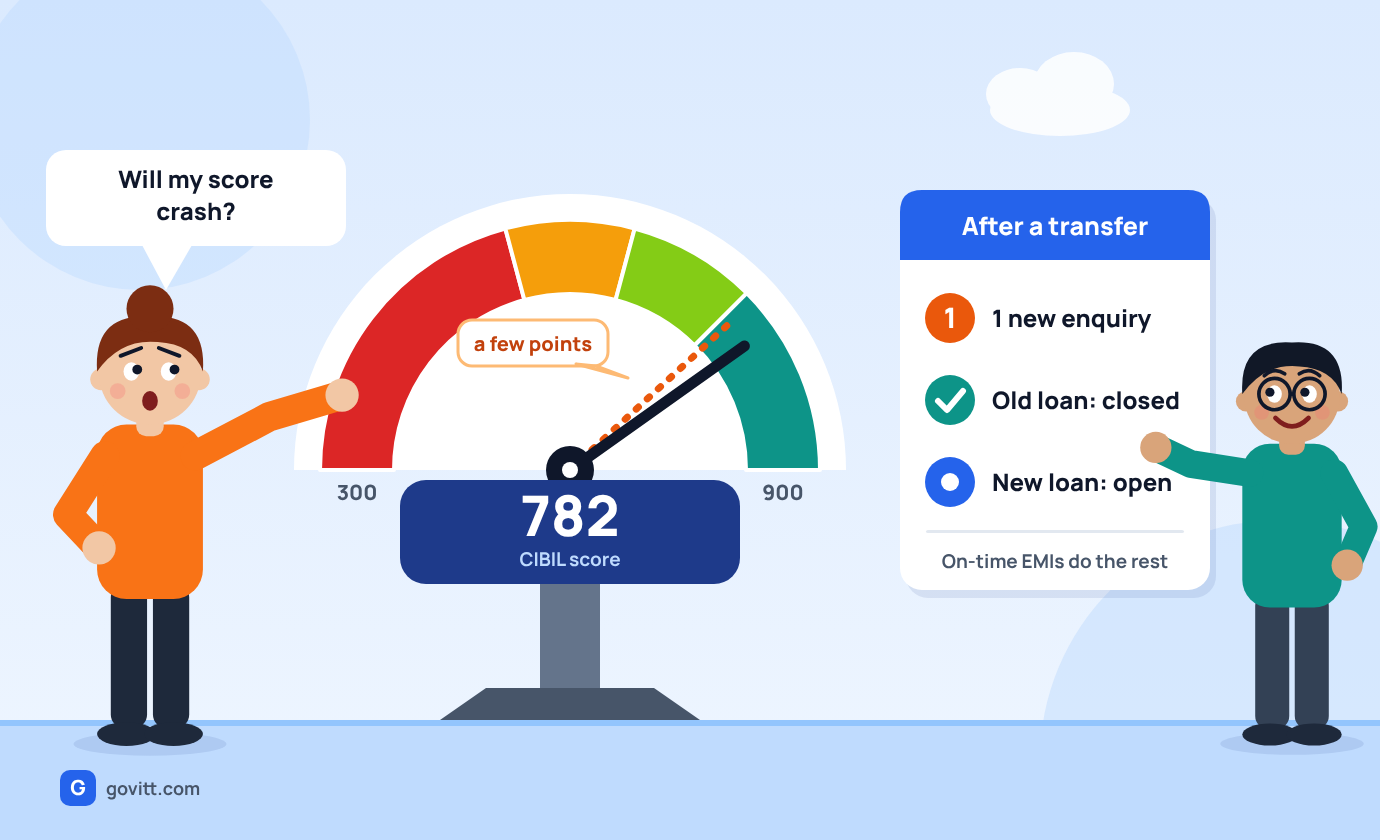
Does a balance transfer affect your CIBIL score? Yes, a little, and for a short while. A home loan transfer puts one new enquiry, one new loan and one closed loan on your report. For a borrower who pays on time, that usually costs a few points.
What can cost you far more is a missed EMI during the handover, or an old loan that still shows as open after you've closed it. Below: what lands on your report and when, how big the dip is, the three things that really hurt, and how to check it all 45 days later.
See your real payoff date in 60 seconds
Banks calculate remaining EMIs by simple subtraction. See your actual payoff date and discover how much interest a balance transfer can save.
First, the honest part about points
I can't give you a points number, and neither can anyone else. No bureau publishes a standard drop per enquiry. Ujjivan Small Finance Bank's guide says there is "no universally fixed number of points" and warns against online claims of a set figure. Paisabazaar says a refinance usually lowers your score "only by a few points". CIBIL itself says enquiries "have minimal impact on your CIBIL score".
So if someone tells you "a transfer costs exactly 15 points", they're guessing. What I can do is show you what changes on your report, and which changes matter.
What lands on your report, step by step
| Step | What your CIBIL report shows | Effect on your score |
|---|---|---|
| You apply to the new lender | An enquiry, with the lender's name, the date, and the loan type and size | A small, temporary dip |
| The new lender pays off your old loan | The old loan is reported as closed. Per CIBIL, closed loans normally stay on your report | Neutral if every EMI was paid on time |
| The new loan starts | A new account with a new "date opened" | Lowers the average age of your accounts a little |
| Every EMI after that | On time or late | This is the part that keeps adding points, or costs them |
What a transfer does to the five things CIBIL scores
CIBIL says five factors make up your score: payment history, credit utilisation, length of credit history, credit mix and new credit.
| Factor | What a transfer does | Effect |
|---|---|---|
| Payment history | The old loan's record stays on your report. The new loan starts clean. Your next EMIs decide the rest | None, if you never miss one |
| Credit utilisation | This is mostly about how much of your card limits you use. A home loan transfer doesn't touch it | None |
| Length of credit history | The new account lowers the average age of your accounts a little. The old loan's history stays on the closed account | Small |
| Credit mix | You still have one home loan, so your mix of loans and cards doesn't change | None |
| New credit | One enquiry and one new account | Small and temporary |
How long does the dip last?
Sources differ, so here's what each says.
- How long an enquiry stays visible: Bajaj Housing Finance and Paisabazaar say up to 2 years. Ujjivan Small Finance Bank says up to 36 months. CIBIL's public pages don't give one number.
- How long it affects your score: Ujjivan says the effect is strongest soon after the enquiry and fades over time. Paisabazaar says it typically lasts a few months, and that the full impact, including the lower account age, normalises within 12 to 18 months.
My read: plan in months, not weeks. If you have another big application coming, such as a car loan or a second property, finish that first or wait a few months after the transfer.
The three things that really hurt
1. A missed or late EMI during the handover
This is the one that does real damage. Paisabazaar warns that a single missed EMI during the transition can significantly hurt your score. It tends to happen by accident: your old EMI falls due while the old loan is being paid off, or the new loan's first EMI date arrives before the auto-debit is set up.
How to avoid it:
- Keep paying the old EMI until the old lender confirms the loan is closed. Cancel the old auto-debit only after that.
- Ask the old lender for the foreclosure letter with the per-day interest figure. The payoff amount changes daily, and the letter has a validity date.
- Set up the new auto-debit before the first EMI is due. The first EMI may be a broken-period amount, so check it.
The full handover sequence is in home loan transfer, step by step.
2. Five applications instead of one
Every formal loan application is a hard enquiry. Checking your own score, a lender's pre-approved offer check and your own bank's routine review are soft, and don't count, according to Paisabazaar. I couldn't find an Indian bureau rule that treats several home loan applications made close together as one, so assume each application counts.
So don't apply to five banks to see who's cheapest.
- Pull your own CIBIL report first. It's a soft check, and CIBIL gives you a free report every year.
- Get indicative rates without a formal application. Ask every lender or app whether its check is hard or soft before you give consent.
- Shortlist two lenders, then apply to both in the same week.
RBI's January 2025 credit reporting directions also require the bureaus to alert you by SMS or email when a lender's enquiry appears on your report. If you get one you don't recognise, check it.
3. The old loan that still shows as open
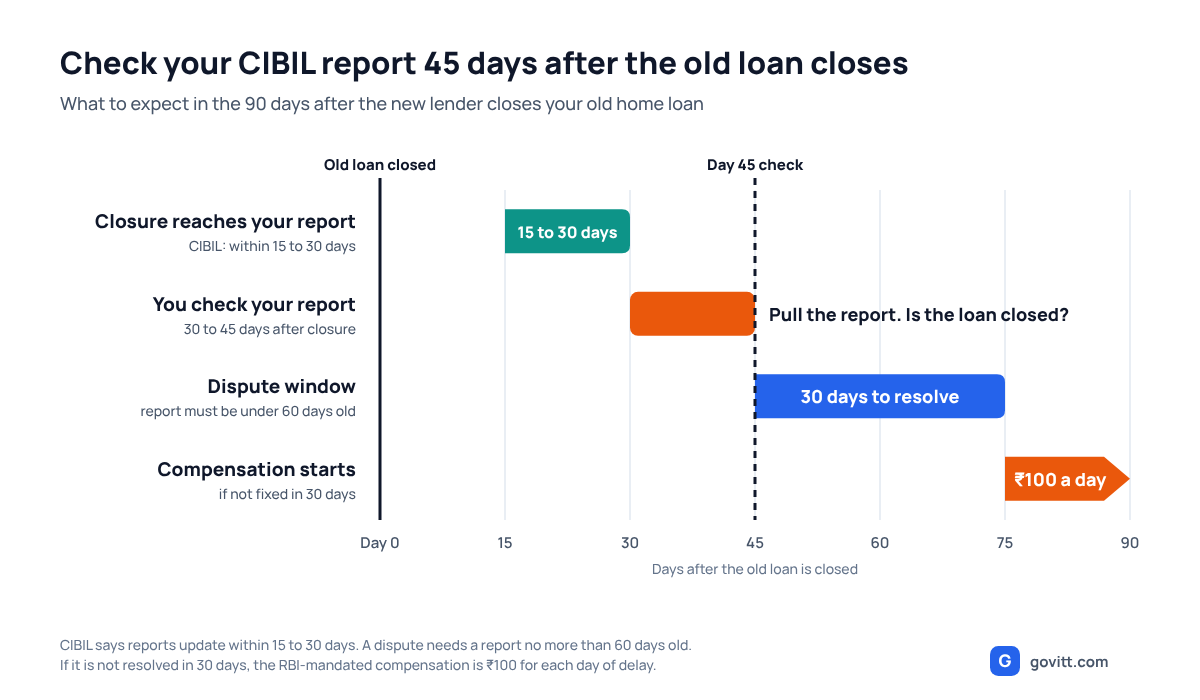
After your old loan is closed, its status should change to closed with a zero balance. This depends on the old lender reporting it. CIBIL says reports update within 15 to 30 days. RBI's directions that took effect in 2025 ask lenders to report on a fortnightly cycle, as of the 15th and the last day of each month, and to send the data to the bureaus within 7 days.
So give it time, then check. Pull your report 30 to 45 days after the closure date. If the old loan still shows an outstanding balance or an active status:
- Write to the old lender with your closure letter attached, and ask it to send corrected data to the bureau.
- If the report still shows it, raise a dispute with CIBIL. Your report must be no more than 60 days old when you file. You can file through the dispute form in your CIBIL account, by email to CIBILinfo@transunion.com, by phone, or at the CIBIL office. The disputed fields show as "Under Dispute".
- Attach proof. CIBIL doesn't list which documents it accepts, so I'd send the closure letter or no-dues certificate and the foreclosure statement.
- If it isn't fixed in 30 days, CIBIL says you're owed RBI-mandated compensation of ₹100 for every day of delay.
When a few points can matter: rate slabs
A few points are nothing for most people. They matter only if you're sitting just above a rate slab.
Lenders price you on the score they see when they pull your report. A new lender's own enquiry can't lower the score it has already pulled. But it can lower the score a second lender sees if you apply a few days later, and so can a credit card or car loan application you make after the transfer.
How much a slab is worth depends on the lender. LIC Housing Finance's grid is fine-grained: its published rate for salaried borrowers up to ₹50 lakh is 7.45% for a score of 750 to 774, 7.65% for 725 to 749, and 7.95% for 700 to 724. At PNB (as of 12 October), the step from the 750 to 799 band down to 700 to 749 is 0.55%, about ₹1,700 a month on ₹50 lakh. I've covered the bands in how your CIBIL score moves your rate.
Here's a stress test, not a forecast. Say you pay 8.75% on ₹50 lakh with 20 years left, and a transfer would put you at LIC's 7.45%. If the dip pushed you down one slab, or even two, the transfer would still save you money.
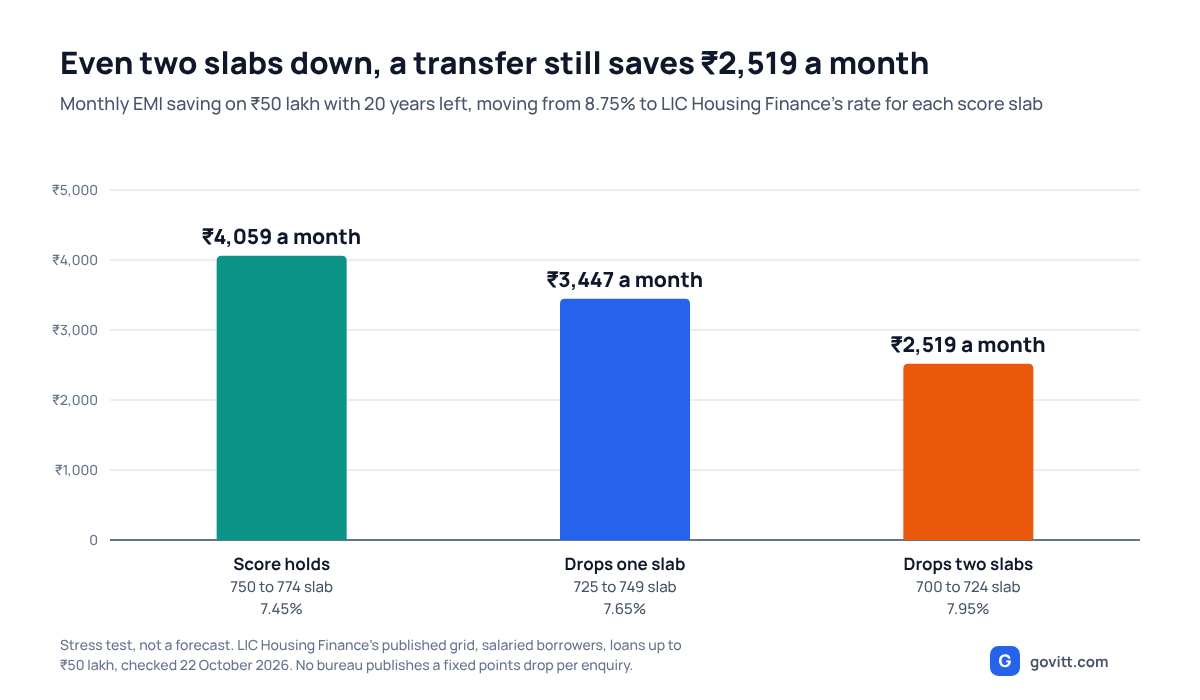
Even in the two-slab case, you'd save ₹2,519 a month. And one hard enquiry on its own is "a few points", not two slabs. The slab problem is real only if you're within a few points of the edge. If you are, check your score before you apply, and keep other applications out of the way.
Should you delay a transfer because of your score?
- Your score is above 750 and your gap is 1% or more. Don't delay. A few points for a few months against ₹3,000 or more a month is an easy trade.
- You have another loan application coming in the next few months. Do the more important one first. If it's the transfer, do it first. If it's a car loan or a second home, finish that application before you start the transfer.
- Your score is below 700. The question isn't the dip. It's that your new rate may be much higher than the headline rates, so the real gap is smaller. At LIC, for example, 600 to 699 is 8.75% and below 600 is 9.55%. Fix the score first. Here's how: can I get a home loan with a 650 CIBIL score.
What I'd do this week
- Pull your free CIBIL report and note your score and the status of every loan.
- Check the rate slab you're in. If you're within about 10 to 15 points of the edge, hold off on other applications.
- Get indicative rates from two lenders without a formal application.
- Apply to both in the same week, then choose.
- Keep paying your old EMI until the old lender confirms closure in writing.
- Set up the new auto-debit before the first EMI date.
- Pull your report at 30 days and again at 45 days after closure. The old loan should say closed, with a zero balance.
- If it doesn't, dispute it with the closure letter and the foreclosure statement.
Our home loan balance transfer page shows how the move works end to end. GoVitt compares 50+ banks and charges you 0% commission.
FAQ
Does a balance transfer affect your CIBIL score? Yes, a little. A home loan transfer adds one enquiry from the new lender, a new loan account, and a closed old account. For a borrower with a clean payment record, that usually costs a few points for a few months. A missed EMI during the handover costs far more.
How many points does a home loan balance transfer reduce? There is no fixed number. No bureau publishes a standard drop per enquiry, and one bank guide says there is "no universally fixed number of points". Paisabazaar says a refinance usually lowers your score "only by a few points". The bigger risks are a missed EMI and several applications in a short time.
Will my old home loan stay on my CIBIL report after it's closed? CIBIL says closed loans normally stay on your report as lenders report them. It should show as closed with a zero balance. Pull your report 30 to 45 days after closure. If it still shows as active, send your closure letter to the old lender and raise a dispute with CIBIL.
How long does it take for my score to recover after a balance transfer? Sources differ. Paisabazaar says the enquiry's effect typically lasts a few months and fades significantly after 12 months, with the full effect, including the lower account age, normalising in 12 to 18 months. On-time EMIs on the new loan help most.
Can I transfer my home loan with a low CIBIL score? You can apply, but the rate you're offered depends on your score. At LIC Housing Finance, a score of 700 to 724 gets 7.95% and 600 to 699 gets 8.75%, against 7.15% for 825 and above. A lower score can shrink or wipe out the saving, so run the numbers before you apply.
Not sure where your score stands, or whether a transfer still pays? Talk to an advisor (free, WhatsApp). GoVitt compares 50+ banks and charges you 0% commission.
This post explains how a balance transfer is reported and is general information, not credit advice. The effect on your score depends on your own report. Lender rates are as published on 22 October 2026. EMI savings use the standard monthly reducing balance method on ₹50 lakh with 20 years left.
Ready to take the next step?
Find out your loan options and check your eligibility with GoVitt today.