
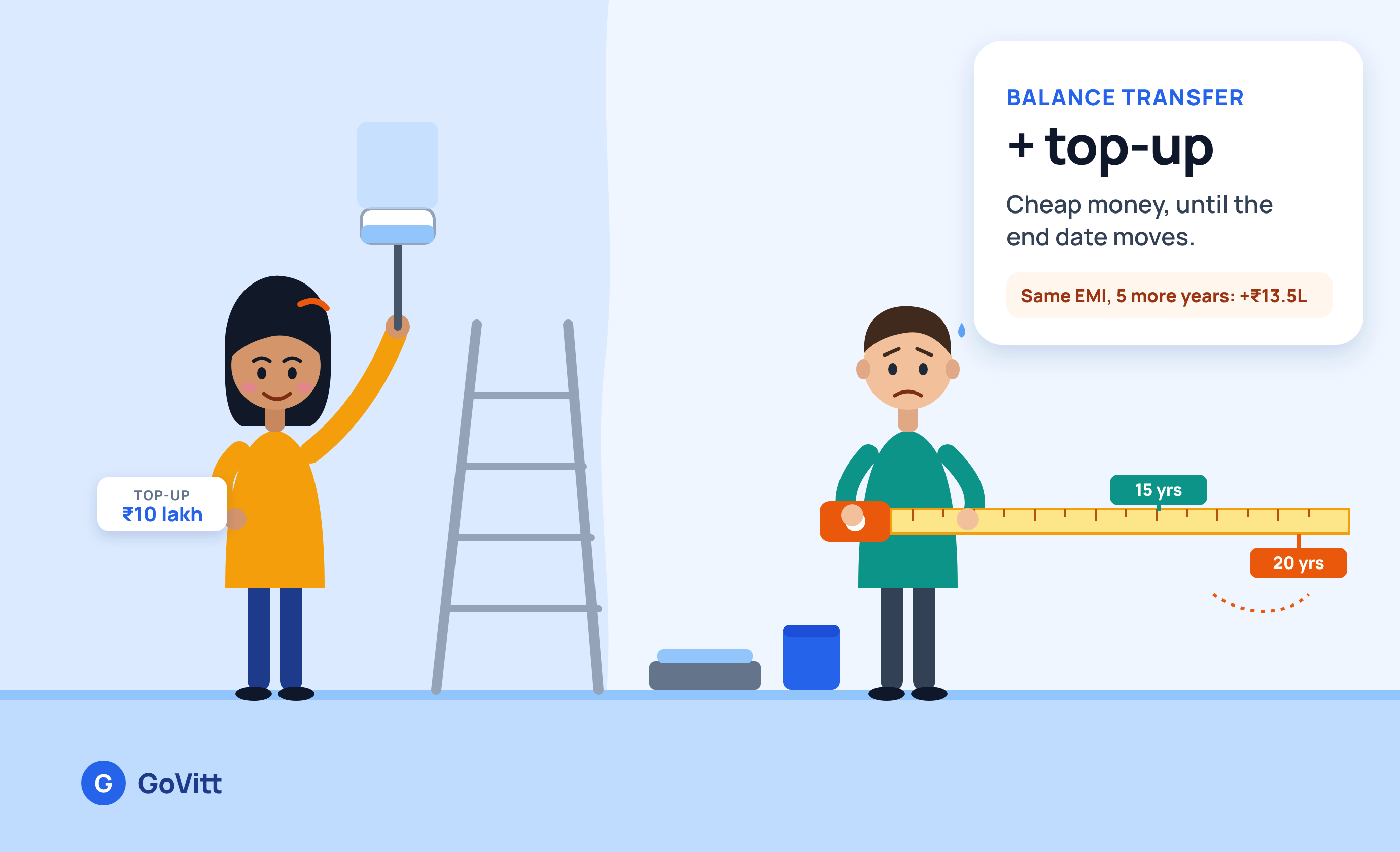
You're moving your home loan to a cheaper bank. The new bank's sales person asks the question they always ask: "Do you need any extra funds? We can add a top-up."
It sounds like free money. The rate is close to a home loan rate, far below a personal loan. And because you're switching anyway, the paperwork is already happening.
Here's the catch. A home loan balance transfer and top-up done the wrong way can cost you more than the transfer saves. Not because of the rate, but because of how long you take to repay it.
See your real payoff date in 60 seconds
Banks calculate remaining EMIs by simple subtraction. See your actual payoff date and discover how much interest a balance transfer can save.
Below I'll show you the real cost of a ₹10 lakh top-up, what lenders charge for it right now, and a simple test for when to say yes.
What a top-up with a balance transfer actually is
A top-up is extra money a lender gives you against the same house, on top of your home loan. When you do it during a balance transfer, the new lender pays off your old bank and hands you the top-up in one go.
Three things make it attractive:
- Rate. Usually 0.25% to 0.50% above the same lender's home loan rate, and far below a personal loan.
- One set of paperwork. The legal check, valuation and mortgage registration happen once, for both.
- Long tenure. You can repay it over many years. This is also the trap.
What lenders charge for a top-up right now
| Lender | Top-up rate | What to know |
|---|---|---|
| SBI | 8.00% to 10.75% | Listed after SBI's 15 October rate change. Processing fee 0.35%, ₹2,000 to ₹10,000, plus GST |
| HDFC Bank | 8.25% to 13.95% (top-up taken with a transfer) | Up to 15 years. HDFC's own page shows two different caps, ₹50 lakh and ₹1 crore, so get the limit in writing |
| ICICI Bank | Not published | Up to 100% of your original sanctioned amount, for up to 20 years |
Compare the top-up rate with the same lender's home loan rate. SBI's home loans start at 7.50% and its top-ups at 8.00%. HDFC's start at 8.00% and its top-ups at 8.25%. Your top-up rate will usually sit a little higher, so ask for both numbers before you sign.
The real cost of ₹10 lakh, by tenure
Let's use a real situation. Say you have:
- ₹40 lakh outstanding at 8.75%, with 15 years left
- An EMI of ₹39,978
- A plan to transfer to 7.50%, and you need ₹10 lakh for a renovation
The top-up rate is 8.00%. Here's what that ₹10 lakh costs you, depending on how long you take to repay it:
| How you borrow ₹10 lakh | EMI | Total interest |
|---|---|---|
| Top-up over 5 years at 8% | ₹20,276 | ₹2.17 lakh |
| Personal loan over 5 years at 12% | ₹22,244 | ₹3.35 lakh |
| Top-up over 10 years at 8% | ₹12,133 | ₹4.56 lakh |
| Top-up over 15 years at 8% | ₹9,557 | ₹7.20 lakh |
| Top-up over 20 years at 8% | ₹8,364 | ₹10.07 lakh |
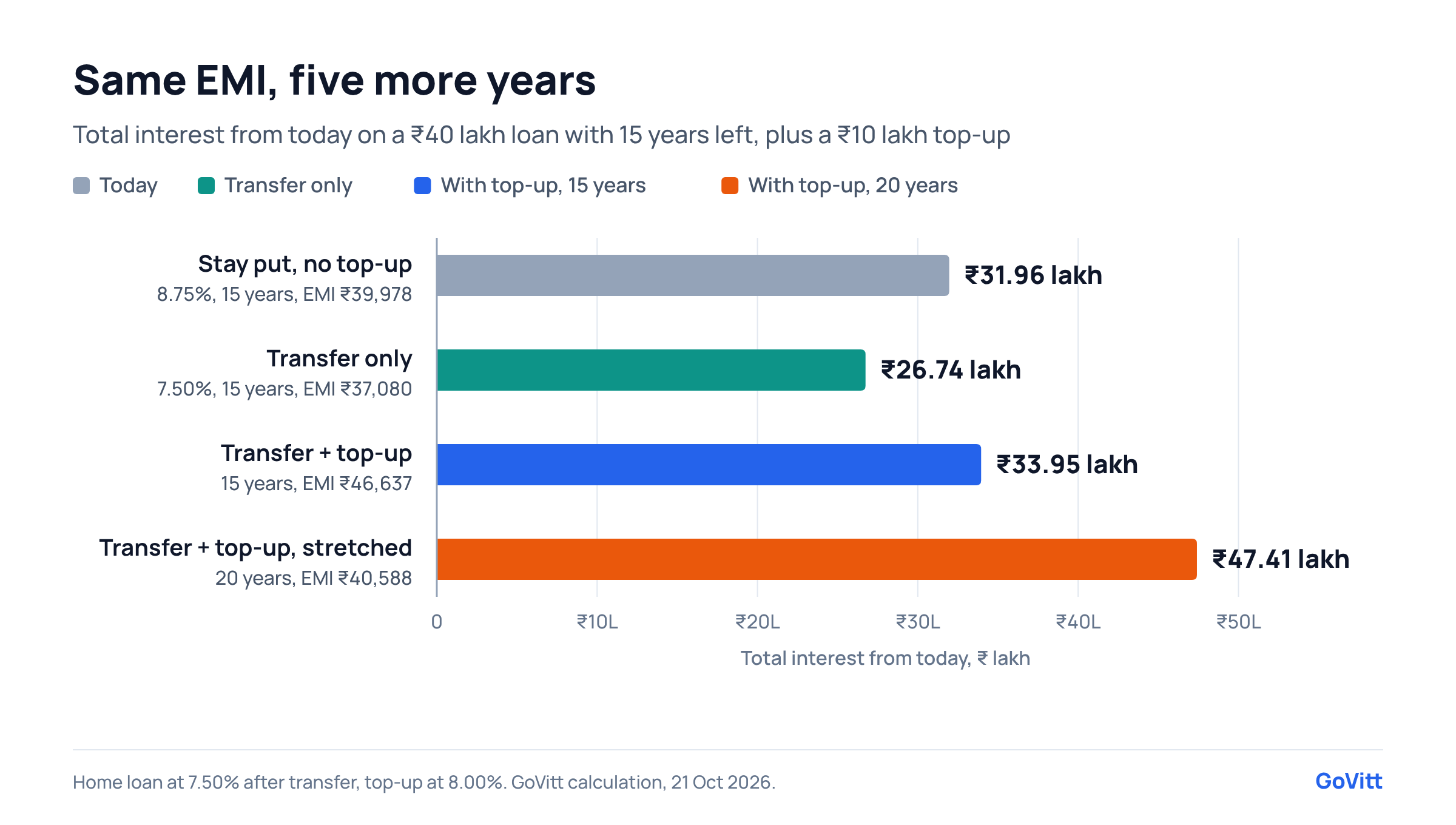
Read that again. A top-up at 8% over 15 years costs more than double a personal loan at 12% over 5 years.
The rate is cheaper. The total is not. Interest is rate multiplied by time, and a top-up's long tenure quietly does the multiplying.
So the top-up wins only if you repay it fast. If you take it over 5 years, you save about ₹1.18 lakh compared with a personal loan. That's the version worth having.
How a 15-year loan quietly turns into 20
Now the part most people miss.
When you add ₹10 lakh to a transfer, your EMI jumps. Many borrowers balk at that. So the lender offers a fix: "We can extend the tenure so your EMI stays about the same."
Here's what that looks like on the same example:
| Option | Tenure | EMI | Total interest from here |
|---|---|---|---|
| Stay put, no top-up | 15 years | ₹39,978 | ₹31.96 lakh |
| Transfer only | 15 years | ₹37,080 | ₹26.74 lakh |
| Transfer and top-up, same 15 years | 15 years | ₹46,637 | ₹33.95 lakh |
| Transfer and top-up, stretched | 20 years | ₹40,588 | ₹47.41 lakh |
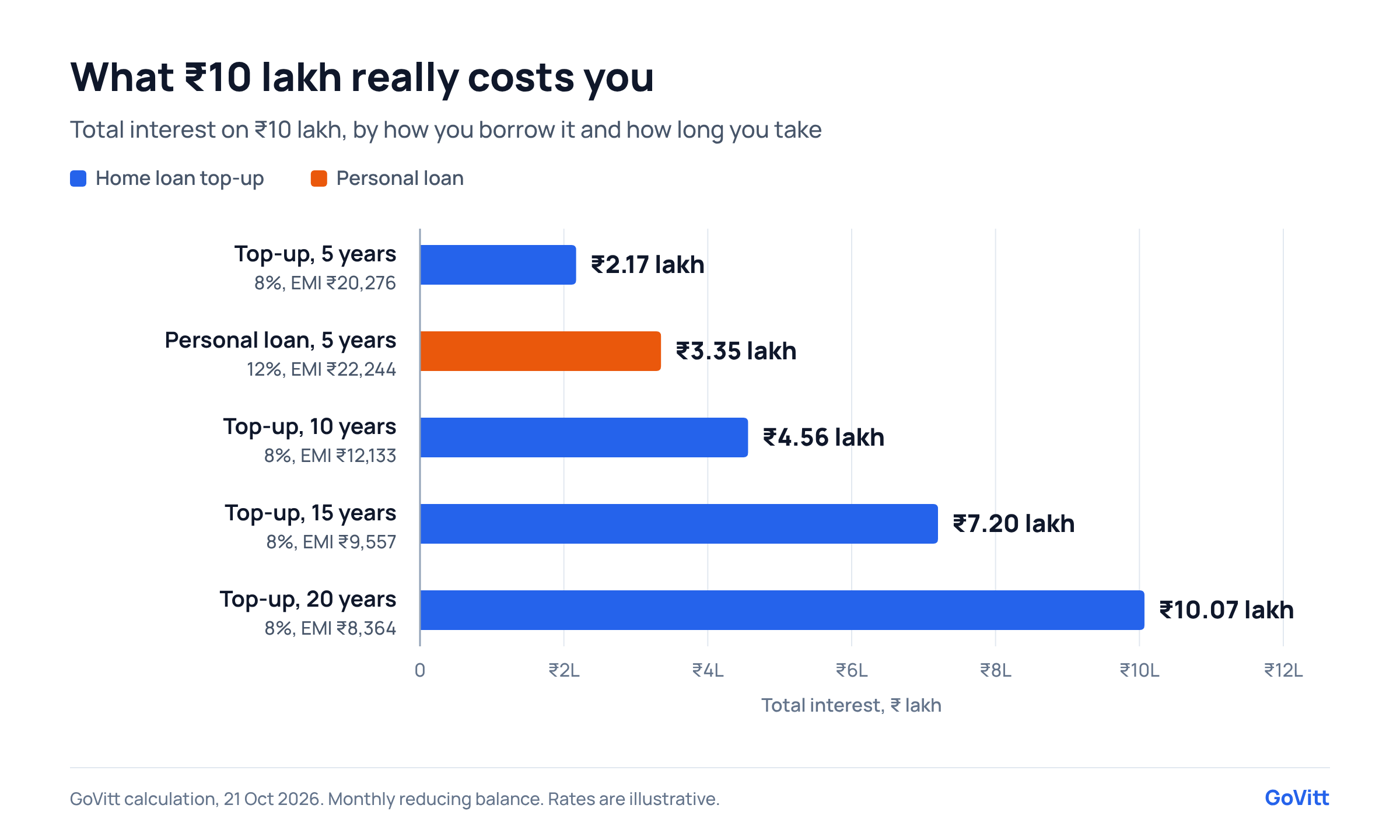
The stretched version has an EMI just ₹610 higher than what you pay today. It feels painless. But you pay EMIs for 5 more years and ₹13.46 lakh more in interest than if you'd kept the 15-year end date.
You did the transfer to save ₹5.22 lakh. The stretch gives all of it back, and then some.
This is the single biggest mistake I see with top-ups. The rate looks great, the EMI looks fine, and nobody looks at the end date.
What the top-up adds to your transfer costs
Adding a top-up to a transfer isn't free, though it's cheaper than doing it separately later.
| Extra cost on a ₹10 lakh top-up | Amount |
|---|---|
| Stamp duty on the mortgage (0.5% in Karnataka) | ₹5,000 |
| Registration (about 0.1%) | ₹1,000 |
| Processing fee (0.35% to 0.50%, plus GST) | ₹4,130 to ₹5,900 |
| Total | about ₹10,000 to ₹12,000 |
Stamp duty in Karnataka is charged on the full sanctioned amount, so a top-up raises it. Every charge on the transfer itself is broken down in home loan balance transfer charges.
Will you get the top-up? Three checks lenders run
1. Property value today. Your outstanding loan plus the top-up must stay within RBI's loan to value limits: 90% for loans up to ₹30 lakh, 80% from ₹30 lakh to ₹75 lakh, and 75% above ₹75 lakh. The bank uses its own valuation today, not what you paid. On our example, ₹50 lakh in total needs the flat valued at ₹62.5 lakh or more. Most Bengaluru flats bought 5 or more years ago clear this easily.
2. Income. The lender rechecks your EMI against your take-home pay. A bigger combined EMI needs a bigger salary.
3. Repayment record. HDFC Bank, for example, asks for 12 months of regular repayment on your current loan before a transfer.
Lenders will also ask what the money is for. RBI has publicly flagged top-ups being used for speculation, and banks now check end use more closely. Don't plan to put a top-up into shares.
Tax: don't count on a deduction
Interest on a top-up counts toward the home loan interest deduction only if you spend the money on buying, building, repairing or renovating a house, and you keep the bills.
Even then, the limit is small for most people. Under the old tax regime, interest on money borrowed for repairs or renovation of a self-occupied home is capped at ₹30,000 a year. Under the new regime, there's no deduction for a self-occupied home at all. (This is now Section 22 of the Income-tax Act, 2025, which replaced the old Section 24(b) from April 2026.)
If the top-up goes to anything else, school fees, a wedding or a car, there's no tax benefit.
When a top-up with your transfer makes sense
Say yes if all of these are true:
- You need the money for something real: a renovation, education, a medical bill, or clearing expensive debt like a credit card
- You'll repay it in 3 to 7 years, either with a short top-up tenure or by prepaying hard
- You're transferring anyway, so the legal, valuation and registration happen once
- The top-up rate is in writing and within about 0.50% of your new home loan rate
When to say no
- The lender offers to stretch your tenure to "keep the EMI the same." That's the ₹13 lakh mistake above.
- You're borrowing for spending, not need. A holiday on a 15-year loan is a very expensive holiday.
- The amount is small. Under ₹2 to ₹3 lakh, fees eat a big share of the saving. A short personal loan or simply waiting may be cleaner. I compared these in before you tap that pre-approved personal loan.
- The top-up rate is far above the home loan rate. If it's 1% or more higher, compare it properly with a personal loan over a short tenure.
- Your property value is tight. If the valuation comes in low, the top-up shrinks or vanishes, and it can delay the whole transfer.
How to ask for it the right way
- Ask for the top-up as a separate amount with its own tenure. Not blended into one 20-year loan.
- Set the top-up tenure to 5 to 7 years, or as short as your budget allows.
- Keep your home loan's end date the same as today. Say this in writing. Don't let the sanction letter quietly add years.
- Get the rate for both parts in the sanction letter and Key Fact Statement.
- Decline bundled insurance unless you actually want it. It adds to the loan, the interest and the stamp duty.
The full transfer process, step by step, is in what actually happens in a home loan transfer.
See your own numbers
Put your outstanding amount, current rate and the rate you've been offered into our free Payoff & Transfer Calculator. It shows your real payoff date, so you'll see straight away if a top-up is stretching it. GoVitt compares 50+ banks and charges you 0% commission. More on how a transfer works on our home loan balance transfer page.
FAQ
Can I take a top-up loan with a home loan balance transfer? Yes. Most banks offer a top-up when they take over your home loan, as one sanction. The new lender pays off your old bank and gives you the extra amount, subject to your property's value and your income.
What is the interest rate on a top-up with a balance transfer? Usually a little above the lender's home loan rate. As of October 2026, SBI lists top-ups at 8.00% to 10.75%, and HDFC Bank at 8.25% to 13.95% when taken with a transfer. Get the exact rate in your sanction letter.
How much top-up can I get with a balance transfer? Your outstanding loan plus the top-up must stay within 75% to 90% of your property's current value, depending on the loan size. Lenders also cap the top-up itself, for example at your original sanctioned amount, and check your income.
Is a top-up cheaper than a personal loan? Only if you repay it quickly. ₹10 lakh at 8% over 5 years costs ₹2.17 lakh in interest, against ₹3.35 lakh for a personal loan at 12% over 5 years. Stretch the top-up to 15 years and it costs ₹7.20 lakh.
Does a top-up increase stamp duty on a balance transfer in Karnataka? Yes. Stamp duty on the mortgage is 0.5% of the full sanctioned amount, so a ₹10 lakh top-up adds about ₹5,000 in stamp duty and ₹1,000 in registration.
Examples as of 21 October 2026. EMIs use the standard monthly reducing balance method. Top-up rates are from each lender's published pages and change often. Tax rules are summarised, not advice for your case. Confirm everything in your sanction letter and Key Fact Statement before you sign.
Ready to take the next step?
Find out your loan options and check your eligibility with GoVitt today.