
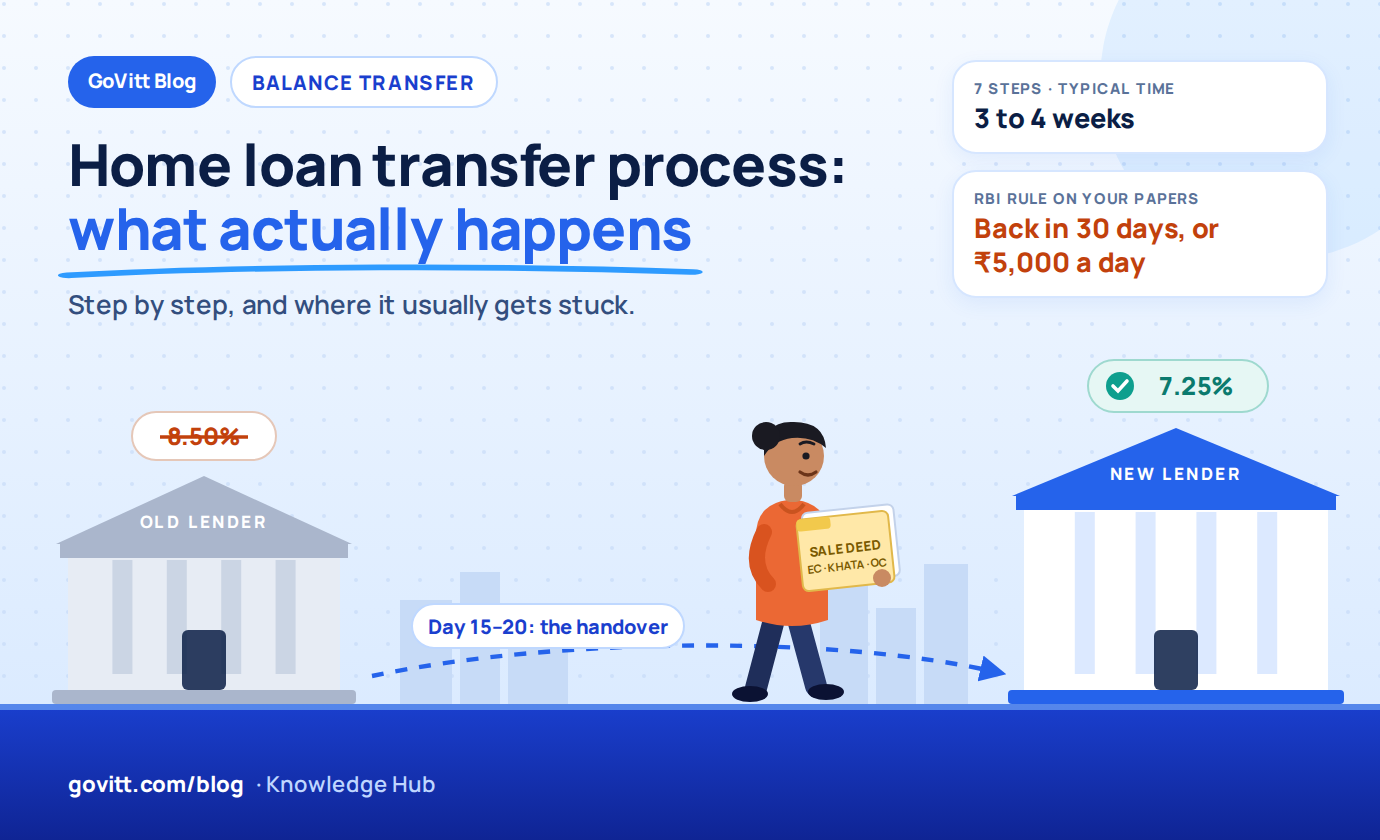
Getting a lower rate is the easy part of a home loan transfer. A new lender is happy to quote you 7.25% on a phone call.
The part nobody prepares you for comes later. It's the few days where your old loan is closed, the new one has started, and your original sale deed is in an envelope somewhere between two banks. That's the week people call us, slightly panicked, asking where their papers are.
So this post is only about the process. If you're still deciding whether a transfer is worth it for you, I did the full maths, charges and all, in this post on moving a ₹50 lakh loan from 8% to 7.20%. Read that first. Come back here once you've decided to go ahead.
See your real payoff date in 60 seconds
Banks calculate remaining EMIs by simple subtraction. See your actual payoff date and discover how much interest a balance transfer can save.
Before you start, check three things
A new lender will usually want to see at least 12 months of EMIs paid on time with your current lender. If an EMI bounced recently, wait a few months, because you won't get the rate you were quoted.
Check your CIBIL score yourself before you apply. Every lender you formally apply with pulls your report, and five applications in two weeks doesn't look good on it. Pick one or two lenders, not six.
And pull out your property papers, or at least the list of what your bank is holding. If your khata was never transferred to your name, or the OC never came, the new lender's lawyer will find it. Fix it first, or the whole thing stalls halfway.
The whole thing on one page
In Bengaluru, a clean transfer usually takes three to four weeks from the first request to the first EMI with the new lender. Here's roughly who does what, and when.
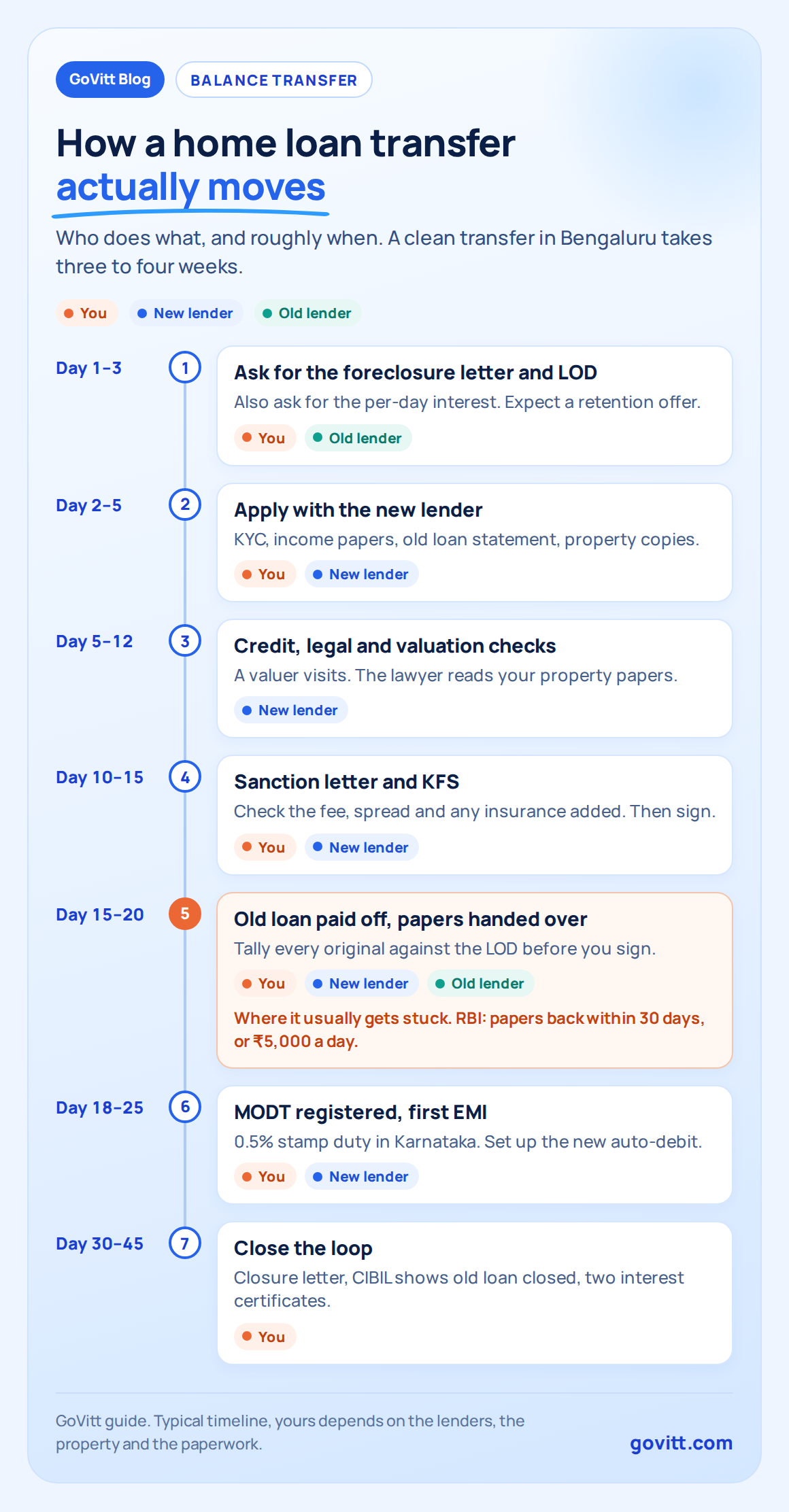
A clean transfer takes three to four weeks. Step 5, getting your original documents back, is where it usually slows down.
Now let me go through each step properly.
Step 1: Ask your current lender for two letters
The first is the foreclosure letter. It shows exactly how much you need to pay to close the loan, as on a particular date. The new lender needs this to know what amount to pay.
The second is the list of documents, which everyone calls the LOD. This is the list of your original property papers that your bank is holding. Sale deed, mother deed, EC, khata, OC, tax receipts, whatever they took from you at the start.
Ask for both in writing, by email or on the bank's app if it has the option. Keep the acknowledgement.
Two small things here. The foreclosure amount changes every day because interest keeps adding up, so ask the bank for the per-day interest figure as well. And the letter is usually valid only till a certain date. If your transfer drags past that, you'll need a fresh one.
Also, don't be surprised if your bank suddenly calls with a rate cut once you ask for a foreclosure letter. That's a retention offer, and it happens a lot. If what they offer is close to the new lender's rate, taking it saves you all the charges and paperwork. There's nothing wrong with using the request as a bargaining chip. It's your loan.
Step 2: Apply with the new lender
The new lender will ask for roughly what they'd ask for on any home loan, plus your old loan details.
For you: PAN and Aadhaar, address proof, photographs.
For your income: last three months' salary slips, Form 16 and six months of salary account statements if you're salaried. If you're self-employed, two to three years of ITR with computation, profit and loss and balance sheet, and twelve months of bank statements.
For the old loan: the sanction letter, the loan account statement for the last twelve months or so, the foreclosure letter and the LOD.
For the property: photocopies of the sale deed and the other papers on the LOD. Your old bank has the originals, and the new lender knows that. Copies are enough at this stage.
Step 3: The new lender checks everything
Three checks run side by side. The credit team looks at your income and your CIBIL report. The legal team goes through the copies of your property papers. And a valuer visits the flat to confirm it's worth what everyone thinks it's worth.
This usually takes about a week. If your property has a long chain of older documents, or it's an independent house rather than a flat in a known project, expect the legal check to take a little longer and ask a few more questions.
Step 4: Sanction letter, KFS, and signing
Once everything clears, you get the sanction letter. Along with it the lender has to give you a Key Fact Statement. It's a short standard document that shows the rate, the fees, and the annual percentage rate, which is the real cost with the fees built in. Read it properly. This is where you'd spot a processing fee that's higher than what the sales person told you, or an insurance premium that's quietly been added to your loan amount.
On insurance: a home loan protection plan is not compulsory. If it's been added and you don't want it, say so before you sign. Anything added to the loan amount also increases the stamp duty you pay on the MODT later.
Check the rate type too. Most new home loans from banks are linked to the repo rate, and the sanction letter should show the spread over repo. That spread is what stays fixed. Everything else moves with RBI.
Then you sign the loan agreement and pay the processing fee.
Step 5: The handover, where it usually gets stuck
This is the step that makes people nervous, so here's exactly what happens.
The new lender issues a cheque or demand draft in the name of your old lender, for the foreclosure amount. Often someone from the new lender goes with you, or on your behalf, to the old lender's branch to hand it over.
The old lender takes the payment, closes the loan, and releases your original documents. Sometimes that's the same day. More often it takes a few days, because the papers are sitting in a central storage facility, not in the branch.
When you get the documents, tally them against the LOD, one by one, before you sign any receipt. If something's missing, write it on the receipt and get the branch to sign next to it. Then the documents go to the new lender, and you should get a written acknowledgement from them listing everything they've received.
If your old lender drags its feet, RBI is on your side. Since December 2023, banks, NBFCs and housing finance companies have to release your original property documents within 30 days of the loan being fully repaid. You can choose to collect them from the branch where your loan was handled or from wherever they're actually stored. And if the delay is the lender's fault, they owe you ₹5,000 for every day past those 30 days. If they've lost the papers, they get another 30 days and have to help you get certified copies at their own cost.
In practice, most lenders don't want to pay ₹5,000 a day, so just mentioning the rule in an email tends to speed things up.
One more thing about this step. Interest on your new loan starts from the day the new lender issues the cheque. Your old loan keeps charging interest until the old lender actually receives it. Every day in between, you're paying interest on both. On a ₹50 lakh loan that's somewhere around ₹1,100 a day. So chase this step. Don't let the draft sit in someone's drawer for a week.
Step 6: MODT and your first EMI
Once the new lender has your original documents, it registers a fresh MODT, the memorandum that records your papers are deposited with it as security. In Karnataka that means a visit to the sub-registrar's office and stamp duty of 0.5% of the loan amount, plus a registration fee. On a ₹50 lakh loan that's about ₹30,000 all in.
If you're taking a top-up along with the transfer, remember the stamp duty is on the whole sanctioned amount, top-up included.
Then set up the auto-debit for the new EMI, and check the date of your first EMI. Sometimes the first one is a broken-period interest amount for the days between disbursement and your regular EMI date, so it may look a bit odd. That's normal.
Step 7: Close the loop
A month or so later, do these and you're done.
Get the loan closure letter or NOC from the old lender, and keep it safely with your other property papers. You'll want it if you ever sell.
Cancel the old auto-debit mandate, but only after the old loan shows as closed. If you stop it earlier and there's a small balance left, you'll get a bounce on your record for no reason.
Check your credit report after 30 to 45 days. The old loan should show as closed with zero balance. If it still shows active, write to the old lender with the closure letter attached.
And for tax, get two interest certificates for the year: one from the old lender for the months before the transfer, and one from the new lender for the rest. Add up the interest from both when you claim under Section 24(b), and the principal from both under 80C, if you're on the old regime. Interest on a loan taken to repay your original home loan remains deductible. Many CAs also treat the processing fee as part of the interest, since the Income Tax Act's definition of interest includes service fees on borrowed money, though it still sits inside the same ₹2 lakh cap for a self-occupied house.
Where transfers usually go wrong
Most of the transfers that get messy go wrong in one of a handful of ways.
The old lender takes weeks to find the original documents. Use the 30-day RBI rule, in writing.
A document on the LOD turns out to be missing, and it only comes to light after the loan is closed. Tally before you sign anything.
The foreclosure letter expires because the new lender took longer than expected, and the amount changes. Keep an eye on the validity date.
The new lender's legal team raises a query about the property that your old lender never asked about. Khata, OC or an old approval. Which is why you check your papers first.
The borrower stops paying the old EMI because "the loan is being transferred." Never do this. Keep paying until the old loan is actually closed. A missed EMI in the middle of a transfer is the worst possible timing.
If you'd like someone to run it for you
This is most of what we do at GoVitt. We compare offers from 50+ banks and housing finance companies, and we don't charge you any commission. Put your numbers into our free Payoff & Transfer Calculator to see what you'd save, or WhatsApp your current rate, outstanding amount and years left to +91 70194 17854. If a transfer makes sense, we'll handle the lender side and chase the documents for you. If it doesn't, we'll tell you that too.
Timelines are typical for Bengaluru and vary by lender, property and paperwork. Stamp duty and MODT charges vary by state. This is general information, not legal or tax advice.
Questions people usually ask
How long does a home loan balance transfer take? Usually three to four weeks from asking your current lender for the foreclosure letter to paying your first EMI with the new lender. The slowest step is normally the old lender releasing your original property documents.
What documents do I need for a home loan transfer? KYC, income proof (salary slips, Form 16 and bank statements, or ITRs and financials if self-employed), your existing loan's sanction letter and statement, the foreclosure letter and list of documents from your current lender, and copies of your property papers.
What is a foreclosure letter? A letter from your current lender stating the exact amount needed to close your loan on a given date. The new lender uses it to pay off the old loan. The amount changes daily, and the letter is usually valid only until a stated date.
What is the LOD in a home loan transfer? LOD stands for list of documents. It lists every original property paper your current lender is holding. Use it to check that everything is returned when the old loan is closed.
What if my old bank delays returning my property documents? Under RBI rules in force since December 2023, lenders must return original property documents within 30 days of full repayment. For delays caused by the lender, they must pay you ₹5,000 for each day of delay. Complain to the lender first, and to the RBI Ombudsman if it isn't resolved.
Do I need to keep paying EMIs to my old bank during the transfer? Yes. Keep paying until the old loan is actually closed. Only cancel the old auto-debit after you've received confirmation that the loan is closed.
Can I claim tax benefits on both loans in the year I transfer? Yes. Get an interest certificate from each lender for the part of the year the loan was with them, and add them up. The combined interest still falls under the same Section 24(b) limit, and the combined principal under 80C, on the old tax regime.
Does a balance transfer affect my CIBIL score? The new lender's enquiry can lower your score slightly for a short time. Once the old loan shows as closed and you pay the new EMIs on time, there's no lasting effect. Avoid applying with many lenders at once.
Ready to take the next step?
Find out your loan options and check your eligibility with GoVitt today.