
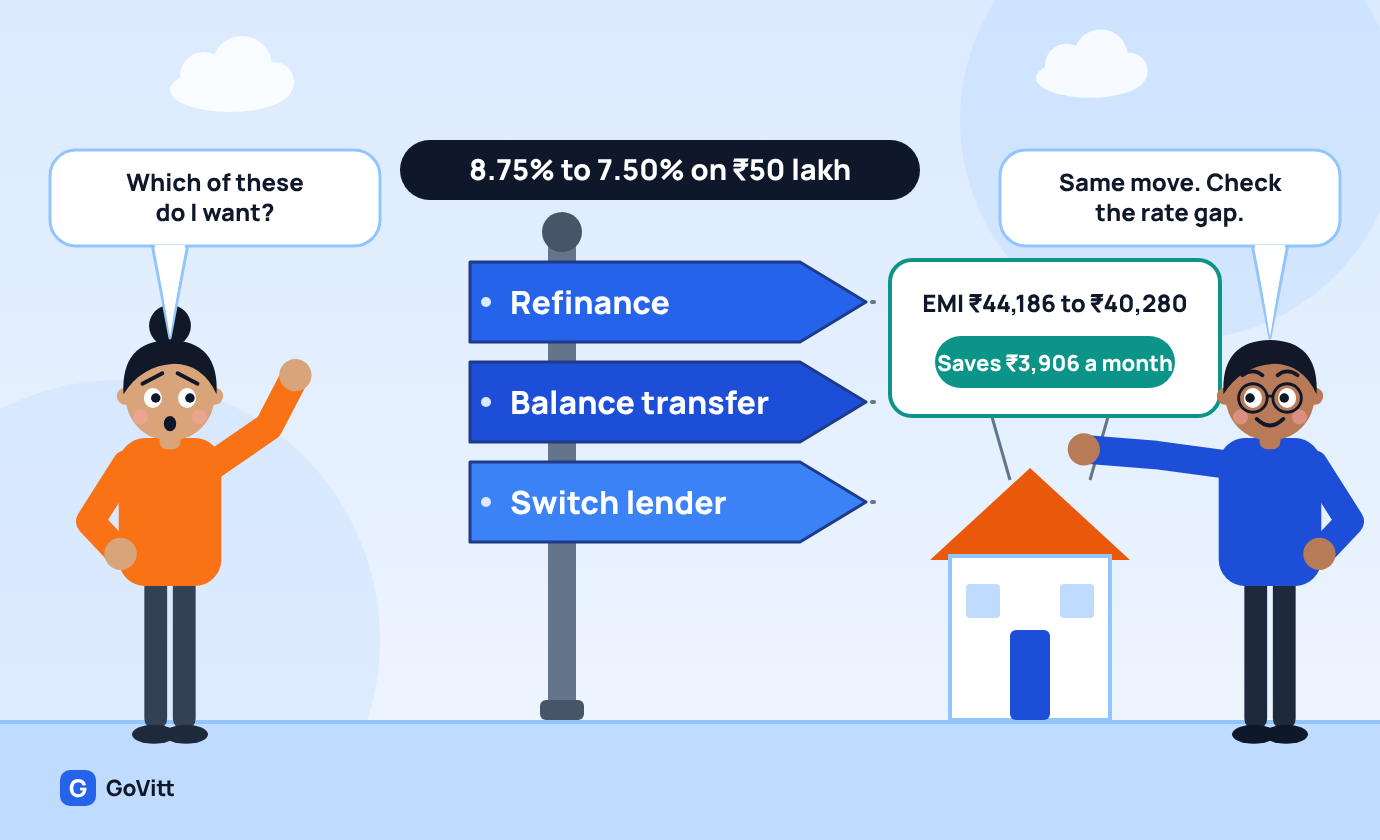
The home loan refinance rate you can get is the rate a cheaper lender, or your own, will price your loan at when it takes it over. Today the lowest published rates run from 7.15% at LIC Housing Finance and 7.50% at SBI to 8.00% at HDFC Bank and Axis Bank. Take ₹50 lakh with 20 years left at 8.75%. Refinancing to 7.50% cuts the EMI from ₹44,186 to ₹40,280, which is ₹3,906 a month.
Refinance, balance transfer, switching: one move, three names. Below: what each version is, the rates lenders publish with their dates, what each version costs, and the gap at which it stops being worth the effort.
Refinance home loan, balance transfer, switch: what each word means
Indian lenders mostly sell this as a balance transfer, and some call it a takeover. "Refinance" is the word borrowers search for. It covers four different things:
See your real payoff date in 60 seconds
Banks calculate remaining EMIs by simple subtraction. See your actual payoff date and discover how much interest a balance transfer can save.
| What people call it | What actually happens | What you pay |
|---|---|---|
| Balance transfer, takeover | A new lender pays off your old loan and you repay the new lender at its rate | Processing fee, legal and valuation, stamp duty on the new mortgage |
| Rate switch with your own lender | Your lender moves your existing loan to a lower rate | A conversion fee, ₹3,540 to ₹5,900 at the banks I checked |
| Transfer with a top-up | The new lender pays off the old loan and lends you extra on top | The transfer costs, plus a higher rate on the extra amount |
| Part payment | You pay the loan down from your own cash and the rate stays | Nothing, on a floating rate loan to an individual |
The last row isn't a refinance, but it is the other way to cut your interest. The third row has its own post: home loan balance transfer and top-up. The rest of this post is about the first two rows, and you should try the second one first.
Home loan refinance rates today: what lenders publish
Every lender advertises the rate for its best borrower. Here is each lender's lowest published rate, what it takes to get it, and what it does to ₹50 lakh with 20 years left at 8.75% (EMI ₹44,186).
| Lender | Lowest rate shown | What it takes | Checked | New EMI | Saving a month |
|---|---|---|---|---|---|
| LIC Housing Finance | 7.15% | Score 825 and above, loan up to ₹50 lakh | 22 Oct | ₹39,216 | ₹4,970 |
| PNB | 7.45% | Score 800 and above | 12 Oct | ₹40,127 | ₹4,059 |
| SBI | 7.50% | Strongest profiles; no public score grid | 26 Oct | ₹40,280 | ₹3,906 |
| Canara Bank | 7.55% | Top credit grade, loan up to ₹50 lakh | 24 Oct | ₹40,433 | ₹3,753 |
| L&T Finance | 7.75% | "Starting as low as", subject to eligibility | 1 Nov | ₹41,047 | ₹3,139 |
| HDFC Bank | 8.00% | Strongest profiles | 1 Nov | ₹41,822 | ₹2,364 |
| Axis Bank | 8.00% | Score 751 and above | 26 Oct | ₹41,822 | ₹2,364 |
| ICICI Bank | 8.75% | Score 750 and above, salaried (7.80% for pre-approved digital offers only) | 21 Oct | ₹44,186 | Nothing |
PNB's figure is from its 12 October rate card, and I couldn't recheck it on PNB's own page. L&T Finance's page gives no date and no score condition. LIC is a housing finance company, so it sets its own rate on its own schedule, as I explained in LIC Housing Finance home loan interest rate (October 2026). The side by side with fees, top-ups and the five year saving is in best banks for home loan balance transfer in 2026, and the live rate list sits on GoVitt's bank offers page.
If you're at 8.75% and the best you can get is 8.75%, the table has nothing for you. ICICI's table rate is the rate you already pay.
The rate in the table is the best case, not your case
Look at one lender's grid. LIC Housing Finance's rate for salaried borrowers runs from 7.15% at a score of 825 and above to 8.75% at 600 to 699 (its grid on 22 October). Same lender, same loan, same day. On ₹50 lakh with 20 years left, the saving against your 8.75% goes from ₹4,970 a month at the top of the grid to nothing at the bottom.
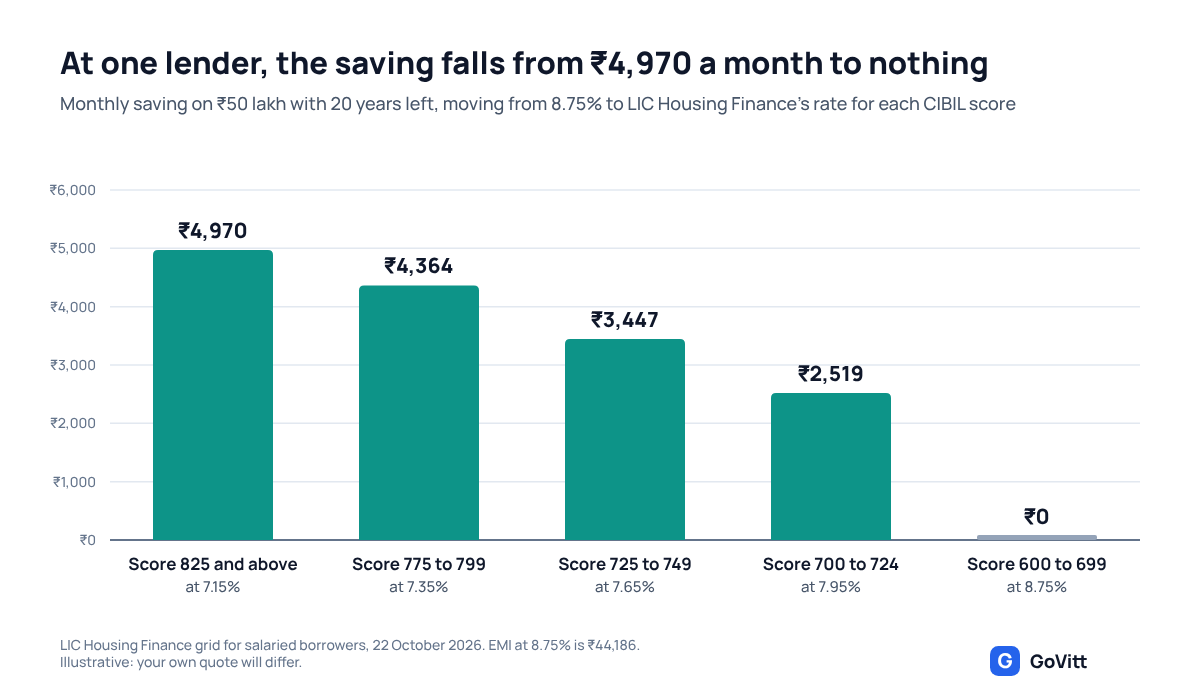
Axis does the same in a narrower band: 8.00% to 8.85% for scores of 751 and above (26 October). So don't ask a lender what its refinance rate is. Ask what rate it will give you, in writing, for your score and your loan. Why quotes land above the advertised rate is in why your home loan rate is higher than what the bank advertises, and how a score moves the spread is in RBI moved your home loan rate by 0.25%. Your CIBIL score can move it by 1.80%.
What a rate gap is worth, and when it pays back
Each 0.25% off your rate is worth about ₹770 to ₹795 a month on this loan. The cost of moving to a new lender, on ₹50 lakh in Bengaluru, runs ₹53,700 to ₹76,500. The low figure is SBI's capped fee of ₹17,700 plus ₹36,000 of shared charges. The high figure is HDFC Bank's maximum fee of ₹29,500 plus ₹47,000. Every line is in home loan balance transfer charges.
| New rate | Gap | New EMI | Saving a month | Pays back in |
|---|---|---|---|---|
| 8.50% | 0.25% | ₹43,391 | ₹795 | 68 to 97 months |
| 8.25% | 0.50% | ₹42,603 | ₹1,583 | 34 to 49 months |
| 8.00% | 0.75% | ₹41,822 | ₹2,364 | 23 to 33 months |
| 7.75% | 1.00% | ₹41,047 | ₹3,139 | 18 to 25 months |
| 7.50% | 1.25% | ₹40,280 | ₹3,906 | 14 to 20 months |
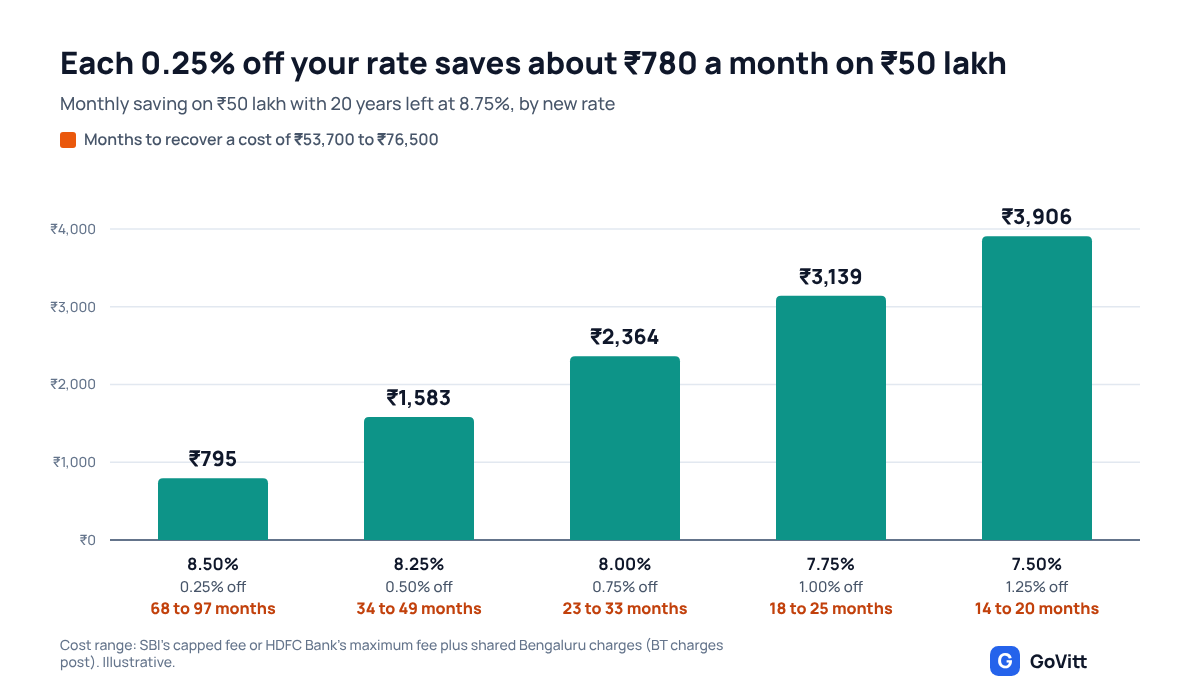
The rule I use: the costs should come back in under two years, and you should expect to hold the loan at least twice that long. On this loan that means a gap of about 1% or more. Between 0.50% and 1% it depends on which end of the cost range you land on. At 0.75% you're back in 23 months with the cheaper fee and 33 with the dearer one. At 0.50% or less, a move to a new lender doesn't pay back inside two years even at the cheap end. That's the case for the next section.
Ask your own lender first: the cheap refinance
Most big lenders will move an existing floating rate loan to a lower rate for a small fee, with no new stamp duty and no valuation. As listed by each lender (the fee figures are the ones in my best banks post, dated 21 to 26 October):
| Your lender | Fee to move to a lower rate | On ₹50 lakh, with GST |
|---|---|---|
| ICICI Bank | ₹3,000 plus taxes | ₹3,540 |
| Axis Bank | ₹3,000 plus GST for ₹30 lakh to ₹75 lakh outstanding | ₹3,540 |
| SBI | ₹5,000 plus GST, for old MCLR or base rate loans | ₹5,900 |
| HDFC Bank | The lower of 0.25% of the outstanding principal or ₹5,000, plus taxes | ₹5,900 |
Axis's figure comes from an undated fees schedule, so confirm it. Say your lender agrees to 8.25%. The saving is ₹1,583 a month, and ₹5,900 pays back in 4 months. If it only agrees to 8.50%, the saving is ₹795 and the fee comes back in 8 months. If it refuses, you've lost a letter, and you now have something in writing to compare against a new lender.
Closing the old loan to move it costs nothing on a floating rate loan taken by an individual for non-business use. RBI barred the charge, and a fixed rate loan can still carry one, so check your sanction letter. The full reading is in your bank can't charge you for prepaying a floating rate home loan.
How many years you have left changes the answer
The monthly saving barely moves as the loan gets shorter. What shrinks is the number of months you collect it. Same ₹50 lakh outstanding, moving from 8.75% to 7.50%:
| Years left | EMI at 8.75% | EMI at 7.50% | Saving a month | Saved over the rest of the loan | Left after the ₹53,700 to ₹76,500 cost |
|---|---|---|---|---|---|
| 20 | ₹44,186 | ₹40,280 | ₹3,906 | ₹9.37 lakh | ₹8.61 to ₹8.84 lakh |
| 15 | ₹49,972 | ₹46,351 | ₹3,621 | ₹6.52 lakh | ₹5.75 to ₹5.98 lakh |
| 10 | ₹62,663 | ₹59,351 | ₹3,312 | ₹3.97 lakh | ₹3.21 to ₹3.44 lakh |
| 5 | ₹1,03,186 | ₹1,00,190 | ₹2,996 | ₹1.80 lakh | ₹1.03 to ₹1.26 lakh |
| 3 | ₹1,58,418 | ₹1,55,531 | ₹2,887 | ₹1.04 lakh | ₹0.27 to ₹0.50 lakh |
With 5 years left, you collect ₹1.80 lakh and spend up to ₹76,500 to get it. It still works, but only just. With 3 years left, you keep ₹0.27 to ₹0.50 lakh after costs, and that's a lot of paperwork for ₹27,000 to ₹50,000. Ask your own lender and stop there.
Worked example: ask first, or move?
Same loan: ₹50 lakh, 20 years left, 8.75%, a five year hold in Bengaluru. I assumed your lender offers 8.25%, which it may not.
| Option | Rate | New EMI | Saving a month | One time cost | Pays back in | Net saving over 5 years |
|---|---|---|---|---|---|---|
| Stay | 8.75% | ₹44,186 | Nothing | Nothing | Not applicable | Nothing |
| Own lender reprices | 8.25% | ₹42,603 | ₹1,583 | ₹5,900 | 4 months | ₹0.89 lakh |
| Transfer to SBI | 7.50% | ₹40,280 | ₹3,906 | ₹53,700 to ₹64,700 | 14 to 17 months | ₹1.70 to ₹1.81 lakh |
Even if your own lender goes to 8.25%, the transfer earns ₹0.81 to ₹0.92 lakh more over five years. But the request to your own lender costs one letter. Make it first, and use the answer as your bid when you talk to anyone else.
If you want extra cash as well
A transfer can carry a top-up, so you refinance and borrow more in one go. It costs more than the transfer. HDFC Bank's top-up starts 0.25% above its main rate, and stamp duty applies to the whole sanctioned amount. Compare the top-up rate on its own, and keep its tenure short. The full picture is in home loan balance transfer and top-up.
When I wouldn't refinance
- The gap is under 0.50%. At 0.25% the costs take 68 to 97 months to come back. Ask your own lender and stop.
- You have 3 years or less left. The net saving is ₹0.27 to ₹0.50 lakh.
- You'll sell or clear the loan within two years. The costs don't come back in time.
- Your score has slipped or you missed a payment recently. HDFC Bank asks for 12 months of regular repayments on your current loan, and ICICI Bank asks for 700 or more on a transfer. A weak score also puts you at the top of the lender's band. How a transfer touches your score is in does a home loan balance transfer hurt your CIBIL score?, and the timing question is in how soon can you transfer a home loan.
- Your loan is still on MCLR. The first step is a move to a repo-linked rate. It's a smaller step than a transfer, covered in still on MCLR? How to move your home loan to a repo-linked rate.
For the gap-versus-hike logic, see rates just went up. Does switching your home loan still make sense?
What I'd do this week
- Pull your numbers. Take the rate on your latest loan statement, the outstanding principal, the months left and your current CIBIL score.
- Find your gap. Compare your rate with the lenders in the table that fit your score. If the gap is under 0.50%, do step 3 and stop.
- Ask your own lender to reprice, in writing. Ask for the new rate, the conversion fee and the date it takes effect.
- If you're still 0.75% or more above a rate you can get elsewhere, collect two written quotes. Ask for the rate, the spread and the processing fee. Don't apply to five lenders at once, because each formal application adds an enquiry to your report.
- Put the quotes into the calculator. The Payoff & Transfer Calculator gives the break-even for your loan.
- Check the date on every offer. RBI's next decision is on 4 December, and all the rates here were set before it. If a waiver or an offer has a deadline, ask what counts as "sanctioned".
FAQ
What is the home loan refinance rate in India right now? The lowest published rates, checked between 21 October and 1 November 2026, run from 7.15% at LIC Housing Finance (score 825 and above, loans up to ₹50 lakh) and 7.50% at SBI, to 8.00% at HDFC Bank and Axis Bank, and 8.75% as ICICI Bank's table rate. Your own rate depends on your score, income and loan size.
Is refinancing a home loan the same as a balance transfer? Mostly. In India, "refinance" is used for a balance transfer to a new lender, and also for moving to a lower rate with your own lender. The second is cheaper, ₹3,540 to ₹5,900 at the banks I checked, and needs no new property papers.
How much does it cost to refinance a home loan? With your own lender, ₹3,540 to ₹5,900 on ₹50 lakh at the banks I checked. With a new lender in Bengaluru, ₹53,700 to ₹76,500 on ₹50 lakh, including fees, stamp duty and registration. The old lender can't charge you to close a floating rate home loan taken as an individual for non-business use.
When does it make sense to refinance a home loan? When the costs come back in under two years and you'll hold the loan for twice that. On ₹50 lakh with 20 years left, that is a gap of about 1% or more. At a gap of 0.50%, it takes 34 to 49 months.
Will refinancing hurt my CIBIL score? A little, and for a short while. A formal application adds an enquiry to your report. I went through what lands on the report, and for how long, in does a home loan balance transfer hurt your CIBIL score?
Run your own numbers. Run the Payoff & Transfer Calculator to see the break-even for your loan. Our home loan balance transfer page shows how a move works. GoVitt compares 50+ banks and charges you 0% commission.
Examples use ₹50 lakh outstanding at 8.75% with 20 years left, standard monthly reducing balance, EMIs rounded to the nearest rupee. Rates are each lender's lowest published rate on the date shown (21 October to 1 November 2026); PNB's is from its 12 October rate card. Cost ranges assume a property in Bengaluru and the shared charges in the BT charges post. Your rate, fees and costs will differ, and festive offers change often. Get every figure in writing and check your sanction letter before you act.
Ready to take the next step?
Find out your loan options and check your eligibility with GoVitt today.