
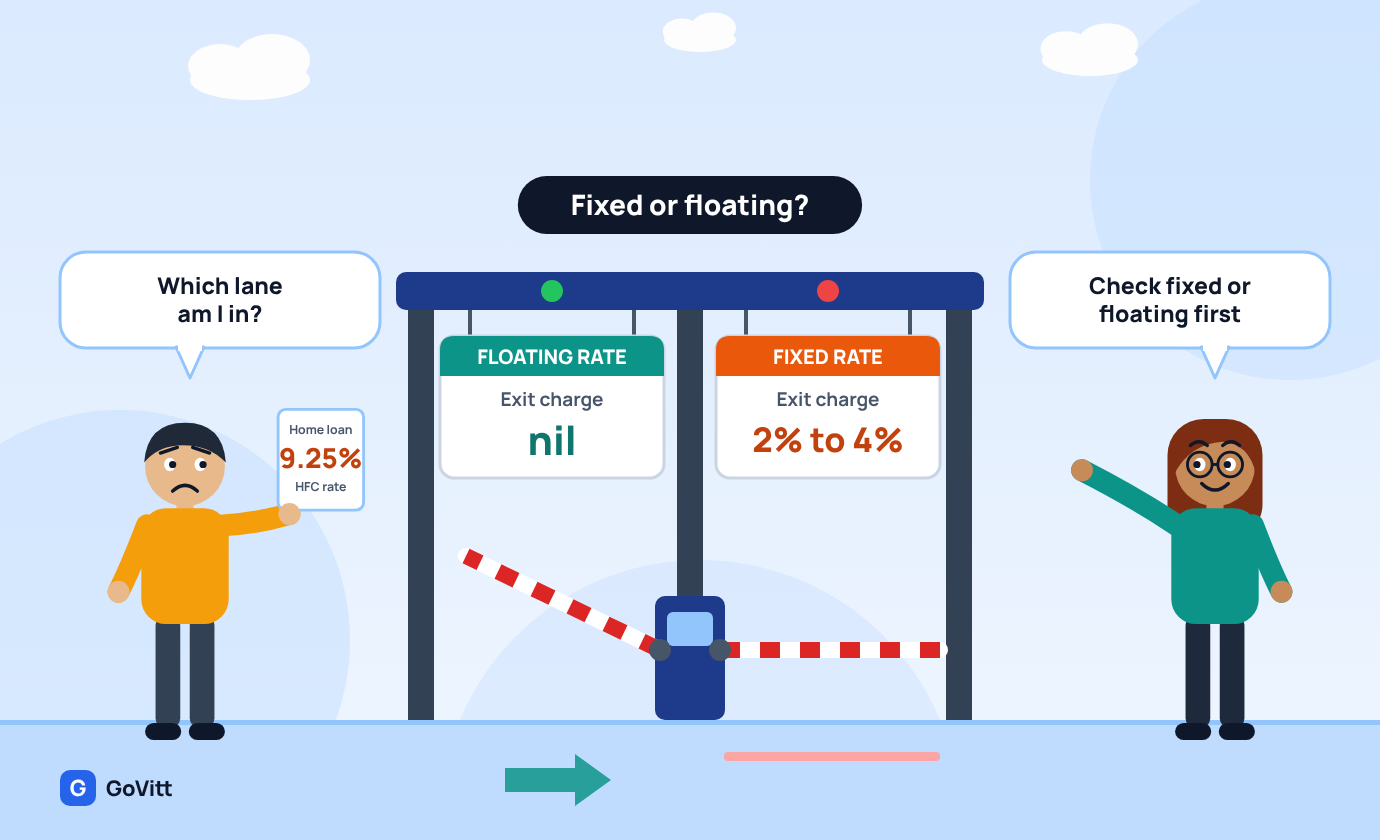
The case to transfer home loan from HFC to bank rests on two things: a rate gap of 1% or more, and a floating rate. Take ₹50 lakh outstanding with 18 years left. At 9.25% the EMI is ₹47,606. At 7.50% it is ₹42,249, which is ₹5,357 a month less. The move costs ₹53,700 to ₹76,500 in Bengaluru and the costs come back in 11 to 15 months.
One thing can wreck that sum faster than the rate: a fixed rate loan. A housing finance company can charge 2% to 4% of what you owe if you repay it with a bank's money. On ₹50 lakh that is ₹1 lakh to ₹2 lakh before GST. Check that first.
You may have heard that housing finance companies charge more than banks. That's half true. Their lowest rates match the banks. The gap sits at the top of their ranges and in older loans. The numbers are below.
See your real payoff date in 60 seconds
Banks calculate remaining EMIs by simple subtraction. See your actual payoff date and discover how much interest a balance transfer can save.
The short version
Move if your floating rate is at least 1% above what a bank quotes you at your score. Ask your housing finance company to reprice you first. Don't move a fixed rate loan until you have the exit charge in writing.
What changes when you leave an HFC
| The loan is the same. The lender's rules are not. | ||
|---|---|---|
| What | Housing finance company | Bank |
| What your rate follows | LIC Housing Finance follows its own prime lending rate and decides when to move it. Bajaj Housing Finance says its loans can be linked to an external benchmark such as repo | Repo linked, reset at least every three months |
| Lowest published rate | LIC 7.15%, Bajaj 7.50%, PNB Housing 7.50% | Union 7.40%, PNB 7.45%, SBI 7.50% |
| Prepayment, floating rate, individual | Nil at LIC and Bajaj | Nil |
| Prepayment, fixed rate, repaid with another lender's money | LIC 2%, Bajaj 4% | Not part of this move |
| Your original property papers | The HFC holds them until you settle | The new bank takes them over |
Look at the second row. The best published rates are close, so the saving comes from moving off a rate that is higher than what you'd be offered today.
Do HFCs really charge more than banks?
Not at the bottom. Here is what two lenders disclosed for the quarter ended September 2026, before the 7 October repo hike.
| Lender | Lowest rate on loans signed | Highest rate on loans signed |
|---|---|---|
| LIC Housing Finance | 7.15% | 11.00% |
| Union Bank of India | 7.15% | 9.35% (mean 8.25%) |
Same floor. The top is 1.65% higher at LIC. On ₹50 lakh over 18 years, a borrower at the top of LIC's range pays ₹53,252 a month and one at the top of Union's pays ₹47,921. That is ₹5,331 a month apart.
The other two big names are harder to read. Bajaj Housing Finance's own page says "from 7.50%" for salaried applicants, and an aggregator lists 7.25%. PNB Housing's page says "as low as 7.50%" in its headline and 7.90% for salaried and 8.10% for self-employed borrowers in its FAQ. Neither page shows a rate by credit score, so I can't tell you where your band lands.
So where does a saving come from? Two places:
- Your spread was fixed years ago. At LIC, it sits on a benchmark LIC controls. New borrowers today may get a lower spread than you. I covered how that works in LIC Housing Finance home loan interest rate (October 2026).
- Your score may have changed. If you were priced near the top of a range because of your score then, a better score now can pull you down. Only if somebody reprices you.
RBI's August draft on loan pricing would bring housing finance companies closer to bank rules, with resets at least every quarter. It's still a draft. I wrote about why it matters in RBI's new loan pricing draft.
What moving costs
The costs are the same as a bank to bank transfer. On ₹50 lakh in Bengaluru:
Charge
Amount
Legal and valuation, MODT stamp duty (0.5% in Karnataka), registration and small charges
₹36,000 to ₹47,000
| New lender's processing fee, with GST | ₹17,700 at SBI, up to ₹29,500 at HDFC Bank |
|---|---|
| Total | ₹53,700 to ₹76,500 |
Every line is explained in home loan balance transfer charges, and the fee by lender is in best banks for home loan balance transfer in 2026. Moving from an HFC adds one cost to check for: the exit charge on a fixed rate loan, covered below.
How big does the gap need to be?
Same loan: ₹50 lakh, 18 years left. Moving to a bank at 7.50%, with costs of ₹53,700 to ₹76,500:
| Your HFC rate | EMI today | EMI at 7.50% | Saving a month | Costs paid back in | Net saving over 18 years |
|---|---|---|---|---|---|
| 8.25% | ₹44,507 | ₹42,249 | ₹2,258 | 24 to 34 months | ₹4.11 to ₹4.34 lakh |
| 8.75% | ₹46,045 | ₹42,249 | ₹3,796 | 15 to 21 months | ₹7.43 to ₹7.66 lakh |
| 9.25% | ₹47,606 | ₹42,249 | ₹5,357 | 11 to 15 months | ₹10.81 to ₹11.03 lakh |
| 9.75% | ₹49,191 | ₹42,249 | ₹6,942 | 8 to 12 months | ₹14.23 to ₹14.46 lakh |
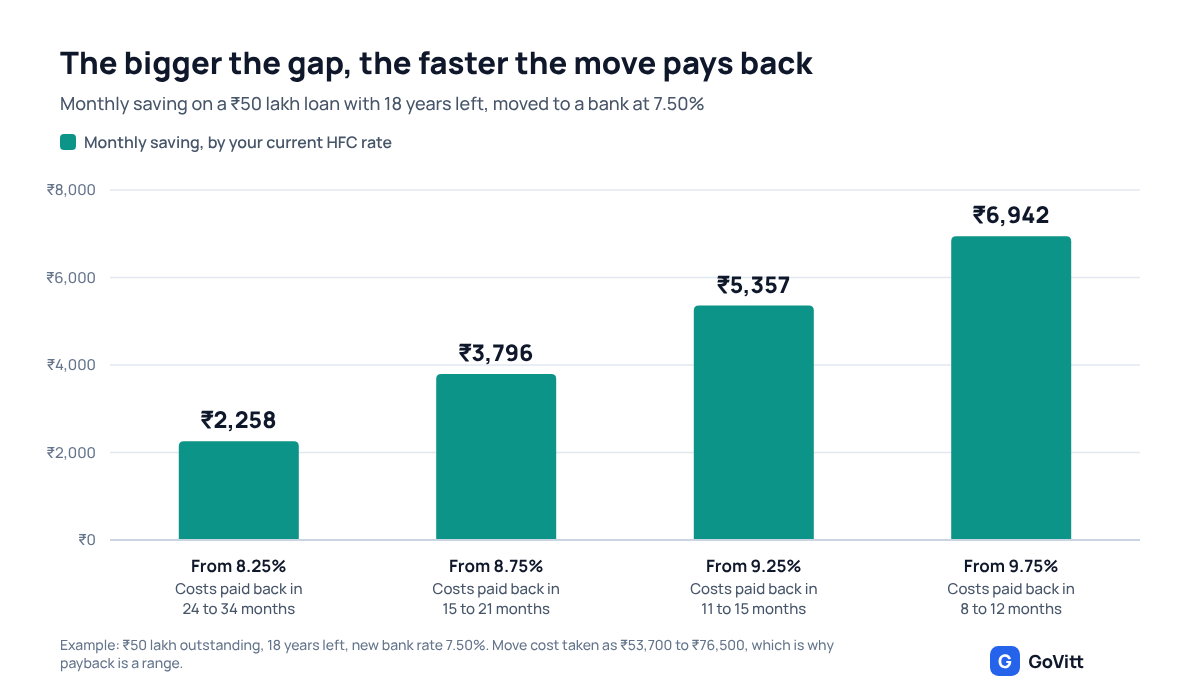
Below 8.25% it gets thin. At 8.00% the saving is ₹1,499 a month and the costs take 36 to 52 months to earn back. At 7.75% it is ₹746 and 72 to 103 months. That is six to nearly nine years. Leave it.
What if the bank quotes you more than 7.50%? Most people don't land on the floor. Say your score puts you at 7.95%, which is where LIC's 700 to 724 band and Union's 700 to 749 band start. From 9.25% the saving is ₹4,009 a month and the costs are back in 14 to 20 months. From 8.75% it is ₹2,448 and 22 to 32 months. The gap still has to be big.
The fixed rate trap
If your loan is floating, skip to the next section. If it's fixed, read this twice.
A fixed rate loan at a housing finance company carries no exit charge when you repay it from your own money. Repaying it with a loan from a bank doesn't count as your own money. Bajaj Housing Finance's page defines "own sources" as anything other than borrowing from a bank, NBFC, HFC or financial institution. A transfer to a bank is exactly that.
LIC's published terms say the same thing: nil from your own funds, 2% if repaid with money from another lender. Bajaj lists 4% on the outstanding principal for its fixed rate term loans. Floating rate loans to individuals are nil at both.
Here is what it does to a ₹50 lakh fixed rate loan at 9.75% with 18 years left, moving to 7.50%. The saving is ₹6,942 a month. GST at 18% is added to the charge.
| What you pay to leave | Charge | With GST | Costs paid back in | Net saving over 18 years |
|---|---|---|---|---|
| Nothing (floating rate) | ₹0 | ₹0 | 8 to 12 months | ₹14.34 lakh |
| 2% (the LIC figure) | ₹1,00,000 | ₹1,18,000 | 25 to 29 months | ₹13.16 lakh |
| 4% (the Bajaj figure) | ₹2,00,000 | ₹2,36,000 | 42 to 46 months | ₹11.98 lakh |
The net saving uses the middle of the move costs, ₹65,100.
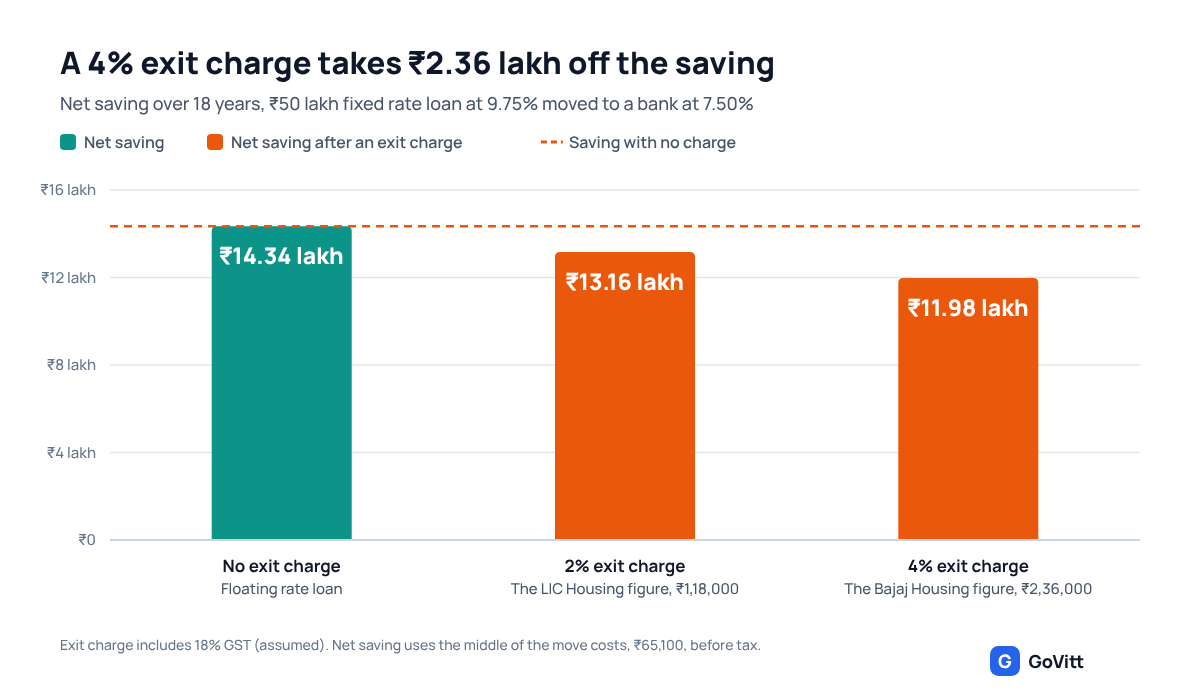
A 9.75% fixed rate is a big gap on purpose. At a smaller gap, the charge decides it. Take a fixed rate of 8.50%, which is where LIC's published fixed rate starts. Moving to 7.50% saves ₹3,024 a month. With no charge, the costs are back in 18 to 26 months. With a 2% charge it takes 57 to 65 months, around five years.
So read your loan agreement for the words "fixed" and "foreclosure". If the loan is fixed, ask two questions in writing: what the exit charge is when the money comes from a bank, and what the lender charges to convert the loan to floating. LIC doesn't publish its conversion fee online.
How many years you have left
The break-even barely moves with the years you have left. The prize does. Same move from 9.25% to 7.50% on ₹50 lakh, using the middle of the move costs:
| Years left | Saving a month | Costs paid back in | Net saving |
|---|---|---|---|
| 3 | ₹4,050 | 14 to 19 months | ₹0.81 lakh |
| 5 | ₹4,209 | 13 to 19 months | ₹1.87 lakh |
| 8 | ₹4,482 | 12 to 18 months | ₹3.65 lakh |
| 12 | ₹4,847 | 12 to 16 months | ₹6.33 lakh |
| 18 | ₹5,357 | 11 to 15 months | ₹10.92 lakh |
With three years left you still win, but by under a lakh. With 18 years left you keep ₹10.92 lakh. Don't write off a short remaining term. Don't expect much from it either.
What the bank will ask that your HFC didn't
A bank checks you from scratch. That's the real risk in this move.
- Your score. ICICI Bank asks for 700 or more on a transfer. HDFC Bank asks for at least 12 months of regular repayments on your current loan. Each bank sets its own bar.
- Your income. The bank rechecks your EMIs against your take-home pay. Most allow 40% to 55%.
- Your property. The bank runs its own legal and valuation check. Before you pay for it, ask what happens to that fee if the bank declines the property.
- A new enquiry. A transfer adds one. CIBIL calls the effect minimal, and no bureau publishes a points figure. I went through it in does a home loan balance transfer hurt your CIBIL score?
So get the bank's sanction before you ask your HFC for a foreclosure letter. If the bank says no after you've told your lender you're leaving, you've lost time for nothing.
Getting your papers back
Your housing finance company holds the original property papers. RBI's rule, in force since 1 December 2023, covers banks and NBFCs, which includes housing finance companies. Original documents must be released within 30 days of full repayment. If the lender is late, it owes you ₹5,000 for every day of delay. If a document is lost or damaged, the lender gets another 30 days to fix it, so the penalty starts after 60 days.
In a transfer, the new bank usually collects the papers. Ask your HFC in writing to hand them to the bank's representative on the day you repay, and note the date. If it slips past 30 days, the ₹5,000 a day applies. The steps, and where they get stuck, are in home loan transfer process, step by step. The document list is in documents required for home loan balance transfer.
Ask your HFC first
The cheapest move is the one you don't make. Most big lenders will move an existing floating rate loan to a lower rate for a small fee, with no new stamp duty and no valuation. LIC's rates for new customers are as low as many banks', and it doesn't publish a fee for moving an existing borrower, so ask for it in writing.
Five things to ask:
- The rate card for existing customers today
- Your spread over its benchmark
- The fee to reprice you, in rupees
- Whether your loan is fixed or floating
- The exit charge if a bank pays you out
If it won't budge, you have a written offer to compare. The LIC case, with the numbers, is in the LIC rate post.
When I wouldn't move
- Your gap is under 1%. At 8.00% to 7.50% the costs take 36 to 52 months to earn back. At 7.75% it is 72 to 103.
- Your loan is fixed, the gap is about 1%, and the exit charge is 2% or more. At 8.50% fixed to 7.50% with a 2% charge, it takes 57 to 65 months.
- You're already at a low HFC rate. At LIC with a score of 800 or more and a loan up to ₹50 lakh, you pay 7.15% to 7.25%. The lowest bank rates in the published tables are 7.40% to 7.55%. There's nothing to gain.
- You haven't had the bank's sanction. Don't give notice to your lender until it's in your hands.
What I'd do this week
- Find out if your loan is fixed or floating. Read the sanction letter. If it's fixed, get the exit charge for repaying with a bank's money, in writing.
- Write down your rate and your score. Take the rate from your latest statement and the CIBIL score from today.
- Ask your HFC to reprice you, in writing, quoting the lower rates in the tables above.
- Get two written quotes from banks at your score. Ask for the spread and the processing fee, not the headline rate. Don't apply to five banks at once.
- Run the numbers. Put your outstanding amount, rate, years left and every charge into the balance transfer calculator and read the break-even.
- Sequence the move. Bank sanction first, then the foreclosure request to your HFC, then the date for your papers in writing.
FAQ
Can I transfer my home loan from an HFC to a bank? Yes. Banks take over home loans from other lenders, including housing finance companies. The new bank pays your HFC the outstanding amount and takes over the loan and the property papers. It rechecks your income, credit score and property, so get its sanction before you ask for a foreclosure letter.
Is there a prepayment charge if I move from an HFC to a bank? On a floating rate loan to an individual, LIC and Bajaj both list nil. On a fixed rate loan the charge is nil only if you repay from your own money. A transfer is borrowing from a bank, so LIC lists 2% and Bajaj 4% of the outstanding principal. Check your loan agreement.
Do HFCs charge higher home loan rates than banks? Not at the bottom. LIC Housing Finance's lowest rate on loans signed from July to September 2026 was 7.15%, the same as Union Bank's. The top was 11.00% at LIC and 9.35% at Union. The gap shows up in older loans and at the top of the range, so compare your own rate with a bank's written quote.
How long will it take to get my property papers back? RBI requires lenders, including housing finance companies, to release original property documents within 30 days of full repayment. After that the lender owes ₹5,000 for each day of delay. If a document is lost or damaged, the penalty starts after 60 days.
What does it cost to move a ₹50 lakh home loan from an HFC to a bank in Bengaluru? ₹53,700 to ₹76,500: ₹36,000 to ₹47,000 in legal, valuation, stamp duty, registration and small charges, plus the bank's processing fee. A fixed rate loan can add an exit charge of 2% to 4% of what you owe.
Will the transfer hurt my CIBIL score? A little, and for a short time. It adds one enquiry. No bureau publishes a points figure for it. How long it lasts is in does a home loan balance transfer hurt your CIBIL score?
Run your own numbers. Run the Payoff & Transfer Calculator to see the break-even for your loan. Our home loan balance transfer page shows how the process works. GoVitt compares 50+ banks and charges you 0% commission.
Rates and rules as of 29 October 2026, except where a date is given. EMIs use the standard monthly reducing balance method and are rounded to the nearest rupee. The examples assume a property in Bengaluru, costs of ₹53,700 to ₹76,500 on ₹50 lakh, and GST at 18% on exit charges. The HFC rates in the tables are illustrative, not quotes. Exit charges and rates differ by lender and by loan agreement, so check your sanction letter before you act. Rates change after every RBI policy decision; we will update this page after 4 December 2026
Ready to take the next step?
Find out your loan options and check your eligibility with GoVitt today.