
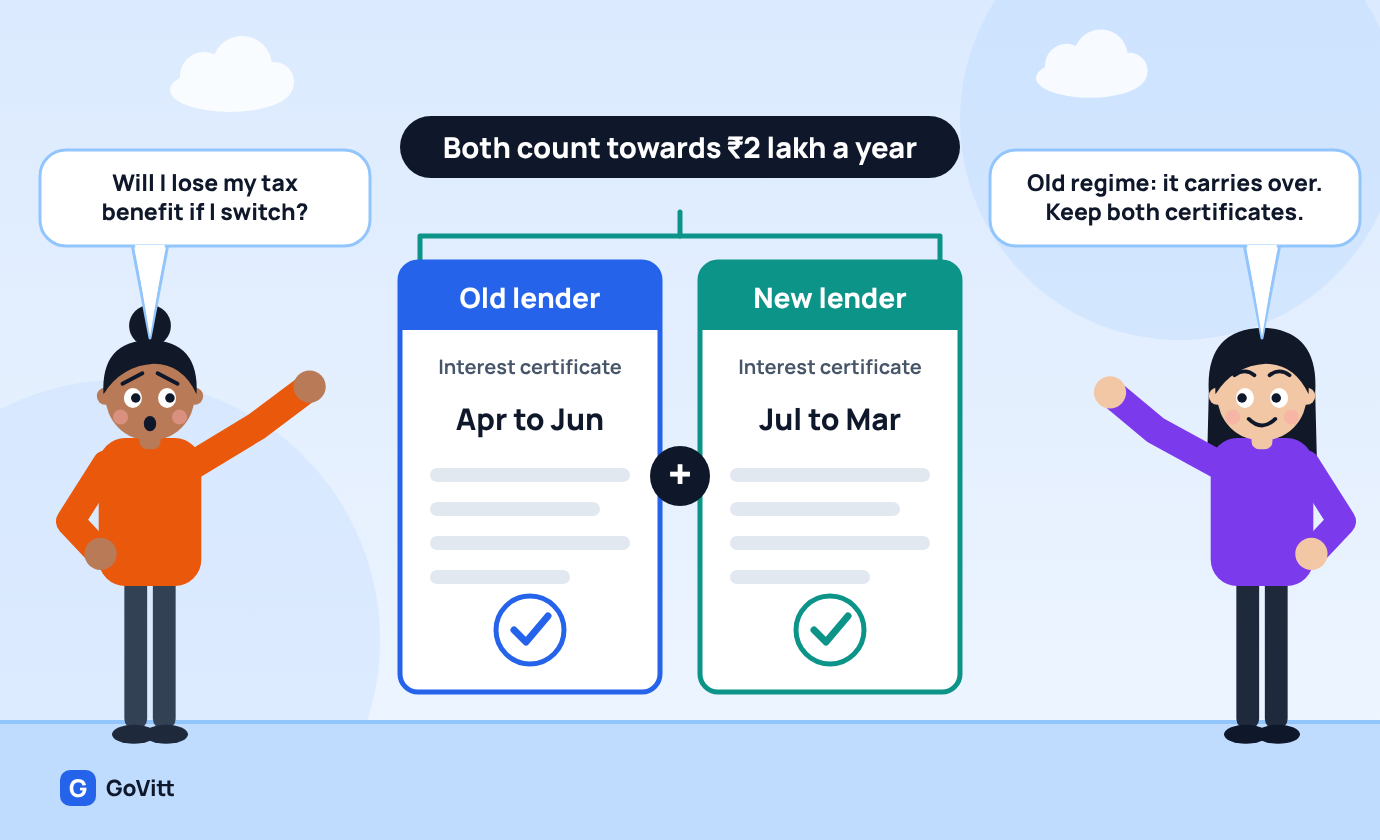
The tax benefit on home loan balance transfer mostly carries over, if you are on the old tax regime. The interest on your new loan still counts under Section 22 of the Income-tax Act, 2025, which replaced Section 24(b) on 1 April 2026, up to ₹2 lakh a year for a house you live in. What does not carry over: anything under the new regime, a top-up spent on something other than the house, and the principal you pay off at closing. And the ₹2 lakh cap can quietly eat part of your saving. On a ₹15 lakh loan moved from 8.75% to 7.50%, you save ₹14,064 in EMIs in the first year, and tax takes ₹5,849 of it.
Below: what carries over, what doesn't, how the cap changes the maths, how a top-up is treated, and what to collect from both lenders.
First, the honest part
This is not tax advice, and I am a CA writing about a rule that changed this year. Four limits on what I could check:
See your real payoff date in 60 seconds
Banks calculate remaining EMIs by simple subtraction. See your actual payoff date and discover how much interest a balance transfer can save.
- Where I read the law. I read Section 22 on the Income Tax Department's site. The Section 123 and new regime points come from a commercial guide (IndianHomeBuyer), and the rest from lender and tax guides, which disagree with each other in places.
- The closing payment. I found no ruling or circular that treats the lump sum that closes your old loan, paid out of the new loan, as principal you repaid. So I say do not claim it.
- Processing fee. Two guides say the fee counts as interest. I could not confirm that against the Act, so I say ask your CA before you rely on it.
- The five year test. The ₹2 lakh limit needs the house to be completed within five years of the end of the year in which the loan was borrowed. I could not confirm whether that clock restarts with the new loan. If your house was finished on time under the old loan, keep proof of the date.
What carries over after a balance transfer
| Item | After a transfer | Where it sits | What to know |
|---|---|---|---|
| Interest on the new loan | Carries over, old regime only | Section 22(1)(b), up to ₹2,00,000 for a self-occupied house | The Act's rule on the lender's certificate (Section 22(4)) covers interest on a new loan taken to repay the earlier borrowing |
| Principal in your EMIs to the new lender | Carries over, old regime only | Section 123, up to ₹1,50,000 with your other eligible items | Shared with PF, insurance, tuition fees and the rest |
| The lump sum that closes the old loan | Do not claim | Section 123 | It is paid out of the new loan. I found nothing that treats it as principal you repaid |
| Stamp duty on the new MODT | Unclear | Section 123 | The guides I read cover stamp duty on a purchase, not on a transfer. Do not count on it |
| Processing fee | Disputed | Counted as interest by two guides | Check with your CA. If you are already at the ₹2 lakh cap, it adds nothing |
| Prepayment or foreclosure charge | Moot for most | None | Floating rate loans to individuals carry no such charge. See the prepayment post |
Section 24(b) after a balance transfer: it is Section 22 now
If you search for "Section 24(b) balance transfer" you will find guides written for the old Act. The Income-tax Act, 2025 came into force on 1 April 2026, and the home loan interest deduction moved to Section 22. The limits did not change: ₹2,00,000 a year on a self-occupied house if the house is completed within five years of the end of the year you borrowed, and ₹30,000 in any other case. The principal and stamp duty deduction that used to be Section 80C is now Section 123, still ₹1,50,000 in total.
The part that protects a transfer is in Section 22(4). The lender's certificate has to state the interest on the borrowing, and also the interest on any new loan taken to repay it. In plain words: a loan you take to pay off your home loan still counts.
The year of the transfer: two lenders, one cap
In the year you move, you pay interest to two lenders. You claim both, but the ₹2 lakh limit is shared, not doubled. Collect:
- From the old lender: an interest and principal certificate up to the closure date.
- From the new lender: the same, from the first day of the new loan.
Give your employer the new lender's details in your tax declaration, or it may not allow the deduction when it works out your TDS. If you own the house jointly, check that the same co-borrowers are on the new loan, because each owner claims their own share.
The ₹2 lakh cap can eat part of your saving
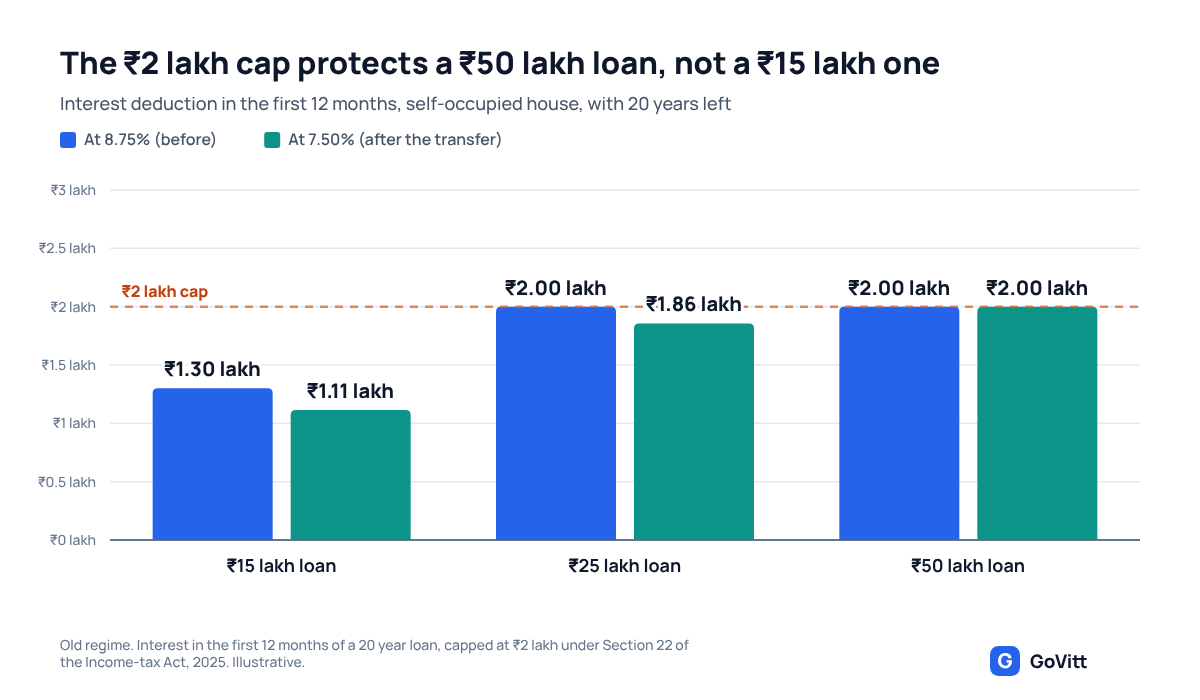
This is the part the guides skip. The cap is a ceiling. If your interest is above ₹2 lakh, a lower rate does not shrink your deduction. If your interest is below ₹2 lakh, it does, and you lose tax saving along with interest.
Take 20 years left, a move from 8.75% to 7.50%, and a taxpayer in the 30% slab (31.2% with cess):
| Loan | Deduction before | Deduction after | Tax saving lost | First-year EMI saving | Saving after the lost tax |
|---|---|---|---|---|---|
| ₹15 lakh | ₹1,30,107 | ₹1,11,359 | ₹5,849 | ₹14,064 | ₹8,215 |
| ₹25 lakh | ₹2,00,000 | ₹1,85,598 | ₹4,493 | ₹23,436 | ₹18,943 |
| ₹50 lakh | ₹2,00,000 | ₹2,00,000 | ₹0 | ₹46,872 | ₹46,872 |
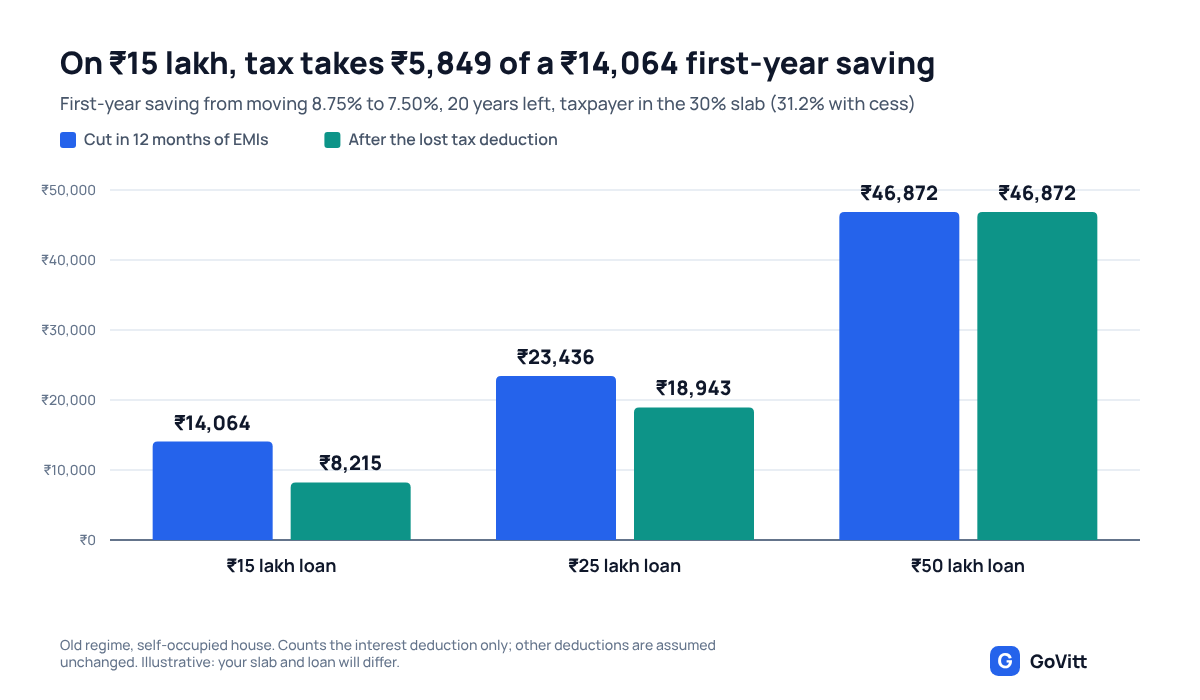
Look at the ₹15 lakh row. The EMI falls by ₹1,172 a month, ₹14,064 over the year. The deduction falls by ₹18,748, which costs you ₹5,849 in tax. You keep ₹8,215, about 58% of the headline saving. On ₹50 lakh the cap holds, and you keep all of it.
Three notes on that table. It covers the first 12 months only, because interest falls over the years and the cap stops mattering sooner or later. It counts the interest deduction only and assumes your other deductions do not change. And it is the old regime, self-occupied house.
None of this means "don't transfer a small loan." On ₹15 lakh you still keep ₹8,215 a year, and the calculator should be run on the after tax figure, not the headline one. The best banks post covers the lender side.
If you are on the new regime
Under the new regime, which is the default, Section 202(2) disallows the interest deduction on a self-occupied house and almost all of Chapter VIII, which includes Section 123. There is nothing to carry over, and nothing to lose. Judge the transfer on the pre-tax numbers. On a house you have let out, the interest is still allowed, but a resulting loss cannot be set off against other income or carried forward under the new regime. The two home loans post covers the let-out rules.
Top-up loan tax benefit
A transfer with a top-up gives you one new loan with two parts, and each part is taxed by what you spent it on. First-year interest on a ₹10 lakh top-up at 7.50% is ₹74,239. What you can claim depends on the use:
| What the top-up paid for | Interest deduction | Cap |
|---|---|---|
| Buying or building the house | Counts under Section 22(1)(b) | Inside the ₹2,00,000 |
| Repair, renewal or reconstruction | Counts, but limited | ₹30,000 a year for a self-occupied house (Section 22(2)(b)) |
| Anything else: a wedding, fees, a car, other debts, a business | None | Nil |
On the repair case, the most you can claim is ₹30,000, which saves ₹9,360 at 31.2%. If the top-up paid for something else, you save nothing on its interest. Keep the bills. The lender's certificate will not split the interest for you, and you may need to show where the money went. The top-up post covers the rule in more detail, and the balance transfer and top-up post covers when to combine them.
Under construction: the five instalments
If you borrowed for a flat that was not finished, the interest you paid before possession is claimed in five equal instalments, starting in the year of completion (Section 22(1)(c)). If you move the loan before then, keep both lenders' certificates for that period. Can you transfer a home loan on an under-construction flat? covers whether a lender will take it at all.
What I'd do this week
- Find your regime. Check which one you filed under last year. If it is the new regime, stop here and use the pre-tax numbers.
- Find your interest. Take your lender's certificate for last year. If the interest is under ₹2 lakh, use the after tax saving.
- Ask for both certificates in the year of the transfer, from the old and the new lender, split by date.
- Check the co-borrowers on the new loan match the old one.
- Tell your employer the new lender's details.
- Keep proof for any top-up spent on the house.
- Ask your CA about the processing fee and the closing payment before you claim either.
FAQ
Is there a tax benefit on a home loan balance transfer? Yes, on the old regime. Interest on the new loan still counts under Section 22, up to ₹2 lakh a year on a self-occupied house, and principal in your EMIs still counts under Section 123, up to ₹1.5 lakh with your other items. On the new regime there is no deduction on a self-occupied house, before or after.
Can I claim Section 24(b) after a balance transfer? Section 24(b) was replaced by Section 22 of the Income-tax Act, 2025 from 1 April 2026. The rule is the same in effect: interest on a new loan taken to repay the old one counts, up to ₹2 lakh for a self-occupied house, if you have the certificate.
Can I claim the principal I repaid when I closed the old loan? I would not. The payment is made out of the new loan, and I found nothing that treats it as principal you repaid. The principal in your EMIs to the new lender counts. Ask your CA if the sum is large.
Is there a tax benefit on a top-up loan? Only for what you spend on the house. Buying or building counts within the ₹2 lakh. Repair or reconstruction counts up to ₹30,000 a year on a self-occupied house. Any other use gets nothing. Keep the bills.
Does the processing fee on a balance transfer qualify for a deduction? Two guides say a processing fee is treated as interest, which would put it inside the ₹2 lakh cap. I could not confirm it against the Act. If you are already at the cap it makes no difference, so ask your CA first.
Not sure how the cap affects your switch? Talk to an advisor on WhatsApp with your outstanding loan, your rate and which regime you filed under. GoVitt compares 50+ banks and charges you 0% commission.
This is general information, not tax advice. Section 22 was read on the Income Tax Department's website on 2 November 2026; the other guides are dated in Sources. EMIs and first-year interest use the standard method, are rounded to the nearest rupee and assume 20 years left. Tax figures use the 30% slab plus 4% cess (31.2%), the old regime, a self-occupied house, and other deductions unchanged. Your slab, loan and dates will differ. Check your lender's certificates and ask your CA before you claim.
Ready to take the next step?
Find out your loan options and check your eligibility with GoVitt today.