
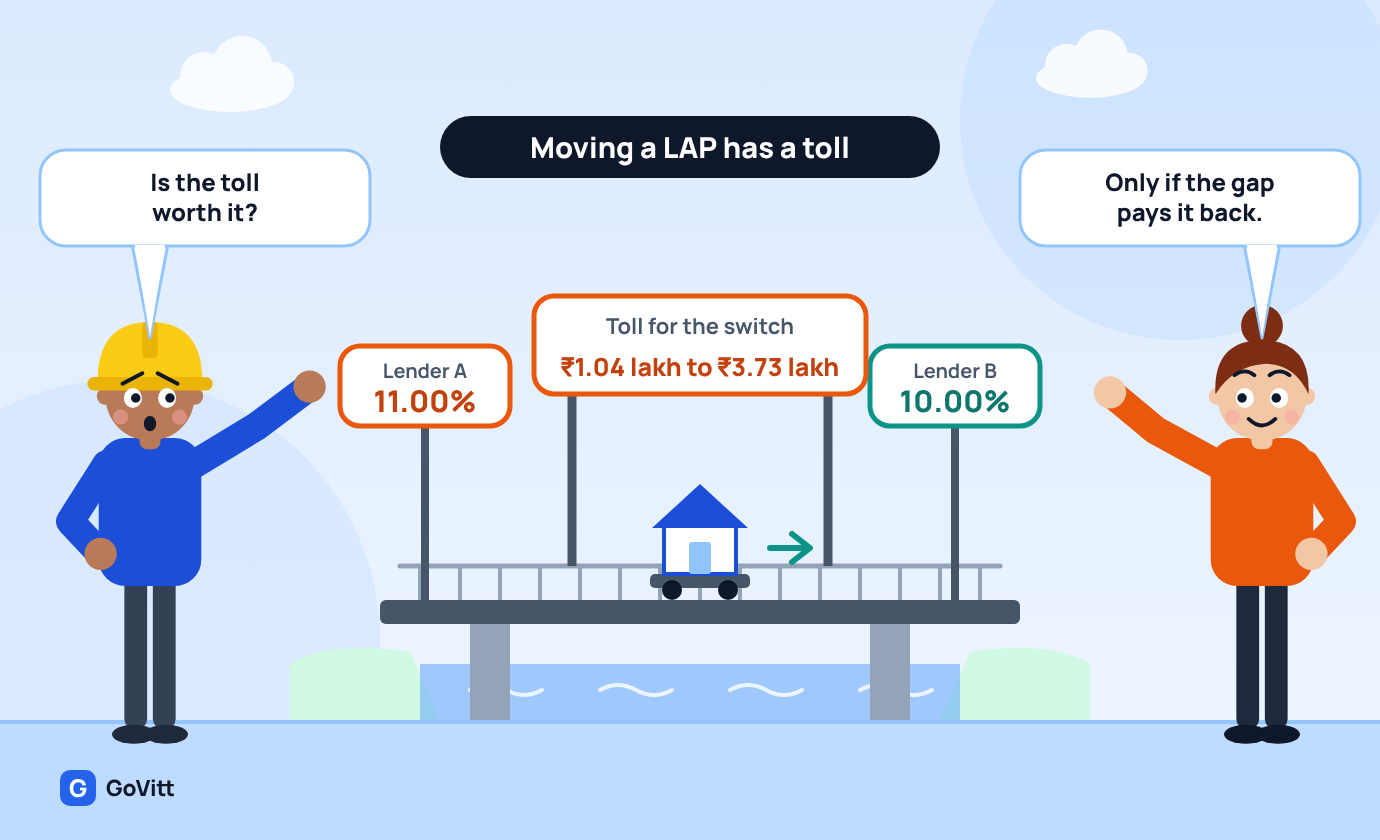
Loan against property balance transfer means a new lender pays off your current LAP, and you repay the new lender at a lower rate. Take a ₹50 lakh LAP with 12 years left at 11.00%. A 1% cut to 10.00% saves ₹2,924 a month. The costs, on the figures lenders publish, run from ₹1.04 lakh to ₹3.73 lakh. At the low end that takes 36 months to come back, and with a foreclosure charge on the old loan, 70 months.
That is why a LAP balance transfer needs a bigger gap than a home loan transfer. The fees are higher, the new lender values the property again, and the old lender may charge you to leave. Below: how the transfer works, what each side charges, who pays an exit fee, and the gap I'd want before I moved. The loan itself is explained in loan against property in 2026: rates, how much you can borrow, and the fine print.
First, the honest part
I couldn't find a lender page that says how many EMIs you must have paid before a LAP transfer, or one that publishes a conversion fee for staying with your current lender and taking a lower rate. Ask both questions. The pages I read also disagree with themselves:
See your real payoff date in 60 seconds
Banks calculate remaining EMIs by simple subtraction. See your actual payoff date and discover how much interest a balance transfer can save.
- L&T Finance lists a processing fee of "up to 3%" in its fee section and "approximately 1%" in its FAQ.
- Shriram Finance gives a valuation fee of ₹3,000 to ₹8,000 in a metro in its text and "₹3,000 to over ₹10,000" in its FAQ.
- Bajaj Finserv's fee page is undated, though it mentions an interest rate policy of March 2026.
So the cost table below shows a light case and a ceiling case, and your sanction letter will land somewhere between them or above.
How a LAP transfer works
- The new lender checks you and the property afresh. Income, credit score (L&T prefers 700 or above), title, and a new valuation.
- You get a sanction letter with the rate, the fees and the amount. The amount can include a top-up on the old balance, which I come to below.
- You get a foreclosure letter and a statement of account from your current lender. The new lender needs both.
- In a typical transfer the new lender pays the old one directly, and your original property papers move across.
- A new mortgage is registered. In Karnataka that is a MODT: stamp duty of 0.5% plus about 0.1% registration, which is ₹30,000 on ₹50 lakh.
The steps for a home loan are the same, and I've covered where they get stuck in home loan transfer process: what actually happens step by step.
What lenders publish
| Lender and source | Interest rate | Other terms |
|---|---|---|
| Bajaj Finserv, LAP balance transfer fees page (fee schedule undated) | 7.50% to 14.25% | Processing up to 3.54% including taxes; documentation up to ₹2,360; mortgage origination fee up to ₹6,000 a property |
| L&T Finance, LAP balance transfer page (read 3 November 2026) | From 9.40% (its calculator runs 9.00% to 13%) | Up to ₹7 crore; 12 to 240 months; CIBIL 700 or above preferred; top-up available alongside |
These are ranges, not what you'd be offered. Rate floors need a strong score, stable income and a clean property.
What it costs on ₹50 lakh
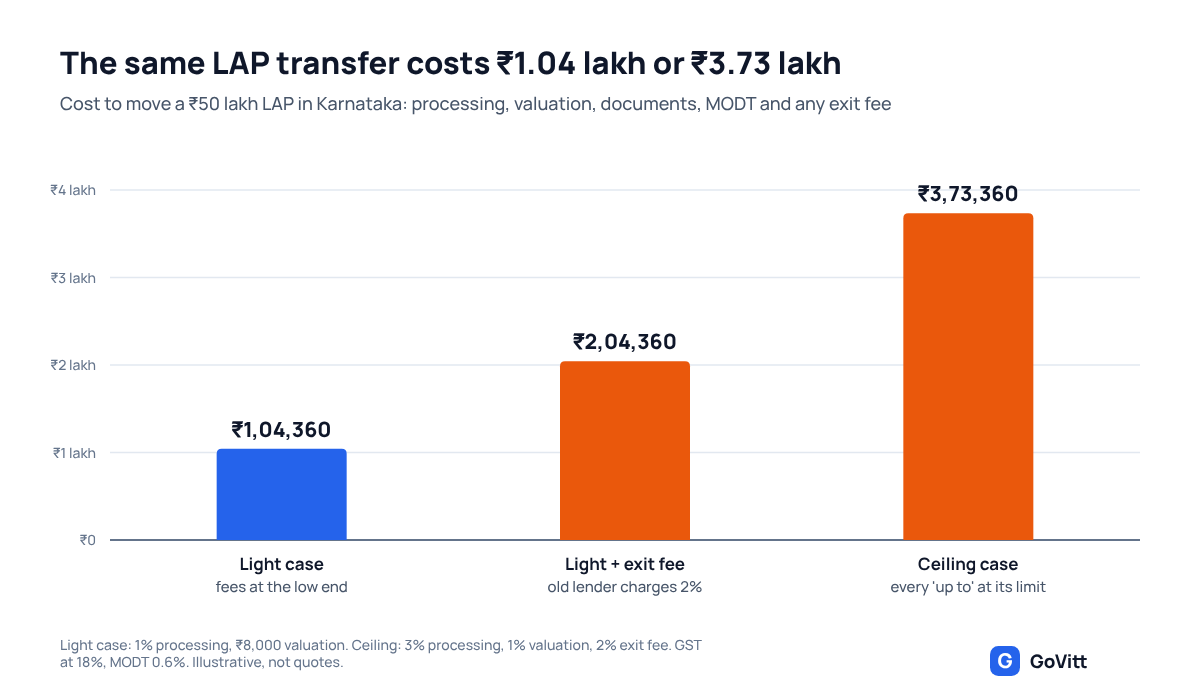
| Cost | Light case | Ceiling case | Where the figure comes from |
|---|---|---|---|
| Processing fee | ₹59,000 (1% plus GST) | ₹1,77,000 (3% plus GST) | L&T FAQ and L&T fee section; Bajaj Finserv's 3.54% gives the same ₹1,77,000 |
| Valuation | ₹8,000 | ₹59,000 (1% plus GST) | Top of Shriram's metro range; L&T's "up to 1%" |
| Login and documentation | ₹7,360 | ₹7,360 | L&T: login up to ₹5,000, documentation up to ₹2,000 plus GST |
| MODT in Karnataka (0.6%) | ₹30,000 | ₹30,000 | GoVitt MODT figures |
| Foreclosure on the old loan | ₹0 | ₹1,00,000 (2%) | Next section |
Total
₹1,04,360
₹3,73,360
The light case is not a quote either. It takes the lower processing fee in L&T's FAQ, the top of Shriram's metro valuation range, and the stated maximum where a page gives only a maximum. The ceiling case takes every "up to" at its limit. For the home loan version of this list, see home loan balance transfer charges: every fee you'll pay.
Will your current lender charge you to leave?
This is the line that moves the break-even most, and it depends on four things: the rate type, what the loan was for, who borrowed, and when it was sanctioned. RBI's Pre-payment Charges Directions, 2025, apply to loans "sanctioned or renewed on or after January 1, 2026".
| Your current LAP | Exit charge |
|---|---|
| Floating rate, to an individual, for personal use | None. RBI bars it, and L&T's page lists nil. |
Floating rate, to an individual or MSE, for business, sanctioned or renewed on or after 1 January 2026, by a commercial bank (not a small finance, regional rural or local area bank), a Tier 4 urban co-operative bank, an upper layer NBFC or an All India Financial Institution
None
Same, from a small finance bank, regional rural bank, Tier 3 urban co-operative bank, state or central co-operative bank, or a middle layer NBFC
None on a sanctioned amount up to ₹50 lakh. Above that, the lender's approved policy.
Floating rate, for business, sanctioned before 1 January 2026
Check your agreement. The Directions' start date doesn't reach back.
Fixed rate
The lender's policy. L&T lists up to 4% in the first year and up to 3% after for an individual; Bajaj Finserv up to 4.72% including taxes.
A company, LLP or firm that isn't an MSE
The lender's policy
L&T's page still lists up to 3% (first year) and up to 2% (after) for business use, and Shriram's explainer says 2% to 5% within 1 to 5 years. Whether those apply to you depends on the lender's category and your sanction date. I've set out the full rule in loan against property for business, including a new business. Don't rely on a lender's web page. Read the prepayment clause in your own sanction letter and ask for the foreclosure amount in writing.
The break-even: how big a gap do you need?
Base case: ₹50 lakh outstanding, 144 EMIs left, current rate 11.00%, EMI ₹62,678. The 11.00% is my assumption for a LAP at the high end of a bank's range or from an NBFC.
| Rate gap | New rate | New EMI | Saved a month | Pays back (light) | Pays back (light + 2% foreclosure) | Pays back (ceiling) | Net saving over 12 years (light) |
|---|---|---|---|---|---|---|---|
| 0.50% | 10.50% | ₹61,207 | ₹1,471 | 71 months | 139 months | 254 months | ₹1,07,464 |
| 1.00% | 10.00% | ₹59,754 | ₹2,924 | 36 months | 70 months | 128 months | ₹3,16,696 |
| 1.50% | 9.50% | ₹58,319 | ₹4,359 | 24 months | 47 months | 86 months | ₹5,23,336 |
| 2.00% | 9.00% | ₹56,902 | ₹5,776 | 19 months | 36 months | 65 months | ₹7,27,384 |
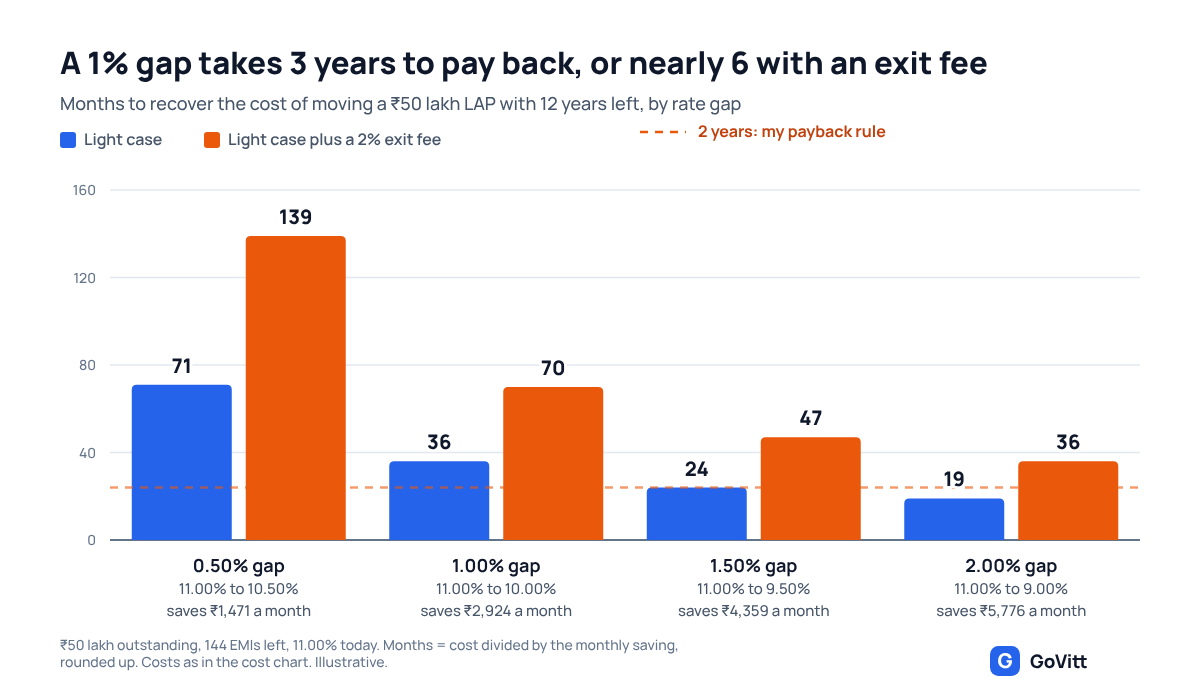
My rule for any transfer: the costs should come back in under two years, and you should expect to hold the loan at least twice that long. On a LAP, only a gap of 1.5% or more passes in the light case, and a 1% gap passes only if the old loan carries no exit charge and your fees are at the low end. A 0.50% gap takes nearly 6 years even then.
If your gap is under 1%, ask your current lender for a rate cut first, in writing. I couldn't find a published LAP conversion fee, so the answer is whatever it tells you. And part prepayments carry no charge on a floating rate loan to an individual for personal use, so extra cash does more good there than fees do.
Top-up with the transfer
L&T says a top-up is available alongside a balance transfer, with the amount set by income, property value, outstanding loan, credit profile and repayment capacity. It gives no limit or rate. A top-up on a transfer is borrowed at the new rate, so compare it with a fresh LAP and with a home loan top-up in top-up vs loan against property vs personal loan. Borrow only what you need. A bigger loan raises the EMI and the interest.
Documents
L&T's page lists these, and other lenders ask for similar sets:
- Identity and address: Aadhaar, PAN, passport or a utility bill under two months old.
- Income, salaried: 3 months of salary slips, 6 months of bank statements, Form 16 and ITRs.
- Income, self-employed: 2 years of ITRs and bank statements (1 year for professionals), plus audited financials where they apply.
- Property: title deed, registered sale deed, latest property tax receipts, approved building plan.
- Existing loan: statement of account and the foreclosure letter.
The home loan version of this checklist is in documents required for home loan balance transfer.
When I wouldn't transfer
- The gap is under 1% and your costs sit anywhere above the light case.
- You have 3 to 4 years left. The costs won't come back.
- Your loan is fixed rate with a 3% to 4% exit charge. Wait for the fixed period to end, or price the exit charge into the break-even above.
- You'd borrow more than you need because a top-up is on offer.
- The new rate is a teaser. Ask for the benchmark and the spread, not the headline.
What I'd do this week
- Pull the old loan's sanction letter. Note the date, rate type, what it was for, who the borrower is and the prepayment clause.
- Get your outstanding balance and EMIs left from the latest statement.
- Run the break-even with your own gap and your own cost. Use the table above as a template.
- Ask two lenders in writing for the rate, the benchmark and spread, the processing fee, the valuation fee and every other charge.
- Ask your current lender for a rate cut, and for the foreclosure amount in writing.
- Sign only when the foreclosure amount matches your statement and the fee you were quoted matches the sanction letter.
FAQ
What is a loan against property balance transfer? It is moving your LAP from one lender to another that charges a lower rate. The new lender pays off the old one, takes a fresh mortgage on the property, and you repay it. A LAP balance transfer can include a top-up if the new lender allows one.
Is there a foreclosure charge when I transfer my LAP? It depends on the rate type, what the loan was for, who borrowed and when it was sanctioned. Floating rate loans to individuals for personal use carry none. Some floating rate business loans sanctioned or renewed on or after 1 January 2026 carry none. Fixed rate loans can carry up to 4% at L&T. Check your sanction letter.
How much lower should the new rate be? On ₹50 lakh with 12 years left, a 1.5% gap pays the light case back in 24 months. A 1% gap takes 36 months, and 70 months with a 2% exit charge. Under 1%, ask your current lender for a cut first.
What does a LAP balance transfer cost in Bengaluru? On ₹50 lakh, my light case is ₹1,04,360 and the ceiling case ₹3,73,360. That includes ₹30,000 for the Karnataka MODT: 0.5% stamp duty plus about 0.1% registration.
Can I get a top-up with a loan against property balance transfer? L&T says yes, with the amount decided by income, property value, outstanding loan, credit profile and repayment capacity. It publishes no limit. The top-up is borrowed at the new rate.
What documents do I need? Identity and address proof, income proof (salary slips, bank statements, Form 16 and ITRs for salaried borrowers; two years of ITRs and statements for self-employed borrowers), the property papers, and the statement of account and foreclosure letter from your current lender.
Not sure if your LAP is worth moving? Talk to an advisor on WhatsApp with your outstanding balance, rate, months left, what the loan was for and the date it was sanctioned. GoVitt compares 50+ banks and charges you 0% commission. For home loans, see the home loan balance transfer page.
Lender pages read on 3 November 2026; undated pages are marked. The 11.00% current rate, the new rates and the ₹50 lakh outstanding with 144 EMIs left are assumptions, not quotes. EMIs use the standard monthly reducing balance method, rounded to the nearest rupee. Payback months are the cost divided by the monthly saving, rounded up. Fees with GST use 18%, and the MODT uses 0.5% stamp duty plus about 0.1% registration. The RBI rule is summarised from paragraphs 3, 4 and 5 of the Directions, and your lender's category matters. Check your sanction letter and Key Facts Statement before you act. This is information, not financial advice.
Ready to take the next step?
Find out your loan options and check your eligibility with GoVitt today.