
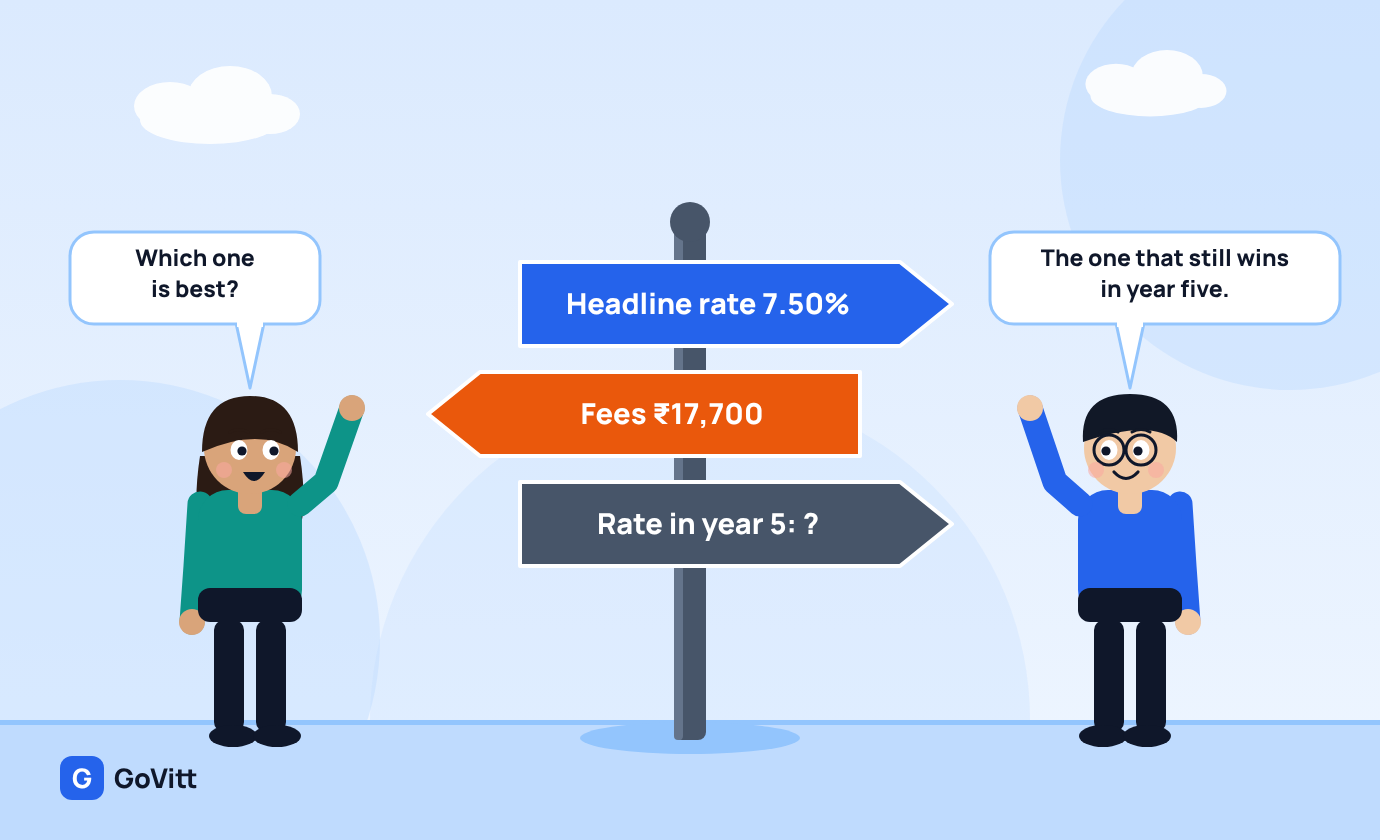
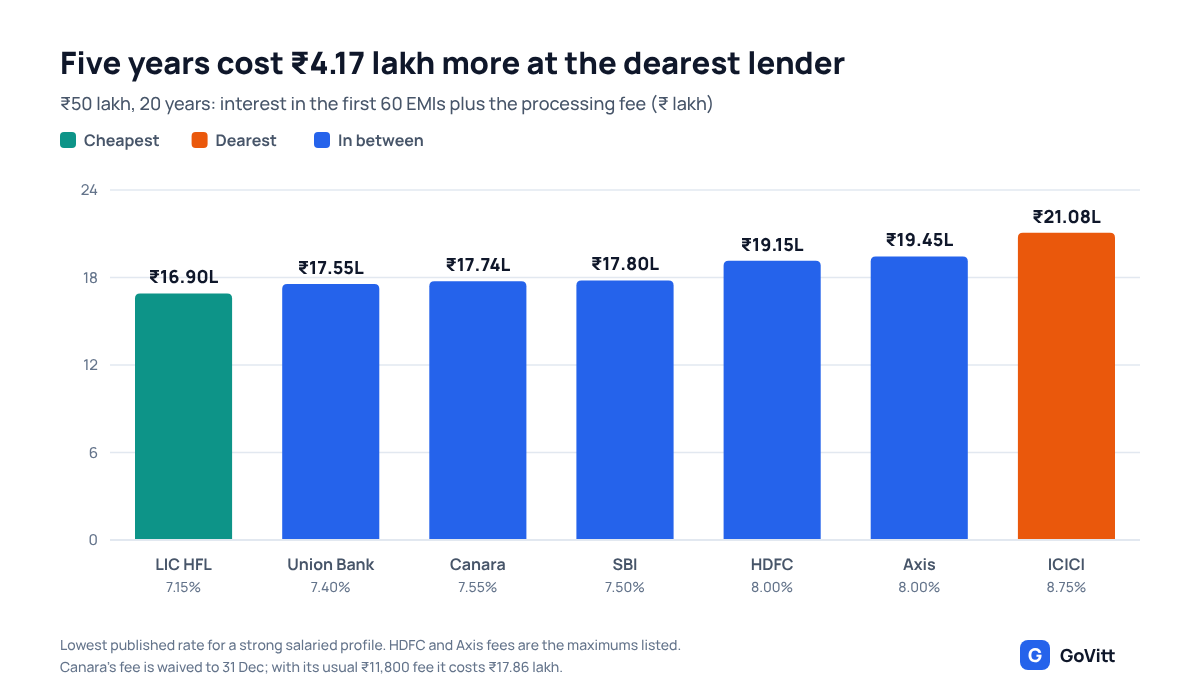
Best home loan in India? There isn't one for everybody. There is the loan that costs you least over the years you'll actually hold it. Take ₹50 lakh over 20 years. Counting interest and the lender's own processing fee for the first five years, that cost runs from ₹16.90 lakh at the cheapest lender I checked to ₹21.08 lakh at the dearest. Same loan, a gap of ₹4.17 lakh.
The rate explains most of that gap, not all of it. Fees reorder lenders that sit close together, and your score decides whether you ever see the advertised rate. So which bank is best for a home loan comes down to three things: the spread you're quoted, the fees you pay, and how long you'll stay. Below: what eight lenders publish, a five-year scoreboard, what a quarter point is worth, and the seven things I'd ask for in writing before I sign.
The short answer
For a salaried borrower with a score of 825 or more, the lowest five-year cost on ₹50 lakh comes from LIC Housing Finance at ₹16.90 lakh. Union Bank of India (₹17.55 lakh), Canara Bank (₹17.74 lakh) and SBI (₹17.80 lakh) follow. HDFC Bank and Axis Bank at 8.00% cost ₹1.36 lakh and ₹1.65 lakh more than SBI. ICICI Bank's table rate of 8.75% costs ₹3.28 lakh more. Those are floor rates for the best profiles, so your own order can change. The sections below show how.
See your real payoff date in 60 seconds
Banks calculate remaining EMIs by simple subtraction. See your actual payoff date and discover how much interest a balance transfer can save.
First, the honest part
I couldn't load SBI's, HDFC's, Canara's or Axis's rate pages on 4 November, so those rows use what I read on 24 to 26 October. LIC's grid is from 22 October, Union's rate sheet (dated 8 October) was read on 28 October, and PNB's rate card is from 12 October. Only ICICI's page loaded today, and it still shows rates valid till 31 October. The repo rate is 5.50% and the next RBI decision is on 2 to 4 December, but a bank can change its spread or fee at any time. Open the lender's own page on the day you apply.
Axis contradicts itself: its table starts at 8.00% and its page description says 8.20%. I used the table.
What each lender publishes
Eight lenders, each at the lowest rate it shows, as last read:
| Lender | Lowest rate shown | What it takes | Benchmark | Rate above the 5.50% repo |
|---|---|---|---|---|
| LIC Housing Finance | 7.15% | Score 825 and above, loan up to ₹50 lakh | Its own prime lending rate | 1.65% (not repo-linked) |
| Union Bank of India | 7.40% | Score 825 and above (7.45% at 800 to 824) | EBLR 8.25%, which is repo plus 2.75% | 1.90% |
| PNB | 7.45% | Score 800 and above, rate card of 12 October | Not stated on the card | 1.95% |
| SBI | 7.50% | Strongest profiles, no public score grid | EBLR 8.15%, which is repo plus 2.65% | 2.00% |
| Canara Bank | 7.55% | Top credit grade, loan up to ₹50 lakh | RLLR 8.25% | 2.05% |
| HDFC Bank | 8.00% | Strongest profiles | Repo plus 2.50% to 7.95% | 2.50% |
| Axis Bank | 8.00% (page description says 8.20%) | Score 751 and above, 8.20% at 750 and below | Repo plus 2.50% to 3.35% | 2.50% |
| ICICI Bank | 8.75% (7.80% only for pre-approved digital loans) | Score 750 and above, salaried | Repo-linked | 3.25% |
Union Bank's full score grid, from 7.40% up to 9.60%, is in Union Bank home loan interest rate (October 2026). LIC is a housing finance company, so it sets its own rate and decides when to move it, as I explain in LIC Housing Finance home loan interest rate (October 2026). The bank-by-bank detail is in the posts on SBI, HDFC, ICICI, Canara and Axis.
The rate you see is the floor, not your rate
Every lender advertises the rate for its best borrower. Yours sits somewhere between that floor and the top of your band, and the distance is worth real money.
Axis shows 8.00% to 8.85% for the same score band of 751 and above. On ₹50 lakh over 20 years, that is an EMI of ₹41,822 against ₹44,505. The difference is ₹2,683 a month, ₹32,196 a year and ₹2.11 lakh over five years. A band that wide is worth more than most fee waivers. So don't ask "who has the lowest rate?" Ask "what spread will you give me, in writing?" I explain how your score moves it in RBI moved your home loan rate by 0.25%. Your CIBIL score can move it by 1.80%.
The five-year scoreboard
Base case: ₹50 lakh, 20 years, a new loan, a salaried borrower. For each lender I took the lowest rate it publishes, its EMI, its processing fee with 18% GST, and the interest in the first 60 EMIs. Five-year cost is the interest plus the fee. I left PNB out because I couldn't confirm its fee on a new loan. Union's fee is 0.50% capped at ₹15,000, plus GST.
| Lender | Rate used | EMI | Processing fee with GST | Interest in 5 years | Five-year cost | Still owed after 5 years |
|---|---|---|---|---|---|---|
| LIC Housing Finance | 7.15% | ₹39,216 | ₹14,750 | ₹16,75,622 | ₹16,90,372 | ₹43,22,662 |
| Union Bank of India | 7.40% | ₹39,974 | ₹17,700 | ₹17,37,212 | ₹17,54,912 | ₹43,38,772 |
| Canara Bank | 7.55% | ₹40,433 | ₹0 while the waiver lasts | ₹17,74,228 | ₹17,74,228 | ₹43,48,248 |
| SBI | 7.50% | ₹40,280 | ₹17,700 | ₹17,61,879 | ₹17,79,579 | ₹43,45,079 |
| HDFC Bank | 8.00% | ₹41,822 | Up to ₹29,500 | ₹18,85,600 | ₹19,15,100 | ₹43,76,280 |
| Axis Bank | 8.00% | ₹41,822 | Up to ₹59,000 | ₹18,85,600 | ₹19,44,600 | ₹43,76,280 |
| ICICI Bank | 8.75% | ₹44,186 | ₹35,400 | ₹20,72,117 | ₹21,07,517 | ₹44,20,957 |
Four things stand out:
- A fee waiver can beat a lower rate, for now. Canara's rate is 0.05% above SBI's, which costs ₹153 a month. With its fee waived, Canara still comes out ₹5,351 cheaper over five years. When the waiver ends on 31 December and Canara's usual ₹11,800 fee returns, SBI wins by ₹6,449. Same rates, different fee, opposite order. Union Bank, at 7.40% with a ₹17,700 fee, beats both, by ₹19,316 against Canara's waived fee and ₹24,667 against SBI.
- Two lenders at 8.00% can sit ₹29,500 apart. The HDFC and Axis fees are the maximums their pages list, so yours may be lower, and negotiating it is worth a call.
- The rate gap compounds. 8.00% instead of 7.50% costs ₹1,542 more every month and ₹1,23,721 more in interest over five years.
- Don't plan around ICICI's 7.80%. It applies only to pre-approved digital loans and depends on your bureau score. The table rate of 8.75% costs ₹3.28 lakh more than SBI over five years.
What a quarter point is worth
A 0.25% lower rate sounds small. On ₹50 lakh over 20 years, 8.00% instead of 8.25% saves ₹781 a month. Here is what it does at four loan sizes, and the fee it justifies if you want that fee back inside two years:
| Loan size | EMI at 8.25% | EMI at 8.00% | Saved a month | Interest saved in 5 years | Fee worth paying (24 months of saving) |
|---|---|---|---|---|---|
| ₹30 lakh | ₹25,562 | ₹25,093 | ₹469 | ₹37,231 | ₹11,256 |
| ₹50 lakh | ₹42,603 | ₹41,822 | ₹781 | ₹62,054 | ₹18,744 |
| ₹75 lakh | ₹63,905 | ₹62,733 | ₹1,172 | ₹93,083 | ₹28,128 |
| ₹1 crore | ₹85,207 | ₹83,644 | ₹1,563 | ₹1,24,102 | ₹37,512 |
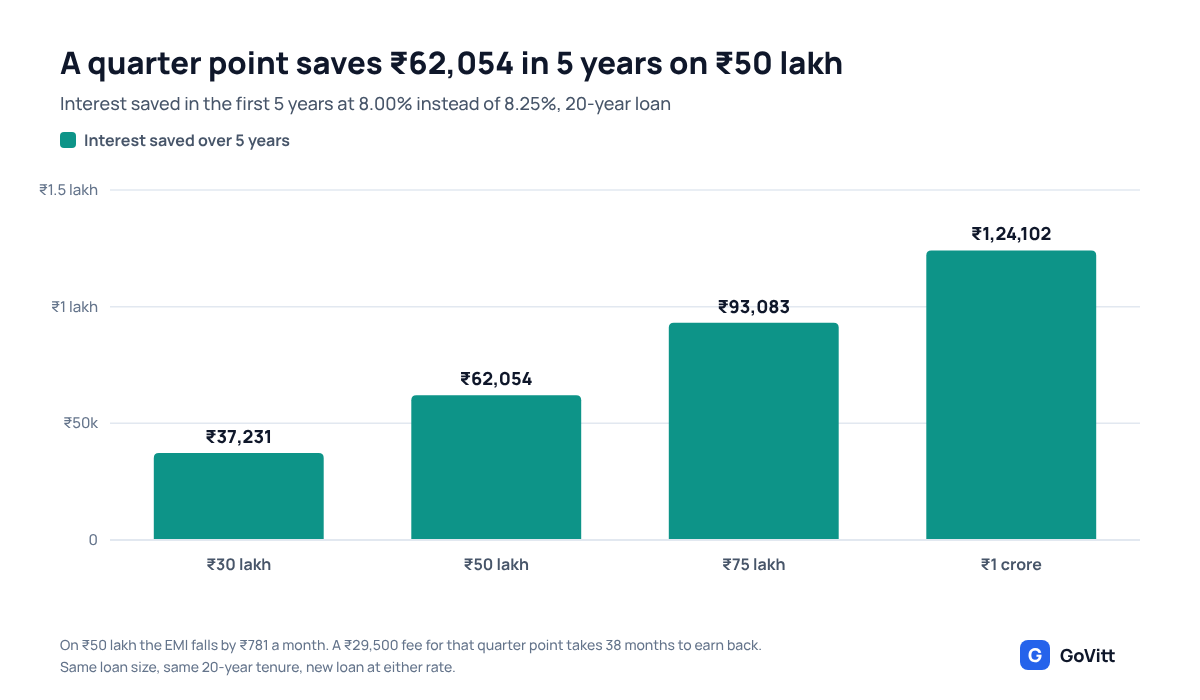
My rule: I want a fee back inside two years. On ₹50 lakh, a quarter point justifies about ₹18,744 of extra fees. A ₹29,500 fee for that same quarter point takes 38 months to earn back. Past two years, the lender with the lower fee is the better bet, unless you expect to keep the loan for most of its term.
What stays the same in year five: the spread
Banks' floating rate home loans are tied to an external benchmark, and the rate resets at least once every three months. That is RBI's 2019 framework. When repo moves, every repo-linked bank moves with it, so the order between banks doesn't change. The spread does the sorting.
RBI's circular lets the lender change the credit risk premium only when your credit assessment changes substantially, and the other spread components once every three years. So the spread you sign is largely the spread you carry. I'd rather negotiate 0.10% off the spread today than chase a teaser. I show how those offers work in festive home loan offers 2026, and why your rate sits above the advertised one in why your home loan rate is higher than what the bank advertises.
Two more rules help you after you sign:
- A hike has to be explained. RBI's August 2023 circular says the lender must tell you at sanction how a benchmark change can affect your EMI or tenure, and at each reset offer you a choice of a higher EMI, a longer tenure or both. You can also prepay part or all of the loan.
- Prepayment is free on most floating rate loans. RBI's Pre-payment Charges Directions, 2025, bar a charge on floating rate loans to individuals for personal use, for loans sanctioned or renewed on or after 1 January 2026. I go through the rule in your bank can't charge you for prepaying a floating rate home loan.
The seven things I ask for in writing
| What to ask for | What a good answer looks like | Why it matters |
|---|---|---|
| The spread and the reset date | A number in the sanction letter, the benchmark named, a reset at least every three months | It's the part of the rate that stays with you |
| Every fee, as one figure | A Key Facts Statement with an APR | RBI requires one on new loans from 1 October 2024, and a charge missing from it can't be levied without your consent |
| What a rate hike does | Your choice of EMI up, tenure up or both | RBI's 2023 rules require the lender to explain this and offer the options |
| Prepayment charges | None on a floating rate loan to an individual | You can part-prepay whenever you have spare cash |
| The cost to reprice later | A written figure | ICICI, Axis, SBI (old MCLR or base rate loans) and HDFC listed ₹3,000 to ₹5,000 plus tax when I checked in October |
| The loan amount | RBI's caps: 90% for loans up to ₹30 lakh, 80% for ₹30 lakh to ₹75 lakh, 75% above ₹75 lakh | It decides how much cash you bring |
| Whether the lender has approved your project | A yes before you pay a token amount | A loan refused after the booking is a loan you can't use |
The last row is the one buyers skip. I cover it in before you pay that booking amount, and the usual application errors in top mistakes to avoid when applying for a home loan.
Which lender suits which borrower
| Your situation | Start with | Watch out for |
|---|---|---|
| Salaried, score 825 or more, loan up to ₹50 lakh | LIC Housing Finance, Union Bank, SBI, Canara | LIC sets its own rate, and Canara's waiver ends 31 December |
| Salaried, score 750 to 800 | SBI, Canara, Axis, HDFC | The band you land in. Get the spread in writing |
| Self-employed | Axis (one table for both), ICICI (8.75% to 10.05%), LIC (about 0.10% more than salaried) | HDFC's fee for non-professionals, up to 1.50% |
| Already paying 8.25% or more | Ask your own bank to reprice, then compare transfers | The gap has to clear your costs |
If you're already in a loan, the comparison moves to a switch. I rank the lenders for that in best banks for home loan balance transfer in 2026, and the process is on the home loan balance transfer page. For the rate side across lenders, see the average home loan interest rate in India right now.
What I'd do this week
- Pull your score. It decides the band, and the band decides the rate.
- Ask three lenders for written quotes. Get the spread, the benchmark, the processing fee and the Key Facts Statement with its APR.
- Work out the five-year cost for each. Add the interest in the first 60 EMIs to the fee. Use the EMI calculator for the EMI, then total the interest in the first 60 rows of the repayment schedule the lender gives you.
- Apply the two-year fee rule. If a lender's fee is higher, check that its lower rate earns the fee back inside two years.
- Ask what "sanctioned" means for any waiver. Canara's runs to 31 December.
- Negotiate the spread, not the fee. The spread is the part you keep paying.
FAQ
What is the best home loan in India? There is no single best loan. On ₹50 lakh over 20 years, the five-year cost runs from ₹16.90 lakh to ₹21.08 lakh across the lenders I checked, mostly because of rate and fee differences. The best one for you is the lowest five-year cost at the spread you're quoted.
Which bank is best for a home loan? For a salaried borrower with a strong score, LIC Housing Finance, Union Bank, SBI and Canara Bank publish the lowest rates, from 7.15% to 7.55%. HDFC Bank and Axis Bank start at 8.00%, and ICICI Bank's table rate is 8.75%. Rates are as of 22 to 28 October 2026, with ICICI re-read on 4 November.
Is the lowest interest rate always the best home loan? No. Canara at 7.55% with no fee beats SBI at 7.50% by ₹5,351 over five years, and loses by ₹6,449 once Canara's fee returns. Compare rate, fee and the years you'll hold the loan.
How much does 0.25% matter on a home loan? On ₹50 lakh over 20 years, 8.00% instead of 8.25% saves ₹781 a month and ₹62,054 of interest in five years. On ₹1 crore it saves ₹1,24,102.
Can I switch if I pick the wrong home loan? Yes, but it costs money. Ask your own bank to reprice first, then compare a transfer. A gap under 0.50% rarely pays for a move.
Want the five-year cost for your own profile? Compare rates from 50+ banks and see what your score qualifies for. GoVitt compares 50+ banks and charges you 0% commission.
Rates and fees as last read: SBI, HDFC Bank, Axis Bank and Canara Bank on 24 to 26 October 2026, LIC Housing Finance on 22 October, Union Bank of India on 28 October (rate sheet dated 8 October), PNB on 12 October and ICICI Bank on 4 November (its rates are marked valid till 31 October). I could not reload the SBI, HDFC, Canara and Axis pages on 4 November, so confirm each on the lender's own site. EMIs use the standard monthly reducing balance method, rounded to the nearest rupee. Five-year cost is the interest in the first 60 EMIs plus the processing fee with 18% GST. The scoreboard uses each lender's lowest published rate for a strong salaried profile, and the HDFC and Axis fees are the maximums listed. Your rate and fee will differ. Festive waivers change often. Get every figure in writing before you sign. This is information, not financial advice.
Ready to take the next step?
Find out your loan options and check your eligibility with GoVitt today.