
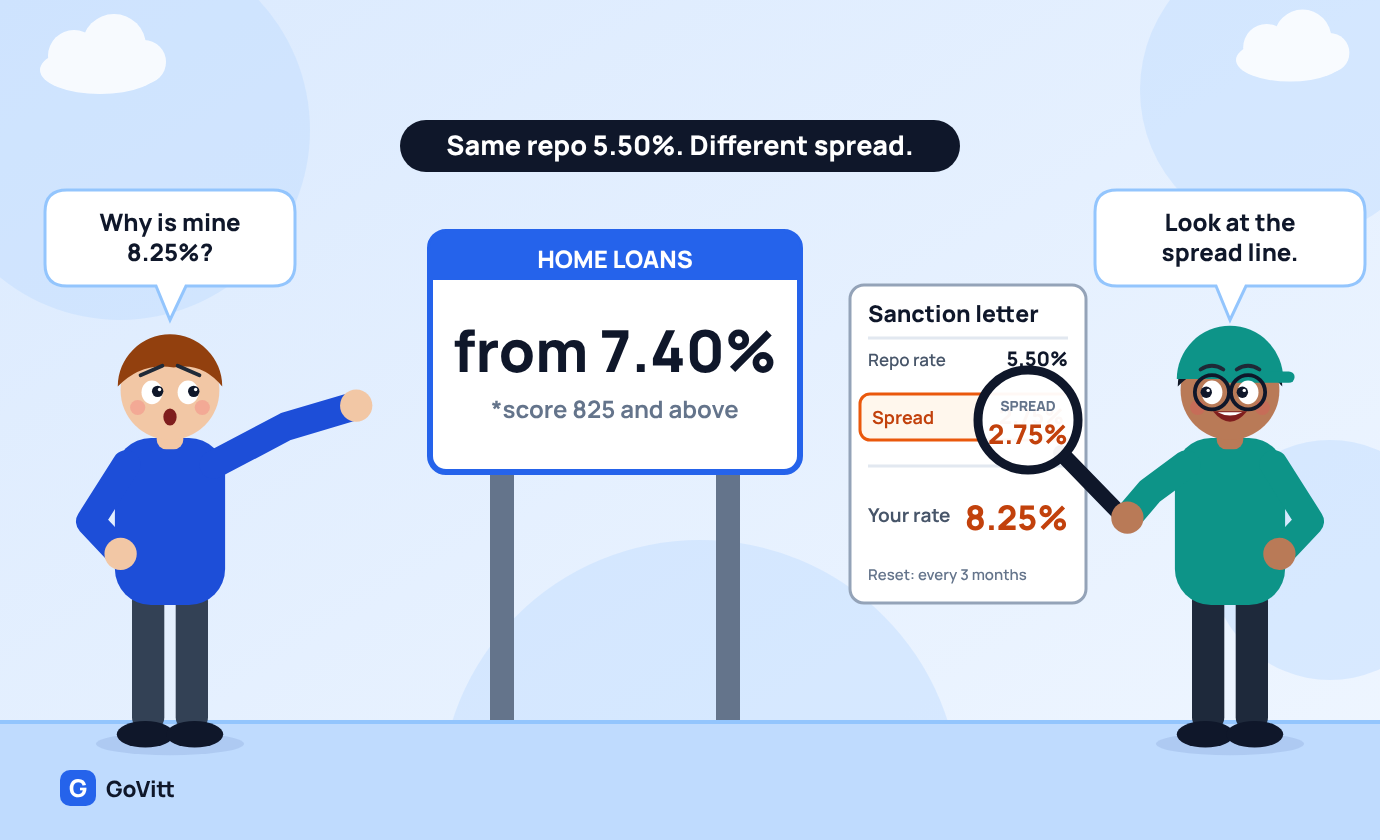
Why is my home loan interest rate high? Because the rate in the bank's ad is its best rate, for its best borrower. Yours is the same benchmark plus a spread that was fixed on the day you were sanctioned. At Union Bank today, repo is 5.50% for everybody. A borrower with a score of 825 or more pays 7.40%, and one with a score of 600 to 649 pays 9.60%. On ₹50 lakh over 20 years that is ₹39,974 against ₹46,934, a difference of ₹6,960 a month, at the same bank on the same day.
The short version: your rate is a benchmark plus a spread. The benchmark moves for everyone. The spread is yours, and most of what makes it high can be changed by asking in writing. Below: what the spread is made of, the six reasons yours sits above the banner, how to read your own sanction letter, and when to ask your bank versus when to move the loan.
What your rate is made of
A repo-linked home loan has three parts:
See your real payoff date in 60 seconds
Banks calculate remaining EMIs by simple subtraction. See your actual payoff date and discover how much interest a balance transfer can save.
| Part | What it is | How it can change |
|---|---|---|
| Benchmark | The repo rate, 5.50% since 7 October 2026 | Your lender has to reset it at least once in three months |
| Credit risk premium | The extra the bank charges for the risk it sees in you: score, income type, loan size | Under RBI's 2019 rules, only if your credit assessment changes substantially, as agreed in your loan contract |
| Other spread | The bank's operating costs and margin | Once in three years, and the bank may cut it earlier to your benefit |
Union Bank shows the arithmetic in its own rate sheet. Its benchmark rate (EBLR) is 8.25%, which is repo at 5.50% plus a spread of 2.75%. Your score band then moves that up or down, from 0.85% off to 1.35% on. So the lowest-risk borrower pays a spread over repo of 1.90%, and the highest-risk one on the sheet pays 4.10%.
What a bank's own numbers show
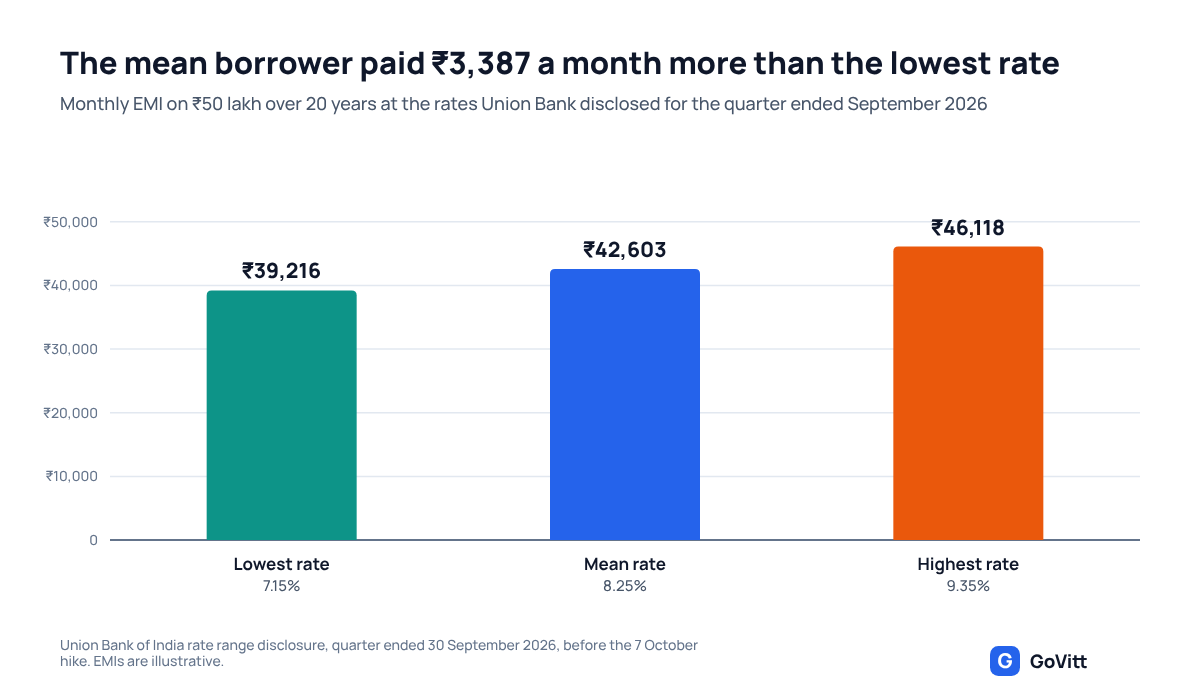
Banks rarely publish what they charge. Union Bank does disclose the range. For the quarter ended September 2026, its home loans ran from a lowest rate of 7.15% to a highest of 9.35%, with a mean of 8.25%. Those were pre-hike figures, and Union's rate card has since moved up 0.25%.
The mean sat 1.10% above the lowest. On ₹50 lakh over 20 years that is ₹42,603 a month at the mean against ₹39,216 at the lowest, a gap of ₹3,387 a month or ₹8.13 lakh over the loan. So the banner rate is the floor at that bank, not the typical price.
RBI's national data points the same way. In the average home loan rate in India right now, I went through RBI's June 2026 figure for the average rate on new bank home loans, 7.66%. That was before the October hike, and it is a different measure from one bank's mean. But the direction is the same: the average borrower pays more than the lowest advertised rate.
Six reasons your rate is above the banner
| Reason | What it can add | Can you change it? |
|---|---|---|
| 1. The banner shows the best score band | Union Bank: 7.40% to 9.60%, 2.20% apart. PNB: 7.45% to 9.25%, 1.80% apart. Canara: 7.55% to 10.25%. LIC Housing Finance: 7.15% to 9.55% | Yes, over time. Fix the score, then ask for the band you now sit in |
| 2. Your profile carries a premium | Self-employed: Bank of Maharashtra adds 0.10% to 0.50%, LIC Housing Finance 0.15% to 0.25%, PNB nothing. Union Bank's sheet adds 0.25% to the applicable rate for a third house and 0.75% from a fourth | Partly. Some lenders charge no premium, so compare |
| 3. Your spread was set at an older, weaker moment | A score that was 660 at sanction and is 780 now usually keeps the old band until you ask | Yes. Ask the bank to reprice, or transfer |
| 4. Your loan sits on an older benchmark | MCLR, Base Rate and BPLR loans carry their own spread and reset on the date in your contract, not on the repo cycle | Yes. Move to a repo-linked rate |
| 5. You are on a variant or a fixed rate | Union Smart Save is priced 0.25% above Union Home in every band. Union's fixed rates run 11.40% to 12.65% | Yes, if the lender lets you move |
| 6. The benchmark itself went up | Repo rose 0.25% on 7 October, from 5.25% to 5.50%. SBI's lowest rate moved from 7.25% to 7.50% | No. Everyone's rate moved |
Reason 6 is the only one that isn't about you. If your last memory of the banner is from September, part of the gap is the hike, and a 0.25% rise from 8.50% adds ₹795 a month on ₹50 lakh over 20 years. Reasons 1 and 2 are the price of your profile on the day you applied. Reasons 3, 4 and 5 are the ones you can pay for years without noticing.
How much one score band can move a rate is in RBI moved your home loan rate by 0.25%. Your CIBIL score can move it by 1.80%. At PNB the top and bottom of the grid are ₹5,666 a month apart on ₹50 lakh over 20 years, which is ₹13.60 lakh over the loan. If you are self-employed, can self-employed people get home loans easily covers how the premium works.
The reason most people miss: your spread was fixed on sanction day
Your benchmark resets, so your rate moves when repo moves. Your spread does not move with your life. Under RBI's circular of 4 September 2019 (RBI/2019-20/53), on floating rate loans linked to an external benchmark:
- The credit risk premium can change only if your credit assessment changes substantially, as your loan contract provides.
- The other parts of the spread can be altered once in three years.
- A bank may cut the spread earlier, to your benefit.
Read that again with your own loan in mind. The rule stops your bank raising your spread on a whim. It does not oblige the bank to lower it when your score goes from 660 to 780. That only happens if you ask, and the bank won't do it for you.
Here is what that costs. Say you have ₹45 lakh left, 18 years to go, and a rate of 8.05%, priced when your score was weaker. A new borrower with your score today gets 7.50%. The EMI at 8.05% is ₹39,510, and at 7.50% it is ₹38,024. The difference is ₹1,486 a month, which is ₹3.21 lakh over the 18 years. Nothing changed except the date on the paperwork.
One caution. The 2019 circular was written for banks. If your lender is a housing finance company, read your contract, because the rules that apply to you may differ. RBI's August 2026 draft would bring housing finance companies under the same spread rules (more on that draft below).
Check your own loan in 10 minutes
Find your sanction letter, or the interest certificate or loan statement from your lender's app. You are looking for four things:
| What to find | What it tells you | Red flag |
|---|---|---|
| Benchmark | Whether you are on repo, EBLR or RLLR, or on MCLR, Base Rate or BPLR | MCLR, Base Rate or BPLR means you are on an older cycle |
| Spread | The number added to the benchmark, such as repo plus 2.75% | A spread above what the bank quotes a new borrower with your score today |
| Reset | How often the rate changes, every 3 months for repo-linked loans | 6 or 12 months, or a reset date that has already passed without a change |
| Credit risk premium clause | Whether the letter splits out the premium, and when it can change | Wording that lets the bank change it at its discretion |
Then look up what the same bank quotes a new borrower with your score. Union's sheet gives you the grid. Most banks publish a rate card or a range, and our rate comparison page lists 50+ lenders. If today's rate for your band is lower than your rate, you have a gap to close.
What each 0.25% of spread costs
Take Union's best rate, 7.40%, as the base, on ₹50 lakh over 20 years:
| Extra spread | Rate | EMI goes up by | Extra interest over 20 years |
|---|---|---|---|
| 0.25% | 7.65% | ₹765 | ₹1.84 lakh |
| 0.50% | 7.90% | ₹1,537 | ₹3.69 lakh |
| 1.00% | 8.40% | ₹3,101 | ₹7.44 lakh |
| 1.50% | 8.90% | ₹4,691 | ₹11.26 lakh |
| 2.20% | 9.60% | ₹6,960 | ₹16.70 lakh |
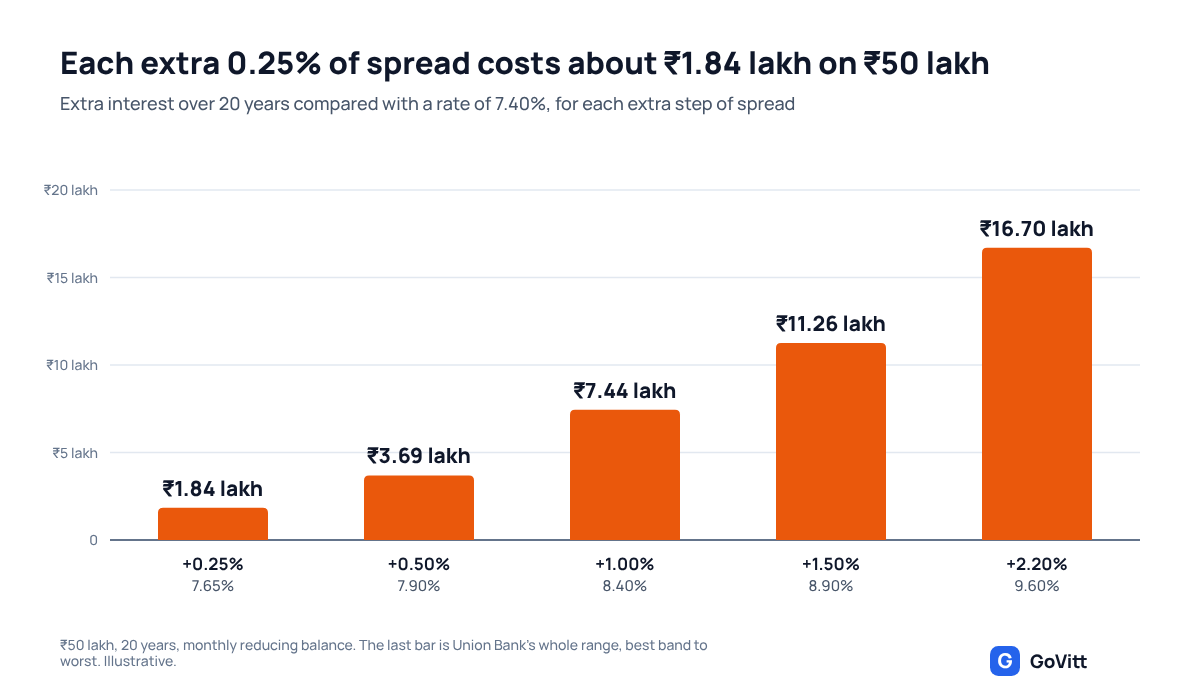
The last row is Union's whole range, best band to worst. Each 0.25% costs about ₹1.84 lakh, which is why a bank can lose 0.25% in a negotiation and still call it a win.
Ask your bank first
Repricing is the cheapest fix, and the fee is small next to the saving. As published by each lender in October 2026:
| Lender | Fee as published | On ₹50 lakh, with GST |
|---|---|---|
| SBI | Conversion fee ₹5,000 plus GST | ₹5,900 |
| HDFC Bank | The lower of 0.25% of principal or ₹5,000 | Up to ₹5,000 |
| ICICI Bank | ₹3,000 plus GST | ₹3,540 |
| Axis Bank | ₹3,000 plus GST for ₹30 lakh to ₹75 lakh outstanding (to a lower floating rate) | ₹3,540 |
| Union Bank of India | ₹7,500 plus GST for an MCLR, Base Rate or BPLR loan above ₹30 lakh, to the external benchmark | ₹8,850 |
Write to your bank and ask for two things: the rate it would give you today as a new borrower with your score, and the fee for moving your loan onto it. Ask for both in writing. If the rate is the same as your current one, you have your answer. If the bank refuses, or the fee is high, you can move the loan. I've put the cost lines in home loan balance transfer charges, and if you are still on MCLR, how to move your home loan to a repo-linked rate and what it costs walks through it.
When a transfer beats asking
A transfer costs more than a repricing. On ₹50 lakh in Bengaluru, I put it at ₹53,700 to ₹76,500 all in. The rule I use: the costs should come back in under two years, and you should expect to hold the loan at least twice that. Here is a ₹50 lakh loan with 18 years left, moved to a lender at 7.50%:
| Your rate now | Monthly saving | Costs paid back in | Net saving over 18 years | My call |
|---|---|---|---|---|
| 9.25% | ₹5,357 | 11 to 15 months | ₹10.81 lakh to ₹11.03 lakh | Transfer |
| 8.75% | ₹3,796 | 15 to 21 months | ₹7.43 lakh to ₹7.66 lakh | Transfer |
| 8.25% | ₹2,258 | 24 to 34 months | ₹4.11 lakh to ₹4.34 lakh | Borderline, ask your bank first |
| 8.00% | ₹1,499 | 36 to 52 months | ₹2.47 lakh to ₹2.70 lakh | Ask your bank, skip the transfer |
At a 0.50% gap the costs take 36 to 52 months to come back, so skip the transfer. At 0.75% it is borderline, at 24 to 34 months. From a 1.25% gap the costs are back in 21 months at the longest, and it wins even after every charge. In between, ask your bank first. How the switch maths changes after a hike is in rates just went up: does switching your home loan still make sense, and the best banks for home loan balance transfer in 2026 shows which lenders take a transfer at the lowest spread.
What RBI's draft would change
In August, RBI published a draft of its Interest Rates on Loans and Advances Directions, 2026. The draft is not a rule. Comments closed on 11 September 2026, and RBI has proposed 1 April 2027 as the effective date. As drafted, it would freeze the spread components other than the credit risk premium for three years from disbursement, require a documented review before a bank changes the credit risk premium, and extend the same rules to housing finance companies. The full breakdown, with the rupee cost of letting a spread drift, is in RBI's new loan pricing draft.
Don't wait for it. If the draft becomes final, it should protect your spread from going up. As I read it, nothing in it lowers a spread you already have. That is still your job.
What I'd do this week
- Find your three numbers. Benchmark, spread and reset frequency, from your sanction letter or loan statement.
- Check your CIBIL score. If it has gone up since you were sanctioned, you have grounds to ask for a lower band.
- Get today's rate for your band. Use the bank's rate card, or our rate comparison page, and note the date.
- Write to your bank. Ask for the rate it would give you today and the fee to move your loan onto it. Get both in writing.
- Run the numbers if it says no. If the gap is 1% or more, the Payoff & Transfer Calculator will show you the break-even for your loan.
- Skip the transfer for a small gap. At a 0.50% gap the costs take 36 to 52 months to come back. Spend that effort on prepaying instead.
FAQ
Why is my home loan interest rate high compared with what the bank advertises? The advertised rate is the bank's lowest, for its best score band. Yours is the benchmark plus a spread set by your score, income type and loan size on the day you were sanctioned. At Union Bank, the same benchmark gives 7.40% at a score of 825 and 9.60% at 600 to 649.
Why is my home loan rate higher than a new borrower's? Your spread was set when you were sanctioned and does not fall on its own when your score improves. A new borrower with today's score gets today's band. On ₹45 lakh with 18 years left, 8.05% against 7.50% is ₹1,486 a month.
Can my bank increase my home loan spread? Under RBI's 2019 circular, the credit risk premium on a repo-linked loan can change only if your credit assessment changes substantially, as your contract provides. The other parts of the spread can be altered once in three years. That circular was written for banks, so if your lender is a housing finance company, check your contract.
How do I reduce my home loan interest rate without switching banks? Ask your bank in writing for the rate it would give you today and the fee to move your loan onto it. Published fees range from ₹3,540 to ₹5,900 with GST on ₹50 lakh. If you are on MCLR, ask for the move to a repo-linked rate.
Is the advertised home loan rate ever the rate I get? Yes, if you are in the best band. At Union Bank that means a score of 825 or more, and at PNB 800 or more. Check the fine print on the banner for the score it needs, because a rate that applies to only some borrowers is still an advertised rate.
See what your loan could cost at a lower rate. Run the Payoff & Transfer Calculator with your balance, rate and years left. GoVitt compares 50+ banks and charges you 0% commission.
Rates and fees as of 28 October 2026 unless stated. EMIs use the standard monthly reducing balance method and are rounded to the nearest rupee. The examples assume ₹50 lakh over 20 years unless stated, and a Bengaluru property for transfer costs. The PNB grid is dated 12 October 2026. RBI's August 2026 directions are a draft and not in force. Rates change after every RBI policy decision; we will update this page after 4 December 2026. Check your sanction letter and your lender's current rate card before you act.
Ready to take the next step?
Find out your loan options and check your eligibility with GoVitt today.