
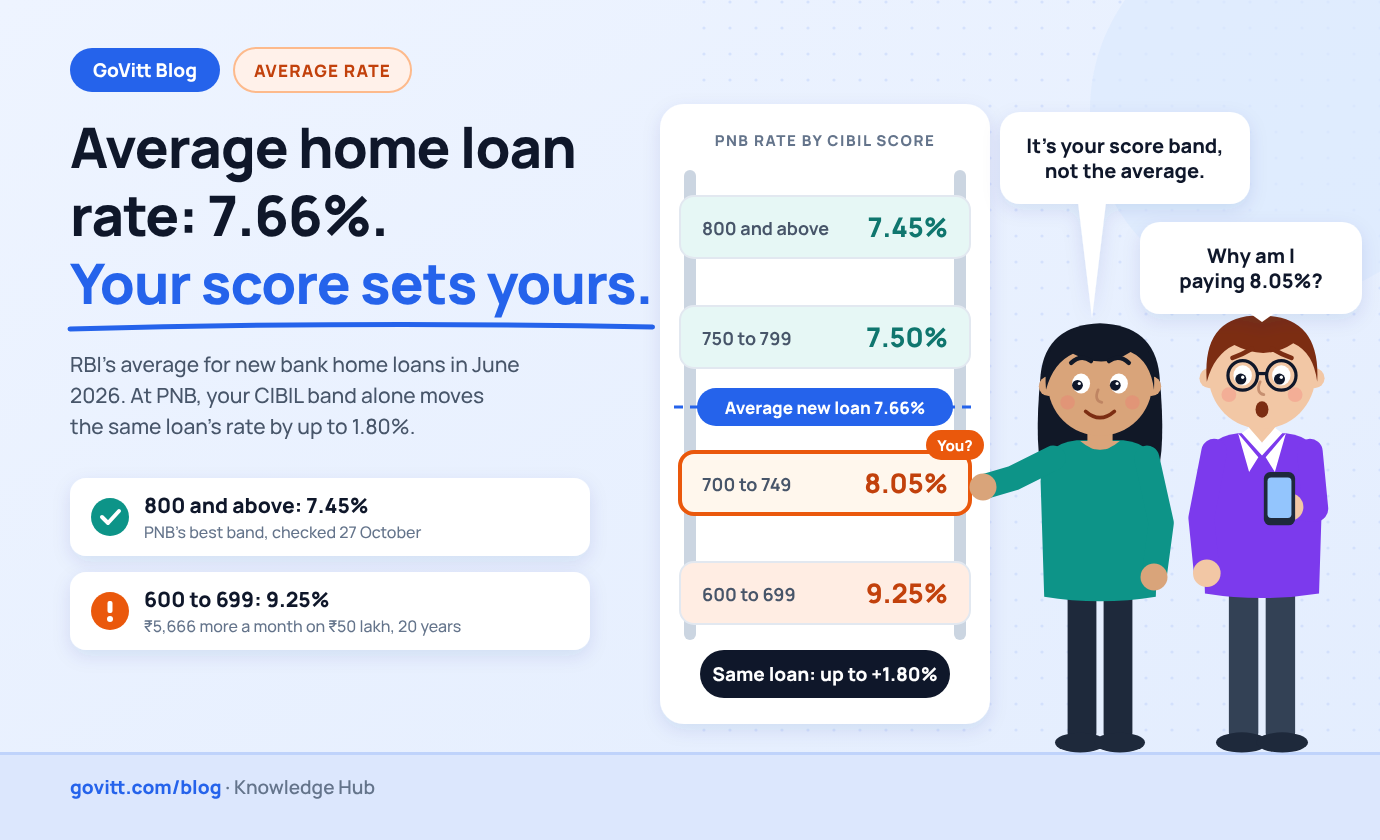
The average home loan interest rate in India on new bank loans was 7.66% in June 2026. That is RBI's own number: the weighted average rate banks charged on fresh home loans that month. In January 2025 it was about 8.70%, so it fell by roughly 1.04% while RBI was cutting.
Then RBI raised the repo rate by 0.25% on 7 October. No housing figure for a month after the hike is out yet, so my working estimate for a new loan today is about 7.9%. That's my number, not RBI's.
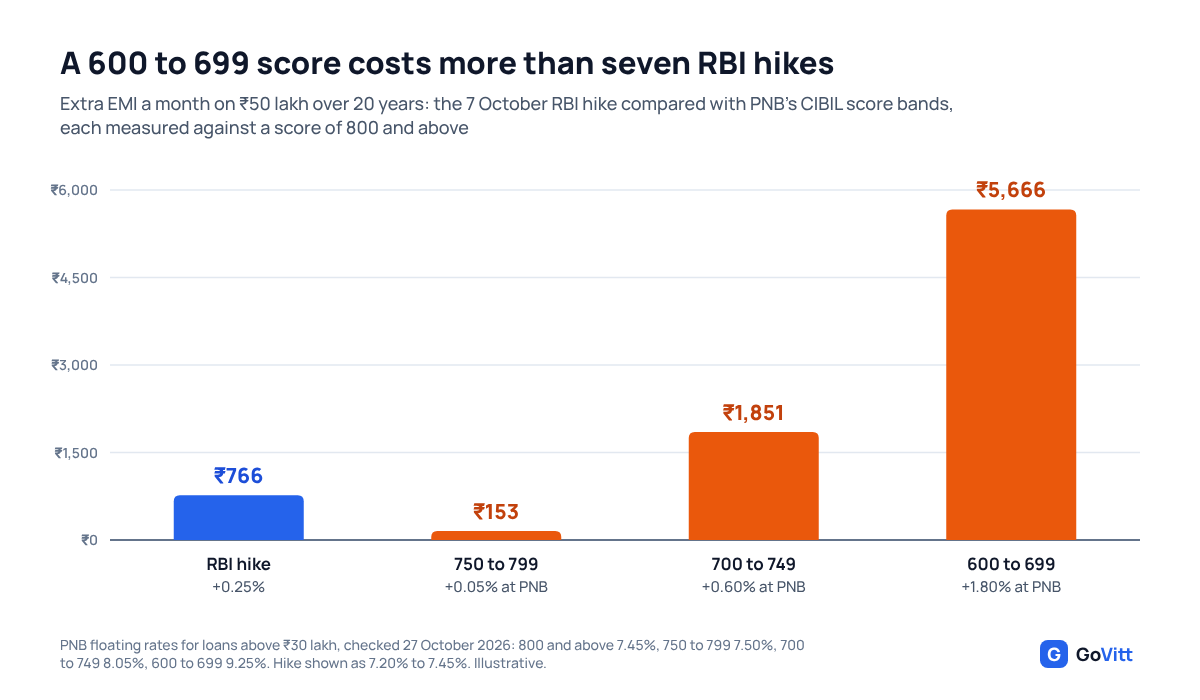
Here's the part the average hides. At PNB, the same home loan costs 7.45% with a CIBIL score of 800 or more and 9.25% with a score of 600 to 699. That 1.80% gap is more than seven RBI hikes. On ₹50 lakh over 20 years, it's ₹5,666 a month.
See your real payoff date in 60 seconds
Banks calculate remaining EMIs by simple subtraction. See your actual payoff date and discover how much interest a balance transfer can save.
So the useful question isn't "what's the average?" It's "where do I sit, and am I paying more than people like me?" Below: what the averages mean, what each lender charges today, where you probably land, and what to do if you're above it.
The short answer
| Which average | Figure | What it tells you |
|---|---|---|
| New bank home loans, June 2026 (RBI data) | 7.66% | What banks charged new home loan borrowers, weighted by loan amount, before the October hike |
| My estimate for a new loan after the 7 October hike | About 7.9% | The June figure plus the 0.25% hike. Not an official number |
| Lowest published rates of 7 large lenders, checked 21 to 27 October | 7.15% to 8.75% (simple average 7.77%) | What the best profiles are offered. Most borrowers pay more |
| All fresh bank loans, every purpose, August 2026 (RBI) | 8.61% | Not a home loan number. If someone quotes it as one, ignore it |
If you're salaried with a score above 750 and you took your loan in the last year, you should be within about 0.25% of the first two rows. If you're well above that, keep reading.
Why the RBI average looks lower than your rate
RBI started publishing sector-wise lending rates, including housing, in its monthly release on bank lending rates in March 2026. It's the most honest "average" there is, because it's what banks charged, not what they advertised. But four things push it below what most people pay:
- It's weighted by rupees, not by people. A ₹2 crore loan to a salaried buyer with an 820 score counts four times as much as a ₹50 lakh loan. Big loans to strong profiles get the sharpest rates, so they pull the average down.
- It covers banks only. The data excludes regional rural banks and small finance banks, and housing finance companies aren't banks at all. A lot of self-employed and lower-score borrowers sit with those lenders, at higher rates.
- It's new loans in one month. If you borrowed in 2023, your rate was set in a different market, and your spread came with it.
- It's from June. The October hike isn't in it.
One more piece of context. Housing is among the cheapest things banks lend for. In the same June data, vehicle loans averaged 9.77% and other personal loans 10.36%, while housing was at 7.66%. Home loans also had a bad loan ratio of just 0.8% in March. Banks compete hard for good home loan borrowers, which is why the gap between a strong and a weak profile matters more than the headline.
What lenders charge today
The lowest rate each lender publishes, and what it takes to get it:
| Lender | Lowest published rate | What it takes | Top of the published range | Checked |
|---|---|---|---|---|
| LIC Housing Finance | 7.15% | Score 825 and above, loan up to ₹50 lakh | 9.55% below 600 | 22 October |
| PNB | 7.45% | Score 800 and above, loan above ₹30 lakh, loan up to 80% of value | 9.25% at 600 to 699 | 27 October |
| SBI | 7.50% | Strongest profiles; no public score grid | Not published as a grid | 26 October |
| Canara Bank | 7.55% (7.50% for ₹50 lakh to ₹1 crore) | Top credit grade | 10.25% (lowest grade) | 24 October |
| HDFC Bank | 8.00% | Strongest profiles | 13.45% | 26 October |
| Axis Bank | 8.00% | Score 751 and above | 9.10% (score 750 and below) | 26 October |
| ICICI Bank | 8.75% (7.80% pre-approved, digital only) | Score 750 and above, salaried | 9.90% for salaried | 21 October |
Four of the seven start below the RBI average. That fits: the average is dominated by strong borrowers who get close to the floor. The full detail for each lender is in our posts on LIC Housing Finance, SBI, Canara Bank, HDFC Bank, Axis Bank and ICICI Bank.
Your score band moves your rate more than RBI does
PNB publishes a clean grid, so it's the easiest way to see this. These are its current rates for a loan above ₹30 lakh, with the loan at most 80% of the property value (PNB's festive campaign rates, 1 October to 31 December 2026):
| CIBIL score | PNB rate | EMI on ₹50 lakh, 20 years | Extra a month vs 800 and above |
|---|---|---|---|
| 800 and above | 7.45% | ₹40,127 | ₹0 |
| 750 to 799 | 7.50% | ₹40,280 | ₹153 |
| 700 to 749 | 8.05% | ₹41,978 | ₹1,851 |
| 600 to 699 | 9.25% | ₹45,793 | ₹5,666 |
Now compare that with the October hike. On a ₹50 lakh, 20 year loan near 7.45%, a 0.25% rise adds ₹766 a month. Dropping from the 800 band to 700 to 749 costs more than twice that. Dropping to 600 to 699 costs more than seven times that.
Over 20 years, the 600 to 699 borrower pays ₹13.60 lakh more interest than the 800 borrower, on the same loan from the same bank. And PNB isn't unusual. LIC's grid runs from 7.15% to 9.55%, and Canara's grades run from 7.55% to 10.25%. I went through how lenders price by score in RBI moved your home loan rate by 0.25%. Your CIBIL score can move it by 1.80%.
What existing borrowers pay
The averages above are about new loans. If you already have one, two things decide your rate:
- The spread you signed for. A repo-linked rate is the repo rate plus a spread, and under RBI's rules that spread stays put unless your credit assessment changes substantially. So two people at the same bank can be 1% apart for years. The one who signed in a tight market, or with a weaker score, keeps paying for it.
- Your benchmark. At the end of June 2026, 29.6% of floating-rate bank loans were still linked to MCLR, not to an external benchmark. MCLR loans reset only on the date in your contract, and the one-year median MCLR was 8.61% in September. If your statement says MCLR or base rate, read still on MCLR? How to move your home loan to a repo-linked rate.
RBI's data shows the same pattern across all bank loans. In August, the average on loans already outstanding was 8.96%, against 8.61% on fresh loans. That's every kind of bank loan, not housing alone, but the direction holds: older loans cost more than new ones, mostly because nobody asks for a reset.
The most common case I see: a loan taken in 2023 at 8.50% to 9%, never repriced, still on the same spread. That borrower is paying 0.75% to 1.25% above where a new borrower with the same profile starts today.
What being above average costs
Same loan, ₹50 lakh over 20 years, at four rates:
| Your rate | EMI | Total interest | Extra interest vs 7.50% |
|---|---|---|---|
| 7.50% | ₹40,280 | ₹46,67,200 | Nil |
| 8.00% | ₹41,822 | ₹50,37,280 | ₹3,70,080 |
| 8.75% | ₹44,186 | ₹56,04,640 | ₹9,37,440 |
| 9.25% | ₹45,793 | ₹59,90,320 | ₹13,23,120 |
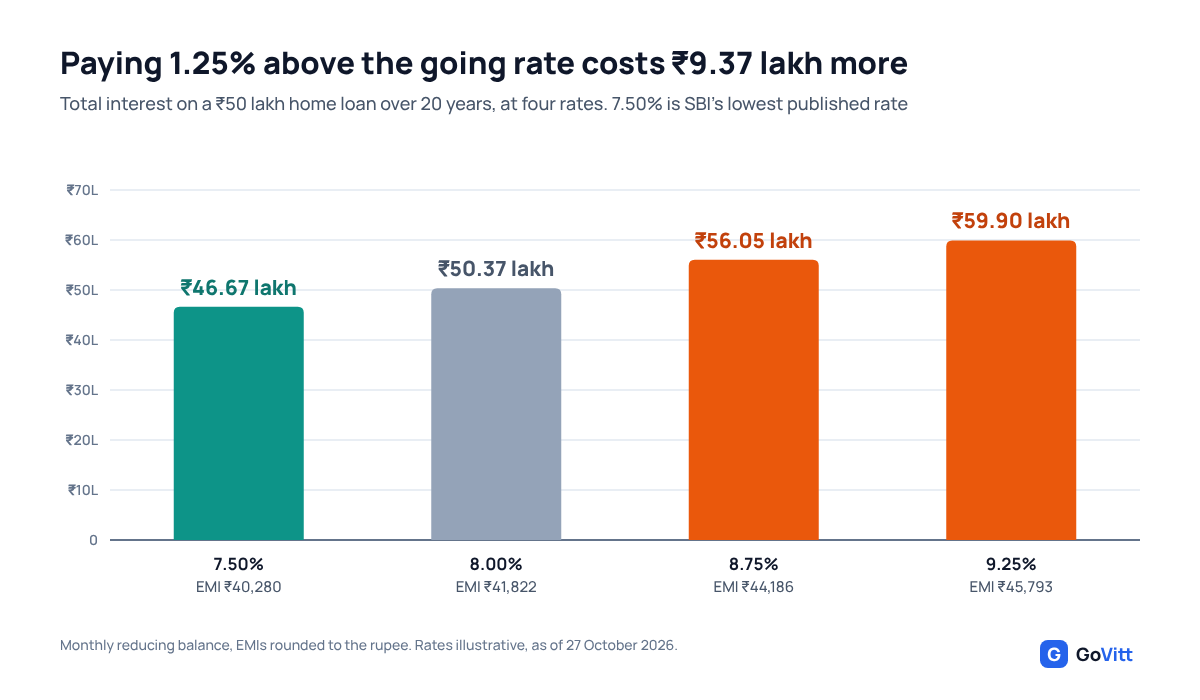
A 1.25% gap doesn't feel like much on a statement. It's ₹3,906 a month, and ₹9.37 lakh over 20 years. If you're at 8.75% with ₹50 lakh and 20 years left, here's what each step down is worth:
| Move from 8.75% to | Saving a month | Saving a year |
|---|---|---|
| 8.50% | ₹795 | ₹9,540 |
| 8.25% | ₹1,583 | ₹18,996 |
| 7.75% | ₹3,139 | ₹37,668 |
| 7.50% | ₹3,906 | ₹46,872 |
Where you probably sit
Going by the published grids and floors above, here's the range I'd expect for a salaried borrower today:
| Your profile | Range you'll see at these lenders | Based on |
|---|---|---|
| Score 800 and above, loan above ₹30 lakh | 7.15% to 7.55% | LIC (7.15% at 825 and above, 7.25% at 800 to 824), PNB 7.45%, SBI 7.50%, Canara 7.55% |
| Score 750 to 799 | 7.35% to 8.00% | LIC 7.35% to 7.45%, PNB 7.50%, Axis 8.00% |
| Score 700 to 749 | 7.65% to 8.20% | LIC 7.65% to 7.95%, PNB 8.05%, Axis 8.20% |
| Score 600 to 699 | 8.75% to 9.25% | LIC 8.75%, PNB 9.25% |
| Loan up to ₹30 lakh, more than 80% of value | From 7.60% | PNB's grid for smaller, higher-value loans |
Self-employed? LIC charges about 0.10% more than salaried, and ICICI's table runs from 8.75% to 10.05%. These are published rates. Banks can quote inside or outside them, and the spread is the one number you can negotiate. If you're more than 0.50% above your row, you're paying for something you don't need to.
Will the average go up again?
RBI's next policy decision is on 4 December. The October minutes said the next move can only be a hike or a pause, and I went through them in RBI MPC minutes, October 2026. I won't guess the outcome.
What I can tell you is the arithmetic. Another 0.25% would add about ₹760 to ₹795 a month on ₹50 lakh over 20 years, depending on where your rate starts. Many banks will extend your tenure instead of raising the EMI unless you ask. How to check what your bank did last time is in banks took one day to pass on RBI's rate hike.
The average moves with the repo rate. Your gap to the average doesn't. That's the part you control.
What I'd do this week
- Find your rate and benchmark. Both are on your latest loan statement or in your bank's app. Note whether it says repo, EBLR, RLLR or MCLR.
- Pull your CIBIL score. Free once a year from CIBIL, and your bank's app may show it too.
- Find your row in the table above. Work out the gap between your rate and the range for your band.
- Under 0.25% above? Leave it. Put spare money into prepayment instead. Floating-rate home loans to individuals carry no prepayment charge.
- 0.50% or more above? Ask your own bank to move you to its current rate. ICICI, Axis, SBI and HDFC charge ₹3,540 to ₹5,900 with GST for this. Get the new spread in writing.
- If they won't, compare a transfer properly, fees included. Start with best banks for home loan balance transfer in 2026, then put your numbers into the Payoff and Transfer Calculator.
FAQ
What is the average home loan interest rate in India right now? RBI's data puts the average rate on new bank home loans at 7.66% in June 2026, weighted by loan amount. RBI raised the repo rate by 0.25% on 7 October, so a new loan today is likely around 7.9%. That's my estimate, not an official figure. Lowest published rates at large lenders range from 7.15% to 8.75%.
Is 8% a good home loan rate in 2026? It depends on your score. For a salaried borrower with 800 or more, 8% is about 0.50% above what PNB, SBI, Canara and LIC publish, which is ₹1,542 a month on ₹50 lakh over 20 years. For a score of 700 to 749, 8% is close to the market.
Why is my home loan rate higher than the average? Usually one of three reasons: your CIBIL band, the spread you signed for when you took the loan, or an old MCLR or base rate link. At PNB, the band alone moves the rate from 7.45% to 9.25%.
Does the RBI average include housing finance companies? No. It covers scheduled commercial banks, excluding regional rural banks and small finance banks. Housing finance companies such as LIC Housing Finance publish their own rates, and some of them average higher because they lend to more self-employed and lower-score borrowers.
How often does the average home loan interest rate change? RBI publishes the data monthly, usually on the last working day, covering the previous month. Repo-linked loans reset at least every three months, so a hike or cut shows up in new and existing loans within a quarter.
See where you stand. Compare rates from 50+ banks and find out what your profile qualifies for today. GoVitt compares 50+ banks and charges you 0% commission.
Rates as of 27 October 2026 for PNB, 26 October for SBI, HDFC Bank and Axis Bank, 24 October for Canara Bank, 22 October for LIC Housing Finance and 21 October for ICICI Bank. The 7.66% average is RBI's weighted average lending rate on fresh housing loans by scheduled commercial banks for June 2026, as reported by Bank of Baroda's economics research team; the "about 7.9%" is my estimate, adding the 7 October hike. EMIs use the standard monthly reducing balance method and are rounded to the nearest rupee. Published rates apply to the profiles stated, and your quote will differ. Check your lender's page or sanction letter before you act.
Ready to take the next step?
Find out your loan options and check your eligibility with GoVitt today.