
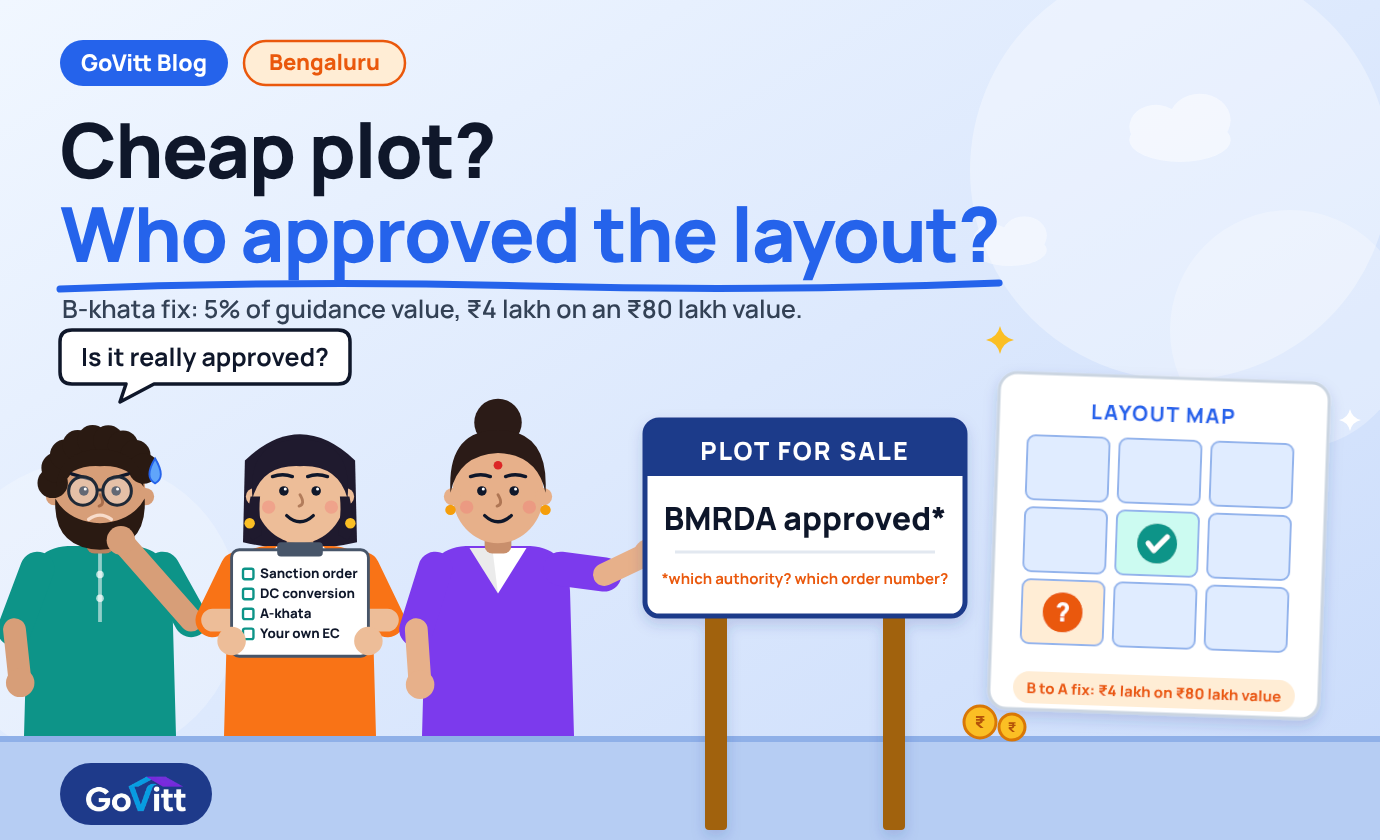
A BMRDA approved layout home loan is easier to get than a loan on a panchayat site, and harder than the seller's flyer suggests. "BMRDA approved" is often a loose phrase: the authority that signs a layout outside the city is usually a local planning authority, not BMRDA itself, and a DC conversion order is not a layout approval at all. A plot that is cheap for a reason is a plot a bank can't lend on, and you find that out after you've paid the token.
Below: the names that changed in Bengaluru, who approves what and where, how banks tend to treat BDA, BMRDA, BBMP (now corporation) and DC-converted land, the khata, a 20 minute check, and what I'd do before paying a rupee.
First, the honest part
Five limits on what I could check, all read on 6 November 2026 unless dated:
See your real payoff date in 60 seconds
Banks calculate remaining EMIs by simple subtraction. See your actual payoff date and discover how much interest a balance transfer can save.
- No bank publishes a layout policy. I found no lender that lists which layouts it lends on. What follows about banks comes from property guides, a lawyer's forum answer and a broker's forum list. None names a lender's rule.
- I read no authority's own page. Kaveri and similar portals block automated readers, and I did not get an authority's page for this post. The authority names and areas come from guides and news.
- Sources disagree on gram panchayat layouts. One guide says most banks refuse them. A lawyer says a panchayat can approve a layout within its limits. Another guide says a loan is possible if the plot is genuinely verified. I show all three.
- The B-khata conversion fee is reported three ways. More below.
- This is not legal advice. A property lawyer has to verify the title and the approvals for your plot before you pay.
The short answer
| What the seller says | What it usually means | What banks tend to do, per the guides I read |
|---|---|---|
| BDA approved | Layout sanctioned by the Bengaluru Development Authority, inside its planning area | Generally approved. With an A-khata, eligible with major banks |
| BMRDA approved | Often sanctioned by a local planning authority in the BMRDA region. Ask which one | Many lenders lend, once the approval is verified |
| BBMP approved plan | A building plan sanctioned by the civic body, now one of five GBA corporations | Banks want it for the construction part, along with the khata |
| DC converted | Agricultural land converted for non-agricultural use. Conversion only | A requirement, not an approval. Banks look for it, and want a layout approval too |
| Panchayat approved | A layout approved by a gram panchayat on the outskirts | Most banks refuse. Case by case where verified |
| Revenue site | Unconverted agricultural land, no planning approval | Usually refused or restricted |
If you take one thing from this post, take this: ask who signed the layout, under what order number and on what date.Then ask your own bank, by plot, whether it lends there.
The names changed: BBMP is now five corporations
The BBMP was dissolved on 2 September 2025, when the Greater Bengaluru Governance Act, 2024 came into force. The Greater Bengaluru Authority (GBA) is now the apex body, with five city corporations: North, South, East, West and Central. Property tax is calculated as before and collected per corporation. Many guides, forms and bank checklists still say BBMP.
For you it means two things. If a paper says "BBMP", it may still be valid, and you should check which corporation now holds the record. And a "BBMP approved plan" today is a plan sanctioned by the corporation for that area. I use "BBMP" below where a bank or seller does, and "corporation" where I mean the new body.
Who approves what, and where
| Where the land is | Who sanctions the layout | Source |
|---|---|---|
| Inside BDA's planning area, the core of the city | BDA, which develops and approves layouts | PropNewz, 21 September and 23 June 2026 |
| The wider region around Bengaluru | A local planning authority under BMRDA: BIAAPA (airport area), Anekal, Hoskote, Nelamangala, Kanakapura, Magadi. BMRDA itself mainly sets rules and helps with master plans | PropNewz, 9 October and 23 June 2026, citing Citizen Matters |
| Outside both, smaller towns and rural belts | DTCP, the state's town and country planning directorate | PropNewz, 23 June 2026 |
| Village limits, outskirts | Historically a gram panchayat, sometimes without higher planning sanction | PropNewz, 21 September 2026 |
| Agricultural land with no conversion | Nobody. A revenue site | PropNewz, 21 September 2026 |
One guide, PropNewz on 9 October, does not mention DTCP at all, and another, on 23 June, does. I take the later authorities from the 23 June guide and say so.
BMRDA approved layout home loan: what it really means
When someone says BMRDA approved, two things can be true. A layout in the BMRDA region may have been sanctioned by one of the local planning authorities, such as BIAAPA near the airport. Or the seller may be using BMRDA as a label for "outside the city". PropNewz, citing Citizen Matters, says BMRDA's role is mainly to set rules and help local authorities with their plans, not to sanction every layout.
So ask for the layout sanction order. It names the authority, the order number, the date, the village and the survey numbers. Check three things:
- The survey number on the order matches the survey number in your title and tax records.
- Your plot sits inside the sanctioned area. An approval may cover only part of a project.
- The land was converted. Layout approval alone does not convert agricultural land.
PropNewz says a plot in a BMRDA approved layout gets loans from many lenders. A second PropNewz guide, on buying a residential plot, goes further: a BDA or BMRDA layout carries "presumed planning compliance, near universal bank financing", while a revenue site or panchayat plot "often struggles" on all three. That's a guide's view, not a bank's. I'd take it as "start here", then ask.
BDA approved property loan: the safest paper
A BDA approved property loan is the easiest case. PropNewz calls BDA-approved layouts the gold standard, with the lowest buyer risk, and says BDA plots with an A-khata are eligible for loans from major banks. The word that matters is A-khata. A BDA layout alone doesn't help if the khata for your plot is wrong or sits in the seller's old name. See the khata section below.
BBMP approved plan home loan: plot is one thing, plan is another
A loan on a plot and a loan to build on it are two questions. For the build, the bank wants to see that the house can be built: an approved building plan. A BBMP approved plan home loan today means a plan sanctioned by the relevant GBA corporation. PropNewz tells buyers to confirm that building plan approval is available for what they plan to build, before they pay.
For a flat, or a house you buy ready, the lender wants the approved plan and the occupancy certificate. Tata Capital's list for a loan against a residential property includes the building plan approval and the occupancy or completion certificate, and my Bengaluru pillar covers what happens when a flat is built outside the sanctioned plan, or has no occupancy certificate at possession: khata, utility connections, resale and final payments can all be affected.
If you're buying a flat in a project, not a plot, the checks are different. See bank-approved projects in Bengaluru: why APF matters before you book.
DC converted land home loan: necessary, not enough
DC conversion is an order by the Deputy Commissioner converting agricultural land to non-agricultural use. A DC converted land home loan is a real product. A NoBroker forum answer lists SBI, HDFC, ICICI, Axis, PNB, Canara and Union Bank as lenders that consider DC-converted sites, case by case. That is a broker's list, not a lender policy, and it says that conversion alone isn't always enough.
The same sources agree on what is missing:
- A layout approval is separate. A lawyer on Kaanoon says DC conversion "will not be sufficient for forming a layout or layout approval". NoBroker says a separate layout approval is required, along with khata and plan sanction, before the land is fully regularised and bank-loan eligible.
- Without conversion the khata is weaker. PropNewz says that without conversion, a khata is typically B or panchayat level, and title is weaker.
- A neighbour's approval does not cover you. In one Kaanoon question, a buyer found a two acre converted plot next to a BIAAPA approved layout. The developer said the plot was too small to be approved, so it had only a panchayat approval. Don't assume the layout next door covers yours.
The khata decides the rest
I covered this in the resale flat post, so here is the short version. An A-khata means the property is regular in the civic body's eyes. A B-khata is a separate register for properties that aren't fully regular, such as unapproved layouts or plan deviations. An e-khata is the digital version of either. Getting one doesn't turn a B into an A. It should be final, not a draft, and in the seller's name.
Most banks, and almost all public sector banks, won't lend on a B-khata. A few housing finance companies and NBFCs may, at higher rates and lower loan to value.
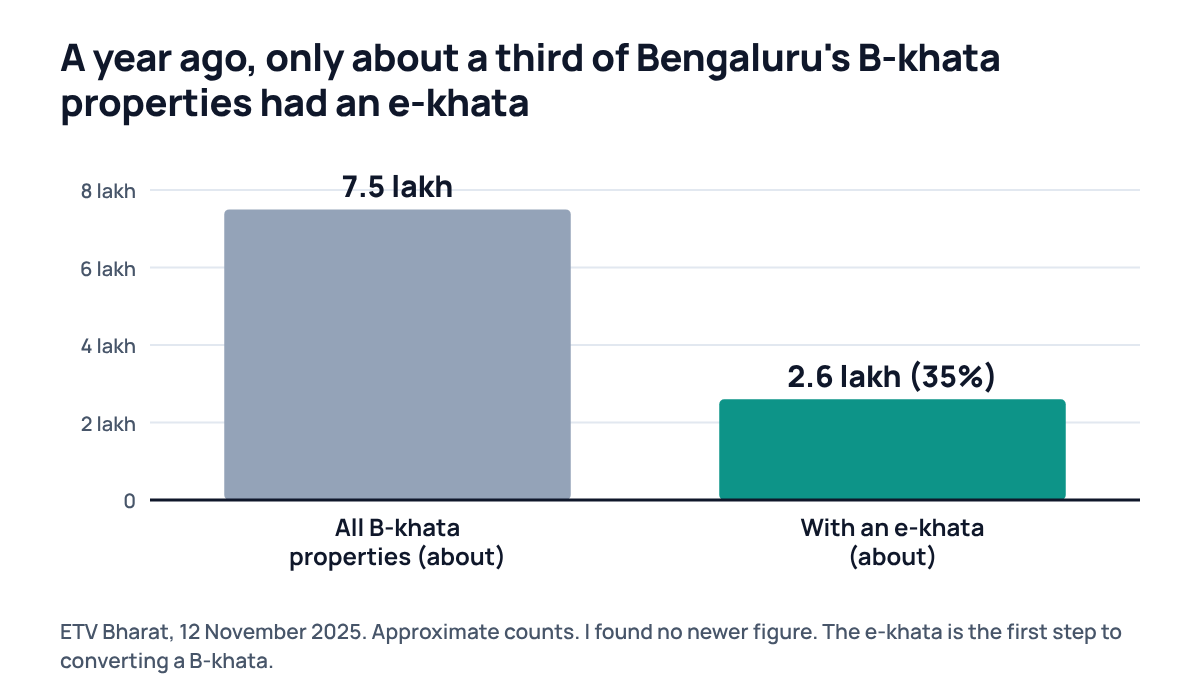
The B-khata is not rare. ETV Bharat (12 November 2025) reported about 7.5 lakh B-khata properties in Bengaluru, of which about 2.6 lakh had an e-khata, which it called the first step to convert. That is about a third.
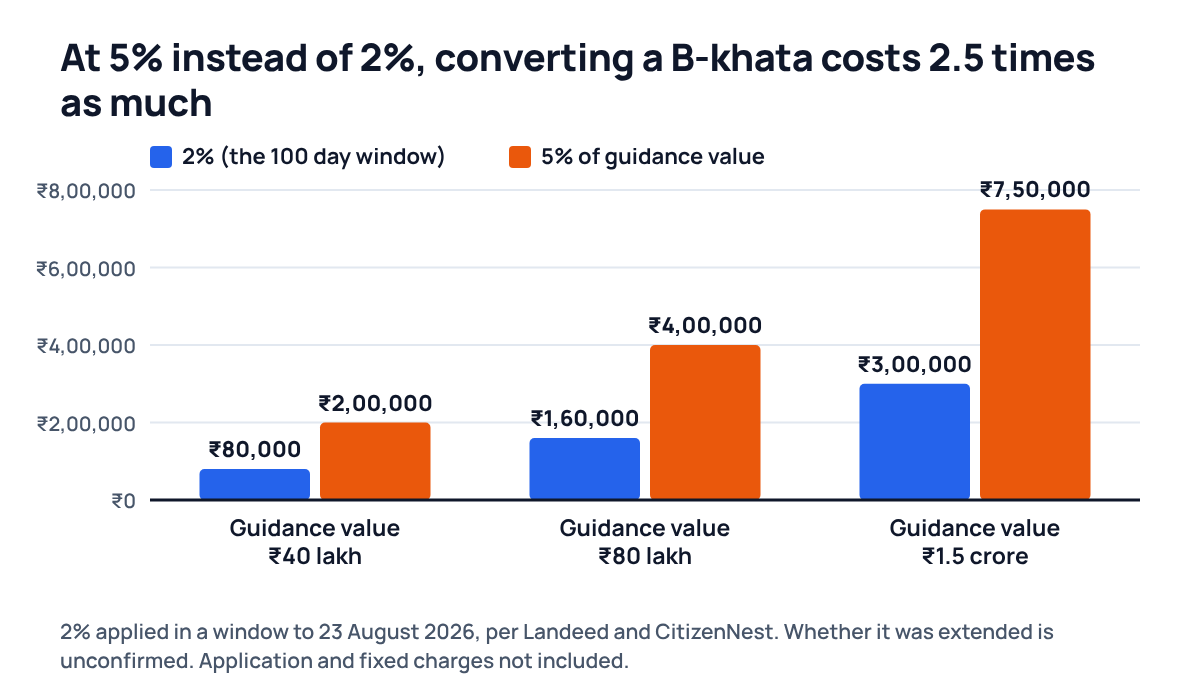
What conversion costs, and the conflict. A conversion scheme covers B-khatas on record by 30 September 2024 (KSandK, 7 November 2025). The reported fee is 5% of the property's guidance value. Two guides, Landeed and CitizenNest, say a 100 day window that opened on 16 May 2026 cut it to 2%, until 23 August 2026, after which it returns to 5%. ETV Bharat's earlier report says 5%. GoVitt's resale post said the window closed in late August. I couldn't confirm whether it has been extended or reopened, so check the GBA's portal before you plan around 2%.
| Guidance value | Fee at 5% | Fee at 2% (the window) | Difference |
|---|---|---|---|
| ₹40 lakh | ₹2,00,000 | ₹80,000 | ₹1,20,000 |
| ₹80 lakh | ₹4,00,000 | ₹1,60,000 | ₹2,40,000 |
| ₹1.5 crore | ₹7,50,000 | ₹3,00,000 | ₹4,50,000 |
Two limits on the scheme, per CitizenNest, an independent guide and not an official page. The land must have a paid-up property tax and no court case or government acquisition. And it lists peri-urban BDA areas and rural panchayat areas as excluded. If that is right, a B-khata in a panchayat layout outside the city may not be fixable under this scheme at all. That is a reason to ask before you buy, not after. Landeed adds that sites and independent houses qualify, and apartment flats generally do not.
Add the other cash. Stamp duty and registration on a purchase above ₹45 lakh in Bengaluru comes to 7.6% of the price: ₹3.80 lakh on a ₹50 lakh plot. The slabs and the caveat are in stamp duty and registration charges in Karnataka.
A 20 minute check before the token
The layout checks come from PropNewz's guides (9 October and 21 September 2026), and I've added the bank step.
- Ask for the layout sanction order. Authority, order number, date, village, survey numbers.
- Confirm the approval with the authority's office, not the seller. Check any published list of approved and unauthorised layouts.
- Match the survey number across the order, the title and the tax records.
- Confirm your plot is in the sanctioned area, not outside it.
- Ask for the DC conversion order, and check it covers this land.
- Pull your own encumbrance certificate for a long period. Don't rely on the developer's copy.
- Check the khata: A or B, final or draft, whose name. For a layout, ask whether the plot can get an A-khata at all.
- Walk the site. Roads, water, drainage and power should exist.
- Ask your bank, by plot, whether it lends there, before you pay. A refusal is information about the approval, not just the bank.
- Get a property lawyer to verify the title and the approvals.
Red flags
PropNewz lists these, and I agree with them:
- A price far below nearby plots. Cheap usually means the paper is wrong.
- A vague seller. One who can't say which authority approved the layout, or won't show the order.
- A plot described only as "revenue site" or "panchayat".
- Mainstream banks that won't touch it. If two or more decline, find out why.
- A promise that the khata will be sorted later. Fix it first, or price it in.
For the reasons banks reject a file on other grounds, see home loan rejected: the 9 usual reasons.
What I'd do before paying the token
- Get the sanction order and the conversion order in writing, before you discuss price.
- Ask which authority signed it, and verify with that authority.
- Pull the EC and the khata yourself.
- Ask two lenders about the plot by name, and write down the answers.
- Make the token refundable if the bank declines the loan on legal or technical grounds.
- Budget the cash: stamp duty and registration, and any khata conversion. The EMI calculator shows the EMI on what you borrow.
- Walk away from a plot you can't verify. A discount is not worth a plot you can't sell or borrow against.
For the lenders that publish rates and fees across Bengaluru, and the wider paperwork, start with home loan in Bangalore: which banks lend easiest here.
FAQ
Can I get a BMRDA approved layout home loan? Many lenders lend on plots in approved layouts in the BMRDA region, according to PropNewz, once the approval is verified. "BMRDA approved" is often a local planning authority's approval, so ask for the order. No bank I found publishes its policy, so ask your bank by plot.
Do banks lend on BDA approved plots? BDA-approved plots with an A-khata are eligible for loans from major banks, per PropNewz (21 September 2026). The khata and the title still have to be clean. A BDA layout with a wrong khata won't help.
Can I get a home loan on DC converted land? Several banks consider DC-converted sites case by case, per a NoBroker list, but conversion alone isn't enough. Lenders also want a layout approval, a khata and the plan sanction. Ask your lender in writing.
Is a BBMP approved plan still valid after GBA? BBMP was dissolved on 2 September 2025, and the Greater Bengaluru Authority and its five corporations replaced it. I found nothing saying earlier plan sanctions lapsed, and nothing official confirming they carry over. Ask the corporation for your area to confirm the record, and ask your bank whether it accepts it.
Will a bank lend on a B-khata plot? Most banks, and almost all public sector banks, won't. A few housing finance companies and NBFCs may, at higher rates and lower loan to value. If the B-khata is eligible for conversion, that is usually the cleaner route, but the scheme's terms have conflicting reports.
How do I check if a layout is approved in Bengaluru? Ask for the sanction order and confirm it with the authority. Check the survey number against your title, make sure your plot is inside the sanctioned area, and pull your own EC. Then have a property lawyer verify the title.
Eyeing a plot and not sure the paper will pass a bank? Talk to an advisor (free, WhatsApp) with the layout name, the authority on the order and the khata type, and we'll check it against our lender panel before you pay a token. GoVitt compares 50+ banks and charges you 0% commission.
Authority names, areas and bank behaviour are as reported in property guides and news read on 6 November 2026, not from the authorities' own pages or any lender's policy, and may have changed. The B-khata conversion terms conflict across sources: 5% of guidance value (ETV Bharat, 12 November 2025), and 2% in a window from 16 May to 23 August 2026 (Landeed, CitizenNest), after which it returns to 5%. Whether the window has been extended is unconfirmed. The fee table is the percentage of an assumed guidance value, with no application or fixed charges. The ETV Bharat counts are from 12 November 2025. Stamp duty and registration are as in GoVitt's earlier post. This is general information, not legal advice. Have a property lawyer verify the title and the approvals for your plot before you pay.
Ready to take the next step?
Find out your loan options and check your eligibility with GoVitt today.