
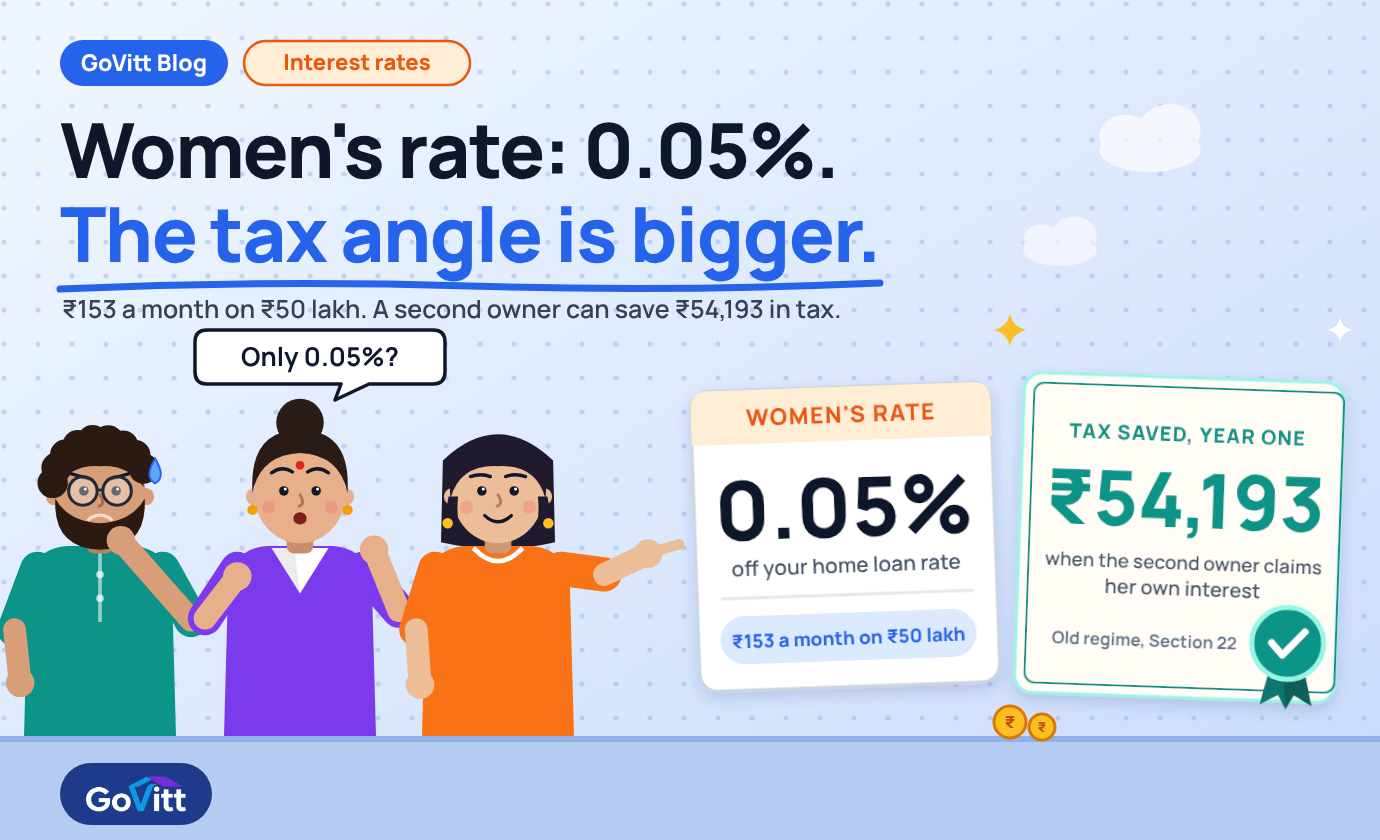
The home loan interest rate for women is usually 0.05% lower than the rate everyone else pays, at the lenders that publish a concession at all. On ₹50 lakh over 20 years at 7.55%, that is ₹153 a month and ₹36,721 over the whole loan. It's real money, and it's small. A CIBIL score of 680 instead of 679 at Union Bank is worth ₹2,390 a month, about 16 times as much.
The bigger reason to put a woman on your loan is not the rate. It is the tax. Below: who publishes the discount, who actually qualifies, what 0.05% is worth in rupees, what SBI says, what Karnataka gives women on stamp duty, and what saves you more.
See your real payoff date in 60 seconds
Banks calculate remaining EMIs by simple subtraction. See your actual payoff date and discover how much interest a balance transfer can save.
First, the honest part
Five limits on what I could check, all read on 6 November 2026 unless dated:
- No two lenders word it the same way. Some say "women borrowers". Union Bank ties it to who owns the house. I couldn't find a lender that says whether she must be the first name on the application.
- SBI is unconfirmed. Its current rate page shows 7.50% "onwards" and no women's line. I couldn't read the terms page behind the asterisk.
- Bank of Baroda is press only. The 0.05% comes from a May 2025 news report. Its own home loan page shows no such line.
- Bank of Maharashtra contradicts itself. Its rate page and its home loan page give different conditions. More below.
- Rates move. RBI raised the repo rate to 5.50% on 7 October, and the next decision is on 4 December. Every rate below can change.
The short answer
At the lenders that publish one, the concession is 0.05% a year, off your rate. It is worth ₹153 a month on a ₹50 lakh loan. If you want the rate benefit, ask whether she has to be the sole owner, a co-owner or the first applicant, and get the answer in the sanction letter. If you want the bigger benefit, make her a co-owner and co-borrower and check the tax rule below with your CA.
Who publishes a women's concession
| Lender | The concession | Condition as published | Source and date |
|---|---|---|---|
| Canara Bank | 0.05% less in every row of its rate table | None stated | Canara's page, as read in my rate post, 24 October 2026 |
| Union Bank of India | 0.05% in the bands where the sheet shows it | Rate sheet footnote: a house singly or jointly owned by a woman. Union's site, as quoted in 2023: she is a borrower or co-borrower and an owner or co-owner | Rate sheet dated 8 October, read 28 October; India.com, 9 March 2023 |
| Bank of Maharashtra | 0.05% | Rate page: only in slabs below a score of 725. Home loan page: no score limit mentioned | Both pages, as read in my rate post, 31 October |
| Bank of Baroda | 0.05% on new home loans and home improvement loans of ₹15 lakh and above | Not specified | Business Standard, 6 May 2025. Its own page shows none on 6 November |
| SBI | Unconfirmed | Press reported 0.05% in 2013 and again on 1 March 2021. The current page shows no women's line | SBI rate page, w.e.f. 15 October 2026 |
| HDFC Bank, PNB | Reported at 0.05% in 2023 | Not stated | India.com, 9 March 2023. Not on a current page I read |
| ICICI Bank, Axis Bank, LIC Housing Finance | None found | Not applicable | My October rate posts |
Two details matter. At Canara the table I use is the rate for other borrowers, and a woman pays 0.05% less in each row: 7.50% instead of 7.55% at the top grade. At Bank of Maharashtra, the rate page also says its grid is shown "including 0.05% concession for women borrower". So I can't tell whether the number you see is already the discounted one. Ask.
What 0.05% is worth in rupees
EMI at 7.55% against 7.50%, over 20 years:
| Loan | EMI at 7.55% | EMI at 7.50% | Saved a month | Saved over 20 years |
|---|---|---|---|---|
| ₹30 lakh | ₹24,260 | ₹24,168 | ₹92 | ₹22,033 |
| ₹50 lakh | ₹40,433 | ₹40,280 | ₹153 | ₹36,721 |
| ₹75 lakh | ₹60,649 | ₹60,419 | ₹230 | ₹55,082 |
The longer the tenure, the more it is worth. On ₹50 lakh the monthly saving is ₹142 over 15 years and ₹171 over 30. In your first five years of a ₹50 lakh loan, the interest saved is ₹12,347.
It does not stack well against other things. Canara's normal fee on ₹50 lakh is ₹11,800 with GST, and it is waived on retail loans from 1 October to 31 December 2026. At ₹153 a month, the women's discount takes 77 months, or 6.4 years, to earn back what that fee waiver gives you today. That is why I'd get the fee waiver in writing before I worry about the 0.05%. How the fee compares across lenders is in Canara Bank home loan interest rate (October 2026).
SBI home loan interest rate for women
SBI's home loan interest rate for women is the one people search most, and the one I can least confirm. Here is what I found:
- SBI's rate page shows a home loan at "7.50% p.a. onwards" with an asterisk, effective 15 October 2026. It does not mention women. The terms behind the asterisk sit on another page I could not read.
- Press reports said SBI offered women a special 0.05% concession, in December 2013 and again on 1 March 2021, which Business Today reported as a 5 basis point concession made available on the eve of International Women's Day. A 2023 list repeats it. None of that is a 2026 source.
- My own SBI post says nothing on the point, because I found nothing on SBI's page to quote. The full rate story is in SBI home loan interest rate (October 2026).
If the 0.05% applies, 7.45% instead of 7.50% on ₹50 lakh is about ₹153 a month. Ask SBI one question, in writing: is the concession in force today, and does the rate you quoted already include it?
The co-owner rule
The rule isn't one rule. Union Bank's wording is the clearest one I found: the woman must be a borrower or co-borrower on the loan, and an owner or co-owner of the property. Both conditions. That has three consequences:
| Setup | What I'd expect | How sure I am |
|---|---|---|
| She is the sole owner and the sole borrower | Qualifies wherever a concession exists | Most sure. Every wording I read would cover it |
| She is a co-owner and co-borrower with her spouse | Qualifies at Union by its own words. Ask the others | Sure at Union, unknown elsewhere |
| She is on the title but not on the loan, or on the loan but not on the title | Likely does not qualify at Union | Ask every other lender |
None of the lender pages I read say she must be the first-named applicant, and none say she can't be. Don't assume either way. Ask: "does it apply if she is the second applicant?" A joint loan also raises what you can borrow, because the bank adds both incomes. How that works is in joint home loan: benefits, eligibility and tax advantages.
One caution. Don't add a name to an existing property just for 0.05%. A transfer of a share can carry its own stamp duty and registration, and I haven't priced it. For a new purchase it is simple: decide the owners before you sign the sale deed.
What saves you more than 0.05%
On ₹50 lakh over 20 years, here is what each lever is worth in EMI:
| Lever | Saved a month | Source |
|---|---|---|
| Women's concession, 0.05% | ₹153 | Above |
| Negotiating 0.10% off your spread | ₹306 | My calculation at 7.55% |
| A rate 0.25% lower | ₹763 | My calculation at 7.55% |
| Union Bank: a score of 680 instead of 679 (at most 8.35% instead of 9.10%) | At least ₹2,390 | Union Bank rate post |
| Canara: top grade at 7.55% instead of grade CRG 3 at 8.75% | ₹3,753 | Canara Bank rate post |
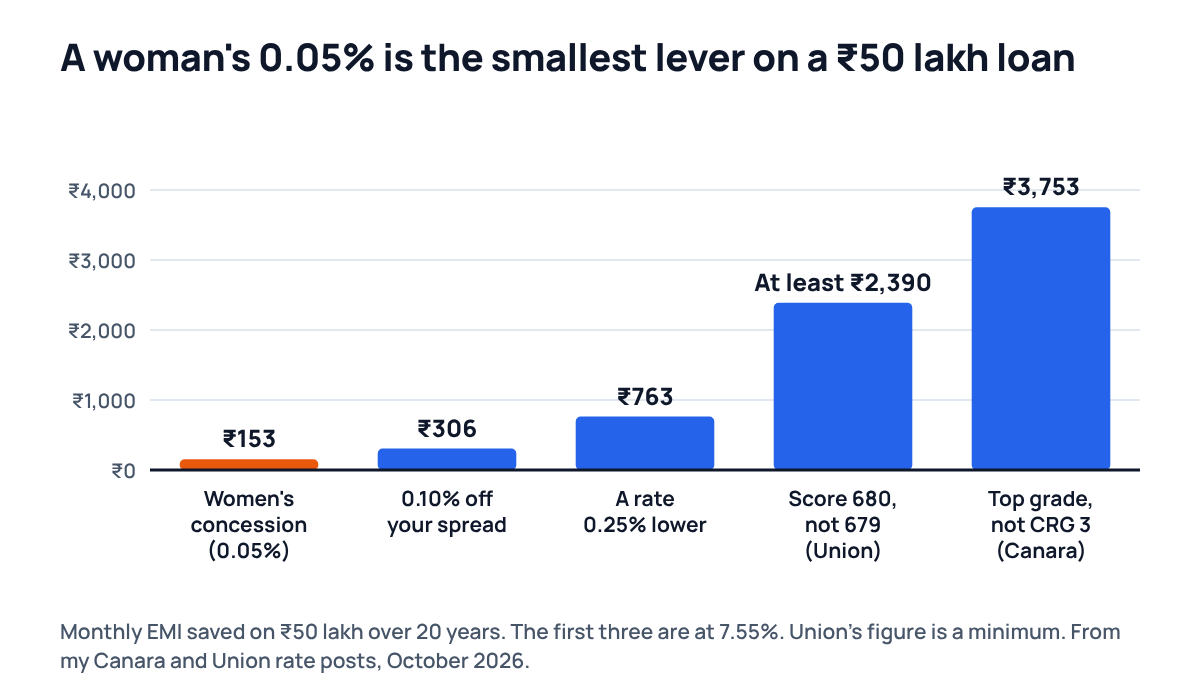
The Union and Canara figures come from my Union Bank and Canara Bank rate posts. The women's discount is the smallest lever on the list. Your score and your spread are the biggest. How much a slab moves your rate is in RBI moved your home loan rate by 0.25%. Your CIBIL score can move it by 1.80%. And remember Bank of Maharashtra's rate page allows its women's line only below a score of 725, so for a strong borrower it may not apply at all.
The tax is the bigger benefit
Here is the part most women's loan guides skip. Each owner who is also a co-borrower and pays EMIs can claim the interest on their own share. Under Section 22 of the Income-tax Act, 2025, which replaced Section 24(b) from 1 April 2026, the limit is ₹2 lakh a year for a self-occupied house, per person. It is old regime only. Under the new regime, which is the default, there is no deduction for a self-occupied house.
The first year of a ₹50 lakh loan at 7.55% over 20 years carries ₹3,73,694 of interest. One owner can claim ₹2 lakh of it. Two owners splitting 50:50 can claim ₹1,86,847 each, which is all of it:
| One owner | Two owners, 50:50 | |
|---|---|---|
| Interest paid in year one | ₹3,73,694 | ₹3,73,694 |
| Interest deduction allowed | ₹2,00,000 | ₹3,73,694 |
| Tax saved at 30% plus cess (31.2%) | ₹62,400 | ₹1,16,593 |
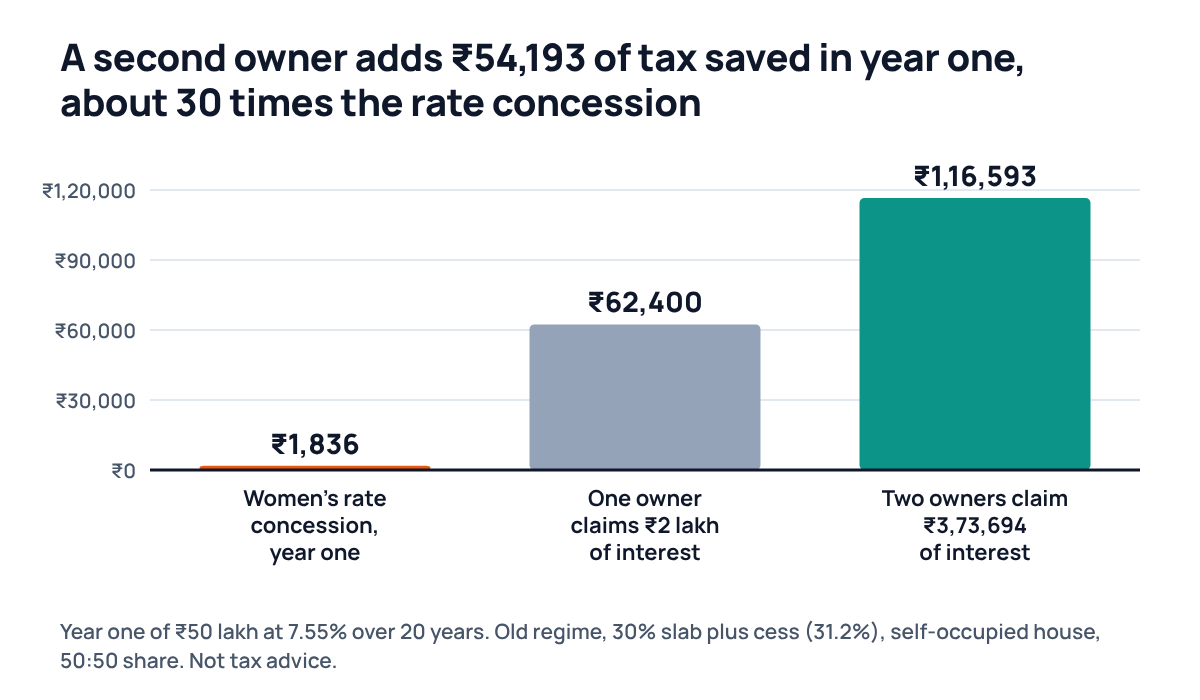
The second owner adds ₹54,193 of tax saved in year one. The women's rate concession over the same year is ₹1,836, so the tax angle is about 30 times bigger. Principal repayment under Section 123 (the old Section 80C) adds up to ₹1.5 lakh each, shared with your other items, and I haven't counted it.
When this does not work:
- She has no taxable income. A deduction needs income to set against. A co-owner with none saves nothing.
- You are on the new regime. There is no deduction for a self-occupied house.
- She isn't a co-borrower, or doesn't pay. The usual conditions are co-ownership on the sale deed, co-borrowing on the loan, and a share of the EMIs from her own account. Keep the bank trail.
- The house is under construction. The ₹2 lakh limit needs completion within five years of the end of the year you borrowed. Otherwise the limit is ₹30,000.
The rules for carrying the deduction after a transfer are in tax benefits after a home loan balance transfer. This is not tax advice, so ask your CA.
What Karnataka gives women: nothing on stamp duty
Some posts promise a stamp duty discount for women. In Karnataka I found none. PropNewz (29 May 2026) says there is no gender-based concession in 2026, and the slabs are 2%, 3% and 5% with registration at 2% from 31 August 2025. The portal that would settle it, Kaveri, blocks automated readers, so confirm there before you sign. On an ₹85 lakh flat the stamp duty and registration is ₹6.46 lakh, in stamp duty and registration charges in Karnataka.
What I'd do this week
- Decide the owners first, with a lawyer, before the sale deed is signed.
- Ask each lender in writing: is the women's concession in force, what are the conditions (sole owner, co-owner, first applicant), and is it already in the rate you quoted?
- Get the concession in the sanction letter, with the rate shown with and without it.
- Fix your score before you apply. One slab is worth more than the whole concession.
- Ask for the fee waiver and a lower spread, both in writing.
- Run the tax example with your CA, using your regime and your slab.
- Compare the final numbers across lenders on the rates page.
FAQ
What is the home loan interest rate for women? At the lenders that publish one, it is 0.05% below the standard rate, for example 7.50% instead of 7.55% at Canara's top grade. On ₹50 lakh over 20 years that is ₹153 a month. Not every lender has one, and the conditions differ.
What is the SBI home loan interest rate for women? I couldn't confirm a women's concession on SBI's current page, which shows a home loan from 7.50% as of 15 October 2026. Press reports from 2013 to 2021 mention 0.05%. Ask SBI in writing whether it is in force and whether your quoted rate includes it.
Do I get the women's rate if my wife is only a co-owner? It depends on the lender. Union Bank's wording needs her to be a borrower or co-borrower and an owner or co-owner. Other lenders don't spell it out, so ask whether co-owner and co-borrower is enough.
Do women pay less stamp duty in Karnataka? I found no gender-based concession. PropNewz (29 May 2026) says Karnataka has none in 2026, and the slabs are 2%, 3% and 5%. Confirm on the Kaveri portal before you register.
Is a joint home loan with my wife cheaper? Not always on the rate, but it can be cheaper in tax if you are on the old regime and both have taxable income. Each co-owner who is also a co-borrower and pays EMIs can claim up to ₹2 lakh a year of interest on a self-occupied house.
Want to see what your own score and profile qualify for? Compare rates from 50+ banks and ask the lender in writing about any women's concession. GoVitt compares 50+ banks and charges you 0% commission.
Rates and conditions are as published on each lender's page on the dates in the table, via my rate posts and a read of the SBI and Bank of Baroda pages on 6 November 2026. Press reports are labelled as such and are not current lender pages. EMIs use the standard monthly reducing balance method, rounded to the nearest rupee, on 20 years unless stated. The tax example assumes the old regime, a self-occupied house completed within five years, both owners on the deed and the loan, an even share, the 30% slab plus 4% cess, and no other deductions. Your property, slab and lender will differ. This is general information, not tax or legal advice. Check your sanction letter and ask for every figure in writing.
Ready to take the next step?
Find out your loan options and check your eligibility with GoVitt today.