
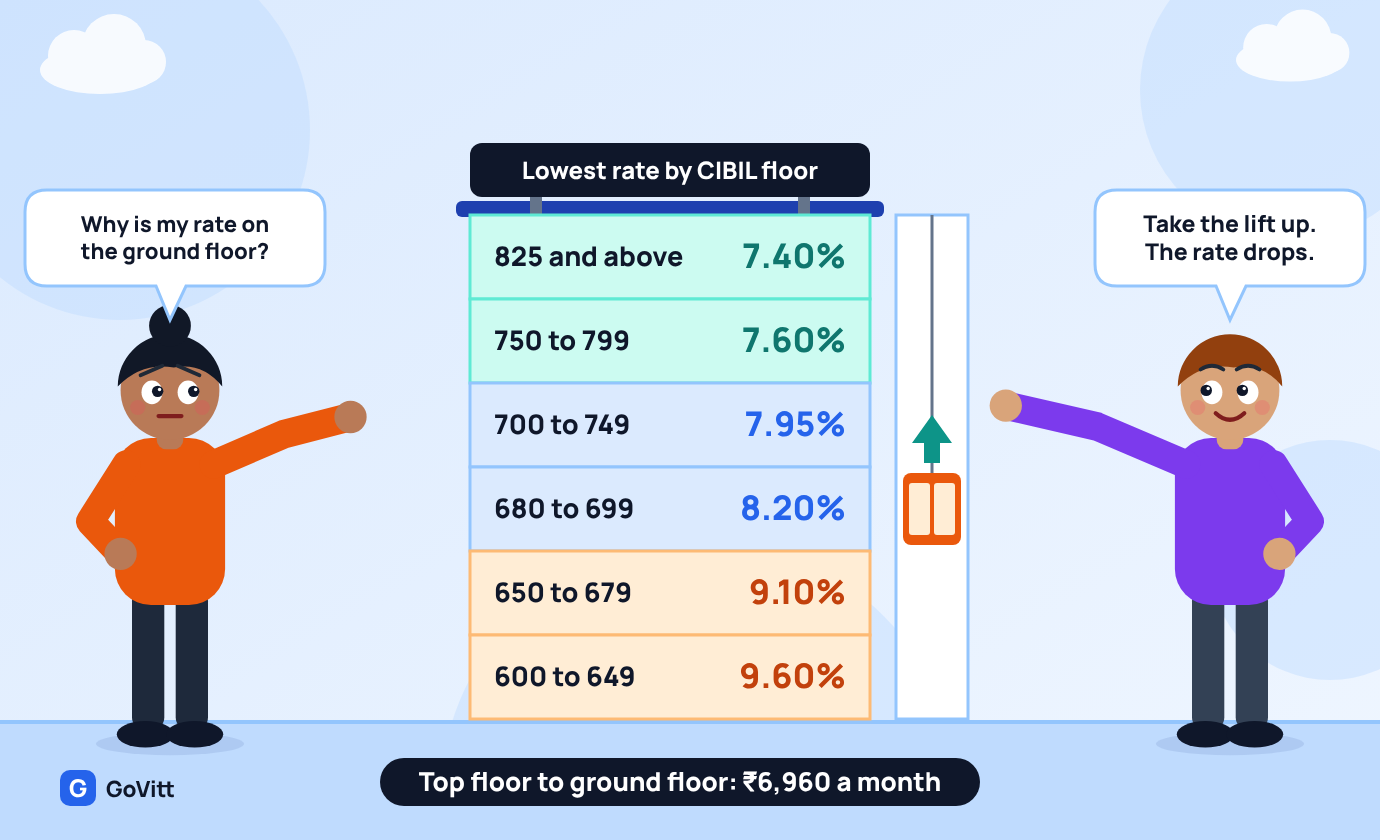
The Union Bank home loan interest rate is 7.40% to 9.60%, going by the rate sheet Union Bank of India updated on 8 October 2026. Your CIBIL score picks where you land: 7.40% at 825 and above, 8.20% to 8.35% at 680 to 699, and 9.60% at 600 to 649. That is repo at 5.50% plus a spread of 1.90% to 4.10%. On ₹50 lakh over 20 years, the distance between the top and bottom band is ₹6,960 a month.
Union's own disclosure for the quarter ended September shows how that plays out. The lowest home loan rate was 7.15%, the highest 9.35% and the mean 8.25%. That was before the 7 October hike, so every figure is now 0.25% higher. The average borrower still paid 1.10% above the best rate, which is ₹3,387 a month on ₹50 lakh.
Two things about Union's pages before you read on. Another page on its site still carries a FAQ line saying rates start at 8.60%. That doesn't match the 8 October sheet, so I've gone with the sheet. And the sheet prints separate columns for salaried and non-salaried borrowers and for men and women, but the text of the PDF doesn't tie every number to its column. Where a band has more than one rate, I show the range. Your sanction letter is the only number that counts.
See your real payoff date in 60 seconds
Banks calculate remaining EMIs by simple subtraction. See your actual payoff date and discover how much interest a balance transfer can save.
Below: your rate by band, every fee Union lists, how a transfer to Union works, and whether it makes sense for you to move.
Union Bank home loan rates at a glance (checked 28 October 2026)
| Item | What Union Bank shows |
|---|---|
| Rate, score 825 and above | EBLR minus 0.85%, which is 7.40% |
| Rate, score 600 to 649 | EBLR plus 1.35%, which is 9.60% |
| EBLR | 8.25%, which is repo at 5.50% plus a spread of 2.75% (sheet updated 8 October 2026) |
| Rate type | Floating, linked to repo; Union says it resets at least once in three months |
| Processing fee | 0.50% of the loan, maximum ₹15,000, plus GST |
| Prepayment, floating rate | Nil for individuals borrowing for non-business purposes |
| Takeover of a loan from another lender | Yes, it is a listed purpose of Union Home |
| Fixed rate option (up to 5 years) | 11.40% up to ₹30 lakh, 12.40% for ₹30 lakh to ₹50 lakh, 12.65% for ₹50 lakh to ₹2 crore |
| Quarter ended September 2026, bank's own disclosure | Lowest 7.15%, mean 8.25%, highest 9.35% |
How Union prices it: the bank sets its EBLR at repo plus 2.75%, then your score band moves that up or down. The best band gets 0.85% off. The worst band listed pays 1.35% on top. That is a 2.20% swing, and it comes from your credit profile alone. The grid below is the one for Union Home, which Union's sheet also uses for Union Awas and for repair and renovation loans.
Your Union Bank rate by CIBIL slab
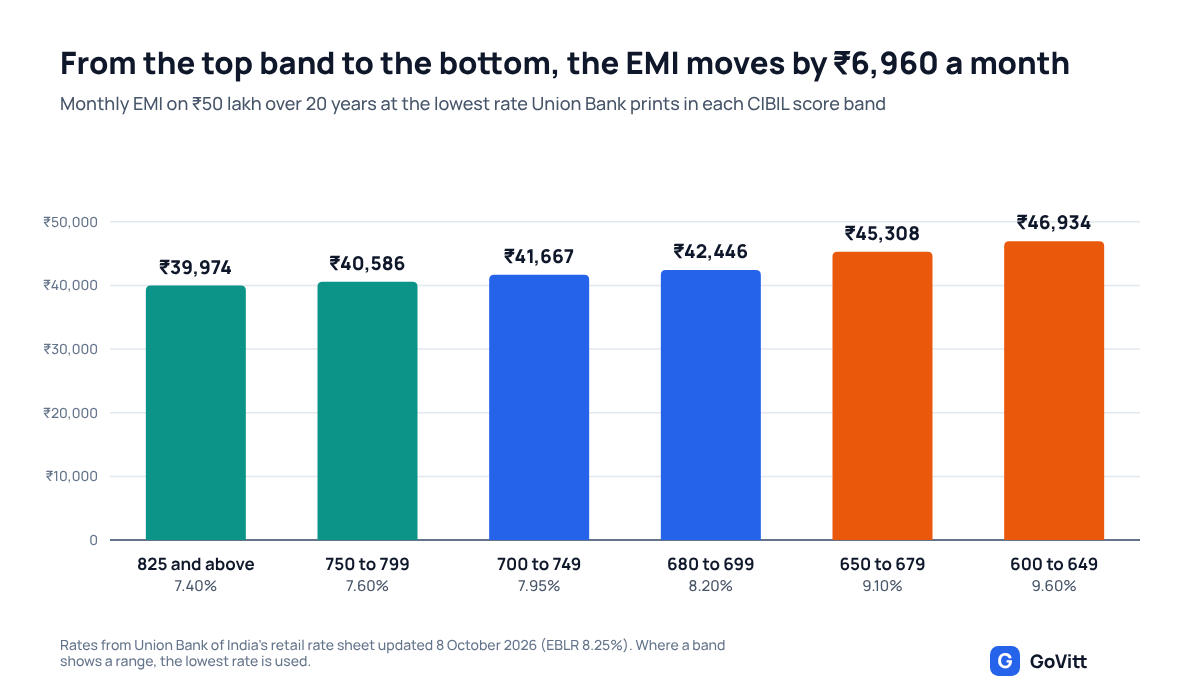
Union publishes eight score bands for a home loan, more than most banks. Here they are, with the EMI on a ₹50 lakh loan over 20 years:
| Score band | Rate (Union Home) | How Union prices it | EMI on ₹50 lakh, 20 years |
|---|---|---|---|
| 825 and above | 7.40% | EBLR minus 0.85% | ₹39,974 |
| 800 to 824 | 7.45% | EBLR minus 0.80% | ₹40,127 |
| 750 to 799 | 7.60% to 7.65% | EBLR minus 0.60% to 0.65% | ₹40,586 to ₹40,739 |
| No credit history (score -1, or 1 to 5) | 7.65% to 7.75% | EBLR minus 0.50% to 0.60% | ₹40,739 to ₹41,047 |
| 700 to 749 | 7.95% to 8.10% | EBLR minus 0.15% to 0.30% | ₹41,667 to ₹42,134 |
| 680 to 699 | 8.20% to 8.35% | EBLR minus 0.05% up to plus 0.10% | ₹42,446 to ₹42,918 |
| 650 to 679 | 9.10% | EBLR plus 0.85% | ₹45,308 |
| 600 to 649 | 9.60% | EBLR plus 1.35% | ₹46,934 |
Some things stand out:
- The big cliff is at 680. A score of 679 prices at 9.10%. A score of 680 prices at 8.35% at the most. That is at least ₹2,390 a month on ₹50 lakh, or ₹5.74 lakh over 20 years. If you're at 670, fix the cause before you apply. Utilisation and a late payment are the usual ones, and this post on a 650 score has the steps.
- The next one is at 750. From the best of the 700 to 749 band to the worst of the 750 to 799 band, the saving is at least ₹928 a month, or ₹2.23 lakh over 20 years.
- No credit history is priced kindly. A borrower with no score (shown as -1, or 1 to 5) pays 7.65% to 7.75%, close to the 750 band. That helps a first-time borrower who has never had a card or loan.
- Government and PSU employees with a score of 750 and above are priced at 7.40%, the same as the 825 band, by Union's sheet.
- The female concession is small. In the bands where Union shows it, a house singly or jointly owned by a woman gets 0.05% off, going by the sheet's own footnote.
- Third and fourth homes cost more. The sheet has a separate line that adds 0.25% to the applicable rate for a third house and 0.75% from a fourth house onwards.
- Assigning a policy takes 0.05% off. Union gives a further 0.05% if you assign a credit, term or life policy to the bank. Ask what the policy costs you before you count that as a saving.
- Union Green Home is cheaper still. The sheet gives a further 0.10% once you submit a green certificate.
Your spread is set when you're sanctioned. Under RBI's rules for repo-linked loans, it stays put unless your credit assessment changes substantially. So that day is the day to ask for the lower end of your band, in writing. How much a score band can move your rate is in RBI moved your home loan rate by 0.25%. Your CIBIL score can move it by 1.80%.
How Union compares
Union's lowest rate, 7.40%, is 0.10% below SBI's lowest of 7.50%, which is ₹306 a month on ₹50 lakh over 20 years, or ₹0.73 lakh. It is 0.05% below PNB's 7.45%, which is ₹153 a month. And it is 0.60% below HDFC Bank's and Axis Bank's 8.00%, which is ₹1,848 a month, or ₹4.44 lakh. LIC Housing Finance, a housing finance company, starts lower at 7.15%, for loans up to ₹50 lakh and a score of 825 and above.
Those are best-case rates. Union's 7.40% needs a score of 825, and at 700 to 749 it is 7.95% to 8.10%. Compare at your own score, not at the headline. The detail on the others is in SBI home loan interest rate (October 2026), HDFC home loan rates at a glance, ICICI Bank home loan interest rate (October 2026), Axis Bank home loan interest rate (October 2026) and Canara Bank home loan interest rate (October 2026). See today's rates across 50+ lenders on our rate comparison page.
Union Bank home loan fees and charges
From Union's schedule of service charges for advances. The document carries no date and quotes charges without GST, so confirm each figure in writing.
| Fee | Amount | On ₹50 lakh |
|---|---|---|
| Processing fee | 0.50% of the loan, maximum ₹15,000, plus GST | ₹17,700 with GST |
| Moving a loan from MCLR, Base Rate or BPLR to the external benchmark | ₹5,000 plus GST up to ₹30 lakh; ₹7,500 plus GST above that; ₹10,000 plus GST for the largest loans | ₹8,850 with GST |
| Relaxation charge, where Union relaxes a norm for you | 0.10% of the loan, minimum ₹500, maximum ₹5,000, one time | ₹5,900 with GST |
| Prepayment, floating rate | Nil for individuals borrowing for non-business purposes | ₹0 |
| Documentation and inspection charges | None on retail schemes | ₹0 |
| Union's own mortgage creation charge | Exempt for retail loans | ₹0 |
| Valuation, legal, stamp duty | As applicable | Ask for the number |
The processing fee is the part to notice. It stops at ₹15,000, so on any loan above ₹30 lakh you pay ₹17,700 with GST, whether the loan is ₹50 lakh or ₹5 crore. On ₹50 lakh Axis's fee can be as high as ₹59,000. The cap is why a lender with a slightly higher rate can still cost less in year one.
Balance transfer to Union Bank
Union takes over home loans from other banks and financial institutions. What it publishes:
- Rate: the same grid as a new loan. I couldn't find a separate transfer rate on Union's pages, so your score band and the spread in your sanction letter decide it.
- Fee: the processing fee above, 0.50% capped at ₹15,000 plus GST.
- Speed: Union says sanction takes about five working days. The transfer itself takes longer, because your old lender has to release the papers. The steps are in home loan transfer process: what actually happens.
- Top-up: the rate sheet lists Union Mortgage Plus at 0.75% above the home loan rate, with another 0.10% if your score is below 700, and a processing fee of 0.50%. I read that as the top-up route. The charges schedule says the standalone Union Top-Up product is discontinued, so ask which product a top-up would sit under, and compare it on its own. More on top-ups in home loan top-up: interest rate, eligibility and the tax rule most people get wrong.
- Costs that remain: legal and valuation, and in Karnataka the fresh mortgage paperwork. Every transfer charge is broken down in home loan balance transfer charges.
On a large loan, the capped fee makes Union cheaper to move to than a lender without a cap. Where the transfer rate stands against the rest is in best banks for home loan balance transfer in 2026.
Who Union Bank suits, and who should look elsewhere
Union can make sense if you:
- Have a score of 800 or more, or are a government or PSU employee with 750 or more. The rate is 7.40% to 7.45%
- Have no credit history. Union prices that at 7.65% to 7.75%
- Are taking a large loan and want the fee capped at ₹17,700
- Will have a woman as sole or joint owner of the house, which earns the 0.05% concession in the bands where Union shows it
Look elsewhere first if you:
- Have a score of 650 to 679. At 9.10% you're paying at least ₹2,390 a month more than you would at 680
- Are buying a third or fourth home. Union's sheet adds 0.25% and then 0.75%
- Plan to take Union Smart Save. The sheet prices it 0.25% above Union Home in every band
- Are moving a loan already at 7.65% or less. The gain is too small to cover the charges
Already with Union? Whether to switch
Here's a worked example. Say you have:
- ₹50 lakh outstanding
- 18 years (216 EMIs) left
- A current rate of 9.10%, so an EMI of ₹47,135. You were sanctioned in the 650 to 679 band, and your score is 760 now
| Option | Cost | Monthly saving | Net saving over 18 years | Cost paid back in |
|---|---|---|---|---|
| Ask Union to move you to 7.65% | ₹17,700 (assumed) | ₹4,439 | ₹9.41 lakh | About 4 months |
| Transfer to a lender at 7.50% | ₹53,700 to ₹76,500 | ₹4,886 | ₹9.79 lakh to ₹10.02 lakh | 11 to 16 months |
| Transfer to 7.50% after Union has cut you to 7.65% | ₹65,100 (midpoint) | ₹447 | ₹0.31 lakh | About 146 months |
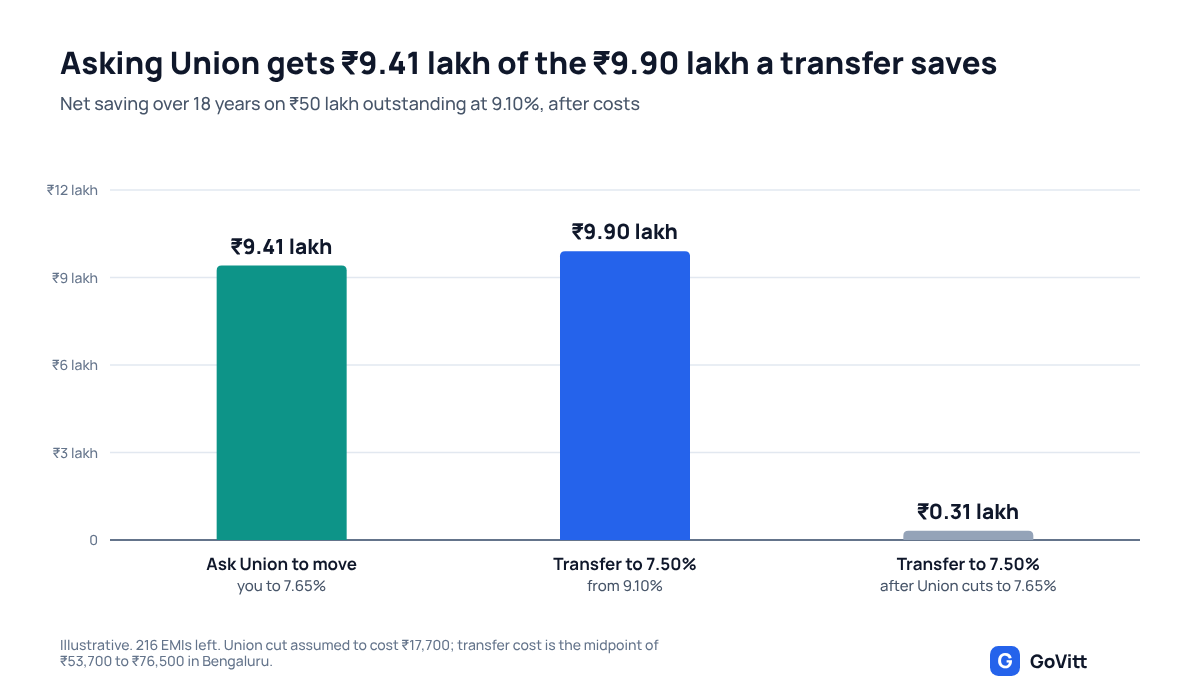
I couldn't find a published fee for repricing a loan that is already on Union's EBLR, so the first row assumes the worst case, a fresh processing fee of ₹17,700. If Union charges less, the first option is better than it looks.
What this tells you:
- Ask Union first. At 760 your band pays 7.60% to 7.65%, and the table uses the top of it. Even at ₹17,700, the move pays for itself in about 4 months. Ask in writing and ask for the rate for your current band.
- Then compare. From 9.10%, a transfer to 7.50% still wins by a wide margin, even after paying every charge. After Union cuts you to 7.65%, the case is weak: the extra ₹447 a month takes about 146 months to earn back.
- Don't move for a small gap. If you're already at 8.00% with Union and the best offer elsewhere is 7.50%, the saving is ₹1,499 a month on these numbers, and the charges take 36 to 52 months to earn back.
The full process is on our home loan balance transfer page. If you're still on an MCLR loan, start with how to move your home loan to a repo-linked rate and what it costs.
Compare before you sign
Union's rate depends on your score band and where your spread lands. Before you accept any offer, compare rates from 50+ banks and see what your profile qualifies for. GoVitt charges you 0% commission.
FAQ
What is the Union Bank home loan interest rate today? As of 28 October 2026, Union Bank of India's rate sheet shows 7.40% to 9.60% for Union Home, depending on your CIBIL score. That is EBLR at 8.25% (repo at 5.50% plus 2.75%) minus 0.85% at the best band and plus 1.35% at the worst.
What is the Union Bank home loan rate for a CIBIL score of 750 or above? 7.60% to 7.65% for 750 to 799, 7.45% for 800 to 824 and 7.40% for 825 and above. Government and PSU employees with 750 or more are priced at 7.40%. On ₹50 lakh over 20 years, the EMI runs from ₹39,974 to ₹40,739.
What is Union Bank's home loan processing fee? 0.50% of the loan, with a maximum of ₹15,000, plus GST. On any loan above ₹30 lakh that is ₹17,700 with GST.
Is there a prepayment charge on a Union Bank home loan? Not on a floating rate loan to an individual for a non-business purpose. Union's schedule lists no foreclosure or prepayment charge for those. Fixed rate loans follow different rules, so ask before you choose one.
Can I lower my Union Bank home loan rate without switching banks? You can ask. If your loan is still on MCLR, Base Rate or BPLR, Union lists a fee for moving to the external benchmark: ₹5,000 plus GST up to ₹30 lakh and ₹7,500 plus GST above that. I couldn't find a published fee for repricing a loan that is already on its EBLR, so get the number in writing.
Can I transfer my home loan to Union Bank? Yes. Takeover of a home loan from another bank or financial institution is a listed purpose of Union Home. The rate is the same grid as a new loan, the processing fee is 0.50% capped at ₹15,000, and Union says sanction takes about five working days.
Not sure Union is your best rate? Compare rates from 50+ banks and see what your profile qualifies for. GoVitt charges you 0% commission.
Rates and fees as of 28 October 2026, from Union Bank of India's retail interest rate sheet (updated 8 October 2026) and its schedule of service charges for advances (undated, charges quoted without GST). EMIs use the standard monthly reducing balance method and are rounded to the nearest rupee. Where Union prints more than one rate in a band, the post shows the range. The switching examples assume a property in Bengaluru. Rates change after every RBI policy decision; we will update this page after 4 December 2026.
Ready to take the next step?
Find out your loan options and check your eligibility with GoVitt today.