

You go for a site visit on a Sunday. The sample flat is lovely, the sales person is very good at his job, and the price on the sheet says ₹90 lakh. You ask, all inclusive? He smiles and says "plus taxes and a few charges, sir, I'll send you the cost sheet."
That cost sheet is where most people's budget quietly falls apart.
Mint ran a piece recently on what to consider when buying a new home from a developer, and it's a topic I keep coming back to, because nearly every new home buyer we speak to at GoVitt is buying from a builder, most of them under construction, and most of them discover the real numbers far too late. So this is my version. Less about the lobby and the amenities, more about the money and the paperwork. Those are the two places where people actually get hurt.
See your real payoff date in 60 seconds
Banks calculate remaining EMIs by simple subtraction. See your actual payoff date and discover how much interest a balance transfer can save.
The price on the brochure is not the price
Let's take that ₹90 lakh flat in Bengaluru and follow the money.
First come the charges builders like to list separately. Car parking, floor rise, preferred location charge if you want the park-facing side, club membership. On a flat this size it's easy for these to add up to ₹8 lakh. Now your agreement value is ₹98 lakh, not ₹90.
Then GST. Under-construction flats priced above ₹45 lakh attract 5% GST, and the builder can't pass you any input tax credit on it. That's ₹4.90 lakh. A ready flat with an occupancy certificate attracts no GST at all, which is worth remembering if you're torn between the two.
Then stamp duty and registration. In Karnataka, stamp duty on a flat above ₹45 lakh is 5%, there's a cess and surcharge on top of that, and the registration fee went up from 1% to 2% at the end of August 2025. All together it comes to about 7.6% of the value. On ₹98 lakh that's ₹7.45 lakh. And this is charged on the agreement value or the government's guidance value, whichever is higher.
Then the small stuff that isn't small. Maintenance advance for a year or two, corpus fund, khata transfer, legal fees. Call it ₹2.30 lakh.
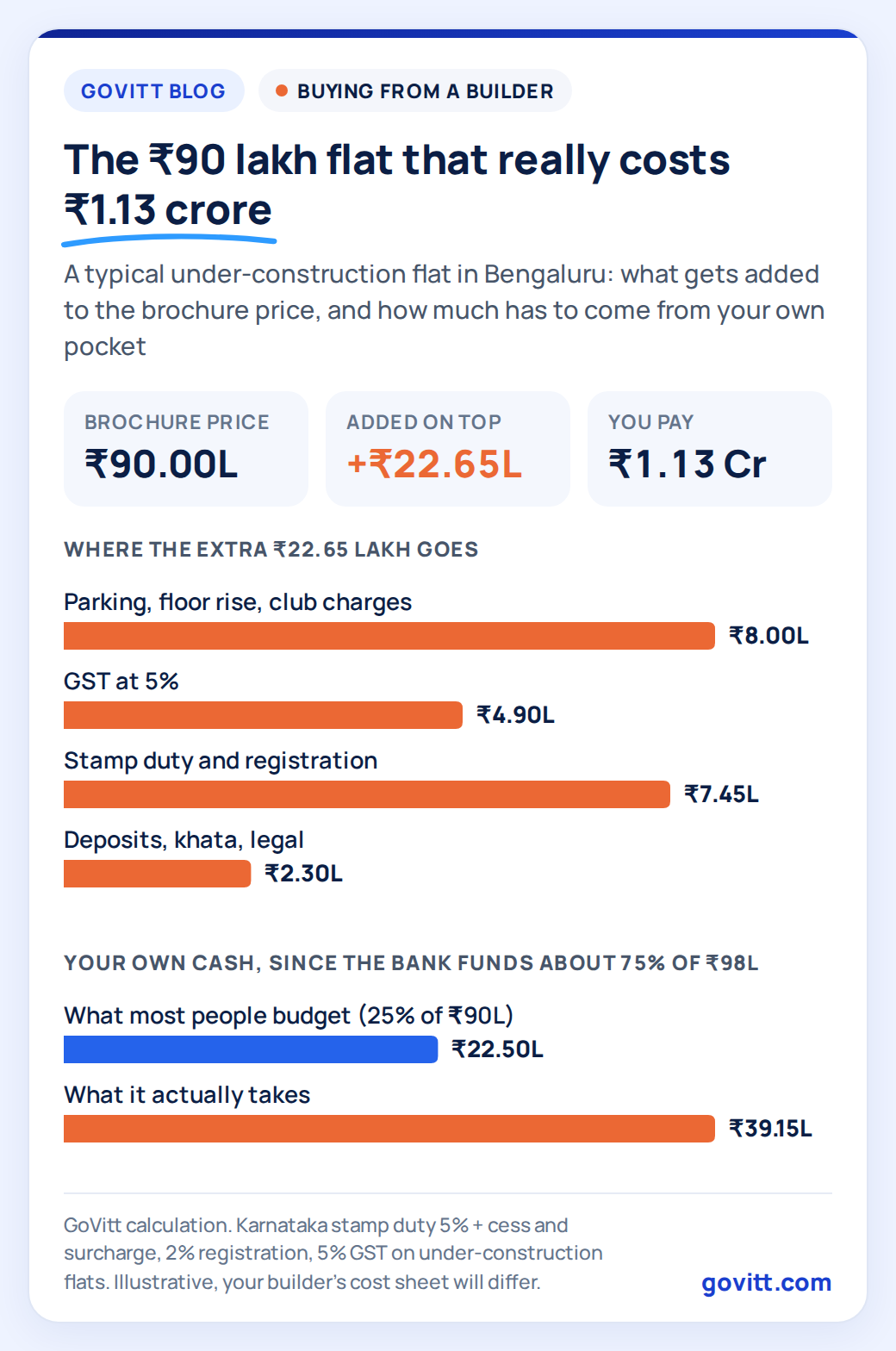
A ₹90 lakh flat ends up at ₹1.13 crore, and the cash you need from your own pocket is closer to ₹39 lakh than ₹22.5 lakh.
So the ₹90 lakh flat costs you ₹1,12,64,800. About 25% more than the number that made you fall in love with it.
Why the loan doesn't cover the gap
This is the part nobody explains properly at the site office.
Most people plan for a 20% or 25% down payment and assume the bank takes care of the rest. On ₹90 lakh they keep ₹22.5 lakh aside and feel fine.
But banks don't lend on your total outgo. RBI caps how much of the property's cost a bank can fund, and on a loan this size it's around 75%. And RBI specifically tells banks not to count stamp duty, registration and documentation charges as part of the property's cost when they work this out, except on very small homes. Deposits and legal fees come from you too.
So on our example the bank funds roughly ₹73.5 lakh, which is 75% of the ₹98 lakh agreement value. Everything else is your money. That's ₹39.15 lakh, not ₹22.5 lakh. A gap of almost ₹17 lakh that people discover somewhere between the booking and the registration, usually with a personal loan offer landing in their inbox at exactly the wrong moment. Don't take it. A personal loan at 12% or more sitting on top of a home loan is how a stretched budget becomes a broken one.
Some lenders will include GST in the cost they fund, some won't, and the exact percentage depends on your profile. Ask your lender before you book, not after. Better still, get your loan sanctioned or at least pre-approved before you pay the booking amount, so you know what the bank will actually give you.
Let the bank do your due diligence for free
This is my favourite trick, and it costs nothing.
Before a bank agrees to fund flats in a project, its legal team goes through the land title and its technical team looks at the approvals and the construction. If they're happy, the project gets approved and the builder gets what's called an APF number from that lender. Big builders usually have several banks on board.
So ask the sales team one simple question: which banks have approved this project?
If three or four large banks have, that's not a guarantee of anything, but it does mean a few legal teams have already looked at the title and not run away. If the answer is one small lender you've never heard of, or a vague "all banks will give loan, sir", that tells you something too. It's not proof of a problem. It's a reason to dig further before you sign anything.
The RERA checks, in the order I'd do them
Open your state's RERA website. For Karnataka it's rera.karnataka.gov.in. If the project isn't registered there, I'd stop right there. No registration means no RERA protection, and that's the main protection you have.
If it is registered, look at a few things on the same page.
The promised completion date the builder has declared to RERA. Not the date the sales person tells you. The one on the portal is the date they're legally held to, and it's often later than what gets said at the site.
The quarterly progress reports. Builders have to upload these. If they've stopped filing, or the photos haven't changed in a year, that's your answer about how construction is really going.
Complaints against the project, and against the builder's other projects. A couple of complaints in a large project is normal. A pattern is not.
Also know what RERA gives you, because the sales team won't volunteer it. The builder has to keep 70% of the money collected from buyers in a separate account for that project, so your money shouldn't be funding somebody else's tower. Flats have to be sold on carpet area, the actual usable floor space, so compare that number and not the "super built-up" figure. And a builder can't take more than 10% of the flat's cost as advance or booking amount before a registered agreement for sale is signed. If you're being asked for 20% "to block the unit", that's not how it's supposed to work.
Read the agreement like you'll need it one day
Because you might.
Check what happens if possession is delayed. Under RERA, if the builder misses the date, you can either walk away and get your money back with interest, or stay in the project and get interest for every month of delay. Some agreements quietly try to put much smaller penalties in their own clauses. Know what the law gives you so you're not bargaining against yourself later.
Check the payment schedule. A construction-linked plan, where you pay as floors actually get built, is safer for you than a time-linked plan where payments fall due on dates regardless of progress.
Check which charges are in the agreement value and which are "extra, payable at possession". The second list is where surprises live.
And check the structural defect clause. For five years from possession, the builder has to fix structural defects and workmanship issues at their own cost. Keep a copy of the agreement somewhere you can actually find it in year four.
The under-construction costs that sneak up on you
When you buy under construction, the bank releases the loan in stages as the building goes up. Until the full loan is disbursed you usually pay only interest on whatever has been released so far. That's the pre-EMI.
It feels cheap in the beginning. It also gets expensive very quickly if you're paying rent at the same time and the project runs late.
Say ₹60 lakh has been disbursed at 8%. Your pre-EMI is ₹40,000 a month. Add ₹30,000 of rent. That's ₹70,000 going out every month and you still don't have a house. One year of delay costs you ₹8.4 lakh, and none of that pre-EMI reduces your loan by a single rupee. If RBI raises rates the way analysts expect this year, that pre-EMI goes up with it.
Some builders offer "no EMI till possession" schemes, where they pay the interest to the bank on your behalf. Read the tripartite agreement very carefully before you go for one of these. The loan is in your name. If the builder stops paying the bank, the bank comes to you, and it's your credit score that takes the hit.
On tax, one thing to know upfront. You can't claim the home loan interest deduction while the flat is under construction. The interest you pay in that period gets added up and claimed in five equal parts from the year you get possession. And if the construction isn't finished within five years from the end of the financial year you took the loan, the deduction on a self-occupied home drops to just ₹30,000 a year. So a badly delayed project hurts your tax planning too, not just your patience. I've written more on how this works if you end up with two home loans.
Don't accept possession without the OC
When the builder finally calls you for possession, ask for the occupancy certificate before you take the keys. Not "it's applied for, it'll come". The actual certificate.
Without it you can run into trouble with khata, with water and electricity connections, and later with resale, because the next buyer's bank will ask for it too. Some banks won't release the last tranche of your own loan without it either. If the builder is pushing people to move in without an OC, that's your bargaining power they're trying to take away. Don't give it up.
So, is buying under construction a bad idea?
No. I'd never say that. Under construction flats are often priced lower than ready ones, you get a choice of floor and facing, and in a good project the price can go up quite a bit by the time you get possession. Plenty of people buy this way and it works out perfectly well.
It's just a bet on the builder. You are paying for something that doesn't exist yet, and your protection is the paperwork and your own homework. Do the checks above, plan for the real cost instead of the brochure price, and don't let a "price going up next week" line rush you into paying before your loan is sorted.
If you're about to book, send us the builder's cost sheet on WhatsApp at +91 70194 17854. We'll tell you how much the bank is likely to fund, how much cash you'll really need, and which of our 50+ partner banks and housing finance companies have approved that project. You can also compare what lenders are currently offering. GoVitt doesn't charge you any commission.
The example uses a ₹90 lakh under-construction flat in Bengaluru with illustrative extra charges. Your builder's cost sheet, your lender's funding and your state's stamp duty will decide your actual numbers. This is general information, not legal advice, so get the title and agreement checked by a property lawyer before you sign.
Questions people usually ask
What are the hidden charges when buying a flat from a builder? The common ones are car parking, floor rise, preferred location charges, club membership, GST, stamp duty and registration, maintenance advance, corpus fund and legal or khata charges. On a ₹90 lakh flat in Bengaluru these can add ₹20 lakh or more to the brochure price. Ask for the full cost sheet in writing before booking.
How much down payment do I need for an under-construction flat? More than most people plan for. Banks usually fund 75% to 80% of the agreement value and don't fund stamp duty, registration or deposits. On a ₹90 lakh flat that becomes ₹98 lakh with charges, you may need close to ₹39 lakh of your own money rather than ₹22.5 lakh.
Is GST applicable on a ready-to-move flat? No. GST applies only to under-construction flats, at 5% for flats above ₹45 lakh and 1% for affordable housing. A ready flat with an occupancy certificate attracts no GST.
How do I check if a builder's project is RERA registered? Search the project on your state's RERA website. In Karnataka it's rera.karnataka.gov.in. Check the declared completion date, the quarterly progress reports and any complaints filed against the project.
How much can a builder take as booking amount? Under RERA, a builder can't take more than 10% of the flat's cost as advance or application fee before signing a registered agreement for sale with you.
What happens if the builder delays possession? Under RERA you can either withdraw and get a refund with interest, or continue in the project and receive interest for every month of delay. Check the date declared on the RERA portal, since that's the one the builder is held to.
What is pre-EMI? When a loan for an under-construction flat is released in stages, you usually pay only interest on the amount disbursed so far. That's the pre-EMI. It doesn't reduce your loan, so long delays can get expensive, especially if you're also paying rent.
Can I claim tax benefits on an under-construction flat? Not during construction. The interest paid before possession is claimed in five equal parts starting from the year you get possession. If construction isn't completed within five years from the end of the financial year the loan was taken, the deduction for a self-occupied home drops to ₹30,000 a year.
Ready to take the next step?
Find out your loan options and check your eligibility with GoVitt today.