
A call I get often goes like this. Someone has a ₹3 lakh bonus sitting in a savings account. Their home loan is ₹50 lakh at 8.25%, with 20 years to go. They have not prepaid a single rupee in two years.
When I ask why, the answer is almost always the same: a relative or a colleague once paid a penalty to close an older loan, and they do not want to lose a few thousand rupees of their own. So the money sits in savings, earning about 3%, while the loan keeps charging 8.25% every year on the full balance.
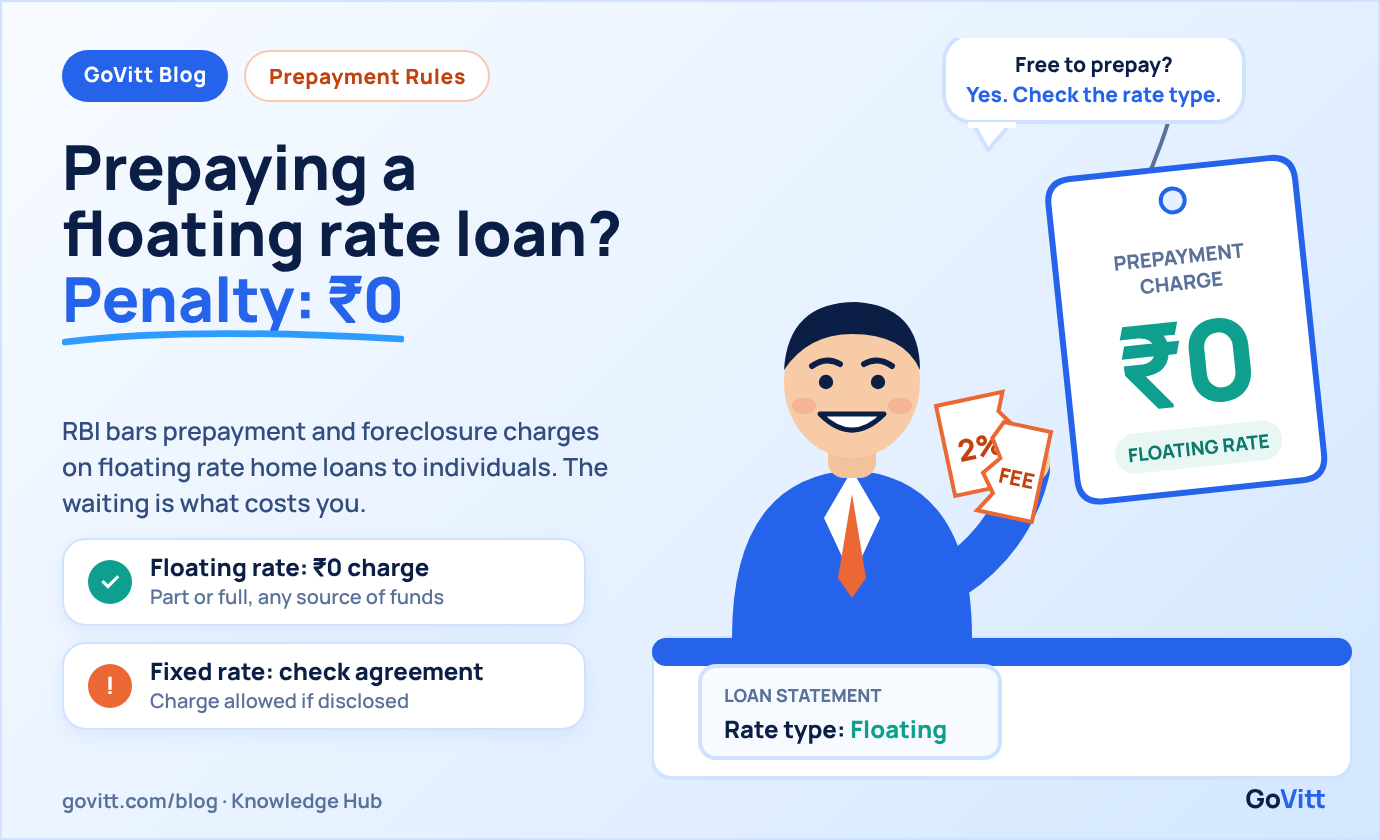
If your loan is a floating rate loan in your own name, that penalty fear is out of date. Here is what the rule says, who it covers, and what the waiting really costs.
See your real payoff date in 60 seconds
Banks calculate remaining EMIs by simple subtraction. See your actual payoff date and discover how much interest a balance transfer can save.
What the RBI rule says
Two RBI documents matter here. The first is a 2014 circular that already barred foreclosure and prepayment penalties on floating rate term loans to individuals taken for non-business purposes. A home loan fits that description.
The second is the Reserve Bank of India (Pre-payment Charges on Loans) Directions, 2025. It was issued on July 2, 2025 and applies to loans sanctioned or renewed on or after January 1, 2026. It repeats the ban for individuals, and it extends the same protection to floating rate business loans taken by individuals and micro and small enterprises.
For a home loan borrower, the useful parts are short. There is no prepayment charge on a floating rate loan, and it does not matter whether you pay part of the loan or all of it, or where the money comes from, so your own savings, a bonus, or funds from another lender all count the same. There is no minimum lock-in period either. If you have a co-borrower, the ban still applies.
Banks, housing finance companies and other regulated lenders are all covered.
Which loans are not covered
This is where people get caught, so read it twice.
A fixed rate loan can still carry a prepayment charge. The lender has to disclose it in the sanction letter, the loan agreement and the Key Fact Statement, but it is allowed. Some borrowers moved to fixed after the recent hike news, and they should check this before sending a large payment.
A loan that starts fixed and later turns floating, often called a dual rate or special rate loan, depends on its status on the day you prepay. If it is floating on that day, no charge. If it is still in the fixed period, the charge in your agreement can apply.
Loans taken in a company's name, or by any entity that is not an individual, sit outside the ban for home loans. Most readers of this blog are salaried people or self-employed individuals, so this will not apply to them, but a line of mention seemed fair.
If you are unsure what you have, look at your latest loan statement. It names the rate type and the benchmark your rate is linked to.
What waiting costs
Let me use the same loan as my earlier prepay post. ₹50 lakh at 8.25% over 20 years means an EMI of ₹42,603. Now take a ₹3 lakh prepayment and keep the EMI unchanged, so the loan simply ends sooner.
Prepay today, and the loan ends 32 months early. You save about ₹10.9 lakh in interest. Wait one year and the saving drops to ₹9.9 lakh. Wait two years and it is ₹9.0 lakh. By year five it is ₹6.6 lakh, and by year ten only ₹3.5 lakh.
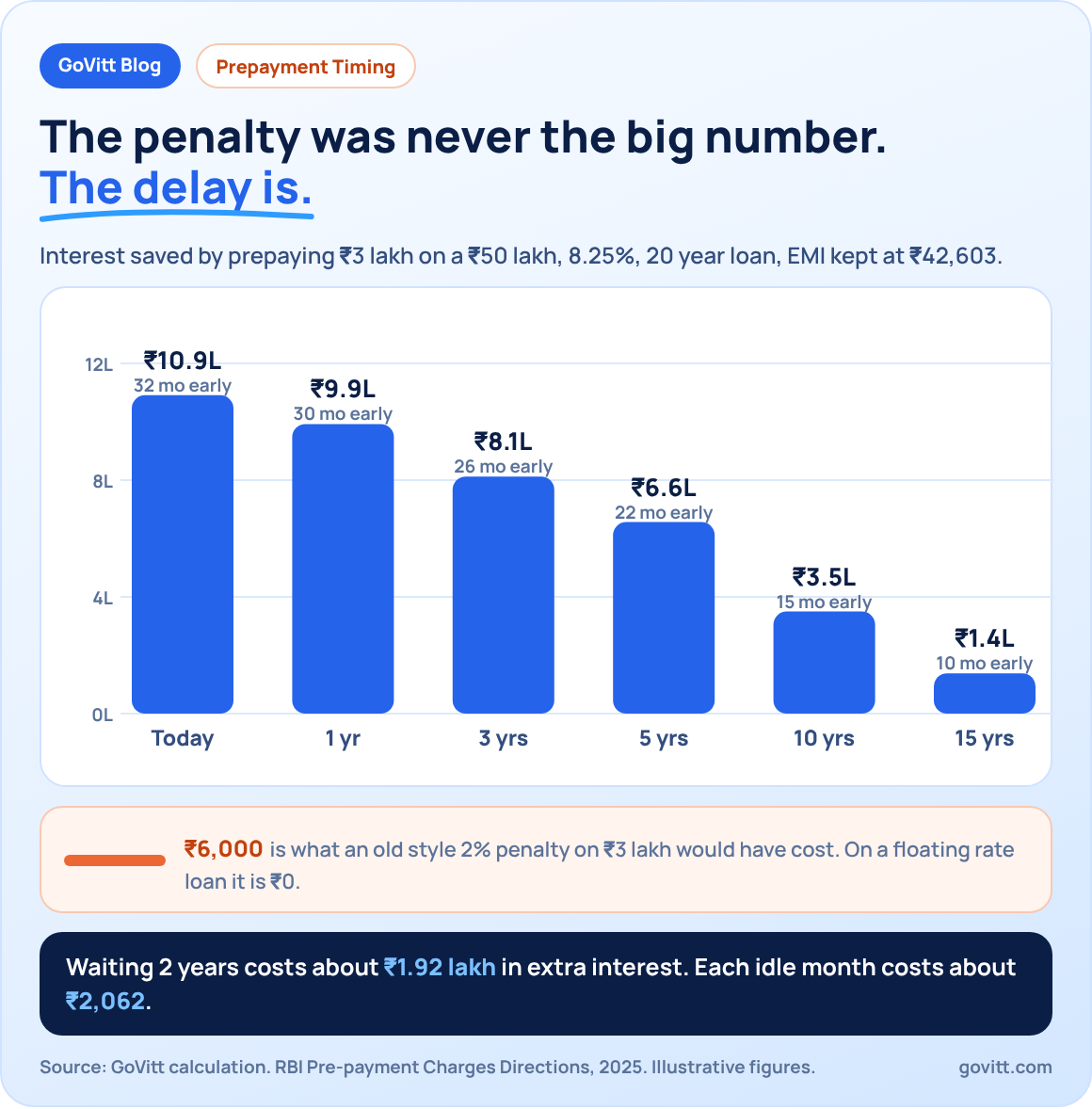
Interest saved by prepaying ₹3 lakh at different points of a ₹50 lakh, 8.25%, 20 year loan with the EMI kept the same. Illustrative figures. The ₹6,000 bar shows what a 2 percent penalty would have cost, for comparison.
Look at the orange bar under the chart. Even if a 2% penalty did apply, it would be ₹6,000 against a saving of ₹10.9 lakh. The penalty was never the big number. The delay is.
Two years of waiting costs this borrower about ₹1.92 lakh in extra interest. Every month the ₹3 lakh stays idle, it costs about ₹2,062 in interest on the loan.
Prepay, or do something else with the money
The rule says you can prepay for free. It does not say you always should.
If the money is your emergency fund, keep it, because a home loan prepayment cannot be taken back out when a hospital bill or a job gap shows up. If you are choosing between prepaying and a fixed deposit, my earlier post on prepaying a home loan vs an FD after the rate hike runs the comparison with real FD rates and tax.
And if your rate is much higher than what new borrowers get, a transfer may save you more than a small prepayment. Because floating rate loans carry no prepayment charge, moving your loan does not trigger a penalty from your old lender either. The home loan transfer process post covers what happens at each step.
If you are weighing whether to switch rate types after the hike, the post on fixed or floating after the inflation jump is the one to read first.
What to check before you pay
The ban covers prepayment charges. It does not mean every lender runs the process the same way. A few things differ, and a five minute call saves you a week of back and forth.
Ask whether there is a minimum amount for part prepayment, since some lenders set one. Ask whether there is a limit on how many times you can prepay in a year. Then ask whether the payment reduces your tenure or your EMI by default, because you may have to request the option you want in writing, and the default is not always the one that saves you more.
Check the Key Fact Statement for any processing or administrative fee that is separate from a prepayment charge, and if you see one, ask the lender to explain it. If a lender does charge a prepayment penalty on a floating rate loan, write to the bank's grievance officer first. If that does not work, the RBI Integrated Ombudsman is the next step.
Finally, keep the receipt and get an updated repayment schedule after each prepayment. Your next statement should show the new balance and the new end date.
Tenure or EMI?
Most borrowers should keep the EMI the same and shorten the tenure. On our example, a ₹3 lakh prepayment two years in saves about ₹9.0 lakh that way.
If you cut the EMI instead, it falls by roughly ₹2,670 a month, but the interest saving is much smaller, about ₹3 lakh over the rest of the loan. Cutting the EMI makes sense when your monthly cash flow is tight and the extra breathing room matters more than the total cost. Otherwise, a shorter loan wins.
Where GoVitt fits in
If you are not sure whether your loan is floating, fixed or dual, send us your latest statement on WhatsApp and we will tell you what applies. We can also run your numbers for prepaying against transferring to a lower rate.
- WhatsApp: +91 70194 17854
- Payoff & Transfer Calculator: govitt.com/post-loan-dashboard
- EMI calculator: govitt.com/home-loan-emi-calculator
- Bank offers: govitt.com/bank-offers
GoVitt doesn't charge you any commission.
Figures in this post are illustrative and rounded. This is general information, not financial or legal advice. Check your own loan agreement and talk to your lender before you prepay.
Questions people usually ask
Can my bank charge a prepayment penalty on a floating rate home loan? No. For a floating rate home loan taken by an individual for non-business purposes, RBI rules bar prepayment and foreclosure charges, and that covers both part prepayment and full closure of the loan.
Does the rule apply to my old loan or only to new loans? The 2014 RBI circular already barred these charges on floating rate loans to individuals, so older floating rate home loans were covered even before the new Directions. The 2025 Directions apply to loans sanctioned or renewed on or after January 1, 2026.
Can a bank charge me if my home loan is on a fixed rate? Yes, it can. Fixed rate loans can carry a prepayment charge, but the lender has to disclose it upfront in the sanction letter, the loan agreement and the Key Fact Statement, so check those documents before you send any money.
What if my loan is fixed for a few years and then turns floating? It depends on the rate type on the day you prepay. If the loan is floating at that time, no charge applies. If it is still in the fixed period, the charge in your agreement can apply.
Does it matter where the prepayment money comes from? No. For floating rate loans to individuals, the ban applies whether you pay from savings, a bonus, or funds from another lender.
Is there a minimum amount for part prepayment? The RBI rule is about charges, not about minimum amounts. Some lenders set a minimum part-prepayment amount, so ask yours before you pay.
Should I reduce my EMI or my tenure after prepaying? Keeping the EMI the same and shortening the tenure saves the most interest over the life of the loan. Reducing the EMI helps your monthly cash flow but saves much less overall.
What can I do if my lender still charges a penalty on a floating rate loan? Ask for the rule they are relying on, in writing. Then raise it with the bank's grievance officer, and if the matter is still not fixed within the lender's stated timeline, file a complaint with the RBI Integrated Ombudsman.
Ready to take the next step?
Find out your loan options and check your eligibility with GoVitt today.