
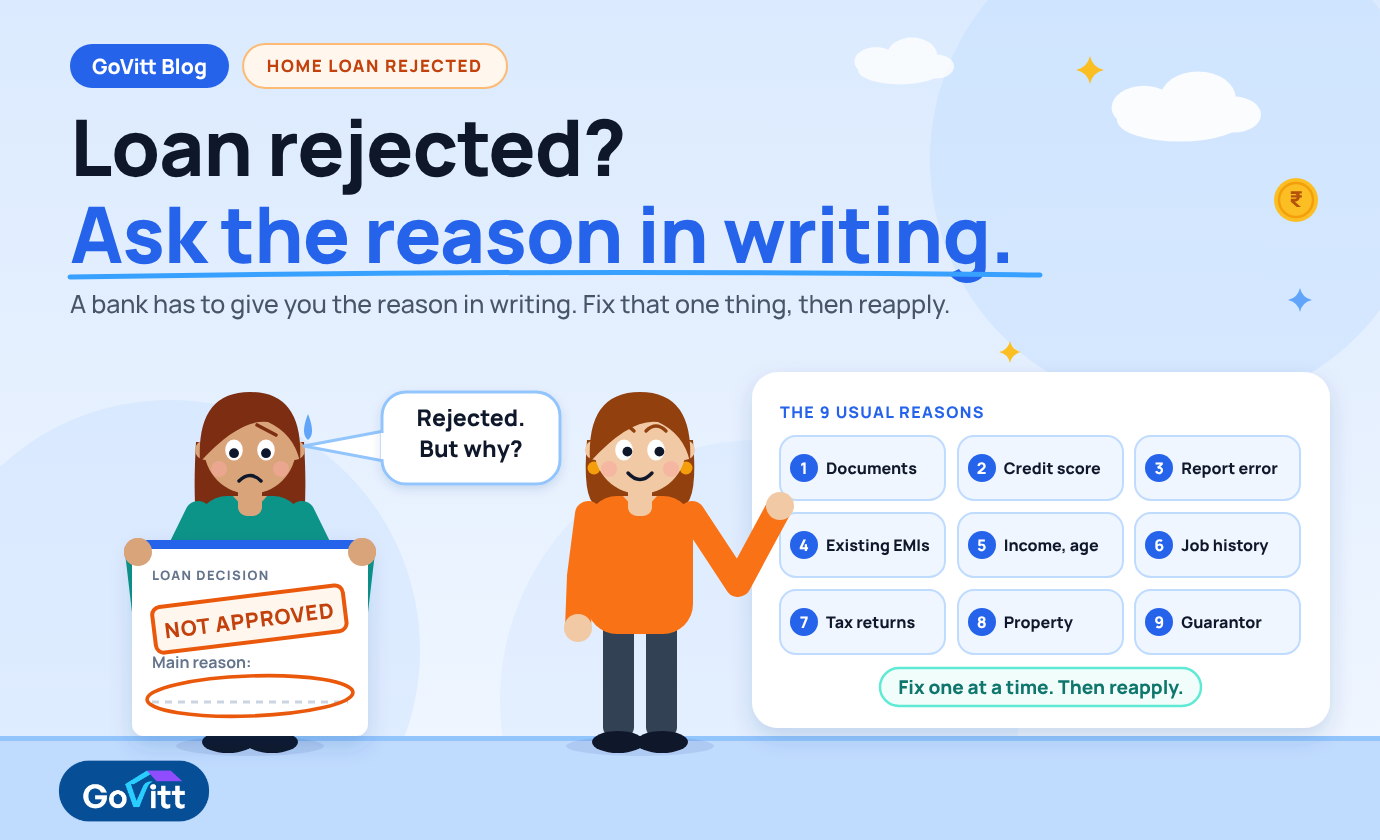
A rejection letter feels final, but it usually points to something you can fix. These are the home loan rejected reasons that banks and lenders list on their own pages, and what to do about each before you reapply. One limit up front: none of the sources I read ranks them by how often they happen. So I won't tell you which is number one. The nine below are in the order you can check them.
Step zero: get the reason in writing
RBI's Fair Practices Code circular of 6 March 2007 says banks must convey in writing the main reasons for rejecting a loan application, for all categories of loans irrespective of any threshold. That circular is addressed to banks. I haven't checked the equivalent rule for housing finance companies, so ask in writing either way.
Then pull your own credit report. RBI's directive of 1 September 2016, in force from 1 January 2017, says each credit bureau must give you one free full report a year, with the score. Both take less than a day, and you need them before you fix anything.
See your real payoff date in 60 seconds
Banks calculate remaining EMIs by simple subtraction. See your actual payoff date and discover how much interest a balance transfer can save.
Don't apply anywhere else yet. A rejected application still leaves an enquiry. CIBIL calls the impact minimal and no bureau publishes a points figure, but five applications in a week looks like panic to the next lender. The wider picture is in home loan eligibility: the 7 checks banks run before they say yes.
The nine reasons at a glance
| # | Reason | Who lists it | Where you'll see it | The fix |
|---|---|---|---|---|
| 1 | Incomplete or mismatched documents | Kotak, Bank of Baroda, Ujjivan SFB, Aditya Birla Capital | Your papers side by side | Match names and addresses, get the bank's checklist |
| 2 | A credit score that is too low | Bank of Baroda (below 650), Kotak (below 700), Ujjivan SFB (below 600) | Your credit report | Fix the report, cut card use, wait |
| 3 | A wrong entry on your report | Ujjivan SFB (check the report for errors) | Your credit report | Dispute it, allow 30 to 45 days |
| 4 | Existing EMIs and past defaults | Kotak, Bank of Baroda, Ujjivan SFB | Your credit report | Clear small loans first |
| 5 | Income or age leaves too small a loan | Ujjivan SFB, Aditya Birla Capital | The sanctioned amount | A smaller loan or a co-applicant |
| 6 | A job that is too new, or too many changes | Kotak, Bank of Baroda, Aditya Birla Capital | Your employment history | Wait, or ask for the minimum in writing |
| 7 | Returns not filed, income not on paper | Bank of Baroda | Your tax returns | File the last two years |
| 8 | A problem with the property | Kotak, Bank of Baroda, Ujjivan SFB, Aditya Birla Capital | The legal and valuation reports | Lawyer check, margin for valuation |
| 9 | A loan you guaranteed, or many recent applications | Aditya Birla Capital (guarantee); Godrej Capital and CIBIL (enquiries) | Your credit report | Know what you've signed for |
1. Incomplete or mismatched documents
Kotak puts this at the top of its list. Bank of Baroda calls incorrect or incomplete documents "one of the most common" reasons. Aditya Birla Capital says "any false or mismatch in the documents" can lead to rejection. Of the nine, this is the one you control completely.
How to confirm: lay your PAN, Aadhaar, salary slips and bank statements side by side. Is your name spelled the same on all of them? Does your address match? Are the statements from the account your salary lands in? The fix: get the lender's own checklist in writing, correct what doesn't match, and send everything in one go.
2. A credit score that is too low
Lenders draw the line in different places. Bank of Baroda lists a score below 650, Kotak says below 700 keeps you at higher risk and Ujjivan Small Finance Bank says below 600. There is no single cut-off, and the full picture is in the minimum CIBIL score for a home loan. What changes with your score is often the price rather than the yes or no.
On ₹50 lakh over 20 years at PNB, the EMI is ₹40,127 at 800 and above, ₹41,978 at 700 to 749 and ₹45,793 at 600 to 699.
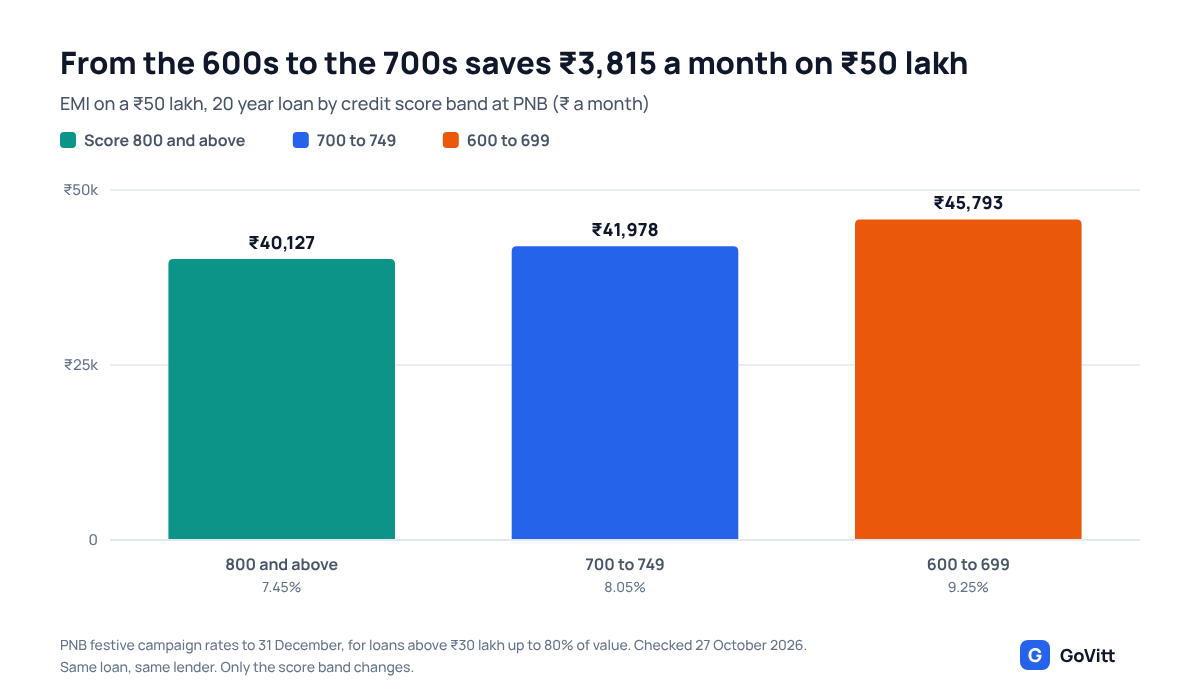
That is ₹3,815 a month between the 600s and the 700s. The fix: pay every EMI and card bill on time, keep card use low, and open no new credit in the months before you apply. If you're in the 600s now, can I get a home loan with a 650 CIBIL score? has the steps.
3. A wrong entry on your credit report
This one isn't on the lender lists as a reason, but Ujjivan Small Finance Bank's own post tells rejected borrowers to pull the report, find errors and start corrections. Look for a loan that is closed but shows as open, a missed payment that was actually paid or a loan that isn't yours.
The fix: raise a dispute with the bureau and send the lender's closure letter as proof. Allow 30 to 45 days for the correction to show. The dispute steps are in does a home loan balance transfer hurt your CIBIL score?. It is written about transfers, but a wrong entry is a wrong entry for any loan.
4. Existing EMIs and past defaults
Every EMI on your report comes out of the share of your income a bank lets you commit, called FOIR. On a take-home of ₹1,00,000, at 8% over 20 years and a 50% FOIR, a bank would lend ₹59.8 lakh with no other EMIs. With a ₹10,000 EMI running, that falls to ₹47.8 lakh. A ₹10,000 car loan EMI costs you ₹11.96 lakh of home loan.
The fix: clear the small loans before you apply, not after. Every ₹5,000 of EMI you clear adds about ₹5.98 lakh of eligibility at those numbers. A past default is different. It needs time and a clean record since, and no shortcut helps.
5. Income or age leaves too small a loan
Ujjivan Small Finance Bank lists income that is unstable or too low to cover the EMI. Aditya Birla Capital adds age. It says age sets your tenure, takes 60 as the retirement age and says rejections are more likely for applicants close to retirement.
On the same ₹1,00,000 take-home at 8% and a 50% FOIR, with the loan ending at 60, a 30 year old qualifies for ₹68.1 lakh and a 50 year old for ₹41.2 lakh. The method is in how much home loan you can get on your salary. The fix: ask for a smaller loan, add a co-applicant with steady income (their report gets read too) or take the longest tenure your age allows. A longer tenure raises the loan your EMI supports, and it raises the total interest.
6. A job that is too new, or too many changes
Kotak says lenders prefer at least three years in the same organisation. Aditya Birla Capital advises staying in a job for two to three years before applying. Bank of Baroda lists frequent job changes as a reason. None of them gives a hard cut-off.
The fix: ask the lender for its minimum in writing before you reapply. And if you're about to switch jobs and buy in the same year, get the sanction first.
7. Returns not filed, income not on paper
Bank of Baroda lists not filing income tax returns as a reason and says it wants two years of them. For self-employed borrowers, banks work from the returns, not your bank balance.
The fix: file the last two years, keep the income on them consistent with what you tell the bank and don't apply until the returns are on record.
8. A problem with the property
The bank lends against the flat, so it checks the flat. Kotak lists an illegal property or an unapproved builder and a low valuation. Bank of Baroda lists title problems. Ujjivan Small Finance Bank mentions legal disputes and Aditya Birla Capital a property that is in dispute or very old.
The valuation is the one people miss. Say you agree to pay ₹80 lakh and the bank's valuer says ₹72 lakh. If the bank applies RBI's 80% cap to its own number, the loan falls from ₹64 lakh to ₹57.6 lakh and you need ₹6.4 lakh more of your own money.
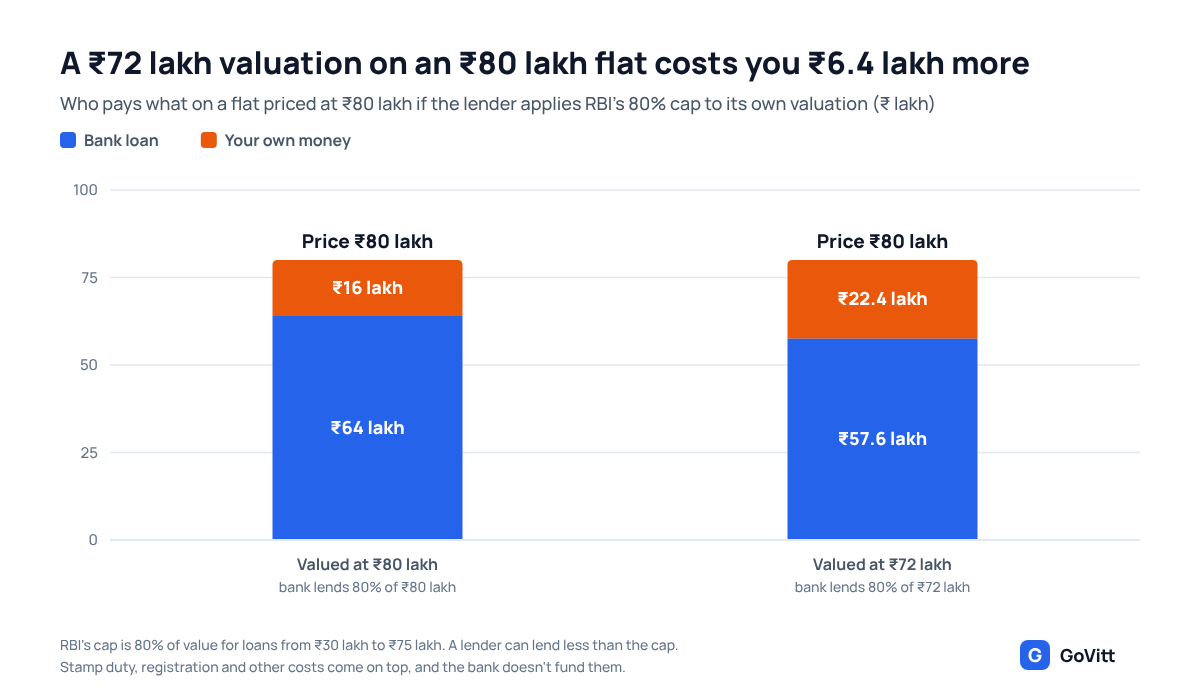
The fix: get a lawyer to check the title before you pay a booking amount, and pick a lender that has already approved the project. The checks are in before you pay that booking amount. A rejection on the property doesn't mean you'll be rejected on the next one.
9. A loan you guaranteed, or many recent applications
Aditya Birla Capital lists standing guarantor for someone else's loan as a reason, because you are liable if the primary borrower defaults. If you've guaranteed a loan, ask the lender how it counts and check whether it shows on your report.
The other half is applications. No bureau publishes how many points an enquiry costs. Godrej Capital's page says a single hard enquiry may lower your score by 5 to 10 points, but it doesn't say where the number comes from, so treat it as a rough guide at best. What I'd say is simpler: two lenders in the same week is a reasonable test, five is not. The common mistakes are in top mistakes to avoid when applying for a home loan.
When to reapply for a home loan after rejection
The sources disagree, and I found no RBI or bank rule that fixes a waiting period. SMFG Grihashakti says there is no universal waiting period, and calls 6 to 12 months a practical approach that depends on whether the cause is fixed. Ujjivan Small Finance Bank says at least six months to a year. Godrej Capital says 3 to 6 months. Aditya Birla Capital gives none.
So don't go by the calendar. I'd reapply when the fix is on paper. Your new report shows the correction (allow 30 to 45 days), the small EMIs are cleared and visible, the documents match and the returns are filed. If the reason was the property, a different property fixes it the same week.
What I'd do this week
- Ask the lender for the reason in writing. Quote RBI's circular if you need to.
- Pull your free credit report and read every line against your own records.
- Match the reason to the table above, and fix that one thing first.
- Get proof of the fix: a corrected report, a closure letter, matching documents, filed returns.
- Run your numbers again in the EMI calculator so you ask for a loan the EMI can carry.
- Reapply to two lenders in the same week, not five, and compare the offers on the rate and the fee.
FAQ
Why was my home loan rejected? Lenders list nine usual reasons: incomplete or mismatched documents, a low credit score, a wrong entry on your report, existing EMIs or past defaults, income or age that leaves too small a loan, a short or unstable job history, unfiled returns, a problem with the property, and a loan you guaranteed. Ask the lender for the main reason in writing.
Can I reapply for a home loan after rejection? Yes. There is no rule I could find that sets a waiting period. Lender pages suggest 3 to 6 months at Godrej Capital and 6 to 12 months at SMFG Grihashakti and Ujjivan Small Finance Bank, and Grihashakti says a minor documentation error may allow an earlier reapplication. I'd reapply once the fix shows on paper, not on a date.
Does the bank have to tell me why my home loan was rejected? Banks do. RBI's Fair Practices Code circular of 6 March 2007 says banks must convey the main reasons for rejection in writing, for all categories of loans irrespective of any threshold. I haven't checked the equivalent rule for housing finance companies, so ask in writing either way.
Does a rejected home loan hurt my CIBIL score? A rejected application still leaves an enquiry on your report. CIBIL calls the impact minimal and no bureau publishes a points figure. The bigger risk is applying to several lenders in a short time. Two in the same week is a reasonable test.
What is the most common reason for home loan rejection? No source I read ranks them. Bank of Baroda calls incorrect or incomplete documents "one of the most common", and Kotak lists them first. Beyond that, lenders list documents, credit score, EMIs, job history, returns, the property and age without a ranking.
Can I get a home loan from another bank after a rejection? Yes, lenders set their own policies. At a score in the 600s, LIC Housing Finance publishes 8.75% and PNB 9.25%. But a wrong report entry or mismatched papers will follow you to the next lender, so fix those first.
Not sure which reason hit you? Talk to an advisor (free, WhatsApp) and we'll go through your rejection letter and report. GoVitt compares 50+ banks and charges you 0% commission.
EMIs and loan amounts use the standard monthly reducing balance method and are rounded to the nearest rupee or to ₹0.1 lakh where shown with one decimal. Eligibility figures assume a ₹1,00,000 take-home, 8%, a 50% FOIR and a loan ending at age 60. Score thresholds, FOIR, age limits and waiting periods differ by lender and your lender decides your eligibility. PNB's rates are festive campaign rates to 31 December 2026 for loans above ₹30 lakh up to 80% of value, as checked on 27 October 2026. This is general information, not financial advice.
Ready to take the next step?
Find out your loan options and check your eligibility with GoVitt today.