
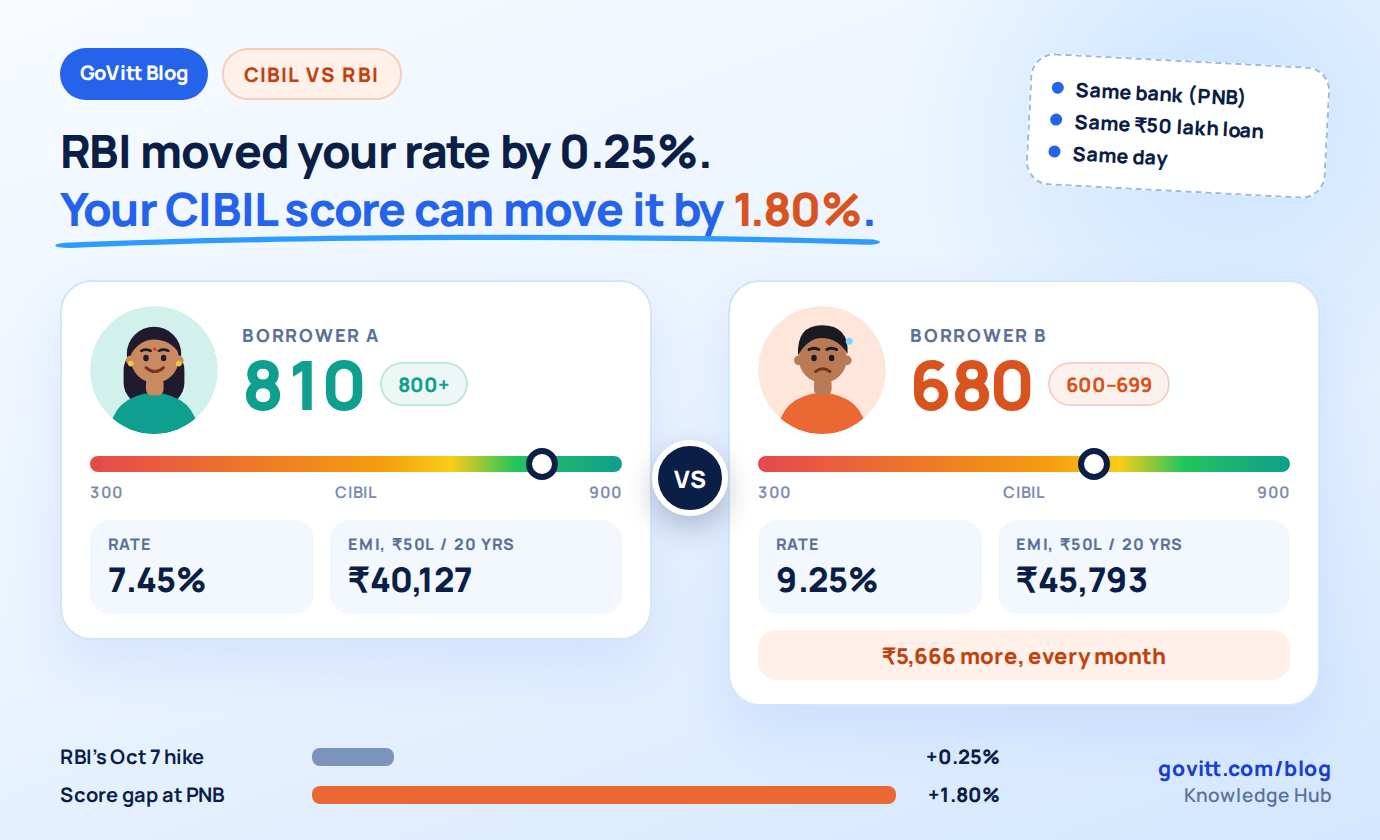
Last week the whole country talked about 0.25%. RBI raised the repo rate, banks passed it on within a day, and every home loan borrower I know asked what it does to their EMI.
Fair question. But while we were updating the rates on our website this weekend, I kept looking at PNB's home loan page. Same bank. Same day. Same ₹50 lakh loan. One borrower gets 7.45%. Another gets 9.25%.
The only difference between them is a three digit number.
See your real payoff date in 60 seconds
Banks calculate remaining EMIs by simple subtraction. See your actual payoff date and discover how much interest a balance transfer can save.
How your score turns into your rate
Every floating rate home loan has two parts. The bank's benchmark rate, which is linked to the repo rate and moves when RBI moves. And a spread on top of it, which the bank decides for you when it sanctions the loan.
That spread is mostly your credit score. A great score gets you a spread below the benchmark. A weak one puts you above it. And unlike the benchmark, the spread stays where it was set for as long as you have the loan.
Most banks don't publish how they price by score. A few do. Here's what three of them show on their websites right now, for salaried borrowers.
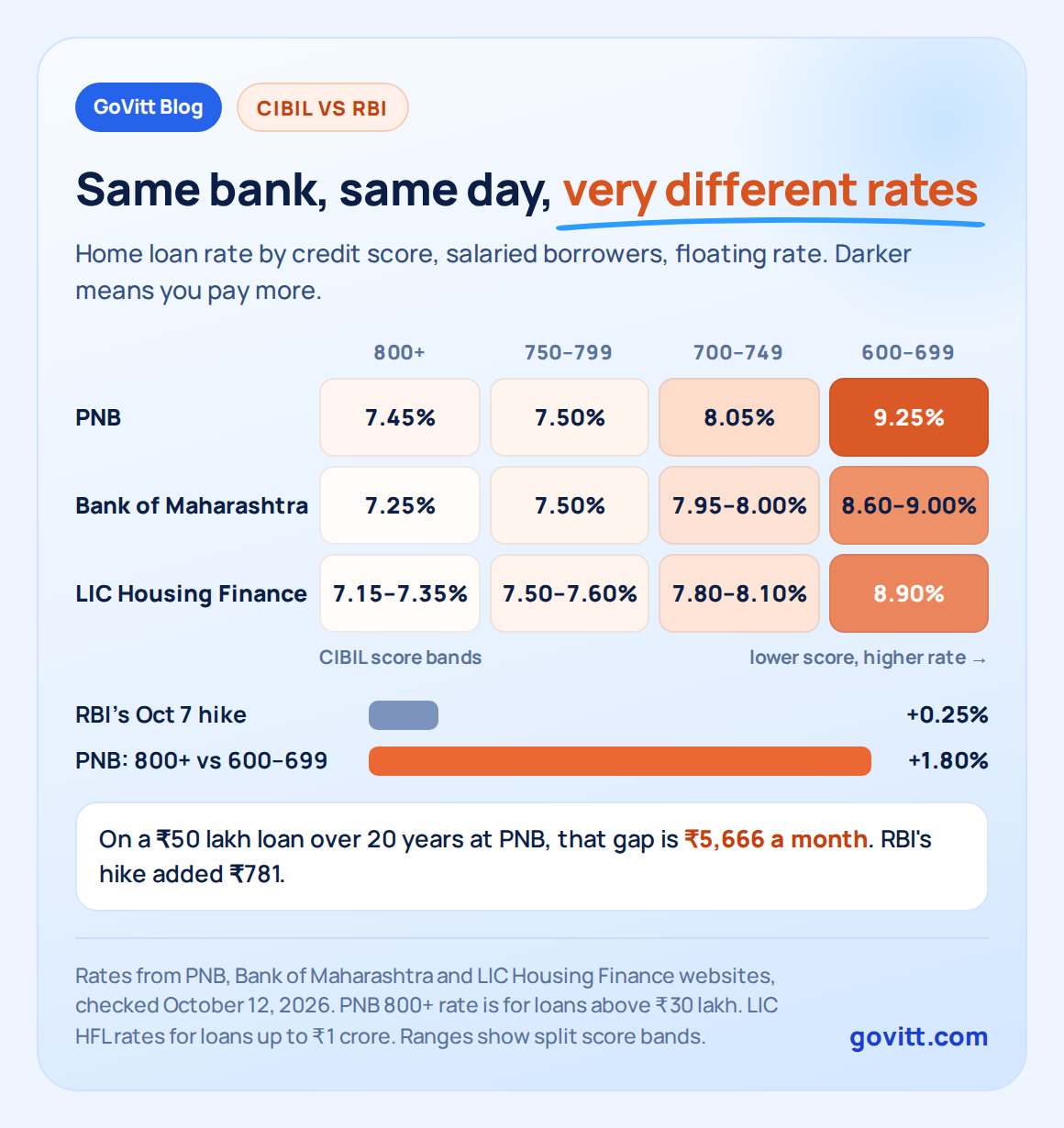
The darker the box, the more you pay. RBI's hike is the small grey bar.
At PNB, the gap between the best and worst band is 1.80%. That's more than seven RBI hikes.
What that means in rupees
Take a ₹50 lakh loan over 20 years at PNB.
With a score above 800, at 7.45%, your EMI is about ₹40,127.
In the 700 to 749 band, at 8.05%, it's ₹41,978. That's ₹1,851 more every month.
In the 600 to 699 band, at 9.25%, it's ₹45,793. ₹5,666 more every month, and about ₹13.6 lakh more over the full loan.
Compare that with RBI's hike, which added about ₹781 a month on a loan this size.
It also changes how much you can borrow. If your budget is a ₹48,000 EMI over 25 years, a score above 800 at PNB gets you about ₹65 lakh. In the 600 to 699 band, the same EMI gets you about ₹56 lakh. Nine lakh rupees less house, for the same monthly payment.
750 is the line that matters
Look at the jumps in the chart. They aren't even.
Going from 750 to 800 saves you very little. At PNB it's 0.05%. At Bank of Maharashtra, about 0.25%.
Dropping below 750 is where it hurts. At PNB the rate jumps from 7.50% to 8.05% the moment you fall into the 700 to 749 band. At Bank of Maharashtra, from 7.50% to 7.95%.
So if your score is 735 and you're planning to apply in a few months, getting it above 750 is worth far more than any negotiation you'll do with the bank. If it's already 780, don't lose sleep trying to push it to 820.
Self-employed pay a little more
Both Bank of Maharashtra and LIC Housing Finance charge self-employed borrowers more for the same score. At Bank of Maharashtra the extra is 0.10% for the best scores and goes up to 0.50% at the bottom. At LIC HFL it's 0.15% to 0.25%.
PNB charges the same either way. Some lenders do, most don't. If you run your own business, it's worth asking about this specifically when you compare offers. I've written more about how banks look at self-employed income in this post.
If you already have a home loan
This is the part most people miss.
Your spread was fixed on the score you had the day the loan was sanctioned. If that was 720 and today you're at 790, the bank isn't going to call you and lower it. You're still paying the 720 price, plus whatever RBI adds.
Say you have ₹45 lakh left with 18 years to go. You were priced in the 700 to 749 band at 8.05%, and your score has since gone above 750, where the same bank would charge 7.50%. That 0.55% is worth about ₹1,486 a month, or around ₹3.2 lakh over the rest of the loan.
You can do two things about it.
Ask your own bank to reprice your loan at the rate it offers new customers with your current score. Most banks will do it for a fee, usually a small percentage of the outstanding or a fixed amount. Get the fee and the new rate in writing before you agree.
If your bank won't move, take the loan to a lender that will. A transfer has its own costs, so do the maths first. I've worked through the full numbers, charges included, in this post, and the step by step process is here.
Either way, check your score first. You can get a free full credit report once a year from each of the credit bureaus.
Getting your score up before you apply
None of this is new, but it works.
Pay every EMI and every card bill on time. One missed payment does more damage than almost anything else, and it stays on your report for years.
Keep your credit card usage low. Under 30% of your limit is a good rule. If you're using more, either pay it down before the statement date or ask for a higher limit.
Don't close your oldest card. A longer credit history helps.
Stop applying for loans and cards for a few months before your home loan application. Every application leaves an enquiry on your report, and lots of them in a short time make lenders nervous.
Read your report line by line. Wrong entries are more common than you'd think, like a loan you closed still showing as open, or a card that isn't yours. Raise a dispute with the bureau and the lender.
The good news is that changes show up faster now. Since January 2025, RBI has required lenders to report your credit data to the bureaus at least every 15 days, not once a month. So if you clear a card balance today, it can reflect in your score within weeks. Still, give yourself three to six months before a big application if your score needs work.
If your score is low right now and you need a loan anyway, it's not the end of the road. This post on getting a home loan with a 650 score goes through your options.
Before you sign anything
Find out your score before you talk to a bank, not after.
Ask every lender for the rate at your score band, not the "starting from" rate on the banner. The banner is the 800-plus rate.
If you already have a loan, compare your current rate with what your bank offers new customers at your score today.
And remember that RBI's hike will be on everyone's loan. The spread is the part you can actually do something about.
Want us to check where you stand?
WhatsApp your CIBIL score, loan amount (or outstanding amount if you already have a loan), current rate and whether you're salaried or self-employed to +91 70194 17854. We'll tell you what rate you should be getting at your score with our 50+ partner banks and housing finance companies, and whether you're overpaying today. You can also see what lenders are offering right now, or run your numbers on our free Payoff & Transfer Calculator. GoVitt doesn't charge you any commission.
Rates are from the PNB, Bank of Maharashtra and LIC Housing Finance websites as on October 12, 2026, for floating rate home loans to salaried borrowers. PNB's 800-plus rate applies to loans above ₹30 lakh with up to 80% LTV. LIC HFL rates are for loans up to ₹1 crore. Lenders change rates often, and your final rate also depends on your income, employer, loan amount and property. EMI figures assume monthly reducing balance.
Questions people usually ask
How much does CIBIL score affect home loan interest rate? A lot more than most people expect. At PNB in October 2026, salaried borrowers with a score of 800 or more get 7.45%, while those between 600 and 699 pay 9.25%. On a ₹50 lakh loan over 20 years, that's a difference of about ₹5,666 a month.
What is the home loan interest rate for a 750 CIBIL score? It depends on the lender. As of October 12, 2026, PNB and Bank of Maharashtra charge 7.50% for salaried borrowers with a score between 750 and 799, and LIC Housing Finance charges 7.50% to 7.60%. Below 750, rates jump by about 0.20% to 0.55% at these lenders.
What is the minimum CIBIL score for a home loan? There's no single cut-off, but most banks price their best rates for 750 and above. Many lenders still lend between 600 and 699, at a noticeably higher rate. Below 600, options shrink and you may need a co-applicant or a housing finance company.
Will my home loan rate go down if my CIBIL score improves? Not automatically. Your spread is fixed at the time of sanction. If your score has improved, ask your bank to reprice the loan at its current rate for your score, usually for a fee, or consider moving the loan to another lender.
Does the RBI rate hike affect everyone equally? Yes. A 0.25% repo hike raises the benchmark for every borrower at that bank by the same amount. Your spread, which depends largely on your credit score at sanction, doesn't change.
How quickly can I improve my CIBIL score? Since January 2025, lenders must report credit data to bureaus at least every 15 days, so changes such as paying down a card balance can show up within weeks. For a meaningful improvement, give it three to six months of on-time payments and low card usage before applying.
Ready to take the next step?
Find out your loan options and check your eligibility with GoVitt today.