
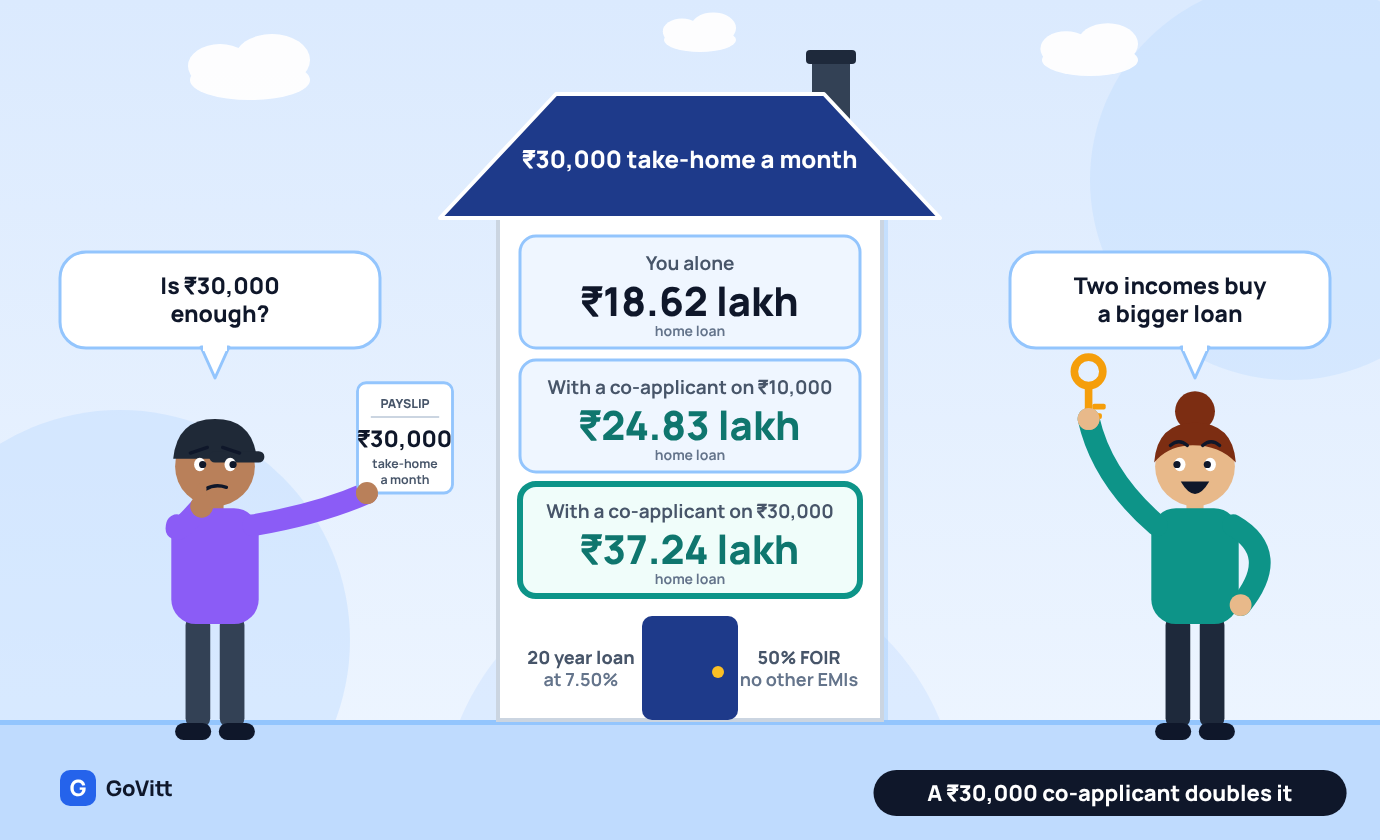
On a home loan on 30000 salary, most banks will lend you about ₹15 lakh to ₹24 lakh over 20 to 30 years. The figure I'd plan around is ₹18.62 lakh over 20 years at 7.50%. That's an EMI of ₹15,000, half your take-home.
Two things move it most. Every ₹1,000 of EMI you already pay cuts ₹1.24 lakh off the loan. And a co-applicant: add a spouse who also earns ₹30,000 and the same math gives ₹37.24 lakh, double the loan.
Banks run two tests and the lower result wins. Below: both tests at ₹30,000, what each bank's rate does to your number, and how to raise it.
See your real payoff date in 60 seconds
Banks calculate remaining EMIs by simple subtraction. See your actual payoff date and discover how much interest a balance transfer can save.
Home loan on ₹30,000 salary at a glance (checked 31 October 2026)
| Item | What to expect |
|---|---|
| Typical loan, 20 years, no other EMIs | About ₹14.9 lakh to ₹20.5 lakh |
| Typical loan, 30 years, no other EMIs | About ₹17.2 lakh to ₹23.6 lakh |
| Working figure at 7.50%, half your salary as EMI | ₹18.62 lakh over 20 years, ₹21.45 lakh over 30 years |
| EMI banks may allow | ₹12,000 to ₹16,500 a month (40% to 55% of take-home) |
| Canara Bank salary multiple | 72 times gross monthly salary: ₹21.6 lakh on ₹30,000 gross |
| Own money needed at ₹18.62 lakh | About ₹2.07 lakh, before stamp duty and registration |
| Repo rate | 5.50% since 7 October 2026 |
Is ₹30,000 enough for a home loan?
Yes, at the low end. ICICI Bank's guide says most loan providers prefer a monthly income of ₹25,000 to ₹40,000. It gives that as a general range for lenders, not as an ICICI rule, and it says lenders test take-home pay after deductions, not your CTC. Bank of Maharashtra's home loan page gives no minimum income at all; it says eligibility depends on income, age and repayment capacity.
So ₹30,000 doesn't earn you a no. It earns you a smaller loan. If you're self-employed, banks look at the income in your tax returns, not a salary slip; that case is in can self-employed people get home loans easily.
The two tests banks run
How banks work out eligibility in general is in the seven checks banks run before they say yes, and the full method is in how much home loan can I get on my salary. For ₹30,000, here's how the two tests play out.
Test 1: how much EMI can your income carry? Banks cap all your EMIs together, the new home loan included, as a share of your take-home pay. This is FOIR. HomeFirst Finance says lenders typically allow 40% to 60%. Each bank sets its own. I plan on 50% and treat anything higher as a bonus.
| FOIR used | Monthly EMI you can carry |
|---|---|
| 40% | ₹12,000 |
| 50% | ₹15,000 |
| 55% | ₹16,500 |
HomeFirst's own guide puts a ₹30,000 salary at ₹13.8 lakh to ₹17.3 lakh using an indicative 8.5%. My figures are higher because I use today's lowest published rates, which only strong profiles get. Treat HomeFirst's range as the cautious end.
Test 2: a multiple of your salary. Some banks also cap the loan at a multiple of what you earn. Canara allows salaried borrowers up to 72 times gross monthly salary, and selectively up to 96 times. On ₹30,000 gross, that's ₹21.6 lakh, or up to ₹28.8 lakh selectively.
At a 50% FOIR over 20 years the income test gives ₹18.62 lakh, below Canara's ₹21.6 lakh, so the income test decides. Stretch to 55% over 30 years and you could service ₹23.60 lakh. Then Canara's multiple would decide.
How much home loan can I get on 30000 salary?
The loan your EMI room can repay at 7.50%, SBI's lowest published rate:
| FOIR used | EMI | 20 years | 25 years | 30 years |
|---|---|---|---|---|
| 40% | ₹12,000 | ₹14.90 lakh | ₹16.24 lakh | ₹17.16 lakh |
| 50% | ₹15,000 | ₹18.62 lakh | ₹20.30 lakh | ₹21.45 lakh |
| 55% | ₹16,500 | ₹20.48 lakh | ₹22.33 lakh | ₹23.60 lakh |
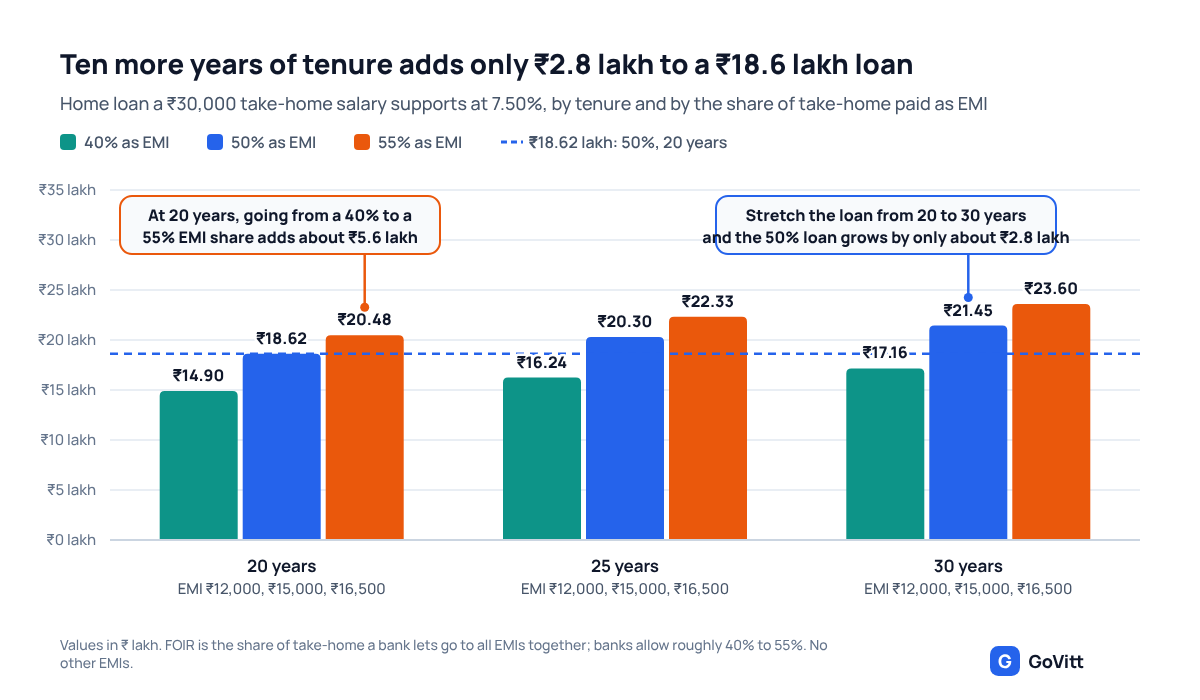
Two things stand out. Going from a 40% to a 55% EMI share at 20 years adds about ₹5.6 lakh, while stretching the loan from 20 to 30 years at 50% adds only about ₹2.8 lakh. How much of your salary the bank lets go to EMIs matters more than the tenure, and the tenure table below shows what the extra years cost in interest.
These figures are indicative. Your bank's own FOIR, how it counts your salary and the rate it gives you will decide the real number.
Bank by bank: how the rate changes your loan
Same ₹15,000 EMI (50% of ₹30,000), at each lender's lowest published rate for a strong salaried profile:
| Bank and rate | Loan over 20 years | Loan over 30 years |
|---|---|---|
| Bank of Maharashtra, 7.25% (score 800 and above, salaried) | ₹18.98 lakh | ₹21.99 lakh |
| SBI, lowest published rate 7.50% | ₹18.62 lakh | ₹21.45 lakh |
| Canara Bank, 7.55% (top grade, up to ₹50 lakh) | ₹18.55 lakh | ₹21.35 lakh |
| PNB, 7.60% (score 750 and above, loan up to ₹30 lakh, loan to value above 80%) | ₹18.48 lakh | ₹21.24 lakh |
| HDFC Bank, lowest published rate 8.00% | ₹17.93 lakh | ₹20.44 lakh |
| Axis Bank, 8.00% (score 751 and above) | ₹17.93 lakh | ₹20.44 lakh |
| ICICI Bank, table rate 8.75% | ₹16.97 lakh | ₹19.07 lakh |
The gap between the top and bottom rows is ₹2.00 lakh of loan over 20 years, on the same salary. And these are best-case rates. At PNB, a score of 700 to 749 gets 8.15% on a loan up to ₹30 lakh (₹17.73 lakh over 20 years) and 600 to 699 gets 9.35% (₹16.26 lakh). At Bank of Maharashtra, a score of 750 to 799 gets 7.50% (₹18.62 lakh) and 650 to 699 gets 8.60% (₹17.16 lakh). How much a score band moves your rate is in RBI moved your home loan rate by 0.25%. Your CIBIL score can move it by 1.80%.
Each bank's full rate card: SBI, Canara Bank, HDFC Bank, Axis Bank and ICICI Bank.
What existing EMIs do to your eligibility
At ₹30,000 this is the biggest swing, because there's so little room to start with. Every rupee of EMI you already pay comes straight out of your FOIR room.
At 50% FOIR, 7.50%:
| Existing EMIs | Left for home loan EMI | Home loan over 20 years | Home loan over 30 years |
|---|---|---|---|
| None | ₹15,000 | ₹18.62 lakh | ₹21.45 lakh |
| ₹2,000 | ₹13,000 | ₹16.14 lakh | ₹18.59 lakh |
| ₹3,000 | ₹12,000 | ₹14.90 lakh | ₹17.16 lakh |
| ₹5,000 | ₹10,000 | ₹12.41 lakh | ₹14.30 lakh |
| ₹8,000 | ₹7,000 | ₹8.69 lakh | ₹10.01 lakh |
Every ₹1,000 of existing EMI costs you ₹1.24 lakh of loan. A ₹3,000 EMI on a phone or a two-wheeler takes ₹3.72 lakh off the home loan. Credit card dues and buy now, pay later accounts get counted too, even if you pay them on time.
20, 25 or 30 years: the real cost
A longer tenure lowers the EMI and raises the loan you qualify for. It also costs far more interest. Take ₹18 lakh at 7.50%:
| Tenure | EMI | Share of ₹30,000 salary | Total interest |
|---|---|---|---|
| 20 years | ₹14,501 | 48.3% | ₹16.80 lakh |
| 25 years | ₹13,302 | 44.3% | ₹21.91 lakh |
| 30 years | ₹12,586 | 42.0% | ₹27.31 lakh |
Going from 20 to 30 years cuts the EMI by ₹1,915 and adds ₹10.51 lakh of interest. At ₹30,000 the 20 year EMI takes 48.3% of your pay, which is tight. I'd take the longer tenure on paper and pay as if it were 20 years when I can. Floating rate home loans to individuals carry no prepayment charge, so the extra goes straight to principal. The same trade-off on a nearby loan size is in ₹20 lakh home loan EMI.
What property can you buy?
RBI caps the loan at a share of the property value, and the share depends on the loan size: 90% for loans up to ₹30 lakh, 80% for loans from ₹30 lakh to ₹75 lakh. At ₹30,000 you're mostly in the generous band:
| Loan | Property it supports | Your own money, before stamp duty and registration |
|---|---|---|
| ₹18.62 lakh (20 years) | About ₹20.69 lakh | About ₹2.07 lakh |
| ₹21.45 lakh (30 years) | About ₹23.84 lakh | About ₹2.38 lakh |
| ₹30 lakh (the top of the 90% band) | About ₹33.33 lakh | About ₹3.33 lakh |
| ₹31 lakh (just over the line) | About ₹38.75 lakh | About ₹7.75 lakh |
The last row is the cliff. Cross ₹30 lakh of loan and the cap drops to 80%, so your own contribution jumps from ₹3.33 lakh to ₹7.75 lakh. Stamp duty and registration come on top, and banks usually won't fund them. In Bengaluru this budget is tight, so check what your target area costs before you apply.
What a co-applicant does to the number
Banks add the co-applicant's income, so the combined income goes through the EMI test. Both credit histories are checked. Same 50% FOIR, 7.50%:
| Co-applicant's income | Combined | EMI at 50% | Loan over 20 years | Loan over 30 years |
|---|---|---|---|---|
| None | ₹30,000 | ₹15,000 | ₹18.62 lakh | ₹21.45 lakh |
| ₹10,000 | ₹40,000 | ₹20,000 | ₹24.83 lakh | ₹28.60 lakh |
| ₹20,000 | ₹50,000 | ₹25,000 | ₹31.03 lakh | ₹35.75 lakh |
| ₹30,000 | ₹60,000 | ₹30,000 | ₹37.24 lakh | ₹42.91 lakh |
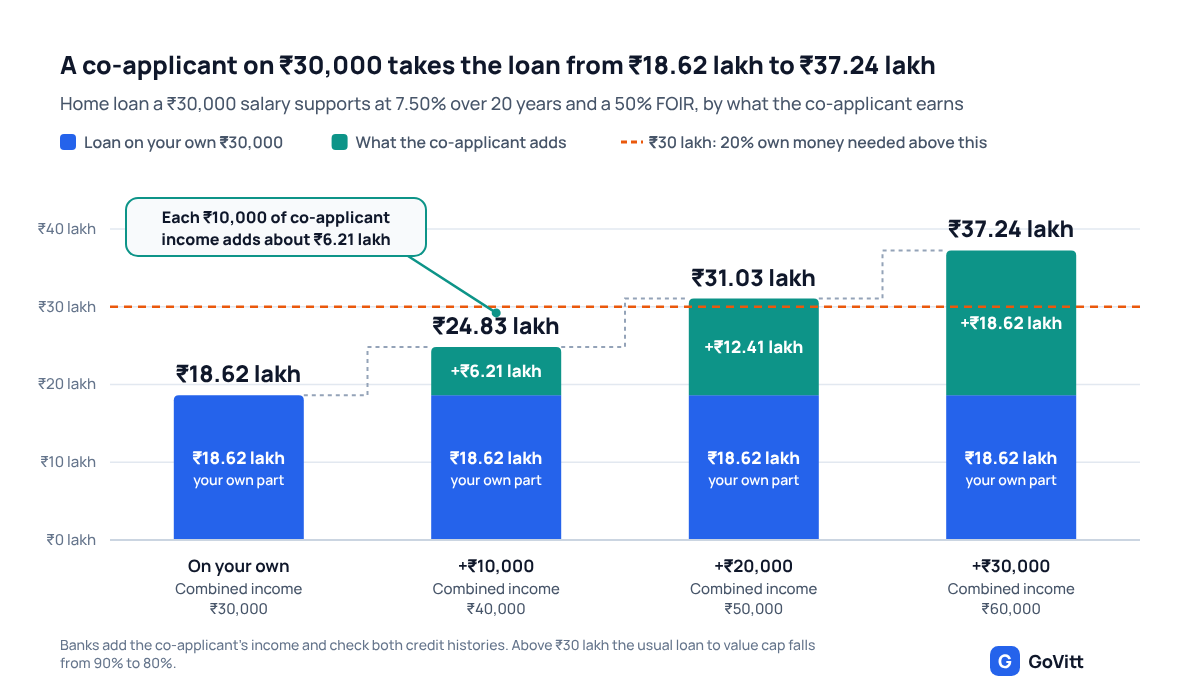
Each ₹10,000 of extra income adds about ₹6.21 lakh. Plan for 20% own money once the loan crosses ₹30 lakh. More on joint loans in joint home loan: benefits, eligibility and tax advantages.
How to raise your eligibility on ₹30,000
- Add a co-applicant with income. It's the only lever that doubles the loan, as the table above shows.
- Close small loans first. Clearing a ₹3,000 EMI before you apply adds about ₹3.72 lakh of eligibility.
- Fix your credit score. At Bank of Maharashtra, moving from the 650 to 699 band to 750 to 799 takes the rate from 8.60% to 7.50%, worth ₹1.46 lakh more loan on the same EMI.
- Show all your income. Variable pay, incentives and rental income may count if they show in your bank statements and tax returns. Ask how your bank treats them.
- Pick a longer tenure if you need the amount, then prepay.
- Put more money down. The loan is only part of the price, so a bigger down payment buys a costlier home without stretching the EMI.
If your household income is up to ₹9 lakh
At ₹30,000 a month your household income is ₹3.6 lakh a year, and even with a co-applicant earning the same it's ₹7.2 lakh. Both are inside the Centre's PMAY-U 2.0 interest subsidy scheme, which covers loans up to ₹25 lakh on a house valued up to ₹35 lakh. As listed on the government's PMAY-MIS portal, households with annual income up to ₹9 lakh qualify (₹3 lakh for EWS, ₹6 lakh for LIG, ₹9 lakh for MIG). The subsidy is 4.0% on the first ₹8 lakh of the loan, for a tenure up to 12 years, with a maximum release of ₹1.80 lakh. It is paid in five equal yearly instalments into the loan account, while the loan is active and more than half the principal is outstanding.
Five things to know:
- It applies to loans sanctioned and disbursed on or after 1 September 2024. The page states no end date.
- Income is self-certified by affidavit, and family members borrowing on the same property count as one family.
- It's once per property. If the previous owner already claimed it, you can't.
- The limits cut both ways. A ₹18.62 lakh loan on a ₹20.69 lakh home fits. The ₹37.24 lakh joint loan above does not, because the scheme stops at a ₹25 lakh loan and a ₹35 lakh house.
- I couldn't confirm other conditions from the page, such as rules on owning another house. Ask your lender whether it processes the subsidy and check the portal before you count on it.
Talk it through before you apply
Two banks can give you very different numbers on the same ₹30,000 salary, and every application leaves an enquiry on your credit report. So don't apply to five banks to find out. Tell us your salary, existing EMIs and the home you have in mind, and we'll tell you where you're likely to get the best rate and amount. The bigger salary brackets are in the ₹50,000 salary guide and the ₹1 lakh salary guide, the EMI calculator lets you test any loan amount, and you can compare rates from 50+ banks.
FAQ
How much home loan on 30000 salary will a bank give? Usually about ₹15 lakh to ₹24 lakh over 20 to 30 years. At 7.50% with half your take-home as EMI and no other loans, it's about ₹18.62 lakh over 20 years or ₹21.45 lakh over 30 years. The exact figure depends on your bank's FOIR, your rate and your existing EMIs.
What EMI can I afford on a ₹30,000 salary? Banks usually allow total EMIs of 40% to 60% of take-home pay, which is ₹12,000 to ₹18,000 a month on ₹30,000. I'd keep it nearer ₹12,000 to ₹15,000 so one bad month doesn't break you.
Is ₹30,000 salary enough for a home loan? Yes, but it's at the low end of what lenders prefer. ICICI Bank's guide gives ₹25,000 to ₹40,000 as the usual preferred range for lenders in general. You'll get a smaller loan, and a co-applicant helps a lot.
Can I get a home loan on a ₹30,000 salary with a personal loan running? Yes, but the loan is smaller. Each ₹1,000 of monthly EMI reduces the home loan you qualify for by about ₹1.24 lakh.
Will a co-applicant increase my loan amount? Yes. Banks add the co-applicant's income, so the combined income is used for the EMI test, and both credit scores are checked. A co-applicant earning ₹30,000 takes the loan to about ₹37.24 lakh over 20 years.
Which bank gives the highest home loan on a ₹30,000 salary? The one that gives you the lowest rate and the highest FOIR. At published rates, Bank of Maharashtra's 7.25% supports about ₹18.98 lakh over 20 years on a ₹15,000 EMI, SBI's 7.50% about ₹18.62 lakh, and ICICI's 8.75% table rate about ₹16.97 lakh.
Not sure what you'll get? Talk to an advisor (free, WhatsApp) with your salary and existing EMIs. GoVitt compares 50+ banks and charges you 0% commission.
Rates as of 31 October 2026 for Bank of Maharashtra, 25 October for PNB (page date), 26 October for SBI, HDFC Bank and Axis Bank, 24 October for Canara Bank and 21 October for ICICI Bank. Each is the lowest or table rate as published and applies only to strong profiles. Bank of Maharashtra's pages print no effective date. FOIR levels are indicative; each bank sets its own. Loan amounts are the principal a given EMI repays, using the standard monthly reducing balance method, rounded. Your result will differ. Government scheme terms are as listed on its portal on 30 October 2026 and can change. We'll update this page after the 4 December 2026 MPC decision.
Ready to take the next step?
Find out your loan options and check your eligibility with GoVitt today.