
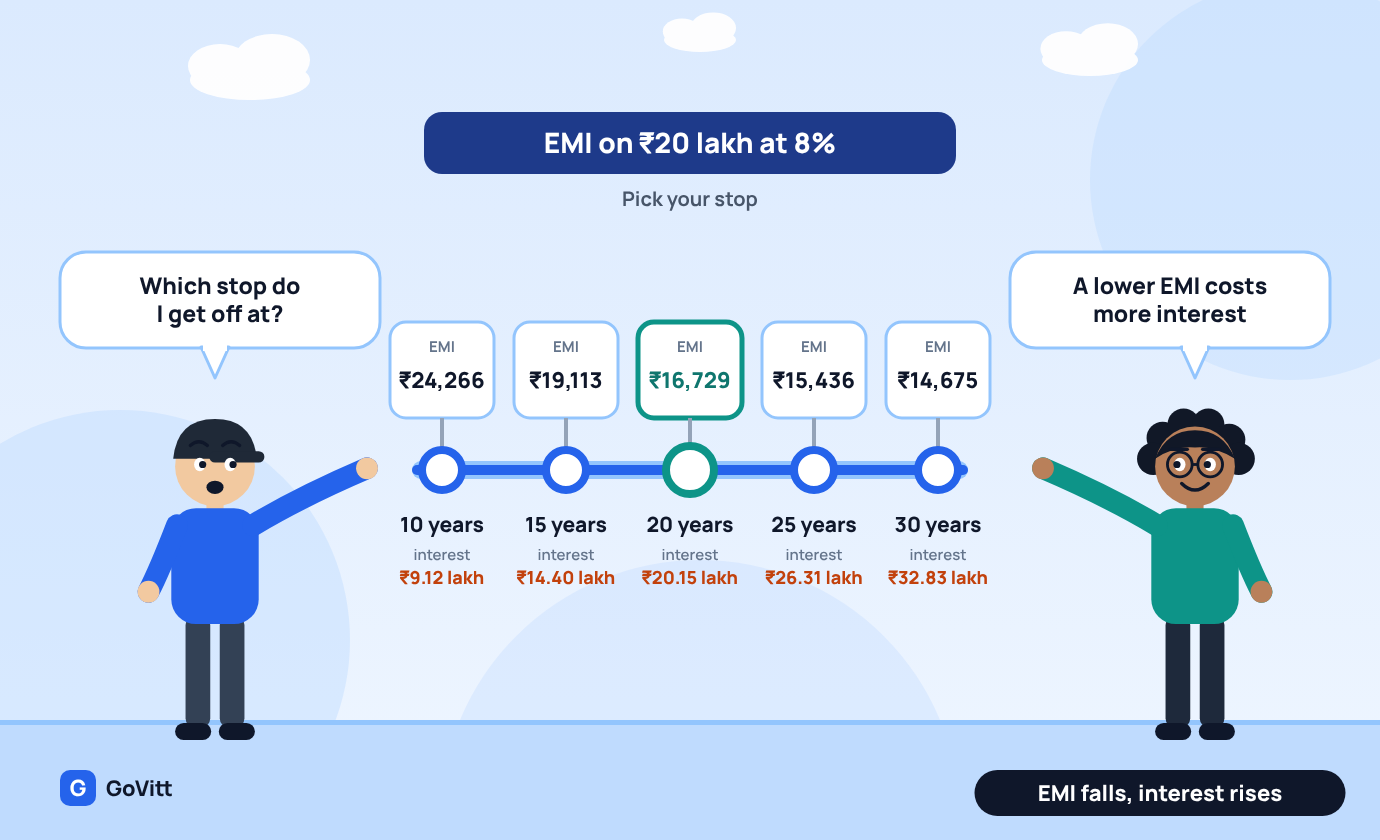
The ₹20 lakh home loan EMI is ₹16,729 a month over 20 years at 8%. Stretch it to 30 years and the EMI falls to ₹14,675. But your total interest jumps from ₹20.15 lakh to ₹32.83 lakh.
Those two numbers are the whole trade. And ₹20 lakh sits in the most generous band in RBI's rules. Up to ₹30 lakh, a bank can lend 90% of the property's value. So a ₹20 lakh loan needs a property worth at least ₹22.22 lakh and ₹2.22 lakh of your own money, before stamp duty. Above ₹30 lakh the cap drops to 80%, and I've worked out what that does further down.
First, the full tables for every rate from 7% to 10% and every tenure from 10 to 30 years, the interest on each, and the take-home salary banks will want to see.
See your real payoff date in 60 seconds
Banks calculate remaining EMIs by simple subtraction. See your actual payoff date and discover how much interest a balance transfer can save.
For context, as of 22 to 28 October 2026 the lowest published home loan rates start at about 7.15% (LIC Housing Finance, for a CIBIL score of 825 and above on loans up to ₹50 lakh), 7.40% (Union Bank of India, score 825 and above), 7.50% (SBI), 7.60% (PNB, for a loan up to ₹30 lakh that is more than 80% of the property's value) and 8.00% (HDFC Bank and Axis Bank), after RBI raised the repo rate to 5.50% on 7 October. At 7.50%, the 20 year EMI on ₹20 lakh is ₹16,112. Most good profiles will land between 7.50% and 9.00%.
Quick answer: ₹20 lakh home loan EMI for 20 years
| Interest rate | EMI | Total interest | Total you pay back |
|---|---|---|---|
| 7.50% | ₹16,112 | ₹18.67 lakh | ₹38.67 lakh |
| 8.00% | ₹16,729 | ₹20.15 lakh | ₹40.15 lakh |
| 8.50% | ₹17,356 | ₹21.65 lakh | ₹41.65 lakh |
| 9.00% | ₹17,995 | ₹23.19 lakh | ₹43.19 lakh |
At 8%, the interest over 20 years is about the same as the loan itself. You borrow ₹20 lakh and pay ₹20.15 lakh to the bank on top.
₹20 lakh home loan EMI at every rate and tenure
| Rate | 10 years | 15 years | 20 years | 25 years | 30 years |
|---|---|---|---|---|---|
| 7.00% | ₹23,222 | ₹17,977 | ₹15,506 | ₹14,136 | ₹13,306 |
| 7.50% | ₹23,740 | ₹18,540 | ₹16,112 | ₹14,780 | ₹13,984 |
| 8.00% | ₹24,266 | ₹19,113 | ₹16,729 | ₹15,436 | ₹14,675 |
| 8.50% | ₹24,797 | ₹19,695 | ₹17,356 | ₹16,105 | ₹15,378 |
| 9.00% | ₹25,335 | ₹20,285 | ₹17,995 | ₹16,784 | ₹16,092 |
| 9.50% | ₹25,880 | ₹20,884 | ₹18,643 | ₹17,474 | ₹16,817 |
| 10.00% | ₹26,430 | ₹21,492 | ₹19,300 | ₹18,174 | ₹17,551 |
Every 1% on the rate moves the 20 year EMI by roughly ₹1,223 to ₹1,305 a month. Going from 8% to 9% costs ₹1,266 a month, or ₹3.04 lakh over the loan. A 0.50% gap between two offers is worth ₹627 a month, or ₹1.50 lakh. That's why your credit score matters as much as the tenure you pick.
Total interest on ₹20 lakh at every rate and tenure
| Rate | 10 years | 15 years | 20 years | 25 years | 30 years |
|---|---|---|---|---|---|
| 7.00% | ₹7.87 lakh | ₹12.36 lakh | ₹17.21 lakh | ₹22.41 lakh | ₹27.90 lakh |
| 7.50% | ₹8.49 lakh | ₹13.37 lakh | ₹18.67 lakh | ₹24.34 lakh | ₹30.34 lakh |
| 8.00% | ₹9.12 lakh | ₹14.40 lakh | ₹20.15 lakh | ₹26.31 lakh | ₹32.83 lakh |
| 8.50% | ₹9.76 lakh | ₹15.45 lakh | ₹21.65 lakh | ₹28.32 lakh | ₹35.36 lakh |
| 9.00% | ₹10.40 lakh | ₹16.51 lakh | ₹23.19 lakh | ₹30.35 lakh | ₹37.93 lakh |
| 9.50% | ₹11.06 lakh | ₹17.59 lakh | ₹24.74 lakh | ₹32.42 lakh | ₹40.54 lakh |
| 10.00% | ₹11.72 lakh | ₹18.69 lakh | ₹26.32 lakh | ₹34.52 lakh | ₹43.18 lakh |
[
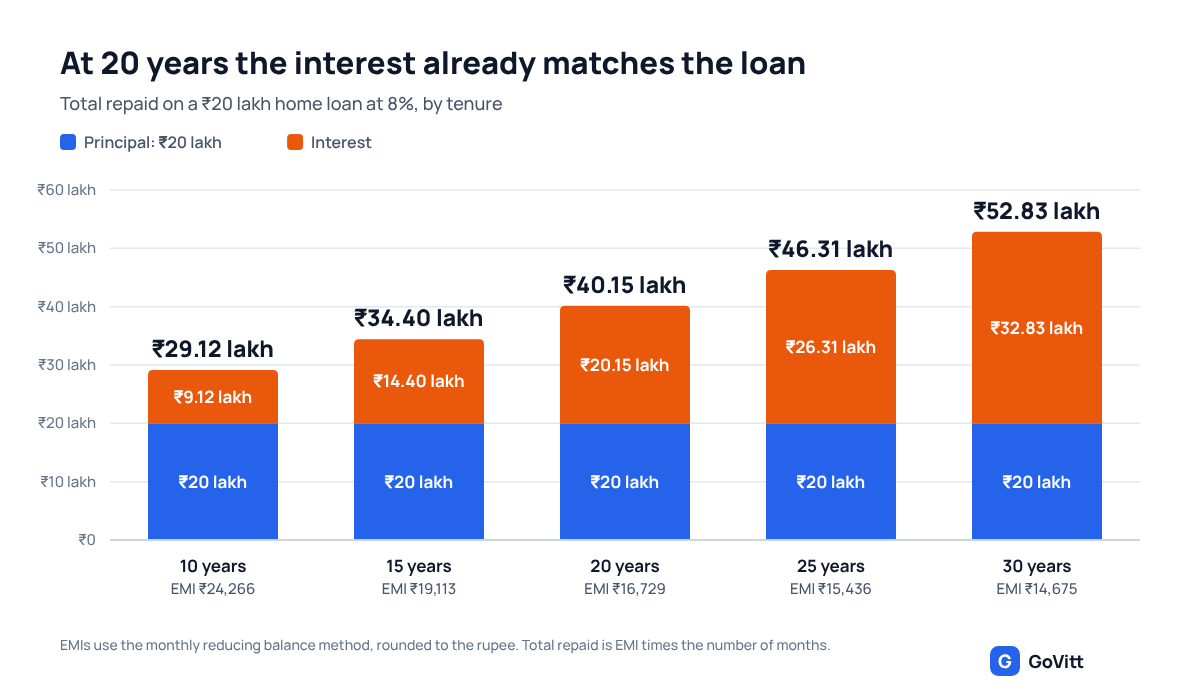
Look at the 30 year column. At 8% you pay ₹32.83 lakh in interest on a ₹20 lakh loan, so you hand the bank ₹52.83 lakh for a ₹20 lakh loan. The EMI is the number everyone checks. The total interest is the one that decides what the house costs you. I've written more on that in everyone checks the EMI, almost nobody checks the number that matters.
Where ₹20 lakh sits between the other loan sizes
At 8% over 20 years, each ₹10 lakh of loan adds about ₹8,364 to the EMI:
| Loan | EMI at 8%, 20 years | Where to read more |
|---|---|---|
| ₹20 lakh | ₹16,729 | This page |
| ₹30 lakh | ₹25,093 | ₹30 lakh home loan EMI |
| ₹40 lakh | ₹33,458 | ₹40 lakh home loan EMI |
| ₹50 lakh | ₹41,822 | ₹50 lakh home loan EMI |
| ₹75 lakh | ₹62,733 | ₹75 lakh home loan EMI |
| ₹1 crore | ₹83,644 | ₹1 crore home loan EMI |
For any other amount there's the home loan EMI per lakh table.
Salary required for a ₹20 lakh home loan
Banks start with your take-home pay, not the loan amount. The test is FOIR (fixed obligations to income ratio), the share of your net income that goes into EMIs. Most salaried borrowers are allowed somewhere between 40% and 55%, and higher earners get more room.
At 50% FOIR and no other loans, here's the net monthly take-home you'd need:
| Rate | 10 years | 15 years | 20 years | 25 years | 30 years |
|---|---|---|---|---|---|
| 7.50% | ₹47,500 | ₹37,100 | ₹32,300 | ₹29,600 | ₹28,000 |
| 8.00% | ₹48,600 | ₹38,300 | ₹33,500 | ₹30,900 | ₹29,400 |
| 8.50% | ₹49,600 | ₹39,400 | ₹34,800 | ₹32,300 | ₹30,800 |
Two things change this a lot:
- Existing EMIs. A ₹10,000 car loan EMI pushes the take-home needed for a 20 year loan at 8% from ₹33,500 to ₹53,500. Every ₹5,000 of existing EMI cuts the 20 year loan you qualify for by about ₹5.98 lakh, which is about 30% of a ₹20 lakh loan.
- A co-applicant. Banks add a spouse's income, so two take-home pays of ₹17,000 can qualify where one can't.
A bank saying yes at 50% doesn't make 50% a good idea. My own ceiling is 35% to 40% of take-home, so one bad month doesn't turn into a missed EMI. On the ₹16,729 EMI, 40% means a take-home of ₹41,900 and 35% means ₹47,800.
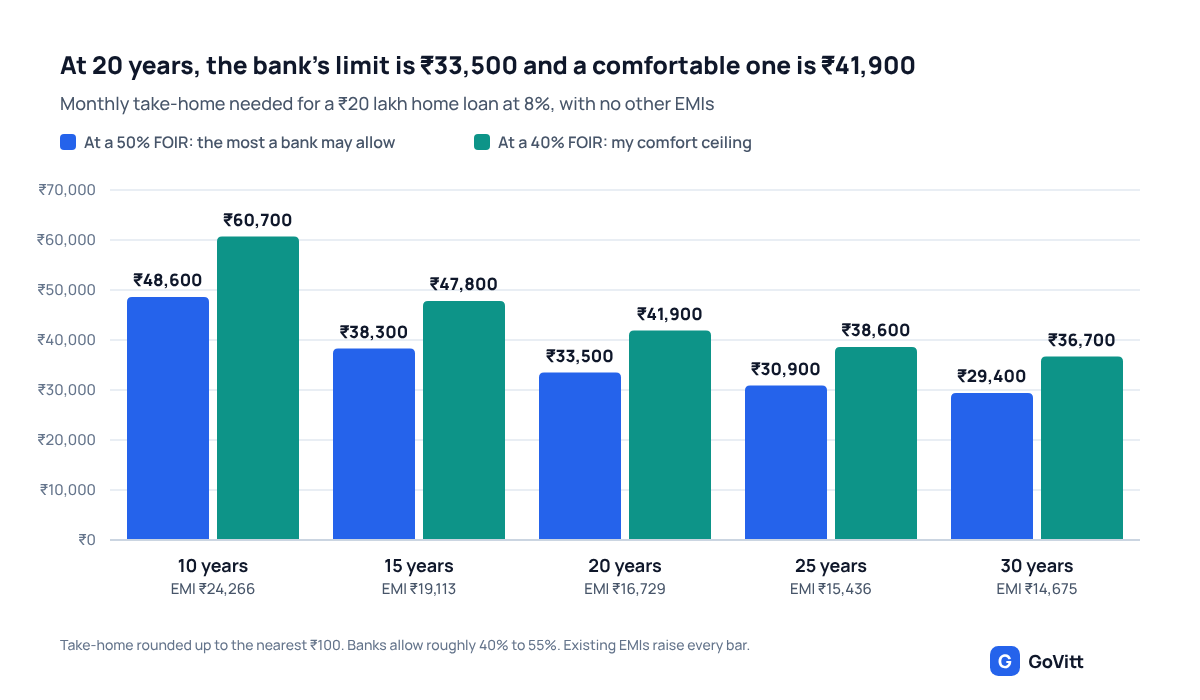
At 8%, a take-home of ₹30,000 supports about ₹17.9 lakh over 20 years or ₹20.4 lakh over 30 years at 50% FOIR. So ₹20 lakh on ₹30,000 works only on a 30 year tenure, and only with no other EMIs. A take-home of ₹50,000 supports ₹29.9 lakh over 20 years, which is comfortable. The full method is in how much home loan you can get on your salary, and the bank by bank view for a mid income is in home loan on ₹50,000 salary.
20, 25 or 30 years? What each one really costs
At 8%:
| Switch | EMI drops by | Extra interest you pay |
|---|---|---|
| 10 years to 20 years | ₹7,537 a month | ₹11.03 lakh |
| 20 years to 25 years | ₹1,293 a month | ₹6.16 lakh |
| 20 years to 30 years | ₹2,054 a month | ₹12.68 lakh |
Going from 20 to 30 years saves ₹2,054 a month but costs ₹12.68 lakh. That's a bad deal if you can afford the 20 year EMI.
But there's a smarter way to use the long tenure. Take 30 years on paper and pay like it's 20. At 8%, a 30 year EMI is ₹14,675. Add ₹2,054 a month as prepayment and you're paying the 20 year EMI of ₹16,729, so the loan closes in 20 years and you save ₹12.68 lakh in interest. Banks can't charge you for prepaying a floating rate home loan, so you get the safety of a low required EMI and the cost of a shorter loan. If money gets tight, you drop back to ₹14,675 without asking anyone. I've covered the rule in your bank can't charge you for prepaying a floating rate home loan.
Pay more and it gets better quickly. ₹3,000 extra closes the loan in 17 years and 8 months and cuts the interest to ₹17.34 lakh. Even ₹2,000 extra closes it in 20 years and 2 months, with ₹20.34 lakh of interest.
One limit: most banks cap tenure so the loan ends by your retirement age. If you're 45, a 30 year loan may not be on the table.
Why ₹20 lakh sits in RBI's top band
RBI caps what a bank can lend as a share of the property's value. The cap is 90% for loans up to ₹30 lakh, 80% for loans from ₹30 lakh to ₹75 lakh, and 75% above ₹75 lakh. A ₹20 lakh loan gets the 90% cap, so it needs a property worth at least ₹22.22 lakh, with ₹2.22 lakh or more from your own pocket. Stamp duty and registration come on top, and banks don't fund those.
Here's how it plays out at different property values (RBI's ceilings, and banks can lend less):
| Property value | Most a bank can lend | Your own money |
|---|---|---|
| ₹22.22 lakh | ₹20.00 lakh | ₹2.22 lakh |
| ₹25.00 lakh | ₹22.50 lakh | ₹2.50 lakh |
| ₹30.00 lakh | ₹27.00 lakh | ₹3.00 lakh |
| ₹33.33 lakh | ₹30.00 lakh | ₹3.33 lakh |
| ₹37.50 lakh | ₹30.00 lakh | ₹7.50 lakh |
| ₹40.00 lakh | ₹32.00 lakh | ₹8.00 lakh |
Notice the flat stretch. A property at ₹33.33 lakh gets you ₹30 lakh. So does a property at ₹37.50 lakh, because the 90% cap stops at ₹30 lakh and the 80% cap only applies to a loan above it. The ceiling starts rising again only when the property passes ₹37.50 lakh. And the step is steep: a ₹30 lakh loan needs ₹3.33 lakh of your own money, a ₹31 lakh loan needs ₹7.75 lakh. That extra ₹1 lakh of loan costs you ₹4.42 lakh more from your own pocket. If you're eyeing a ₹35 lakh flat, plan on a loan of ₹30 lakh, not ₹31 lakh.
What a ₹20 lakh loan costs before the first EMI
The processing fee is the first bill, and it varies a lot. As listed on each lender's pages in October 2026:
| Lender | Processing fee as listed | On ₹20 lakh, with GST |
|---|---|---|
| Canara Bank | 0.50%, minimum ₹1,500, maximum ₹10,000; waived till 31 December | ₹0 now (₹11,800 normally) |
| LIC Housing Finance | 0.25% on loans up to ₹1 crore, capped at ₹15,000 | ₹5,900 |
| SBI | 0.35% for salaried borrowers, capped at ₹15,000 | ₹8,260 |
| Union Bank of India | 0.50%, capped at ₹15,000 | ₹11,800 |
| HDFC Bank | Up to 0.50%, minimum ₹4,000, negotiable | Up to ₹11,800 |
| ICICI Bank | 0.50%, plus an administrative charge of 0.25% or ₹5,000, whichever is lower | ₹17,700 |
| Axis Bank | Up to 1% or ₹10,000, whichever is higher | Up to ₹23,600 (₹11,800 at the minimum) |
That's a gap of up to ₹17,700 between LIC and the top of Axis's range. On a loan this size, the fee is a real share of the cost: ICICI's ₹17,700 is 0.89% of the loan. Ask for the fee in writing and negotiate it. Stamp duty and registration come on top.
If your household income is up to ₹9 lakh
A ₹20 lakh loan fits inside the Centre's PMAY-U 2.0 interest subsidy scheme, which covers loans up to ₹25 lakh on a house valued up to ₹35 lakh. As listed on the government's PMAY-MIS portal, households with annual income up to ₹9 lakh qualify (₹3 lakh for EWS, ₹6 lakh for LIG, ₹9 lakh for MIG). The subsidy is 4.0% on the first ₹8 lakh of the loan, for a tenure up to 12 years, with a maximum release of ₹1.80 lakh. It is paid in five equal yearly instalments into the loan account, while the loan is active and more than half the principal is outstanding.
Four things to know:
- It applies to loans sanctioned and disbursed on or after 1 September 2024. The page states no end date.
- Income is self-certified by affidavit, and family members borrowing on the same property count as one family.
- It's once per property. If the previous owner already claimed it, you can't.
- I couldn't confirm other conditions from the page, such as rules on owning another house. Ask your lender whether it processes the subsidy and check the portal before you count on it.
The tax part
In the first year of a ₹20 lakh loan at 8% over 20 years, you pay ₹1,58,472 in interest. The deduction on a self-occupied home is capped at ₹2 lakh a year, and only in the old tax regime. So the whole first-year interest fits inside the cap, with about ₹41,500 of room to spare. In the 30% slab with cess, the cap is worth up to ₹62,400 a year, and the first year's interest alone saves up to ₹49,443.
If you and your spouse are both co-owners and co-borrowers, and both of you pay the EMIs, each of you can generally claim up to ₹2 lakh on your share. This is now Section 22 of the Income-tax Act, 2025, which replaced the old Section 24(b) from 1 April 2026. It's a summary, not advice for your case. Ask your CA before you count on it.
What I'd do before applying
- Start from the EMI, not the loan amount. Decide what you can pay without strain, then work back to the loan.
- Check your CIBIL score. At 750 and above you're in the best rate bands. On ₹20 lakh, a 0.50% gap is worth ₹627 a month, or ₹1.50 lakh over 20 years.
- Close small loans first. Every ₹5,000 of existing EMI cuts a 20 year loan you qualify for by about ₹5.98 lakh.
- Take the longest tenure you're offered, then prepay. A low required EMI costs nothing. A forced high one can cost you a missed payment.
- Compare at least three lenders on the rate and the fee. On ₹20 lakh, the fee alone can differ by up to ₹17,700.
- If your household income is up to ₹9 lakh, ask about the PMAY-U 2.0 subsidy before you sign. It is worth up to ₹1.80 lakh.
FAQ
What is the EMI for a ₹20 lakh home loan for 20 years? At 8%, the EMI is ₹16,729 a month. At 7.50% it's ₹16,112, at 8.50% it's ₹17,356, and at 9% it's ₹17,995.
What is the EMI for a ₹20 lakh home loan for 30 years? At 8%, it's ₹14,675 a month, and you'll pay ₹32.83 lakh in interest over the loan. At 7.50% it's ₹13,984 and at 8.50% it's ₹15,378.
What is the EMI for a ₹20 lakh home loan for 15 years? At 8%, it's ₹19,113 a month, with ₹14.40 lakh in interest. At 7.50% it's ₹18,540 and at 8.50% it's ₹19,695.
What salary is required for a ₹20 lakh home loan? At 8% for 20 years and a 50% FOIR, you'd need about ₹33,500 in net monthly take-home with no other loans. Over 30 years, it drops to about ₹29,400. Existing EMIs push it up, and a co-applicant's income can bring it down.
Can I get a ₹20 lakh home loan on a ₹30,000 salary? Only just. At 50% FOIR and 8%, ₹30,000 take-home supports about ₹17.9 lakh over 20 years or ₹20.4 lakh over 30 years, and only with no other EMIs. Adding a co-applicant's income is the usual way to make it comfortable.
How much down payment do I need for a ₹20 lakh home loan? At least 10% of the property value, because RBI allows loans up to ₹30 lakh to go to 90% of the value. That means a property of ₹22.22 lakh or more and ₹2.22 lakh or more of your own money, plus stamp duty and registration.
Run your own numbers. Use the EMI calculator to plug in your rate, tenure and prepayments. When you're ready, GoVitt compares 50+ banks for you at 0% commission.
EMIs use the standard monthly reducing balance method and are rounded to the nearest rupee. Salary figures are rounded up to the nearest ₹100. Rate and fee references are as of 22 to 28 October 2026. Loan to value figures are RBI's ceilings, and your lender may lend less. Your actual rate depends on your credit profile and lender. Tax figures are a summary for the old tax regime, not tax advice. Government scheme terms are as listed on its portal on 30 October 2026 and can change.
Ready to take the next step?
Find out your loan options and check your eligibility with GoVitt today.