
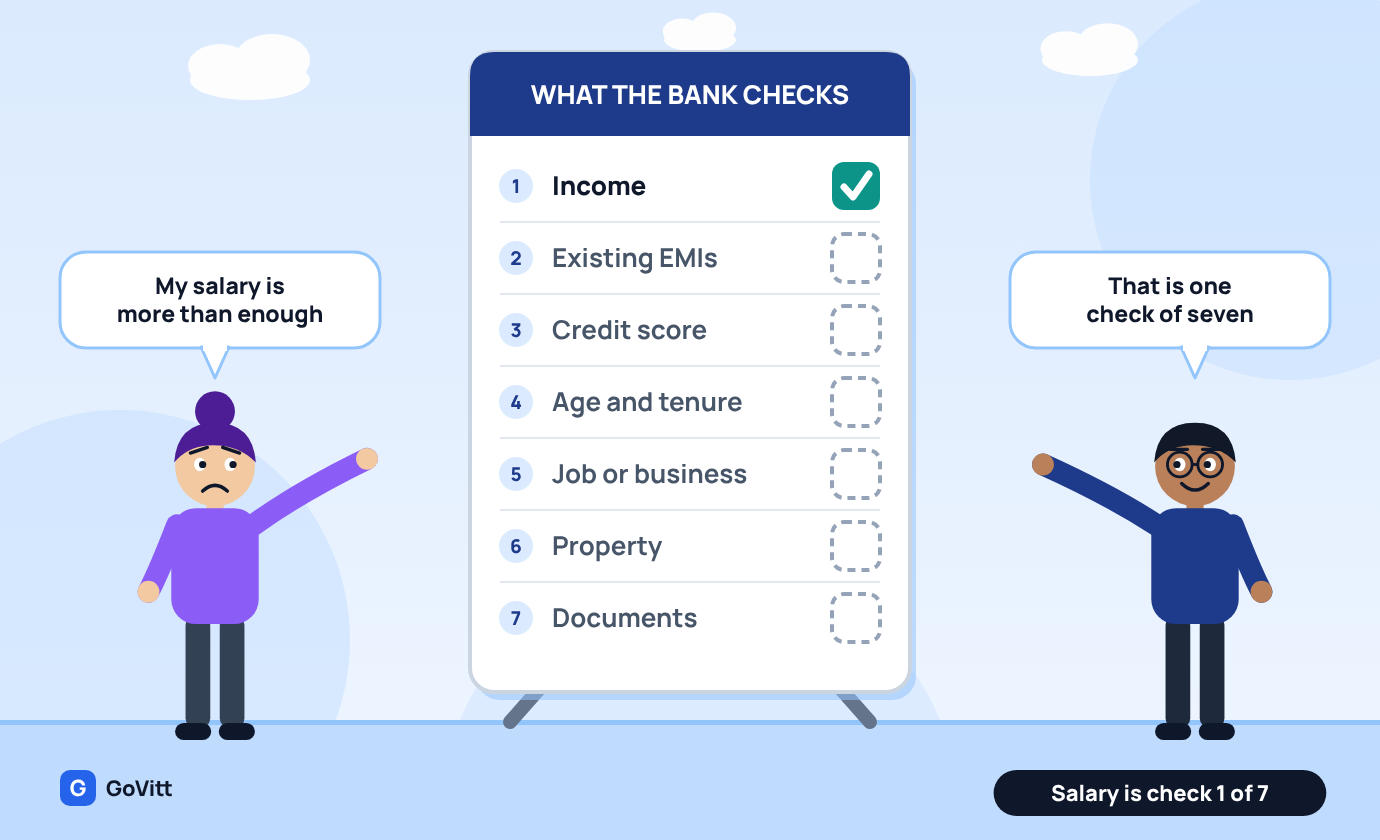
Home loan eligibility is seven checks, and income is only the first one. On a take-home of ₹1,00,000 a month, a bank working at a 50% FOIR and 8% will lend about ₹59.8 lakh over 20 years. Give the same person ₹20,000 of existing EMIs and that drops to ₹35.9 lakh. Same salary, same bank, ₹23.9 lakh less.
The other six checks are your existing EMIs, your credit score, your age, how long you've held your job or business, the property and your documents. A bank can say no on any one of them. You can fix most of them before you apply.
Two limits first. No bank publishes its full credit policy, so this is built from the pages banks do publish. And none of the sources I read ranks the reasons for rejection by how often they happen. The nearest is Bank of Baroda, which calls incorrect or incomplete documents "one of the most common". So I won't tell you which check fails most. I'll tell you what each one tests and the number to know.
See your real payoff date in 60 seconds
Banks calculate remaining EMIs by simple subtraction. See your actual payoff date and discover how much interest a balance transfer can save.
The seven checks at a glance
| # | Check | What the bank tests | The number to know |
|---|---|---|---|
| 1 | Income | Can your take-home carry the EMI? | Banks allow roughly 40% to 55% of take-home for EMIs |
| 2 | Existing EMIs | What is already committed? | Every ₹5,000 of existing EMI cuts a 20 year loan by about ₹5.98 lakh |
| 3 | Credit score | Do you pay what you owe, on time? | 750 and above gets the best bands, below 700 costs more |
| 4 | Age | How many earning years are left? | For salaried borrowers I plan on the loan ending by 60 |
| 5 | Job or business | How steady is the income? | Kotak prefers three years in one organisation, self-employed borrowers need 2 to 3 years of returns |
| 6 | Property | Is the asset clean, and worth the loan? | RBI caps the loan at 90%, 80% or 75% of value |
| 7 | Documents | Is the file complete and consistent? | Bank of Baroda: one of the most common reasons |
Check 1: your income, and the part the bank counts
Banks start from take-home pay, not the CTC on your offer letter. They apply FOIR (fixed obligations to income ratio), the share of your net monthly income that can go to EMIs. Most salaried borrowers are allowed somewhere between 40% and 55%. The method is in how much home loan you can get on your salary.
At 8% over 20 years, with no other loans:
| Monthly take-home | Loan at 50% FOIR | Loan at 40% FOIR |
|---|---|---|
| ₹50,000 | ₹29.9 lakh | ₹23.9 lakh |
| ₹75,000 | ₹44.8 lakh | ₹35.9 lakh |
| ₹1,00,000 | ₹59.8 lakh | ₹47.8 lakh |
| ₹1,50,000 | ₹89.7 lakh | ₹71.7 lakh |
| ₹2,00,000 | ₹1.20 crore | ₹95.6 lakh |
Every ₹10,000 of take-home supports about ₹5.98 lakh at 50%. A bank saying yes at 50% doesn't make 50% a good idea. My own ceiling is 35% to 40% of take-home, so one bad month doesn't turn into a missed EMI. The bank by bank view is in home loan on ₹50,000 salary and home loan on ₹1 lakh salary.
Rate matters here too, because the same EMI supports a smaller loan as the rate rises. In our Bengaluru festive flat example, an EMI of ₹70,930 supports ₹86.4 lakh at 7.75% and ₹84.8 lakh at 8%. One 0.25% rise takes ₹1.6 lakh off the loan you qualify for. I went through that case in buying a flat in Bengaluru this festive season.
Which income counts. Banks generally count your fixed monthly pay. Whether bonuses, incentives or rent are counted, and in what share, differs by lender, so ask before you build a plan on them. If you're self-employed, banks work from your returns, not your bank balance. Can self-employed people get home loans easily has the 2 to 3 years of ITRs and business vintage banks usually ask for. Bank of Baroda lists not filing returns among its reasons for rejection and says it wants two years of them.
A co-applicant. Their income is added to yours. Their credit report gets read too, so check theirs before you add them. The benefits and the age band are in joint home loan benefits, eligibility and tax advantages.
Check 2: your existing EMIs
This is the check people forget, and it is the cheapest to fix. Every EMI on your credit report comes out of the same FOIR. On a take-home of ₹1,00,000, at 8% over 20 years and a 50% FOIR:
| Existing EMIs | Loan you qualify for | Lost versus no EMIs |
|---|---|---|
| ₹0 | ₹59.8 lakh | Nil |
| ₹10,000 | ₹47.8 lakh | ₹11.96 lakh |
| ₹20,000 | ₹35.9 lakh | ₹23.91 lakh |
| ₹30,000 | ₹23.9 lakh | ₹35.87 lakh |
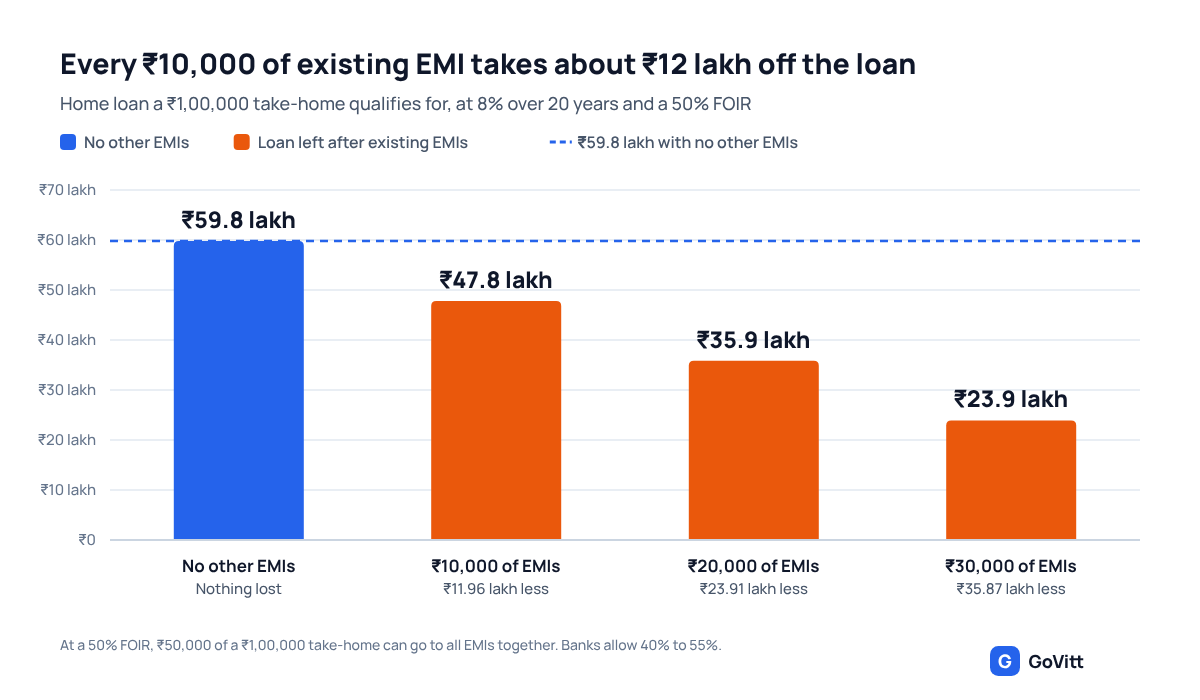
A car loan EMI of ₹10,000 costs you ₹11.96 lakh of home loan. Clearing a ₹5,000 EMI adds about ₹5.98 lakh. Whether your bank also counts a share of your credit card balances is a lender-level rule I couldn't pin down from published pages, so ask. Either way, pay the small loans off before you apply, not after.
Check 3: your credit score
The score is the bank's quickest read on whether you pay what you owe, and it sets your rate as well as your yes or no. Here is where the sources I read draw their lines:
| Source | What it says about the score | Date |
|---|---|---|
| Bank of Baroda | A score below 650 is on its list of rejection reasons; above 701 is treated as creditworthy | Page dated 10 June 2022 |
| Kotak Mahindra Bank | A score below 700 keeps you at higher risk | Page dated 25 June 2026 (its disclaimer says July 2025) |
| LIC Housing Finance | Publishes a rate for every band down to below 600: 9.55% | Checked 22 October 2026 |
| PNB | Publishes 9.25% for 600 to 699 | Checked 27 October 2026 |
So below 650, files start to stall. Lenders still quote there, at a price. At PNB, on ₹50 lakh over 20 years, the EMI is ₹40,127 for a score of 800 and above, ₹41,978 for 700 to 749 and ₹45,793 for 600 to 699 (loan above ₹30 lakh, up to 80% of value, festive rates). That's ₹5,666 a month between the top and bottom bands. How score and rate fit together is in RBI moved your home loan rate by 0.25%. Your CIBIL score can move it by 1.80%, and if you're near the line, read can I get a home loan with a 650 CIBIL score.
Two habits matter before you apply. Pull your own report first: RBI's directive of 1 September 2016, in force from 1 January 2017, says each credit bureau must give you one free full report, with the score, in a calendar year. And don't apply to five banks in a week. Enquiries and how to dispute a wrong entry are covered in does a home loan balance transfer hurt your CIBIL score. It is written about transfers, but enquiries and disputes work the same way for any loan application.
Check 4: your age, and the tenure it leaves you
A bank wants the loan closed by a maximum age, so your age sets your longest tenure. None of the official bank pages I could open states one age for every borrower, and the figures on comparison sites disagree with each other. So I use 60 as a working retirement age for salaried borrowers, the same assumption as in our salary post, and you should ask your bank for its own number. Our joint loan post puts the usual applicant age band at about 21 to 65.
On a take-home of ₹1,00,000, at 8% and a 50% FOIR, with the loan ending at 60:
| Your age | Longest tenure | Loan you qualify for |
|---|---|---|
| 30 | 30 years | ₹68.1 lakh |
| 35 | 25 years | ₹64.8 lakh |
| 40 | 20 years | ₹59.8 lakh |
| 45 | 15 years | ₹52.3 lakh |
| 50 | 10 years | ₹41.2 lakh |
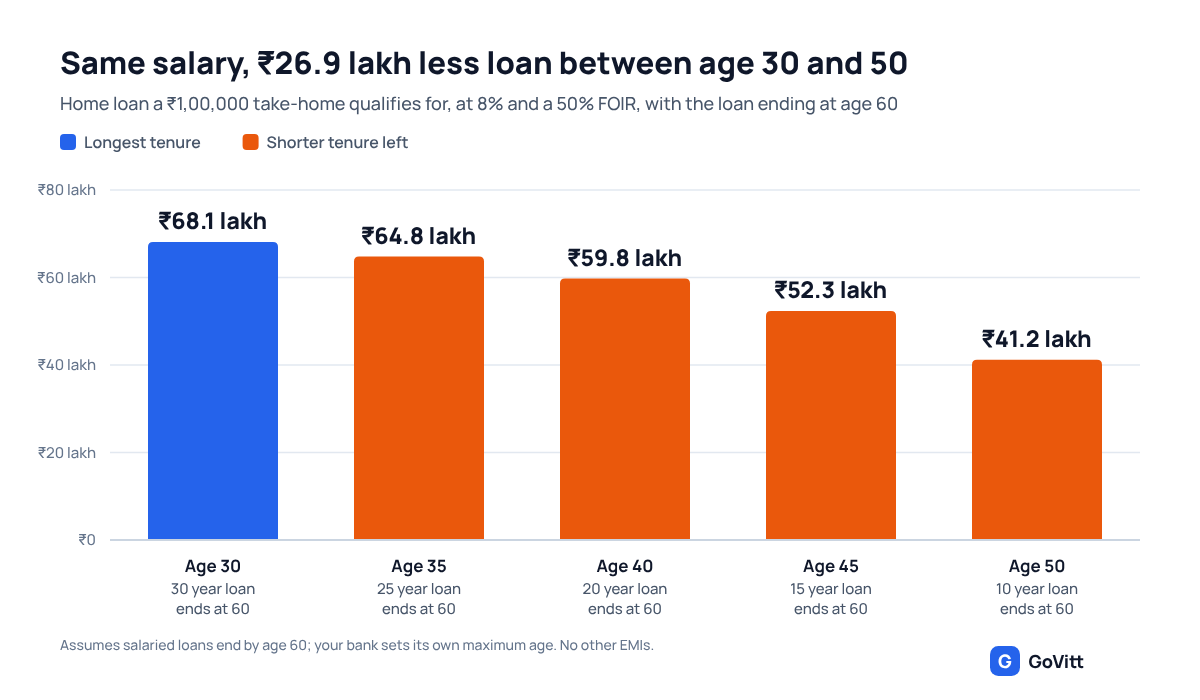
The same salary supports ₹68.1 lakh at 30 and ₹41.2 lakh at 50. Every five years you wait costs between ₹3.36 lakh and ₹11.11 lakh of eligibility at this salary. Pay rises can make that back, but a bank only counts the pay you draw today.
Check 5: how long you've held your job or business
Banks want evidence the income will keep arriving. Kotak's page says lenders prefer at least three years in the same organisation. Bank of Baroda lists frequent job changes as a reason for rejection. Neither gives a hard cut-off, and the minimum differs by lender and by category. If you've just changed jobs, ask the bank for its minimum in writing before you apply. If you're about to switch jobs and buy in the same year, I'd get the sanction first.
For self-employed borrowers the test is business vintage plus returns: 2 to 3 years of each in the cases I've covered in can self-employed people get home loans easily. Keep the returns filed and the income on them consistent with what you tell the bank.
Check 6: the property you're buying
The bank lends against the property, so it checks the asset as hard as it checks you. Kotak lists an illegal property or an unapproved builder and a low valuation as rejection reasons. Bank of Baroda lists title problems. The title, the approvals and the builder's record are covered in before you pay that booking amount.
Then there is RBI's loan to value cap: 90% of the property's value for loans up to ₹30 lakh, 80% from ₹30 lakh to ₹75 lakh and 75% above ₹75 lakh. What that means for your own money:
| Loan | Property value needed | Your own money |
|---|---|---|
| ₹20 lakh | ₹22.22 lakh | ₹2.22 lakh |
| ₹30 lakh | ₹33.33 lakh | ₹3.33 lakh |
| ₹50 lakh | ₹62.50 lakh | ₹12.50 lakh |
| ₹75 lakh | ₹93.75 lakh | ₹18.75 lakh |
| ₹1 crore | ₹1.33 crore | ₹33.33 lakh |
Those are RBI's ceilings, and a bank can lend less. Stamp duty and registration come on top, and banks don't fund them. Plan for the valuation too. Say you agree to pay ₹80 lakh and the bank's valuer says the flat is worth ₹72 lakh. If the bank applies the 80% cap to its own number, the most it can lend falls from ₹64 lakh to ₹57.6 lakh, and you need ₹6.4 lakh more from your own pocket. I'd plan as if it does.
Check 7: your documents
Kotak puts incomplete or incorrect documents at the top of its list. Bank of Baroda calls them "one of the most common" reasons. This is also the check you control completely. A typical file has KYC, income proof and property papers, and your bank's own checklist is the one that counts.
What stalls files is mismatch. Check that your name is spelled the same on your PAN, Aadhaar, salary slips and bank statements, that your address matches across them, and that the statements you submit are from the account your salary lands in. Get the bank's list in writing, tick it off and send everything in one go.
What the rejection lists say
Putting the Kotak and Bank of Baroda lists next to the seven checks:
| Reason on the lists | Which check | What to do before you apply |
|---|---|---|
| Incomplete or incorrect documents (both) | 7 | Match names and addresses across every paper, get the bank's checklist |
| Low credit score (BoB: below 650, Kotak: below 700) | 3 | Pull your report free, fix errors, cut card use, wait if needed |
| Unstable employment or frequent job changes (both) | 5 | Ask for the minimum in writing, avoid switching mid-application |
| Existing debts or past defaults (both) | 2 and 3 | Clear small EMIs, a past default needs a clean run since |
| Not filing returns (BoB) | 1 and 5 | File the last two years |
| Title problems, illegal property, unapproved builder, low valuation | 6 | Lawyer check on title, bank-approved projects, keep a valuation margin |
What I'd do before applying
- Pull your credit report. It is free once a year from each bureau. Fix anything wrong before a bank sees it.
- Work out your number the way a bank does. Take-home, times 40%, minus your existing EMIs. That's the EMI you can safely carry. Then turn it into a loan with the EMI calculator.
- Clear the small loans. A ₹5,000 EMI is worth about ₹5.98 lakh of home loan.
- Match the tenure to your age. Ask the bank for its maximum age at maturity and check the longest loan it leaves you.
- Check the builder and the title before you pay a booking amount. Waiting for the bank's legal team to find a title problem is the expensive way.
- Get the file right once. One checklist, one set of matching papers, sent together.
- Apply to two lenders in the same week, not five. Compare the offers on the rate and on the fee. The rate comparison is on the bank offers page.
FAQ
What is home loan eligibility, and how do banks check it? Home loan eligibility is the loan amount and tenure a bank will offer you, based on seven checks: your income, existing EMIs, credit score, age, job or business stability, the property and your documents. Banks test income through FOIR, the share of take-home that can go to EMIs.
What are the home loan eligibility criteria in India? There is no single national rule. Banks set their own, within RBI's loan to value caps of 90%, 80% and 75%. The criteria that recur on bank pages are age, income, credit score, employment or business history, existing debts and a clean property.
What salary do I need for a home loan? There is no universal minimum. At 8% over 20 years and a 50% FOIR, every ₹10,000 of take-home supports about ₹5.98 lakh, so ₹50,000 supports about ₹29.9 lakh and ₹1,00,000 supports about ₹59.8 lakh, with no other EMIs.
What CIBIL score do I need for a home loan? There is no single cut-off. Bank of Baroda lists a score below 650 among its reasons for rejection and Kotak says below 700 keeps you at higher risk. A score of 750 and above gets the best published bands at the lenders I checked.
What is the maximum age for a home loan? Each bank sets its own maximum age at maturity, and I couldn't find one figure that official pages agree on. For salaried borrowers I plan on the loan ending by 60. Ask your bank for its number before you pick a tenure.
How can I increase my home loan eligibility? Add a co-applicant, clear small EMIs, take the longest tenure your age allows and lift your score. At 8% over 20 years, each ₹5,000 of EMI you clear adds about ₹5.98 lakh. A longer tenure raises the loan your EMI supports, but it raises the total interest too.
Not sure which check you'd fail? Talk to an advisor (free, WhatsApp) and we'll go through your numbers. GoVitt compares 50+ banks and charges you 0% commission.
Loan figures use the standard monthly reducing balance method at 8% and are rounded to the nearest rupee. Loan amounts are rounded to ₹0.1 lakh where shown with one decimal. FOIR limits, age limits and document lists differ by bank, and your lender decides your eligibility. Loan to value figures are RBI's ceilings, and your lender may lend less. Rate references are as of 22 to 27 October 2026.
Ready to take the next step?
Find out your loan options and check your eligibility with GoVitt today.