
Why more homebuyers are applying together
Property prices in most Indian cities have risen faster than individual salaries. A ₹80 lakh apartment in Bengaluru that was aspirational five years ago is now the baseline in many neighbourhoods. For a lot of buyers, that gap between what they earn and what they can borrow — alone — is the real obstacle.
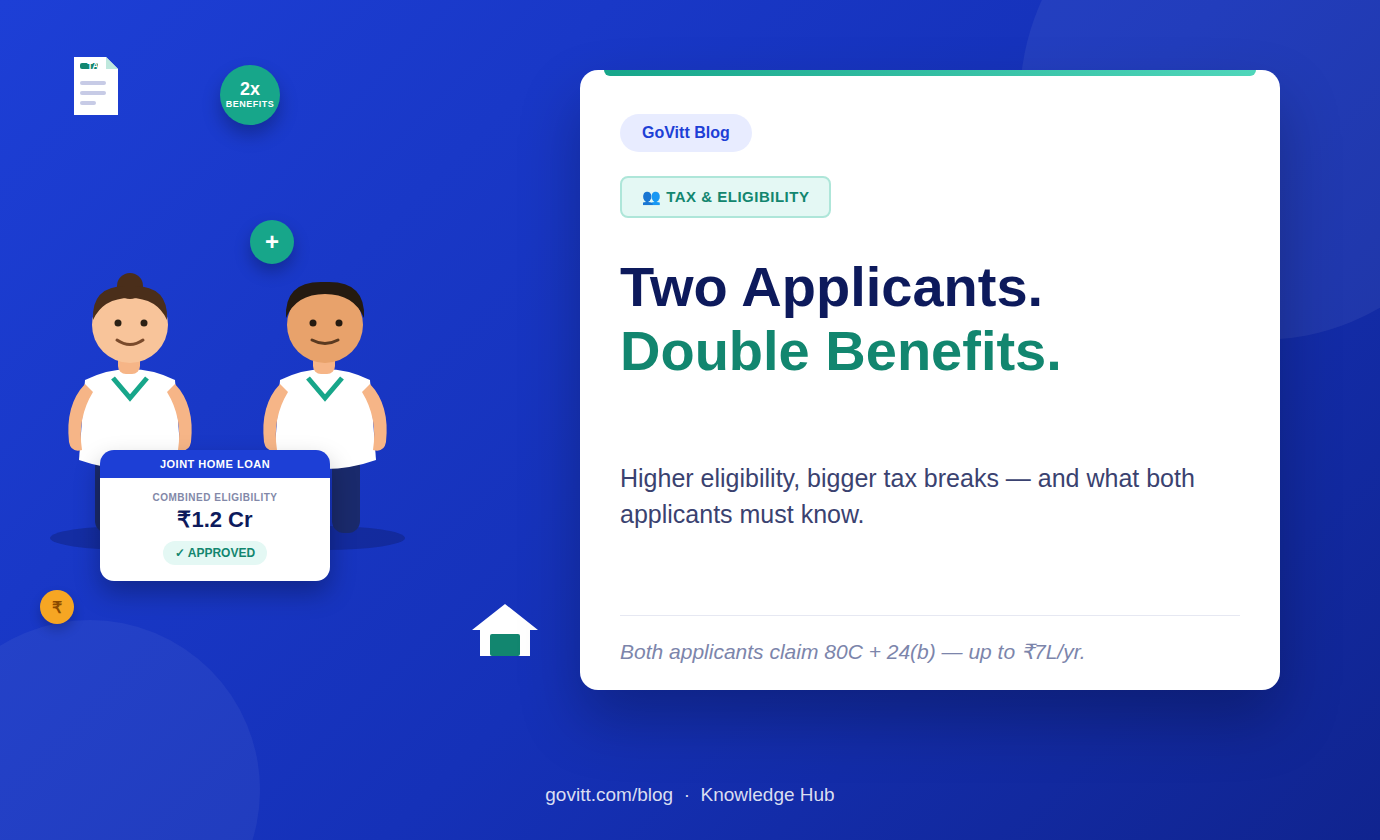
A joint home loan closes that gap. By applying with a spouse, parent, or sibling, you combine incomes, share the repayment load, and often unlock a higher loan amount than either of you could qualify for individually. On top of that, there are meaningful tax benefits that most people don't fully use.
See your real payoff date in 60 seconds
Banks calculate remaining EMIs by simple subtraction. See your actual payoff date and discover how much interest a balance transfer can save.
Here's everything you need to know before going down this route.
What is a joint home loan, exactly?
A joint home loan is simply a home loan where two or more people apply together and share responsibility for repayment. The people applying together are called co-applicants or co-borrowers.
The lender evaluates everyone's income, credit profile, and repayment capacity together — not separately. That combined picture is usually stronger than any one applicant alone, which is the whole point.
One important thing: most lenders require at least one co-applicant to also be a co-owner of the property. Being a co-borrower on the loan without being on the property documents is possible in some cases, but being both is the cleaner arrangement — and it's what unlocks the tax benefits.
Who can apply together?
Husband and wife — the most common combination, and the one most lenders are set up for. Both incomes count, repayment is shared, and both can claim tax deductions.
Parent and child — a son or daughter applying with a parent works well when one party has a stable income and the other has existing assets or property. It's also a common way for younger buyers to increase their eligibility early in their careers.
Siblings — many lenders allow this, particularly when both have stable salaried incomes.
Adult children with parents — works in reverse too. Parents and their earning children can apply together to access a higher loan amount.
Unmarried couples — some lenders do allow this, but policies vary. Check directly with the lender before assuming eligibility.
The real benefits
You can borrow more: This is the headline reason. When two incomes are considered together, the eligible loan amount goes up — sometimes significantly.
For example: if one applicant earns ₹60,000 a month and the other earns ₹50,000, their combined income of ₹1,10,000 can unlock a loan amount neither could get alone. That difference can mean a better location, a larger home, or simply not having to compromise.
Better approval odds: A stronger combined financial profile reduces the lender's perceived risk. If one applicant has a slightly lower credit score or shorter employment history, the other's profile can offset it. That said, a very poor score from either applicant can still drag down the application — more on that below.
Shared EMI burden: When two people are paying the EMI, the monthly strain on any one person is lower. This matters over a 15–20 year loan. It also provides a buffer — if one person's income is disrupted temporarily, the other can cover repayments without the loan going into default.
Tax benefits — for both of you: This is the part most people underutilise. If both applicants are co-owners of the property and both contribute to EMI repayment, each can claim deductions separately — on both the principal and the interest component — up to the applicable limits under the Income Tax Act.
For a family where both spouses are earning and paying taxes, this can add up to a significant combined saving every year. We'll cover this in more detail below.
Tax benefits on a joint home loan
The tax advantages of a joint home loan can be substantial — provided certain conditions are met.
Condition 1: Both applicants must be co-owners of the property (names on the sale deed).
Condition 2: Both must be co-borrowers on the loan.
Condition 3: Both must be contributing to the EMI repayment.
If all three conditions are met, each co-borrower can individually claim deductions on:
- Principal repayment — under Section 80C, up to the applicable annual limit
- Interest paid — under Section 24(b), up to the applicable annual limit for a self-occupied property
This means a husband and wife who both earn, both own the property, and both pay the EMI can each claim these deductions separately — effectively doubling the household tax saving compared to a solo applicant.
Since tax rules and limits can change, it's worth checking current provisions with a CA or tax advisor before filing — but the structure itself is well-established and widely used.
Eligibility — what lenders actually look at
Age — Each applicant must fall within the lender's eligible age band, typically 21–65 years. The loan tenure is often calculated based on the older applicant's retirement age.
Income — Both salaried and self-employed applicants are considered. Lenders look at stability and consistency, not just the number. If you're self-employed and wondering how your income will be assessed, this guide on home loans for self-employed individuals covers what banks actually look for.
Credit scores — Both applicants' scores are evaluated. A score of 750 or above from both is the strongest position to be in. If one applicant has a lower score, it can affect the rate offered or, in some cases, the approval itself. If you're concerned about where your score stands, read our guide on home loans with a lower CIBIL score before applying.
Existing liabilities — Outstanding personal loans, car loans, credit card debt — all of these reduce the combined eligible loan amount. The lower the existing debt, the better the eligibility.
Documents you'll both need
Since there are two (or more) applicants, each person needs to submit their own set of documents.
Identity and address proof — Aadhaar, PAN card, passport, or voter ID for each applicant
Income documents
For salaried applicants:
- Last 3 months' salary slips
- 6 months' bank statements
- Form 16
For self-employed applicants:
- 2–3 years' ITRs
- Business financial statements
- Bank statements
Property documents — Sale agreement, title documents, approved building plan, and any builder-related approvals if it's an under-construction property
Requirements vary across lenders, so confirm the exact list once you've shortlisted who you're applying with.
Things to sort out before you apply
A joint home loan is a long financial commitment — often 15–20 years. Before signing, make sure these things are clear between everyone involved:
Who pays what every month?
Decide this upfront. Whether it's 50-50, proportional to income, or one person handles it fully — have the conversation and document it informally if needed. Assumptions lead to friction later.
What happens if one person's income stops?
Job loss, illness, career break — these things happen. Know in advance how the EMI gets covered if one co-borrower can't contribute for a period.
How is ownership structured on paper?
The sale deed should clearly reflect each person's ownership share. This matters for tax claims, and it matters even more in the unlikely event of a dispute or separation. Get this right at the start.
Check both credit profiles before applying – If one applicant has a poor credit score, it's better to know before the lender does. You may want to improve it first, or apply with a different combination. A rejected application affects both applicants' scores. Understanding what a lower CIBIL score means for your loan options will help you assess whether you're ready to apply.
Compare lenders — don't just go to your salary account bank – Rates, processing fees, and eligibility criteria differ considerably across lenders. GoVitt lets you compare 50+ banks and NBFCs in one place, for free, with zero commission. It takes minutes and often reveals options you wouldn't have thought to check.
FAQs
- Can both applicants claim tax benefits?
Yes — if both are co-owners, co-borrowers, and contributing to repayment. Each can claim deductions independently up to the applicable limits.
- Does a joint loan guarantee a higher loan amount?
It improves eligibility significantly, but approval and the final amount still depend on credit profiles, existing liabilities, and property valuation. It's not automatic, but it's a meaningful advantage.
- What if one person wants to exit the loan midway?
This is complicated. Removing a co-borrower from an active home loan requires the remaining borrower to demonstrate they can service the loan alone — and the lender has to agree. It's possible but not straightforward. Think of a joint home loan as a long-term shared commitment, not something easily unwound.
- Can a non-earning family member be a co-applicant?
Some lenders allow it, but the non-earning co-applicant doesn't improve your loan eligibility since their income isn't counted. Their inclusion may be required for property ownership reasons, but it won't help with the loan amount.
- Is there a maximum number of co-applicants?
Most lenders accept up to 2–3 co-applicants. Beyond that, it varies. Check with the specific lender.
Is a joint home loan right for you?
It makes strong sense when:
- You need a higher loan amount than your individual income supports
- You and your co-applicant both have stable incomes and decent credit scores
- You both want to claim the tax benefits
- You've had an honest conversation about repayment responsibilities
It needs more thought when:
- One applicant has a significantly weaker credit profile
- The co-applicant relationship is unclear on the ownership side
- There's uncertainty about long-term income continuity for either person
The bottom line
A joint home loan is one of the more practical tools available to homebuyers — it increases what you can borrow, reduces what each person has to pay, and if structured correctly, reduces what both of you pay in taxes.
The key is going in prepared. Know both your credit profiles, decide on ownership structure upfront, and compare lenders before committing. The first bank that says yes isn't necessarily the one giving you the best deal.
GoVitt helps you compare home loan offers from 50+ lenders at no cost — no commission, no spam. If you're planning to apply jointly, it's a good place to start.
Ready to take the next step?
Find out your loan options and check your eligibility with GoVitt today.