
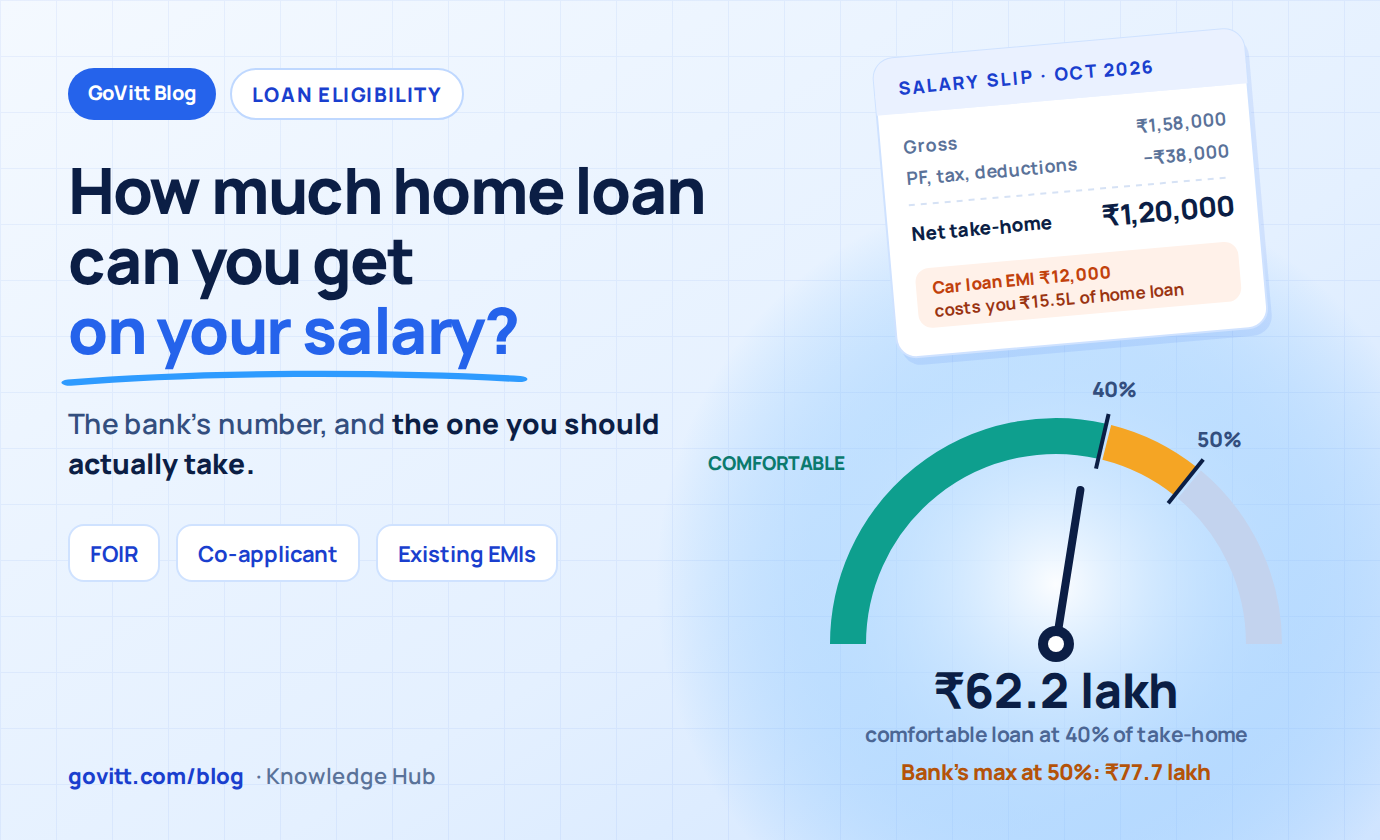
"I take home ₹1.2 lakh a month. How much loan will I get?"
That's probably the question I get asked most, usually right after someone has seen a flat they like. And the honest answer is that there are two numbers. The one the bank will give you, and the one you should actually take. They're not the same.
Let me go through how the bank's number is worked out first, because once you see it, a lot of things start making sense. Including why your car loan matters far more than you think.
See your real payoff date in 60 seconds
Banks calculate remaining EMIs by simple subtraction. See your actual payoff date and discover how much interest a balance transfer can save.
The bank checks two limits, and the lower one wins
The first limit is how much EMI your income can carry. Banks call this FOIR, fixed obligations to income ratio. Basically, out of your monthly take-home, what share can go towards EMIs, all of them put together. For most salaried borrowers it's somewhere between 40% and 55%, depending on how much you earn and the lender. Higher incomes get a bit more room, because someone earning ₹3 lakh a month has more left over after paying 50% than someone earning ₹50,000.
So if you take home ₹1.2 lakh and the bank allows 50%, your total EMIs can be up to ₹60,000. At 8% for 25 years, a ₹60,000 EMI supports a loan of about ₹77.7 lakh.
The second limit is how much of the property's value the bank is allowed to fund. RBI caps this. On loans up to ₹30 lakh, banks can lend up to 90% of the property value. Between ₹30 lakh and ₹75 lakh, up to 80%. Above ₹75 lakh, up to 75%. And stamp duty and registration aren't counted in the property value for this, except on homes below ₹10 lakh.
So even if your salary supports ₹77.7 lakh, if the flat costs ₹90 lakh, the most the bank will lend is 75% of that, ₹67.5 lakh. The rest comes from you.
Whichever of the two numbers is lower is your actual limit.
A rough guide by salary
Here's what the income limit works out to at different take-home salaries, assuming no other EMIs, 50% FOIR and an 8% rate.
| Monthly take-home | EMI the bank allows | Loan over 20 years | Loan over 30 years |
|---|---|---|---|
| ₹50,000 | ₹25,000 | ₹29.9 lakh | ₹34.1 lakh |
| ₹75,000 | ₹37,500 | ₹44.8 lakh | ₹51.1 lakh |
| ₹1 lakh | ₹50,000 | ₹59.8 lakh | ₹68.1 lakh |
| ₹1.5 lakh | ₹75,000 | ₹89.7 lakh | ₹1.02 crore |
| ₹2 lakh | ₹1 lakh | ₹1.20 crore | ₹1.36 crore |
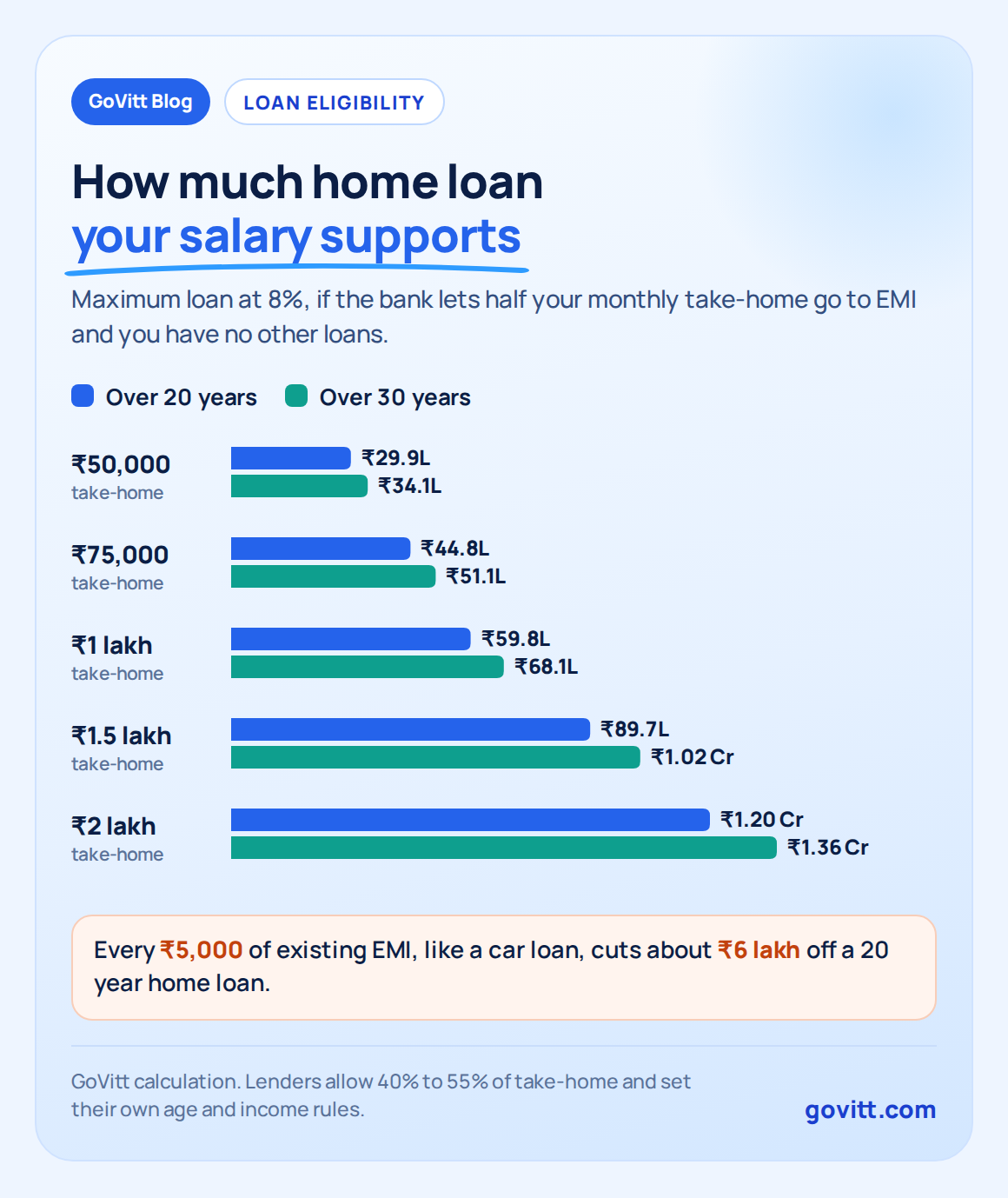
What your salary supports at 8%, assuming no other loans. Every existing EMI pulls these numbers down.
Two things to notice. Going from 20 years to 30 years only adds about 14% to how much you can borrow, but it adds a lot more to the interest you pay. And these are maximums. Each lender has its own rules, so treat the table as a starting point, not a promise.
Why your car loan matters so much
This is the part that surprises people.
Say you take home salary is ₹1.2 lakh, you're 34, and you have a car loan with a ₹12,000 EMI. Without the car loan, your 50% limit leaves ₹60,000 for the home loan EMI, which supports about ₹77.7 lakh over 25 years. With the car loan, only ₹48,000 is left, which supports about ₹62.2 lakh.
That ₹12,000 car EMI just cost you ₹15.5 lakh of home loan.
As a thumb rule, every ₹5,000 of existing EMI takes about ₹6 lakh off a 20 year home loan at 8%. Personal loans, car loans, consumer durable EMIs, the phone you bought on no-cost EMI, all of it counts. Many banks also count a part of your credit card limit or outstanding.
So if a car loan or personal loan has only a few months left, and you have the cash, closing it before you apply can increase your eligibility more than any negotiation with the bank will.
Things that push your number up or down
A co-applicant helps the most. If your spouse takes home ₹60,000 and comes on as a co-applicant, the bank adds their income too. In our example that takes the limit from ₹62.2 lakh to about ₹1.01 crore. They'll usually need to be a co-owner as well, and it has a nice tax side effect too. More on that in our post on joint home loans.
Age matters more than people expect. Banks want the loan to finish around your retirement age, usually 60 for salaried people and a bit later for self-employed. At 34 you can easily get 25 or 30 years. At 45 you might only get 15, and the same ₹48,000 EMI then supports only about ₹50 lakh.
Then your credit score. A lower score usually means a higher rate, and a higher rate means a smaller loan for the same EMI. At 7.75%, ₹48,000 a month over 25 years supports ₹63.5 lakh. At 8.25%, it's ₹60.9 lakh. If your score is on the lower side, this post on getting a loan with a 650 score will help.
And the RBI decision this week. RBI announces its policy on October 7, and most economists expect a 0.25% hike. If that happens, the same ₹48,000 EMI supports about ₹1.3 lakh less over 25 years. Small, but if you're right at the edge, it matters. I did the full maths for festive season buyers in this post.
If you're self-employed, banks look at the income in your ITR, usually an average of the last two or three years, not your bank credits. If you've been showing low profits to save tax, that's exactly what will come back to you here. This postgoes into it.
The number you should actually borrow
Now my opinion, as someone who does this every day.
Just because the bank will let you put 50% of your take-home into EMIs doesn't mean you should.
At ₹1.2 lakh take-home, 50% is ₹60,000 a month on EMI. That leaves ₹60,000 for rent until you move in, school fees, groceries, parents, insurance, savings, and the odd medical bill. It's doable on paper. It's tight in real life, and it leaves nothing for a rate hike or a bad year at work.
I'd rather see most people keep total EMIs around 35% to 40% of take-home.
| Share of take-home on EMI | EMI | Loan over 25 years |
|---|---|---|
| 35% | ₹42,000 | ₹54.4 lakh |
| 40% | ₹48,000 | ₹62.2 lakh |
| 50% (bank's max) | ₹60,000 | ₹77.7 lakh |
The difference between 40% and 50% is about ₹15 lakh of loan, and that ₹15 lakh could be the difference between a flat you're happy in and a flat you're stressed in. If the flat you want only works at 50%, either bring in a co-applicant, wait a year, or look a little further out.
And remember the cash part. On top of the down payment, you'll need money for stamp duty, registration and the other charges that builders add, which the bank doesn't fund. On a ₹1 crore flat in Bengaluru that's easily ₹7 to ₹8 lakh more. The full list is in this post on buying from a builder.
Before you go flat hunting
Work out your number first, not after you've fallen for a flat. Take your monthly take-home, subtract your current EMIs, decide what share you're comfortable putting into a home loan, and try it at a rate half a percent above today's. Then check how much cash you have for the down payment plus about 8% more for charges.
If you'd like a second pair of eyes on it, WhatsApp us your take-home salary, existing EMIs, age and the flat price you're looking at on +91 70194 17854. We'll tell you what the banks will actually give you, which of our 50+ partner banks and housing finance companies suit your profile, and what we think is a comfortable number. You can also play with the numbers on our EMI calculator. GoVitt doesn't charge you any commission.
All figures are illustrative, at 8% unless stated, with monthly reducing balance. Each lender has its own FOIR, age and income rules, and your eligibility also depends on your credit history, employer and the property. This is general information, not a loan offer.
Questions people usually ask
How much home loan can I get on a ₹1 lakh salary? If ₹1 lakh is your monthly take-home and you have no other loans, most banks would allow an EMI of about ₹50,000. At 8%, that supports roughly ₹60 lakh over 20 years or ₹68 lakh over 30 years. Existing EMIs, your age and credit score can change this.
What is FOIR in a home loan? FOIR stands for fixed obligations to income ratio. It's the share of your monthly take-home that a bank allows to go towards all your EMIs together, including the new home loan. For salaried borrowers it's usually between 40% and 55%.
How much of the property value will a bank fund? Under RBI rules, up to 90% on loans up to ₹30 lakh, up to 80% on loans between ₹30 lakh and ₹75 lakh, and up to 75% on loans above ₹75 lakh. Stamp duty and registration are usually not included, so you pay those yourself.
Does an existing car loan or personal loan reduce my home loan eligibility? Yes, directly. Every existing EMI reduces the EMI room left for your home loan. As a rough rule, every ₹5,000 of existing EMI cuts about ₹6 lakh from a 20 year home loan at 8%.
How can I increase my home loan eligibility? Add an earning co-applicant, close small loans before applying, opt for a longer tenure if your age allows it, and improve your credit score to get a lower rate. Self-employed borrowers should make sure their ITRs reflect their real income.
Should I borrow the maximum the bank offers? Usually not. The bank's limit can put half your take-home into EMIs. Keeping total EMIs around 35% to 40% of take-home leaves room for a rate hike, emergencies and savings.
Does a rate hike reduce how much I can borrow? Yes. At a higher rate, the same EMI supports a smaller loan. On a ₹48,000 EMI over 25 years, a 0.25% hike from 8% to 8.25% reduces eligibility by about ₹1.3 lakh.
Ready to take the next step?
Find out your loan options and check your eligibility with GoVitt today.