
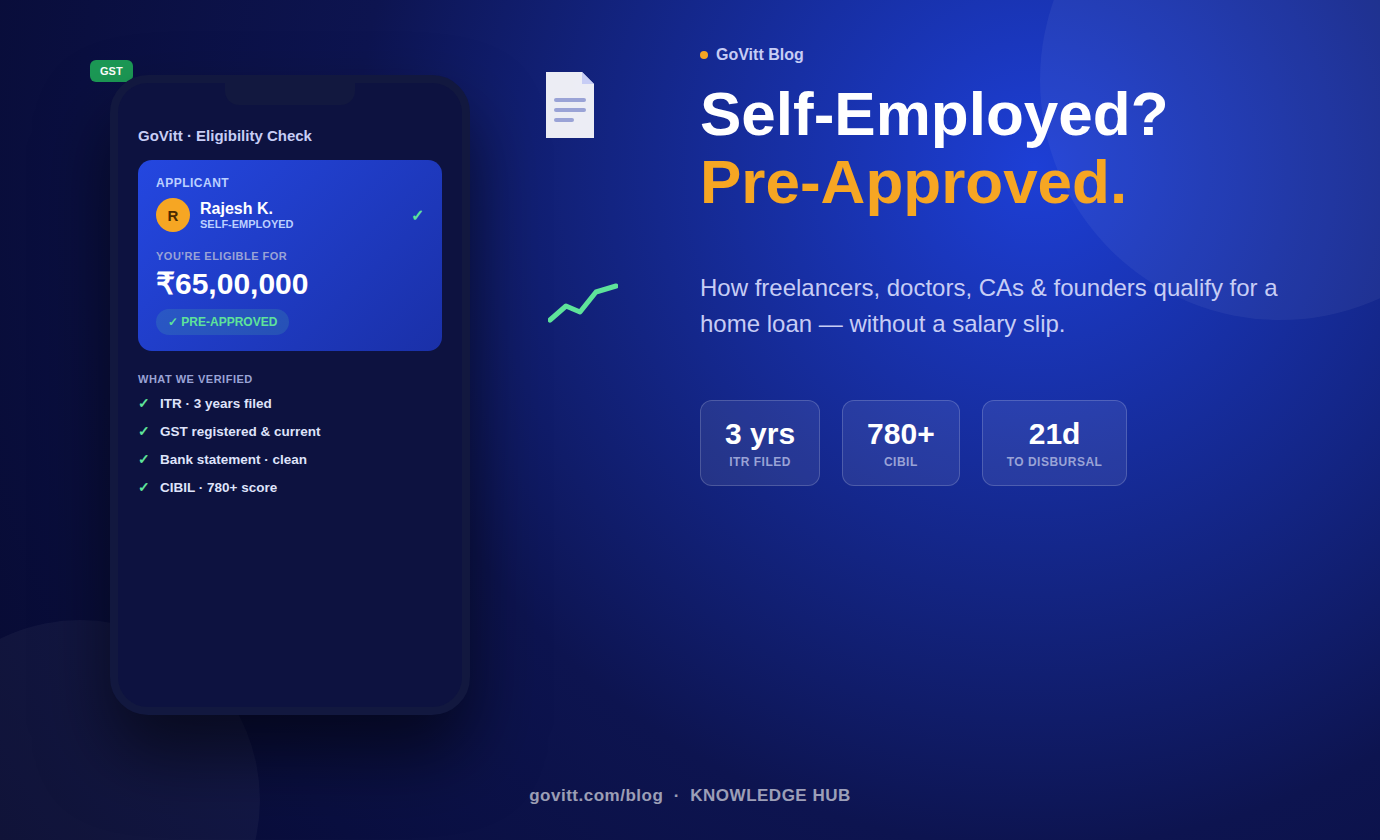
If you run your own business, freelance, consult, or do any kind of work that doesn't come with a monthly salary slip, you've probably picked up the impression that home loans are harder for people like you. Most articles you read are aimed at salaried buyers. Most online calculators ask for your "monthly salary" as if everyone has one. And every time you've casually asked a friend who works at a bank, the answer comes wrapped in a few extra "just keep in mind..." caveats.
Here's the honest truth: self-employed people get home loans all the time. Chartered Accountants Doctors, business owners, lawyers, consultants, freelance designers, shop owners, founders, content creators and other business owners— they're all buying houses with home loans. Banks aren't refusing self-employed customers as a category.
What they are doing is looking at you a bit more carefully. And that's where most of the difficulty actually comes from.
See your real payoff date in 60 seconds
Banks calculate remaining EMIs by simple subtraction. See your actual payoff date and discover how much interest a balance transfer can save.
The thing isn't your self-employment. The thing is income consistency and how clearly you can prove it.
A salaried employee shows up with three salary slips and the bank knows what they earn. You don't have that luxury. Your income may swing from month to month, your good year and your bad year might look very different on paper, and the line between business income and personal income can get blurry. The bank's job is to get comfortable with all of that — and your job is to make their life easy.
Let's walk through what they actually look for, and how you can position your case to make the answer be yes.
So can self-employed people actually get home loans?
Yes, comfortably, and the list of who qualifies is a lot wider than people assume:
- Business owners (small, medium, large)
- Doctors and medical professionals
- Lawyers and Chartered Accountants
- Architects and consultants
- Shop and showroom owners
- Startup founders
- Independent professionals — designers, content creators, photographers
- Freelancers and gig workers (this used to be hard; less so now)
Plenty of self-employed borrowers actually qualify for bigger loans than salaried ones, simply because their income is higher. Doctors and CAs running good practices, founders pulling decent compensation, business owners with healthy profits — these are profiles banks like.
What you should expect:
- More documentation than a salaried borrower
- A more careful look at your income across multiple years
- A stricter view of bank statements and business health
- Possibly a slightly higher rate, especially if your income looks lumpy
- A slower process — sometimes a few extra weeks compared to a salaried file
It's not impossible. It's just not as automatic.
Why is it slightly harder?
Comes down to one word: predictability.
When the bank lends to a salaried employee, they have a fairly clean picture. A person earns ₹X every month, employer is verifiable, salary slips back it up, the salary credit hits the same account on the same date for years. Easy.
Your situation is messier:
- Your income probably varies month to month
- Some months you have huge inflows, some months are quiet
- Your "income" on tax returns might be lower than your actual lifestyle suggests, because you're claiming legitimate business expenses
- Your business itself has risk — markets shift, clients drop off, costs rise
So when a bank looks at lending you ₹50 lakh over 20 years, they want stronger proof that you can keep paying through all the ups and downs. That's not unreasonable from their side. The trick is showing them what they need to see.
What banks actually look at
1. How stable your income is
This matters more than the absolute number. A business making a steady ₹15 lakh a year for the last three years generally looks better to a lender than one that made ₹8 lakh, then ₹25 lakh, then ₹12 lakh — even if the second one made more in total.
Banks want to see consistency or, even better, gradual growth. Big swings make them nervous, because they suggest your income could just as easily swing the other way during your loan tenure.
If your last few years have been bumpy, expect more questions. Bring an explanation that makes sense — a one-off bad year is fine, a pattern of volatility is harder to explain away.
2. Your Income Tax Returns
This is where a lot of self-employed home loan applications quietly run into trouble.
Most lenders want 2 to 3 years of ITRs. They're going to use the income you've declared to figure out how much you can borrow.
Now here's the awkward truth: many self-employed people legitimately reduce their declared income through business expense claims to keep their tax bill down. Smart from a tax perspective. Painful from a home loan perspective.
If you've been declaring ₹6 lakh in profit but your real take-home is closer to ₹15 lakh, the bank can only lend you based on the ₹6 lakh number. Your home loan eligibility will be a fraction of what your actual lifestyle would support.
The fix here isn't to suddenly inflate your income before applying — that doesn't work and is also not legal. The real fix is to plan ahead. If you know you're going to apply for a home loan in 18–24 months, talk to your CA about declaring more of your income properly during those tax years. You'll pay more tax in the short term, but you'll qualify for a much bigger loan.
3. How long your business has been around
Banks generally prefer businesses that have been operating for at least 2 to 3 years. Longer is better.
Newer businesses can still get loans, but the scrutiny goes up. The bank wants to see that your business isn't going to fold in the first few years of your loan tenure. If your business is only a year old but you have strong personal banking history and other assets, NBFCs are usually more flexible than banks here.
4. Bank statements (this is where the real story is)
For salaried people, salary slips do the heavy lifting. For self-employed borrowers, bank statements are everything. Lenders pull 6 to 12 months of statements and they read them carefully.
What they're checking:
- Regular credits coming in — ideally consistent, ideally growing
- Healthy average balance — they want to see you don't operate hand-to-mouth
- Cheque returns — even one or two bounced cheques in your statement is a serious red flag
- Frequent overdrafts — same problem
- Round-tripping or shuffling money between accounts — they notice this and it makes them suspicious
- Cash withdrawals dominating — they prefer digital, traceable activity
Honestly, a lot of self-employed home loan applications get sunk by banking habits the borrower didn't realise were a problem. Cleaning up your account behaviour for 6 to 12 months before applying — fewer cheque returns, healthier average balance, more digital traceability — can make a real difference.
5. Your CIBIL score
Same logic as for any borrower:
- 750+ — you're in great shape
- 700 to 749 — workable, decent terms
- Below 700 — expect more friction, possibly a higher rate
Self-employed people sometimes have messier credit profiles because business cash flow can lead to delayed credit card payments or stretched personal loans. Worth pulling your CIBIL report well before applying and cleaning up anything that's hurting your score.
6. What you already owe
Business loans, personal loans, vehicle loans, credit card balances, EMIs you've taken to bridge cash flow — banks add it all up.
The general comfort zone is that your total EMIs (including the new home loan) shouldn't go beyond 40 to 50% of your monthly income. Self-employed borrowers often forget to count their business loans against their personal eligibility, but lenders absolutely include those when calculating your debt burden.
If you're sitting on a chunky business loan, paying part of it down before applying for a home loan can free up significant eligibility.
What documents you'll need to put together
Specifics vary lender to lender, but the typical list:
Identity and address:
- Aadhaar
- PAN
- Passport (sometimes)
- Voter ID or another acceptable address proof
Income side:
- ITRs for the last 2 to 3 years (with computation of income)
- Profit and loss statements for the same period
- Balance sheets, audited where applicable
- GST returns (if registered)
- Business proof — registration certificate, partnership deed, MOA/AOA for companies, professional registration for doctors/CAs/lawyers
Banking:
- 6 to 12 months of bank statements (both business and personal accounts)
Property:
- Sale agreement
- Title chain documents from the seller
- Builder approvals (for new properties)
- Encumbrance certificate
- All other property paperwork
A bit more paperwork than a salaried applicant, but nothing unusual. Get a checklist from the bank or your consultant up front and assemble everything in one shot — drip-feeding documents over weeks is how applications get delayed.
What about freelancers and gig workers?
A few years ago, this was genuinely hard. Lenders didn't quite know what to do with someone whose income came from twenty different clients, often via international wires, with no traditional employer anywhere in the picture.
That's changed. Most major banks now actively lend to freelancers, especially in tech, design, and consulting where good incomes are common.
What they look at instead of salary slips:
- Regular client payments hitting your bank account
- Contracts or retainer agreements with major clients
- Tax filings showing consistent professional income
- Digital payment records — UPI, payment gateways, international wires
- Invoices issued
A freelancer with steady client payments, clean ITRs, and a couple of years of professional income on record is a perfectly fine borrower. Some lenders are more comfortable with this profile than others — comparing across lenders matters more for freelancers than almost anyone else.
Why self-employed home loans get rejected
The recurring patterns:
Declared income is too low. Already covered above. The single biggest reason. People legitimately optimize their tax filings and then can't borrow what they actually deserve to borrow.
Messy banking. Cheque returns, frequent overdrafts, low average balances, irregular deposits — any of these can sink an application even when the income is fine on paper.
Weak credit score. Late EMIs, high credit card utilisation, business cash flow stress spilling into personal credit. The bank sees it and gets cautious.
Too much existing debt. Especially business loans the borrower didn't think to count.
Incomplete or inconsistent documentation. Missing GST returns, ITRs that don't match the bank statements, balance sheets that look hand-prepared rather than properly compiled. All of it adds friction and any one of them can be a deal-breaker.
How to actually improve your odds
Get your books in order
This is the foundational thing. If your business records are sloppy — bookkeeping done at the last minute, invoices missing, expenses not properly classified — fix it before you apply. Consider getting a CA involved if you've been doing it yourself.
Clean books make every other part of the application easier. Bank statements line up with ITRs, ITRs line up with GST returns, GST returns line up with invoiced revenue. When everything tells the same story, the bank gets comfortable quickly.
File ITRs every year, on time, even when you don't have to
Skipping a year of ITRs because your income was low or you weren't required to file is a mistake when you're planning to borrow. Lenders want a continuous track record. Two years of filed ITRs followed by a missing year and another filed year looks much worse than three consecutive filed years, even if the actual income is similar.
Plan your tax declarations around your home loan plan
If you're going to apply for a home loan in 2027, the ITRs the bank will look at are your FY 2024-25, FY 2025-26, and FY 2026-27 returns. Whatever income you declare in those years is what they'll use to calculate eligibility.
This isn't about gaming the system — it's about timing legitimate tax decisions to match your borrowing plans. Talk to your CA about it well in advance.
Clean up your credit profile
Pay everything on time. Bring credit card balances down to under 30% of the limit. Avoid taking on any new loans in the 6 to 12 months before applying.
Bring down existing debt
If you have a business loan or personal loan you can pay off (or pay down significantly), do it. Lower debt-to-income ratio means higher home loan eligibility, every time.
Put more cash into the down payment
A bigger down payment makes the bank's risk smaller, and self-employed borrowers benefit from this even more than salaried ones. Going from 15% down to 25% down can change the conversation from "we're not sure" to "let's do it."
Do self-employed borrowers pay higher interest rates?
Sometimes, yes — but it's not automatic. Lenders see variable income as slightly riskier, and that can show up as a quarter or half a percent on the rate. Not always, but often enough.
That said, a self-employed borrower with strong profits, a 780 CIBIL score, and a decade of business history can absolutely get the same rate as a salaried borrower. The "self-employed premium" mostly applies when other parts of the profile are weaker.
This is also why comparison matters more for self-employed applicants. Different banks treat self-employed income very differently — some are far more comfortable with it than others. Walking into one bank and accepting their rate is leaving money on the table.
Platforms like GoVitt let you see what multiple lenders would actually offer for a self-employed profile in one place, so you can pick the bank that handles your kind of income best instead of taking whatever the first lender quotes.
Salaried vs self-employed — at a glance
| Factor | Salaried Borrowers | Self-Employed Borrowers |
|---|---|---|
| Income proof | Salary slips, Form 16 | ITRs, P&L, balance sheets |
| Income stability | Fixed monthly | Variable |
| Documentation | Simpler, lighter | More detailed |
| Approval speed | Faster, often 2–3 weeks | Slightly longer, 4–6 weeks |
| Flexibility needed | Lower | Higher |
| Rate offered | Standard | Sometimes a small premium |
What this table doesn't show: self-employed borrowers often have much higher loan eligibility once their numbers are properly demonstrated, because their actual income is often higher than what an equivalent salaried role would pay. The hill is steeper to climb, but the view at the top can be better.
Key takeaways
- Self-employed people absolutely get home loans — the process is just more paperwork-heavy
- The biggest factor is showing stable, properly documented income across 2–3 years
- ITRs, bank statements, and business history do the heavy lifting
- Underreporting income to save tax can hurt your home loan eligibility — plan ahead
- Clean banking habits matter more than people realise
- Higher down payments and stronger credit help offset the perceived risk
- Comparing lenders matters more for self-employed borrowers than for anyone else
Conclusion
Being self-employed isn't a problem when it comes to home loans. Being self-employed and unprepared is.
Banks aren't trying to keep you out — they're trying to figure out if you can pay the EMI for the next 20 years. Your job is to make that question easy for them to answer. Strong tax filings, clean bank statements, consistent business performance, and responsible credit behaviour together form a story that any lender will be willing to back.
The borrowers who run into trouble are usually the ones who started thinking about the loan three months before applying. The borrowers who breeze through are the ones who set up the financial picture properly over the previous two or three years and walked in with everything in order.
Before you apply, take time to compare lenders too. Self-employed eligibility rules vary widely from one bank to the next — what one bank treats as a complicated profile, another might handle without blinking. Tools like GoVitt make this comparison easier by letting you see what different lenders would offer for your specific profile, instead of going branch to branch hoping the answer changes.
A bit of preparation now can mean a bigger loan, a better rate, and far fewer headaches when you're actually trying to buy.
FAQs
Can I get a home loan if my business is less than 2 years old?
Possible, but tougher. Most banks prefer 2 to 3 years of business vintage. If yours is newer, expect stricter scrutiny — they'll want strong income, clean banking, and possibly a co-applicant. NBFCs tend to be more flexible than banks for newer businesses. If you can wait until you cross the 2-year mark, the process gets noticeably easier.
Do banks look at business turnover or profit?
Profit, mostly. Turnover tells them how big your business is, but profit tells them what you actually take home. A business doing ₹2 crore in turnover but only ₹8 lakh in profit will be evaluated based on that ₹8 lakh. So the question they're really answering is: how much of your business revenue actually becomes income you can use to pay an EMI?
Can cash-based businesses get home loans?
Yes, but it's harder than it should be. Lenders strongly prefer digitally traceable income because cash transactions are difficult to verify. If most of your business runs on cash, your bank deposit patterns and tax filings have to do a lot of work to convince the lender. Moving as much of your business as possible to digital — UPI, bank transfers, card payments — makes a real difference, both for taxes and for borrowing.
Is GST registration mandatory for a self-employed home loan?
Not always. Plenty of self-employed borrowers without GST registration get loans, especially professionals (doctors, lawyers) whose income doesn't trigger GST requirements. But if your business should be GST-registered and isn't, that becomes a credibility issue. Where GST does apply, your returns add useful proof of business activity and consistent income.
Will a co-applicant help my application?
Often, yes. Adding a working spouse or family member — especially a salaried one — usually improves approval chances meaningfully. Their income gets added to yours for eligibility, their salary balances out your variable income, and their CIBIL score (if strong) adds confidence. Just remember: a co-applicant is fully responsible for repayment alongside you. Have that conversation seriously before pulling them in.
Are NBFCs easier than banks for self-employed borrowers?
Often, yes. NBFCs and housing finance companies tend to be more flexible with self-employed profiles — they'll consider alternative income evidence, work with newer businesses, and overlook some of the things banks treat as deal-breakers. The trade-off is usually a slightly higher interest rate. For a strong self-employed profile, try the banks first; for a more complicated one, NBFCs are often where you'll actually get the loan.
Ready to take the next step?
Find out your loan options and check your eligibility with GoVitt today.