
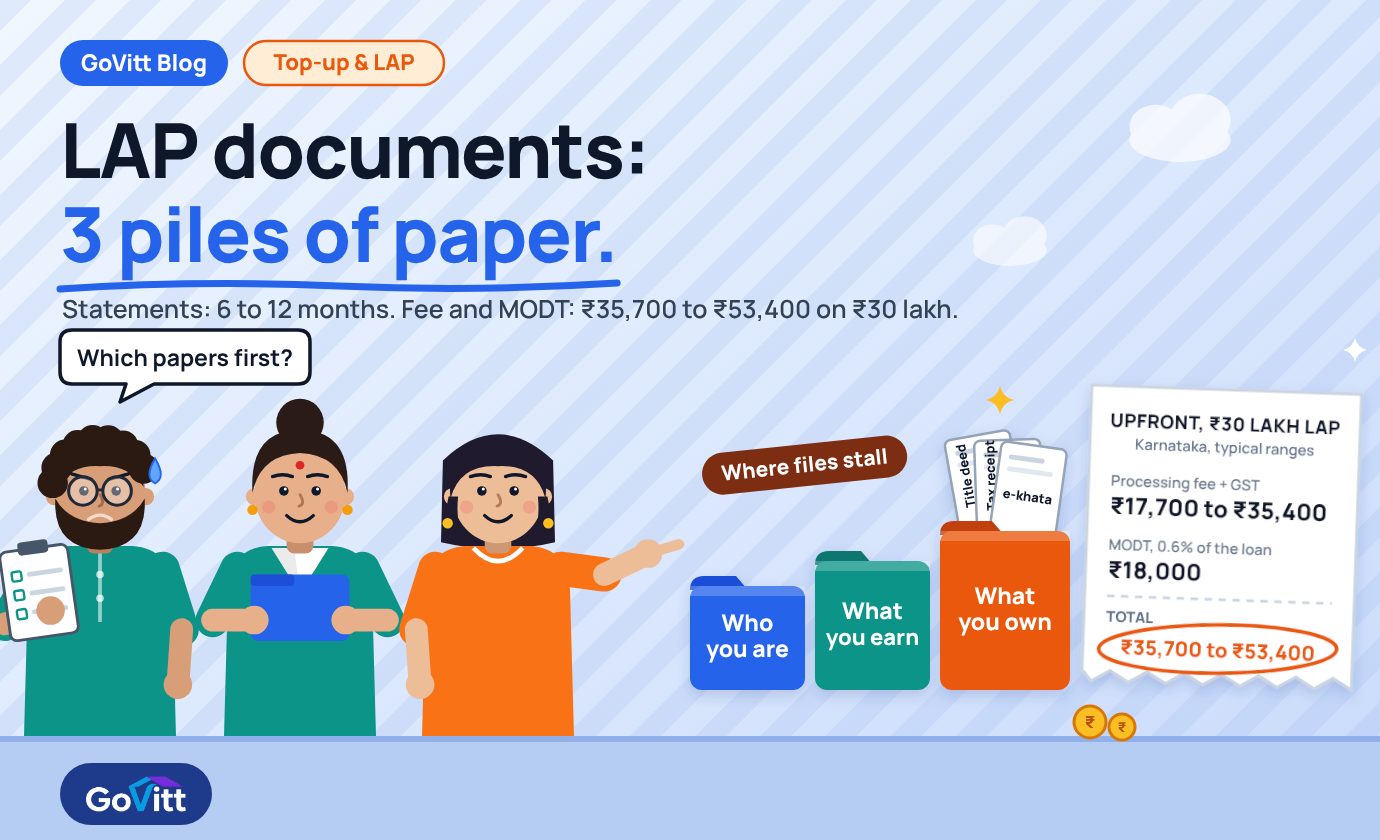
The documents required for loan against property fall into three piles: who you are, what you earn and what you own. The first two piles are routine. The third is where files stall, because a lender won't lend against a paper it can't read. And the lists differ more than you'd expect: HDFC Bank asks a salaried borrower for 6 months of salary slips, Tata Capital and Bajaj Housing Finance ask for 3.
Below: the full checklist, where three lenders' lists disagree, the Bengaluru papers they don't print, what to carry for a self-employed or business loan, and how to apply without the third request for the same paper.
See your real payoff date in 60 seconds
Banks calculate remaining EMIs by simple subtraction. See your actual payoff date and discover how much interest a balance transfer can save.
First, the honest part
Four limits on what I could check:
- I read three lender pages on 6 November 2026: Tata Capital, Bajaj Housing Finance and HDFC Bank. I did not read SBI's or ICICI's document pages for this post.
- Bajaj's page contradicts itself on how many months of bank statements it wants. I show both numbers below.
- None of the three pages mentions Karnataka papers such as the e-khata. Those come from my own Bengaluru posts and I label them.
- Every lender says it may ask for more. Tata Capital and Bajaj both say additional documents may be requested during processing. A checklist is where you start, not where you finish.
The short answer
| Pile | What it proves | Core documents |
|---|---|---|
| Who you are | Identity, address, age | PAN, a photo ID, an address proof, passport photos, signature verification |
| What you earn | You can repay | Salaried: salary slips, bank statements, Form 16. Self-employed: ITR, profit and loss statement, balance sheet, bank statements |
| What you own | The property can be sold if you can't repay | Title deed and chain of ownership, sale deed, latest property tax receipt, approved plan, occupancy certificate where it applies, encumbrance certificate |
Tata Capital adds a point that saves time: scanned copies are enough for the first application, but originals of the property papers are needed to complete processing and disbursement. So scan everything now and find the originals before you're asked.
Pile 1: who you are (KYC)
| Document | What the lenders say |
|---|---|
| PAN | Mandatory at Bajaj. Both Tata Capital and Bajaj accept Form 97 where you have no PAN |
| Photo ID | Tata Capital: one valid photo ID, such as a voter ID, passport, driving licence or Aadhaar. Bajaj: passport, driving licence, voter ID, NREGA job card or an NPR letter |
| Address proof | The same options as the photo ID. HDFC Bank's page lists a ration card, telephone bill, electricity bill or voter ID |
| Date of birth | Bajaj accepts a passport, PAN, driving licence, voter ID or a birth certificate |
| Photographs | Passport size, for every applicant and co-applicant |
| Signature | Tata Capital lists photograph and signature verification |
Aadhaar is optional at both Bajaj and Tata Capital. Tata Capital's FAQ says it isn't strictly mandatory, though you need one valid photo ID and one address proof. If a co-applicant is on the loan, they supply the same set.
Pile 2: what you earn
This is where the lists differ most. Here is a salaried borrower across three lenders:
| Document | Tata Capital | Bajaj Housing Finance | HDFC Bank |
|---|---|---|---|
| Salary slips | Last 3 months | Last 3 months | Last 6 months, showing all deductions |
| Bank statements | Last 12 months | 12 months in its table, 6 months in its general section | 6 months showing salary credits |
| Form 16 | Last 2 years | Mentioned, no years given | Two years |
| Other | None listed | Bonus slip with bank credits, and an appointment letter if the job is under a year old | None listed |
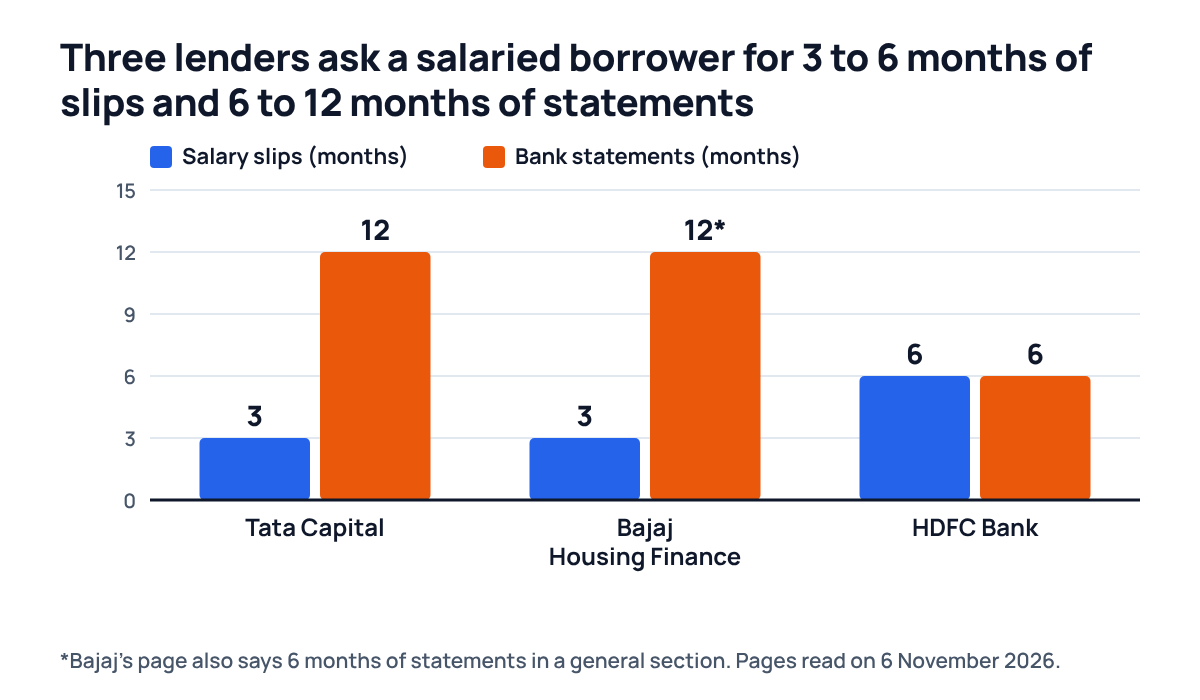
Three lenders, three answers. Slips run from 3 to 6 months and statements from 6 to 12. My rule is to carry the longest version of everything: 6 months of slips, 12 months of statements and 2 years of Form 16. You may never be asked, and if you are, it's in your folder.
For self-employed borrowers the differences are bigger:
| Document | Tata Capital | Bajaj Housing Finance | HDFC Bank |
|---|---|---|---|
| Returns and accounts | ITR, profit and loss statement and balance sheet. Years not stated | Latest ITR and a profit and loss statement. Years not stated | Certified financial statements for the preceding 3 years. ITR not named |
| Bank statements | Last 12 months | 12 months from your business and savings accounts, preferably through an account aggregator | 6 months showing income credits |
| Other | None listed | Consent to fetch your data from the Income Tax and GST portals | Udyam Registration Certificate for MSME borrowers |
Carry three years of ITR with computation, the matching profit and loss statement and balance sheet, 12 months of statements for every account the business uses, and your GST returns if you're registered. Tata Capital's own FAQ says an ITR "may not be mandatory, subject to eligibility", so a lender may assess you on bank statements instead. Don't count on it. Ask which route you're on.
Two more items cause delays:
- Existing loans. Bajaj asks for 6 months of statements showing your loan repayments and for sanction letters and payment records of any existing loans. A top-up on a home loan you already have is a different route. Compare it in top-up vs loan against property vs personal loan.
- Professionals. Bajaj asks for the degree certificate, and for a doctor the state medical council registration or for a chartered accountant the certificate of practice.
For firms and companies the entity papers are on top: Udyam registration, GST registration, a partnership deed or LLP agreement or the certificate of incorporation with the MOA and AOA, a list of directors, and authorised signatory KYC. The business loan version of this checklist is in loan against property for business.
Pile 3: what you own
This pile decides the file. The lenders' lists, merged:
| Document | Why they want it | Who lists it |
|---|---|---|
| Title deed, and the chain of previous ownership documents | Proves the seller owned it and each sale before | Tata Capital, Bajaj |
| Sale deed and agreement papers | Proves how you came to own it | Tata Capital, Bajaj |
| Latest property tax receipt | Proves the dues are paid | Tata Capital, Bajaj (municipal tax and water tax receipts) |
| Approved building plan | Proves the building is as sanctioned | Tata Capital, for a residential property |
| Occupancy or completion certificate | Proves it was finished and cleared for use | Tata Capital |
| Encumbrance certificate | Shows any other charge on the property | Tata Capital, where the lender asks |
| Maintenance bill | Shows the society's dues | Bajaj |
| Trade licence, GST certificate, utility bills in the business name | For a commercial property | Tata Capital |
| Copies of all papers for the property pledged | A catch-all | HDFC Bank |
That is what the lender pages print. In Bengaluru, from my own earlier posts, add these, because they are what stalls Bengaluru files:
- A final e-khata in your name, not a draft. A B-khata or a draft e-khata is the usual reason a Bengaluru file stops. Most banks won't lend on a B-khata. My resale flat post covers A against B and the conversion rules.
- A fresh encumbrance certificate from Kaveri 2.0. An old mortgage still showing because the release deed was never registered will hold up the file.
- The release papers of any earlier loan, if you have just repaid one.
- MODT. In Karnataka your lender registers a memorandum of deposit of title deeds at the sub-registrar, and you pay for it. More in MODT charges in Karnataka.
If the property is a plot or a house in a layout rather than an apartment, the layout's approval papers matter too, and a bank may ask which authority sanctioned it.
What the paperwork costs
Documents aren't free, and the biggest line sits in this pile. On a typical LAP in Karnataka, the processing fee is 0.5% to 1% of the loan plus 18% GST, and MODT is about 0.6% of the loan: 0.5% stamp duty plus about 0.1% registration. These are typical ranges from my loan against property pillar, not quotes. Legal and valuation charges are extra and lenders charge them at actuals.
| Loan | Fee with GST | MODT | Total, low to high |
|---|---|---|---|
| ₹20 lakh | ₹11,800 to ₹23,600 | ₹12,000 | ₹23,800 to ₹35,600 |
| ₹30 lakh | ₹17,700 to ₹35,400 | ₹18,000 | ₹35,700 to ₹53,400 |
| ₹50 lakh | ₹29,500 to ₹59,000 | ₹30,000 | ₹59,500 to ₹89,000 |
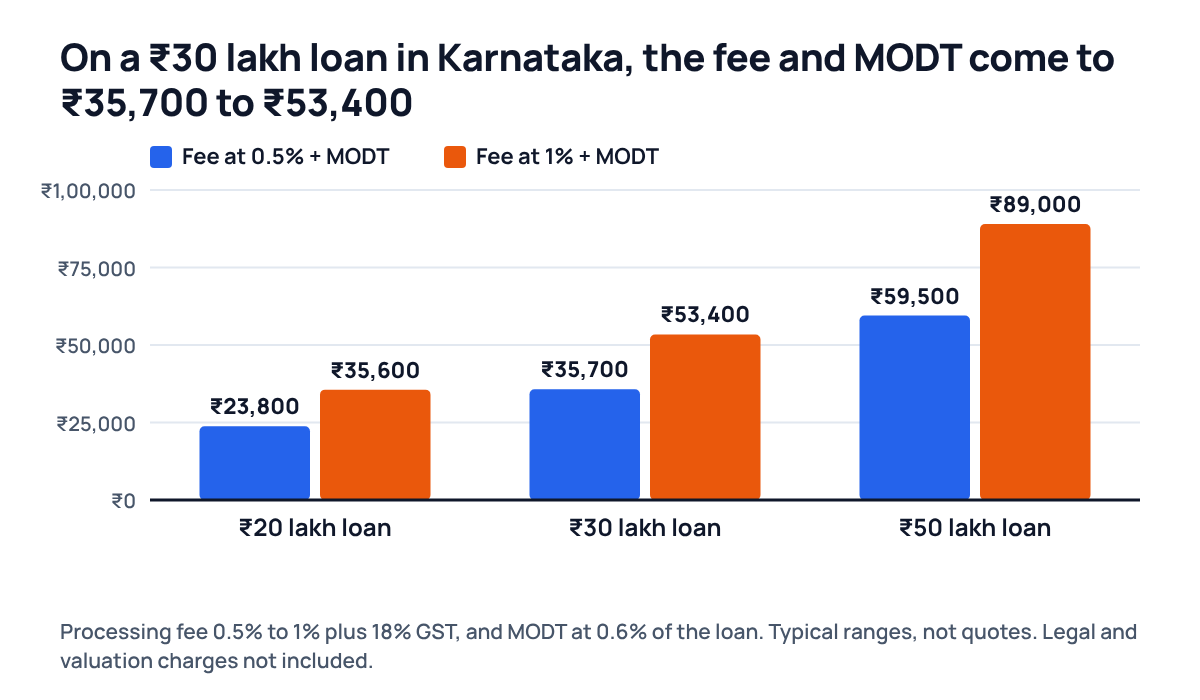
Ask for these two lines in writing before you pay for the valuation.
Apply for a loan against property: the steps
To apply for a loan against property, work in this order. It saves the most calls.
- Check your score and your income limit. A lender caps the loan at the lower of the property limit and the income limit, as the pillar post shows. The EMI calculator gives you the monthly figure.
- Pull the property papers first. The final e-khata, a fresh EC, the tax receipt and the title chain. If one is wrong, fix it before you apply.
- Scan everything, with each paper as one clean file. Scans are enough to apply, and Tata Capital says originals follow.
- Apply with two or three lenders, not ten. Each application leaves an enquiry on your report.
- Expect a valuation and a legal check on the property. This is where a missing paper surfaces.
- Read the sanction letter for the rate, the fee, the prepayment terms and what you were charged for the paperwork.
- Hand over the originals and sign. The lender registers its charge, and the loan is disbursed.
What I'd do this week
- Make one folder with three sub-folders: who you are, what you earn, what you own.
- Carry the longest version of each list: 6 months of slips, 12 months of statements, 2 years of Form 16, 3 years of ITR and financials.
- Download a fresh EC and the final e-khata before anything else.
- Ask every lender for its current list, in writing, for your type of property and your type of income.
- Ask which route you're on if you're self-employed: ITR or bank statement assessment.
- Get the fee and the MODT in writing before you pay for a valuation.
FAQ
What are the documents required for loan against property? Three piles: identity and address (PAN, photo ID, address proof), income proof (slips, statements and Form 16 for salaried people, ITR and financials for self-employed people) and property papers (title deed, sale deed, tax receipt, approved plan and encumbrance certificate). Lists differ by lender.
How do I apply for a loan against property? Check your score and income limit, gather the property papers, scan everything and apply with two or three lenders. Expect a valuation and a legal check, then read the sanction letter before you sign. Originals of the property papers are needed before disbursal.
Do I need an ITR to get a loan against property? Usually, if you're self-employed. Bajaj asks for the latest ITR, and Tata Capital lists it too, though its FAQ says it may not be mandatory subject to eligibility. HDFC Bank's page names certified financial statements for three years. Ask your lender which route applies to you.
Is Aadhaar mandatory for a loan against property? Not at the two lenders that say. Bajaj calls Aadhaar optional, and Tata Capital says it isn't strictly required if you have one valid photo ID and one address proof.
Can I apply with scanned copies? For the first application, yes, according to Tata Capital. Original property documents are required to complete processing and disbursement.
What property documents do banks need in Bangalore? The lender pages I read list the title deed and chain, sale deed, latest tax receipt, approved plan and occupancy certificate. For Bengaluru I'd add a final e-khata in your name and a fresh encumbrance certificate, because a B-khata or an old mortgage on the EC stalls files.
Not sure your property papers will clear a lender? Talk to an advisor (free, WhatsApp) and send us the list. We'll tell you what's missing before you apply. GoVitt compares 50+ banks and charges you 0% commission.
Document lists are as printed on the Tata Capital, Bajaj Housing Finance and HDFC Bank pages read on 6 November 2026, and are paraphrased. I did not read SBI's or ICICI's lists for this post. Bajaj's page gives two different numbers for bank statements, and both are shown. The Bengaluru papers come from my earlier posts, not from the lenders' pages. The cost table uses typical ranges: a processing fee of 0.5% to 1% plus 18% GST, and MODT of 0.5% stamp duty plus about 0.1% registration, which are not quotes. Legal and valuation charges are left out. Your lender may ask for more. Confirm every document and every charge with the lender in writing. This is general information, not legal advice.
Ready to take the next step?
Find out your loan options and check your eligibility with GoVitt today.