
On 7 October, RBI raised the repo rate by 0.25% to 5.50%, its first hike in nearly four years. That much you know. What you didn't know until Wednesday was what the six people who made that call actually think comes next.
The RBI MPC minutes for October 2026 came out on 21 October. They show all six members voted for the hike. They also show most of them expect to do more, but not too fast.
Here's what each member said, what markets now expect on 4 December, and what each outcome does to your EMI.
See your real payoff date in 60 seconds
Banks calculate remaining EMIs by simple subtraction. See your actual payoff date and discover how much interest a balance transfer can save.
The one paragraph worth reading
If you read nothing else from the minutes, read Deputy Governor Poonam Gupta:
"It is conceivable that a further increase in the policy rate might be needed to keep inflation low and inflationary expectations anchored."
Put that next to what Governor Sanjay Malhotra signalled: rate cuts are off the table for now, and the next move can only be a hike or a pause. RBI's own resolution says the same thing in plain words: policy action ahead "can only be a rate hike or a pause."
So December is not a question of cut or hike. It's hike or wait.
Who said what
| Member | Role | Repo hike | Stance | What they flagged |
|---|---|---|---|---|
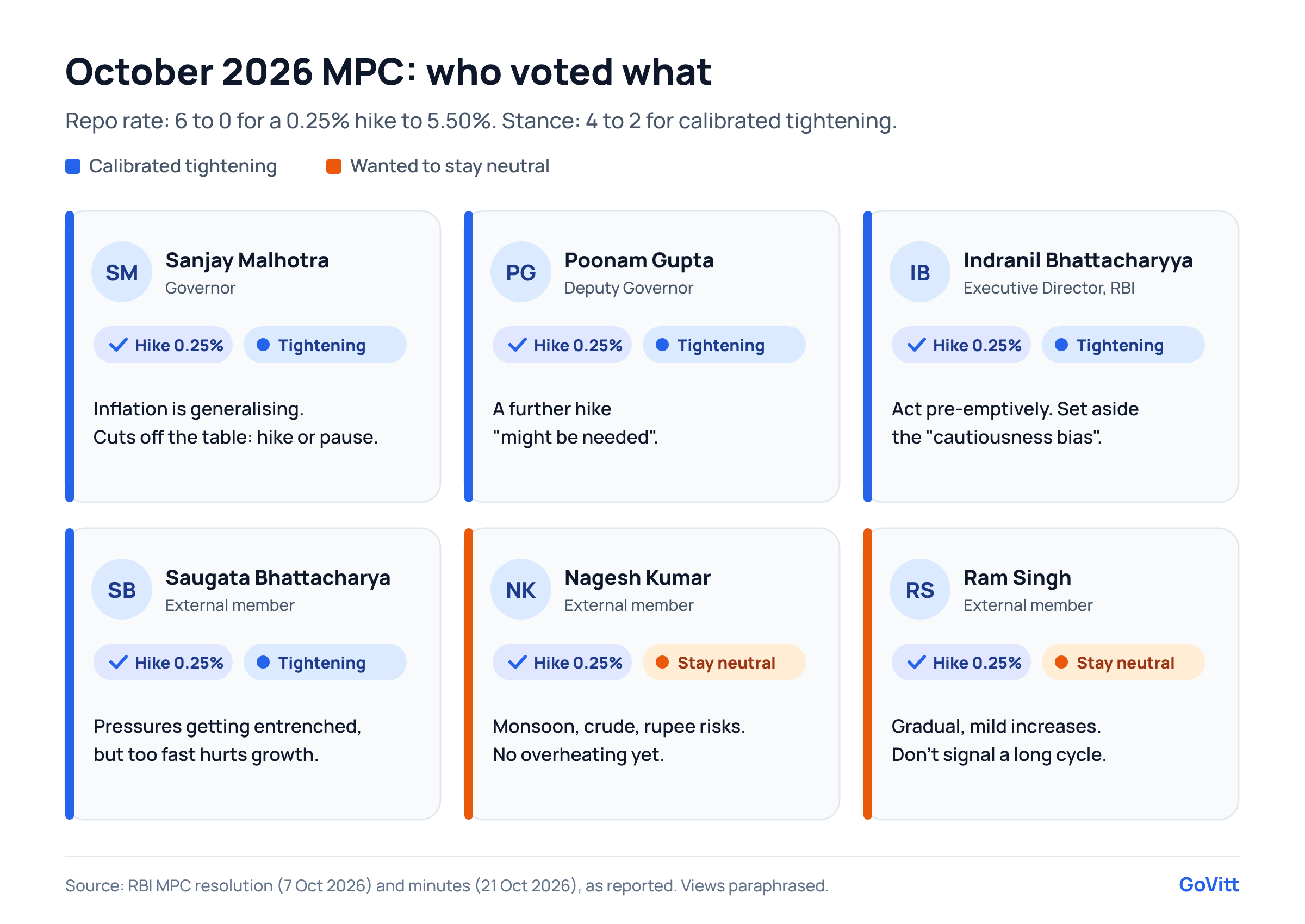
| Sanjay Malhotra | Governor | Yes | Calibrated tightening | "Increasing signs of generalisation of inflation" |
| Poonam Gupta | Deputy Governor | Yes | Calibrated tightening | A further hike "might be needed" |
| Indranil Bhattacharyya | Executive Director, RBI | Yes | Calibrated tightening | Act pre-emptively, set aside the "cautiousness bias" |
| Saugata Bhattacharya | External member | Yes | Calibrated tightening | Price pressures getting entrenched, but too fast a rise "risks constricting growth" |
| Nagesh Kumar | External member | Yes | Wanted neutral | Weak monsoon, crude, rupee; no sign of overheating yet |
| Ram Singh | External member | Yes | Wanted neutral | Prefers gradual, mild increases; warns against signalling a long cycle |
The vote on the rate was 6 to 0. The vote on the stance was 4 to 2. That split matters: two of the six think the new "calibrated tightening" stance promises more hikes than the data justifies today.
Why they hiked
The minutes point to three things:
- Inflation is spreading. In August, 37% of the items in the consumer price basket had inflation above 4%, up from 20% in March. That's what the Governor means by "generalisation".
- Supply shocks are feeding through. Higher crude prices and a weak monsoon pushed up food and fuel, and members worry about "second round effects" on everything else.
- Growth can take it. Members described growth as resilient, with strong demand and credit growth.
Since the meeting, September retail inflation came in at 5.54%, getting close to RBI's 6% upper limit.
RBI's own numbers from the October policy show where it thinks inflation is heading:
| Period | RBI's inflation projection |
|---|---|
| July to September 2026 | 4.9% |
| October to December 2026 | 6.0% |
| January to March 2027 | 5.7% |
| Full year 2026-27 | 5.2% |
| April to June 2027 | 5.6% |
A projection of 6.0% for this quarter, right at the top of RBI's tolerance band, is the single strongest argument for another hike.
What markets expect for 4 December
The next MPC meeting runs 2 to 4 December, with the decision on 4 December. As reported on the day the minutes came out:
- Barclays expects two more hikes in this cycle
- Goldman Sachs expects at least three more, spread from December 2026 to June 2027
- HSBC expects a bigger 0.50% hike in December
- Markets are pricing in a little over 1% of hikes over the next 12 months
My read: another 0.25% in December is the base case. The minutes don't support a big jump, given what Saugata Bhattacharya and Ram Singh said about growth and a long cycle. A pause is possible only if October inflation, due in mid-November, comes in clearly softer.
That's an opinion, not a forecast I'd bet your budget on. So plan for the range, not one number.
What December could do to your EMI
Say you have ₹50 lakh outstanding with 20 years left. Before October you paid 8.00%. After the October hike you pay 8.25%, so your EMI is ₹42,603.
| What happens | Your rate | EMI | Extra a month vs now | If the bank stretches tenure instead |
|---|---|---|---|---|
| No change in December | 8.25% | ₹42,603 | None | None |
| 0.25% hike | 8.50% | ₹43,391 | ₹788 | About 12 months longer |
| 0.50% hike | 8.75% | ₹44,186 | ₹1,582 | About 27 months longer |
| 1% over the next 12 months | 9.25% | ₹45,793 | ₹3,190 | About 66 months longer |
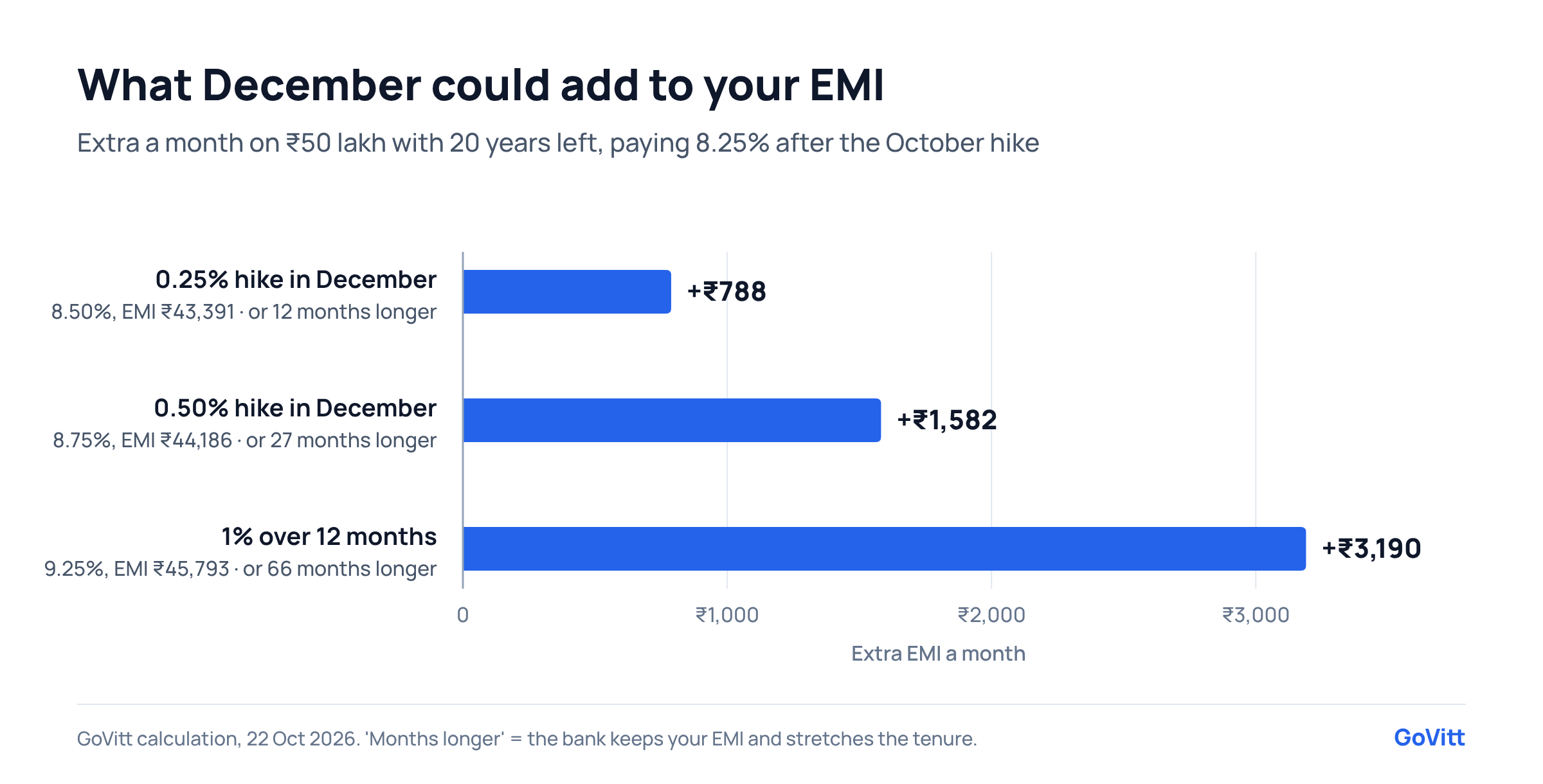
Look at the last column. That's what happens if your bank keeps your EMI the same and quietly extends your loan instead. Many banks do this by default.
On a 0.25% hike, a higher EMI costs you about ₹1.89 lakh more over the loan. A longer tenure costs about ₹5.17 lakh. On a full 1% cycle, the gap is ₹7.66 lakh against ₹28.15 lakh. Same hikes, very different bills.
When you'll actually feel it
- Repo-linked loans (most bank home loans since October 2019): banks moved their benchmark rates on 8 October. Your EMI changes on your next reset date, which comes at least every three months.
- MCLR loans: only at your loan's reset date, often once a year. I explained this in SBI raised its MCLR on 15 October.
- Housing finance companies: your rate is tied to the lender's own prime rate, which moves when the lender decides.
What I'd do before 4 December
- Find your reset date. It's in your loan statement or sanction letter.
- Tell your bank in writing: raise my EMI, don't stretch my tenure. RBI rules let you choose. The table above shows why.
- Prepay if you have spare cash. There's no charge on a floating rate home loan, and every rupee you prepay now stops earning interest at the higher rate.
- Check your spread. If your bank charges new borrowers less than you, ask your bank to reprice. A conversion fee of a few thousand rupees beats any hike.
- If you're 0.5% or more above the best rates, price a transfer now. It won't protect you from the next hike, since a floating rate still moves with repo. But you'd be moving from a lower base. Compare today's rates on our rate comparison page.
- Don't panic into a fixed rate. Fixed rates are higher today, and fixed loans usually carry charges if you prepay or switch.
The October hike and what to do about it are covered in RBI just raised the repo rate to 5.50%. If you want to see how the hiking cycle was expected to play out before it began, read RBI may hike in October and again in December.
If you're buying a home in the next few months
The hike changes your budget more than your decision. Here's how I'd adjust:
- Budget at 8.75%, not today's rate. On ₹50 lakh over 20 years, that's ₹44,186 a month. If that EMI is comfortable, a December hike won't hurt you.
- Compare lenders on the spread, not the headline. Your spread over the benchmark stays with you for the life of the loan. The repo part moves for everyone.
- Keep a buffer. Banks will lend you up to about 50% of your take-home pay as EMI. With rates still rising, I'd stay nearer 40%.
- Don't delay a good deal to wait for cuts. The minutes say cuts are off the table for now. Waiting is a bet against RBI's own signal.
What could make RBI pause instead
The minutes leave a pause on the table. These are the signals that would make one more likely:
- Softer October inflation, due in mid-November, especially if food prices ease
- Crude prices falling back from their recent highs
- Growth slowing faster than expected, which is the risk Saugata Bhattacharya and Ram Singh flagged
If none of these show up before 4 December, expect another hike.
Dates to watch
| Date | What |
|---|---|
| Mid-November 2026 | October retail inflation |
| 2 to 4 December 2026 | MPC meeting; decision on 4 December |
| About two weeks later | Minutes of the December meeting |
Run your own numbers
Put your loan amount, current rate and years left into our EMI calculator and try 8.50%, 8.75% and 9.25%. You'll see your own version of the table above in a minute. To see your real payoff date after the October hike, use the Payoff & Transfer Calculator.
FAQ
What do the RBI MPC minutes for October 2026 say? All six members voted to raise the repo rate by 0.25% to 5.50%. Four voted to change the stance to "calibrated tightening", while Nagesh Kumar and Ram Singh preferred to keep it neutral. Several members flagged that inflation is spreading, and Deputy Governor Poonam Gupta said a further hike "might be needed".
Will RBI hike the repo rate in December 2026? Nobody knows yet. The minutes rule out cuts in the near term and say the next move is a hike or a pause. As of 21 October, Barclays, Goldman Sachs and HSBC all expected more hikes, and markets were pricing in a little over 1% over 12 months. The decision is on 4 December.
What will my EMI be if the repo rate rises again in December? On ₹50 lakh with 20 years left at 8.25%, a 0.25% hike adds about ₹788 a month and a 0.50% hike adds about ₹1,582, if your EMI rises rather than your tenure.
When is the next RBI MPC meeting? 2 to 4 December 2026, with the decision announced on 4 December.
Should I switch to a fixed rate home loan before December? Usually not in a hurry. Fixed rates are higher than floating rates today, and fixed loans often carry prepayment or switching charges. A fixed rate makes sense only if you expect a long hiking cycle and won't prepay during the fixed period.
Based on the minutes of the MPC meeting of 5 to 7 October 2026 (released 21 October 2026) as reported, and RBI's October 2026 policy resolution. Market expectations are as reported on 21 October 2026 and will change. EMIs use the standard monthly reducing balance method.
Ready to take the next step?
Find out your loan options and check your eligibility with GoVitt today.