
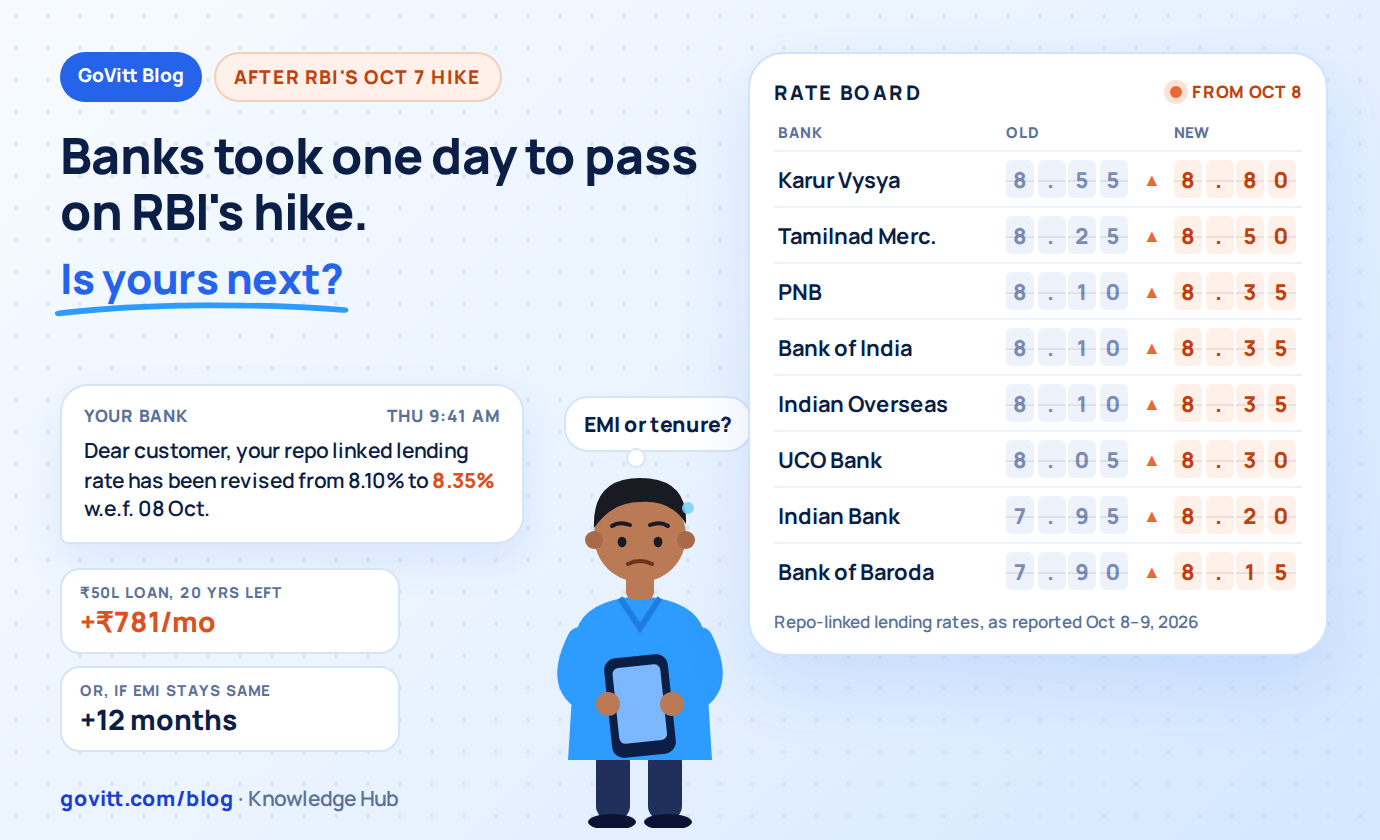
RBI raised the repo rate on Wednesday morning. By Thursday, a friend who has his home loan with a public sector bank forwarded me an SMS. Two lines, very polite, telling him his "repo linked lending rate has been revised."
He wanted to know if that meant his EMI was going up.
Probably, yes. Or his loan was about to get longer. The SMS didn't say which, and that's the part I want to talk about.
See your real payoff date in 60 seconds
Banks calculate remaining EMIs by simple subtraction. See your actual payoff date and discover how much interest a balance transfer can save.
Who's raised rates so far
Within a day or two of RBI's hike, several banks increased their repo-linked lending rate by exactly 0.25%, the same as the repo hike. Here's who had announced by October 9, going by reports in Business Standard and ETV Bharat.
| Bank | Old rate | New rate |
|---|---|---|
| Punjab National Bank | 8.10% | 8.35% |
| Bank of India | 8.10% | 8.35% |
| Indian Overseas Bank | 8.10% | 8.35% |
| UCO Bank | 8.05% | 8.30% |
| Indian Bank | 7.95% | 8.20% |
| Bank of Baroda | 7.90% | 8.15% |
| Tamilnad Mercantile Bank | 8.25% | 8.50% |
| Karur Vysya Bank | 8.55% | 8.80% |
Most of these took effect from October 8.
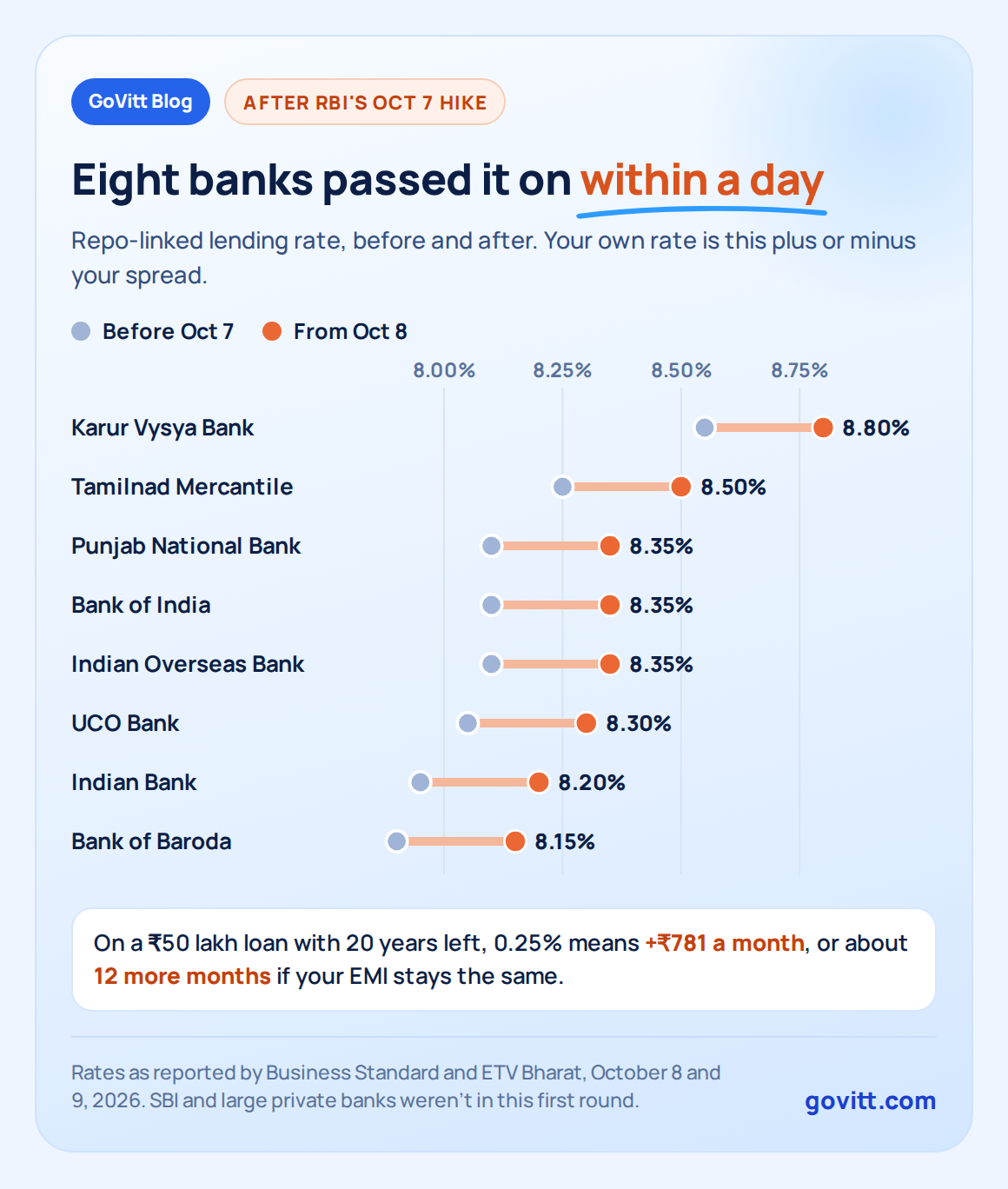
All eight passed on the full 0.25% within a day or two. More will follow.
SBI and the big private banks weren't in this first round of announcements. That doesn't mean they won't. If your loan is with one of them, keep an eye on your email and the bank's website over the next couple of weeks.
Wait, isn't 8.35% my interest rate?
Not exactly, and this confuses a lot of people.
The rate in that table is the bank's benchmark. Your actual home loan rate is that benchmark plus or minus a spread the bank fixed for you when it sanctioned the loan, based mostly on your credit score and profile. So someone with a great CIBIL score at PNB might be paying a bit less than 8.35%, and someone else at the same bank might be paying more.
What matters is this: your spread doesn't change. The benchmark went up by 0.25%, so your rate goes up by 0.25% too. Whatever you were paying on Tuesday, add a quarter percent.
When will you actually feel it?
If your loan is linked to the repo rate, the new rate kicks in from your next reset date. RBI requires these loans to reset at least once every three months, so at most you have till early January. Some banks reset monthly, so for some people it's next month.
If your loan is on MCLR, nothing happens today. It changes on your reset date, usually once a year, by however much the bank's MCLR has moved by then. Banks tend to be quick to move MCLR up and slow to bring it down, so if you're still on MCLR, this is a good moment to ask your bank about switching to the repo-linked rate.
If you're with a housing finance company, it moves when the company changes its own benchmark rate, which can happen any day.
What a 0.25% hike does, and what 0.75% would do
For a ₹50 lakh loan with 20 years left at 8%:
| Repo goes up by | Your EMI goes up by | Or your loan runs longer by |
|---|---|---|
| 0.25% (what happened this week) | ₹781 a month | about 12 months |
| 0.50% (if RBI hikes again in December) | ₹1,569 a month | about 26 months |
| 0.75% (repo at 6%, SBI Research's view) | ₹2,364 a month | about 43 months |
That last row isn't me being dramatic. SBI's own research team said this week that it expects RBI to raise rates by another 0.50% by December, taking the repo rate to 6%, with inflation possibly peaking near 6.8% in November. Not everyone agrees, but it's worth planning for.
Look at the right column again. If rates go up 0.75% and your bank just keeps stretching your tenure, a 20 year loan becomes almost 23 and a half years. Over the life of the loan, that costs about ₹17.85 lakh in extra interest. Raising the EMI instead costs about ₹5.67 lakh. Same hikes, a ₹12 lakh difference, depending on what you tell your bank.
The one message I'd send my bank this week
Most borrowers never tell the bank what they want, and the bank picks the option that's least noticeable, which is a longer tenure. RBI's rules on floating rate loans let you choose. So choose.
Something as simple as this works, by email or through the bank's app or website:
Subject: Home loan [account number], choice on rate revision
Dear Sir or Madam, I understand my home loan rate will be revised following the recent change in the repo rate. I would like my EMI to be increased so that my loan tenure stays the same. Please confirm the revised EMI and send me an updated repayment schedule. Regards, [name, phone number]
That's it. Keep the reply. If your EMI is already tight and you can't increase it right now, ask for a mix: a smaller EMI increase and a smaller tenure increase. You can always prepay later to pull the tenure back.
If you're paying 8.75% or more
Then the gap between you and the best rates in the market didn't change this week. But it's still there, and you're now paying it on top of a higher base.
Someone at 8.75% after this hike is paying about ₹3,900 a month more on ₹50 lakh than someone at 7.50%. If your rate is well above what your bank offers new customers, ask them to match it first. Many will, for a small fee. If they won't, a balance transfer may be worth it. I've done the full maths, charges included, in this post, and the step by step process is here.
One thing though. When rates start rising, lenders often get less generous with the spreads they offer new customers. If you were thinking about switching anyway, sooner is usually better than later.
Quick checklist for this week
Find your loan statement and note your current rate, whether it's repo-linked or MCLR, and your reset date.
Check your bank's website for its new repo-linked lending rate.
Send the message above, asking for a higher EMI rather than a longer tenure.
If you're on MCLR, ask about moving to the repo-linked rate.
If your rate is above 8.75% after this hike, check what other lenders would offer you.
And if you have any spare cash sitting idle, prepaying a bit now saves you interest at the new, higher rate.
Want us to check your loan?
WhatsApp your outstanding amount, current rate, bank and years left to +91 70194 17854, and we'll tell you what this week's hike means for your EMI or tenure, and whether a better rate is available to you. Or run your numbers on our free Payoff & Transfer Calculator. GoVitt works with 50+ banks and housing finance companies, and we don't charge you any commission.
For the full story on RBI's decision itself, read what RBI announced on October 7.
Bank rates are as reported on October 8 and 9, 2026, and may change. Your actual rate is your bank's benchmark plus your own spread. EMI figures assume a ₹50 lakh loan with 20 years left at 8% before the hike, monthly reducing balance and full pass-through. SBI Research's projection is a forecast, not a certainty.
Questions people usually ask
Which banks have increased home loan rates after the RBI hike? By October 9, 2026, Punjab National Bank, Bank of India, Indian Overseas Bank, UCO Bank, Indian Bank, Bank of Baroda, Tamilnad Mercantile Bank and Karur Vysya Bank had raised their repo-linked lending rates by 0.25%, mostly effective October 8. More banks are expected to follow.
Has SBI increased its home loan rate? SBI wasn't among the first banks reported to have raised rates on October 8 and 9. Check SBI's website or your loan account for the latest, since banks usually announce changes within a few days to a couple of weeks of an RBI hike.
Is the bank's repo-linked lending rate my home loan rate? Not exactly. Your rate is the bank's repo-linked lending rate plus or minus the spread set for you at sanction. The spread stays the same, so a 0.25% rise in the benchmark raises your rate by 0.25%.
When will my EMI change after the hike? On repo-linked loans, from your next reset date, which by RBI rules comes at least once every three months. MCLR loans change on their own reset date, usually once a year.
How do I stop my bank from increasing my tenure instead of my EMI? Write to your bank before the reset and ask for the EMI to be increased with the tenure unchanged, and ask for a revised repayment schedule. RBI's rules on floating rate loans let you choose between a higher EMI, a longer tenure or a mix.
Will home loan rates go up again? Possibly. RBI changed its stance to "calibrated tightening," and SBI Research expects the repo rate to reach 6% by December 2026. Others expect a smaller rise. Plan your budget for at least one more hike.
Ready to take the next step?
Find out your loan options and check your eligibility with GoVitt today.