
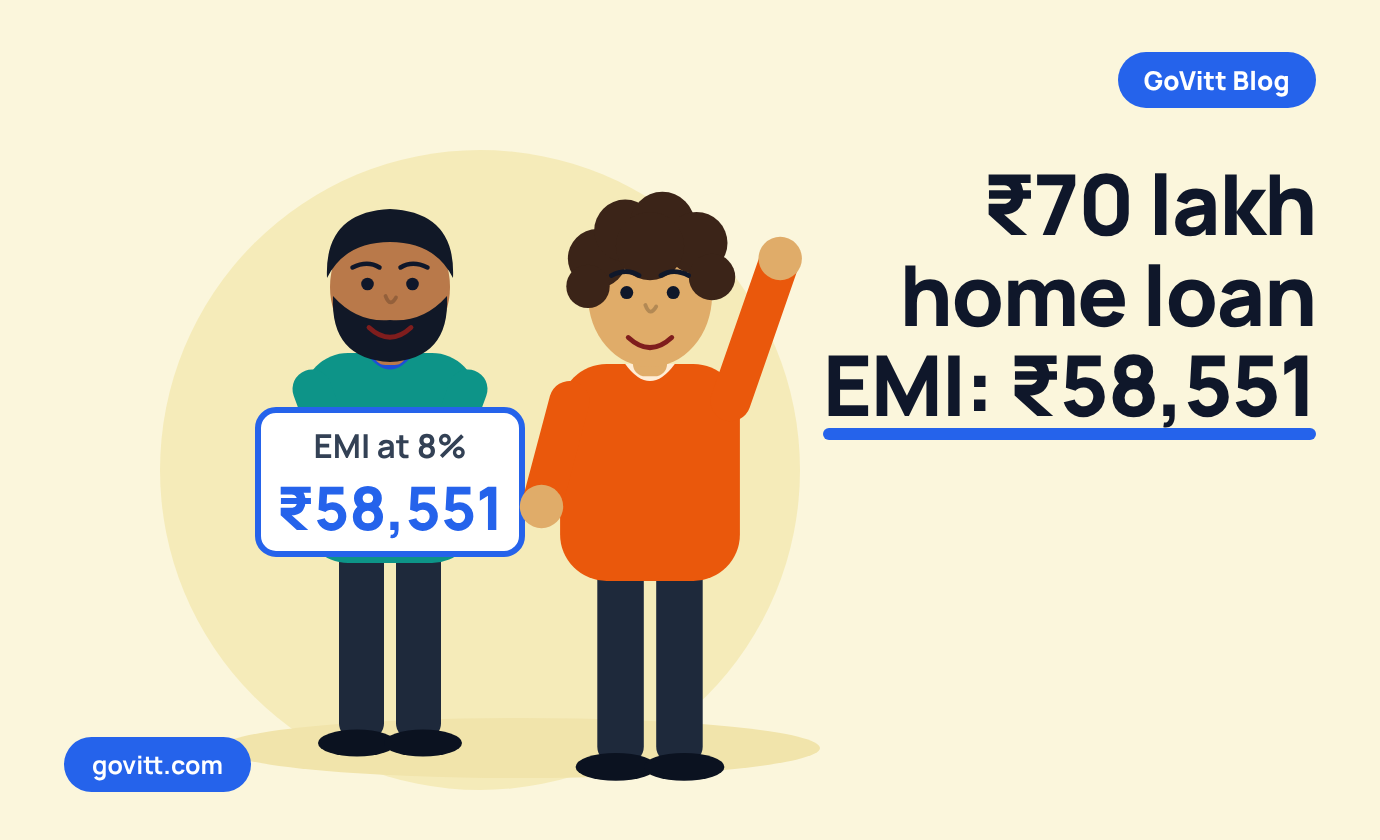
The ₹70 lakh home loan EMI is ₹58,551 a month over 20 years at 8%. Stretch it to 30 years and the EMI falls to ₹51,364, but your total interest jumps from ₹70.52 lakh to ₹114.91 lakh. That's the whole trade in two numbers.
₹70 lakh sits inside RBI's 80% band, which runs up to ₹75 lakh. So the bank can lend ₹70 lakh against a flat worth ₹87.5 lakh, and you bring ₹17.5 lakh of your own money before stamp duty. A ₹75 lakh loan needs ₹18.75 lakh. Your own money rises by ₹1.25 lakh for ₹5 lakh more of loan, and the cap drops for anything above that.
For context, the lowest floors I read on lenders' own pages are 7.35% (Union Bank of India, on its sheet effective 21 November 2026), 7.40% (Bank of Baroda), 7.45% (Punjab National Bank) and 7.50% (Canara Bank on loans between ₹50 lakh and ₹1 crore), after RBI raised the repo rate to 5.50% on 7 October 2026. At 7.50%, the 20 year EMI on ₹70 lakh is ₹56,392. Most good profiles will land between 7.50% and 9.00%. Detail: Union Bank, Bank of Baroda, PNB.
See your real payoff date in 60 seconds
Banks calculate remaining EMIs by simple subtraction. See your actual payoff date and discover how much interest a balance transfer can save.
Quick answer: ₹70 lakh home loan EMI for 20 years
| Interest rate | EMI | Total interest | Total you pay back |
|---|---|---|---|
| 7.50% | ₹56,392 | ₹65.34 lakh | ₹135.34 lakh |
| 8.00% | ₹58,551 | ₹70.52 lakh | ₹140.52 lakh |
| 8.50% | ₹60,748 | ₹75.80 lakh | ₹145.80 lakh |
| 9.00% | ₹62,981 | ₹81.15 lakh | ₹151.15 lakh |
At 8% you borrow ₹70 lakh and pay the bank ₹70.52 lakh on top. The interest is a little more than the loan itself.
₹70 lakh home loan EMI at every rate and tenure
| Rate | 10 years | 15 years | 20 years | 25 years | 30 years |
|---|---|---|---|---|---|
| 7.00% | ₹81,276 | ₹62,918 | ₹54,271 | ₹49,475 | ₹46,571 |
| 7.50% | ₹83,091 | ₹64,891 | ₹56,392 | ₹51,729 | ₹48,945 |
| 8.00% | ₹84,929 | ₹66,896 | ₹58,551 | ₹54,027 | ₹51,364 |
| 8.50% | ₹86,790 | ₹68,932 | ₹60,748 | ₹56,366 | ₹53,824 |
| 9.00% | ₹88,673 | ₹70,999 | ₹62,981 | ₹58,744 | ₹56,324 |
| 9.50% | ₹90,578 | ₹73,096 | ₹65,249 | ₹61,159 | ₹58,860 |
| 10.00% | ₹92,506 | ₹75,222 | ₹67,552 | ₹63,609 | ₹61,430 |
Each 1% on the rate between 7% and 9% moves the 20 year EMI by roughly ₹4,280 to ₹4,430 a month. Going from 8% to 9% costs ₹4,430 a month, or ₹10.63 lakh over the loan. A 0.50% gap between two offers is worth ₹2,197 a month, or ₹5.27 lakh.
Total interest on ₹70 lakh at every rate and tenure
| Rate | 10 years | 15 years | 20 years | 25 years | 30 years |
|---|---|---|---|---|---|
| 7.00% | ₹27.53 lakh | ₹43.25 lakh | ₹60.25 lakh | ₹78.42 lakh | ₹97.66 lakh |
| 7.50% | ₹29.71 lakh | ₹46.80 lakh | ₹65.34 lakh | ₹85.19 lakh | ₹106.20 lakh |
| 8.00% | ₹31.91 lakh | ₹50.41 lakh | ₹70.52 lakh | ₹92.08 lakh | ₹114.91 lakh |
| 8.50% | ₹34.15 lakh | ₹54.08 lakh | ₹75.80 lakh | ₹99.10 lakh | ₹123.77 lakh |
| 9.00% | ₹36.41 lakh | ₹57.80 lakh | ₹81.15 lakh | ₹106.23 lakh | ₹132.77 lakh |
| 9.50% | ₹38.69 lakh | ₹61.57 lakh | ₹86.60 lakh | ₹113.48 lakh | ₹141.90 lakh |
| 10.00% | ₹41.01 lakh | ₹65.40 lakh | ₹92.12 lakh | ₹120.83 lakh | ₹151.15 lakh |
Look at the 30 year column at 8%. You pay ₹114.91 lakh in interest on a ₹70 lakh loan, so you hand the bank ₹1.85 crore in all. The EMI is the number everyone checks. The total is the one that decides what the house costs you, and I've written more on that in everyone checks the EMI, almost nobody checks the number that matters.
Where ₹70 lakh sits between the other loan sizes
At 8% over 20 years, each ₹10 lakh of loan adds about ₹8,364 to the EMI:
| Loan | EMI at 8%, 20 years | Where to read more |
|---|---|---|
| ₹50 lakh | ₹41,822 | ₹50 lakh home loan EMI |
| ₹60 lakh | ₹50,186 | ₹60 lakh home loan EMI |
| ₹70 lakh | ₹58,551 | This page |
| ₹75 lakh | ₹62,733 | ₹75 lakh home loan EMI |
| ₹80 lakh | ₹66,915 | ₹80 lakh home loan EMI |
For any other amount, use the home loan EMI per lakh table.
What a published rate grid does to a ₹70 lakh EMI
Banks don't quote one rate. They publish a grid and your credit profile puts you on a row. Canara Bank's own page, read on 21 November 2026, has a grid for loans above ₹50 lakh up to ₹1 crore, which is where ₹70 lakh falls. The RLLR is 8.25% in every row. The page labels the rows CS:1 to CS:6 and doesn't map them to CIBIL scores, so I can't tell you which row is yours.
| Canara row (loan above ₹50 lakh up to ₹1 crore) | Rate for other borrowers | EMI, 20 years | Rate for women borrowers | EMI, 20 years |
|---|---|---|---|---|
| CS:1 | 7.50% | ₹56,392 | 7.45% | ₹56,178 |
| CS:2 | 7.60% | ₹56,820 | 7.55% | ₹56,606 |
| CS:3 and new to credit | 7.90% | ₹58,116 | 7.85% | ₹57,899 |
| CS:4 | 8.80% | ₹62,083 | 8.75% | ₹61,860 |
| CS:5 and CS:6 | 10.20% | ₹68,482 | 10.15% | ₹68,249 |
On the same ₹70 lakh, the top row and the bottom row are ₹12,090 a month apart. That is more than the gap between a 20 year and a 30 year tenure (₹7,187). The page also takes 0.05% off for takeover proposals and for some salaried groups, with a floor of 7.40% after all concessions. If you're buying, your row matters more than the bank's logo, which is the point of how a credit score moves your rate. If you want the minimum score banks accept, see minimum CIBIL score for a home loan.
Salary required for a ₹70 lakh home loan
Banks start with your take-home pay, not the loan amount. The test is FOIR (fixed obligations to income ratio), the share of your net income that goes into EMIs. Most salaried borrowers are allowed somewhere between 40% and 55%, and higher earners get more room.
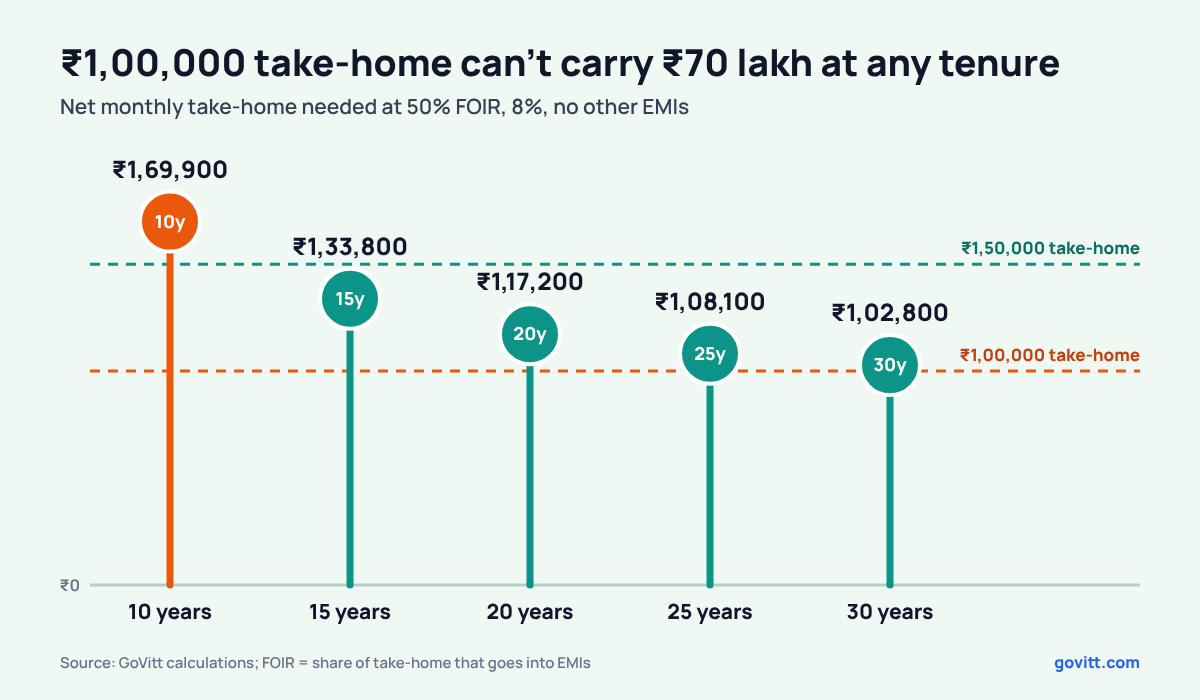
At 50% FOIR and no other loans, here's the net monthly take-home you'd need:
| Rate | 10 years | 15 years | 20 years | 25 years | 30 years |
|---|---|---|---|---|---|
| 7.50% | ₹1,66,200 | ₹1,29,800 | ₹1,12,800 | ₹1,03,500 | ₹97,900 |
| 8.00% | ₹1,69,900 | ₹1,33,800 | ₹1,17,200 | ₹1,08,100 | ₹1,02,800 |
| 8.50% | ₹1,73,600 | ₹1,37,900 | ₹1,21,500 | ₹1,12,800 | ₹1,07,700 |
Two things change this a lot:
- Existing EMIs. A ₹10,000 car loan EMI lifts the take-home needed for a 20 year loan at 8% from ₹1,17,200 to ₹1,37,200. Every ₹5,000 of existing EMI cuts the 20 year loan you qualify for by about ₹6 lakh.
- A co-applicant. Banks add a spouse's income, so two take-home pays of about ₹58,600 can qualify where one can't.
A bank saying yes at 50% doesn't make 50% a good idea. My own ceiling is 35% to 40% of take-home, so one bad month doesn't turn into a missed EMI. On the ₹58,551 EMI, 40% means a take-home of ₹1,46,400 and 35% means ₹1,67,300.
At 8%, a take-home of ₹1,00,000 supports about ₹59.8 lakh over 20 years or ₹68.1 lakh over 30 years at 50% FOIR, with no other EMIs. So ₹70 lakh on ₹1,00,000 doesn't work even on the longest tenure. A take-home of ₹1,50,000 supports about ₹89.7 lakh over 20 years or ₹102.2 lakh over 30 years, so ₹70 lakh fits there with room to spare.
The full method is in how much home loan can I actually get on my salary, and the bank by bank views are in home loan on ₹1 lakh salary and home loan on ₹50,000 salary.
20, 25 or 30 years? What each one really costs
At 8%:
| Switch | EMI drops by | Extra interest you pay |
|---|---|---|
| 10 years to 20 years | ₹26,378 a month | ₹38.61 lakh |
| 20 years to 25 years | ₹4,524 a month | ₹21.56 lakh |
| 20 years to 30 years | ₹7,187 a month | ₹44.39 lakh |
Going from 20 to 30 years saves ₹7,187 a month and costs ₹44.39 lakh. If you can afford the 20 year EMI, that's a bad deal.
But there's a smarter use of the long tenure. Take 30 years on paper and pay like it's 20. At 8%, the 30 year EMI is ₹51,364. Add ₹7,187 a month as prepayment and you're paying the 20 year EMI of ₹58,551, so the loan closes in about 20 years and you save ₹44.39 lakh in interest. Banks can't charge you for prepaying a floating rate home loan, so you get the safety of a low required EMI with the cost of a shorter loan. If money gets tight, you drop back to ₹51,364 without asking anyone. I cover that rule in your bank can't charge you for prepaying a floating rate home loan, and whether to cut the EMI or the tenure when you prepay in part-prepaying your home loan.
Smaller amounts work too. On the 30 year loan, ₹5,000 extra closes it in 22 years and 1 month with ₹79.29 lakh of interest. ₹10,000 extra closes it in 18 years with ₹61.99 lakh of interest.
Where your EMI goes: interest first
On a 20 year loan at 8%, the first EMI is mostly interest. In year 1, ₹46,221 of every ₹58,551 EMI is interest and ₹12,330 reduces the loan, which means 78.9% of what you pay goes to the bank. By year 10 the split is ₹33,280 interest and ₹25,271 principal. In year 20 it is ₹2,459 and ₹56,092.
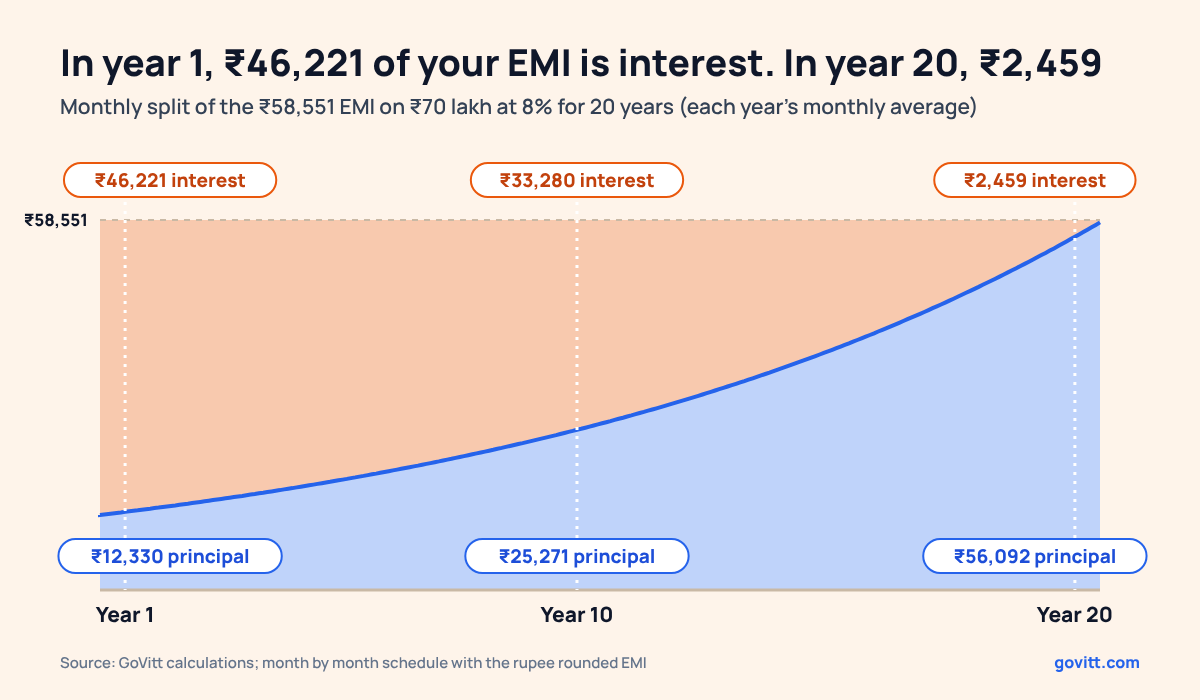
Add it up and the first ten years carry ₹48.52 lakh of the ₹70.52 lakh total interest, which is 69%. That's why a prepayment in year 2 is worth far more than the same amount in year 15, and why a transfer is best done early. I explain when it stops being worth it in how soon can you transfer a home loan.
Why a ₹70 lakh loan needs a ₹87.5 lakh flat
RBI caps what a bank can lend as a share of the property's value. The cap is 90% for loans up to ₹30 lakh, 80% for loans from ₹30 lakh to ₹75 lakh, and 75% above ₹75 lakh. A ₹70 lakh loan sits in the 80% band, so the property must be worth at least ₹87.5 lakh and you must put in at least ₹17.5 lakh. Stamp duty and registration come on top, and banks don't fund those. I list the Karnataka numbers in stamp duty and registration charges in Karnataka.
Here's how it plays out at different property values (RBI's ceilings, and a bank can lend less):
| Property value | Most a bank can lend | Your own money |
|---|---|---|
| ₹75 lakh | ₹60 lakh | ₹15 lakh |
| ₹80 lakh | ₹64 lakh | ₹16 lakh |
| ₹87.5 lakh | ₹70 lakh | ₹17.5 lakh |
| ₹90 lakh | ₹72 lakh | ₹18 lakh |
| ₹93.75 lakh | ₹75 lakh | ₹18.75 lakh |
| ₹1 crore | ₹75 lakh | ₹25 lakh |
| ₹1.1 crore | ₹82.5 lakh | ₹27.5 lakh |
Notice the flat stretch. A flat at ₹93.75 lakh gets you ₹75 lakh. So does a flat at ₹1 crore, because the 80% cap stops at ₹75 lakh and the 75% cap only applies to a loan above it. So for a flat around ₹1 crore, plan on ₹75 lakh at most. At 8% over 20 years that EMI is ₹62,733, which is ₹4,182 more a month than the ₹70 lakh EMI.
What a ₹70 lakh loan costs before the first EMI
The processing fee is the first bill and it differs by lender. These are from each lender's own pages:
| Lender | Processing fee as listed | On ₹70 lakh, with GST |
|---|---|---|
| Canara Bank (read 21 November) | 0.50%, minimum ₹1,500, maximum ₹10,000. Waived until 31 December 2026 | ₹0 now (₹11,800 normally) |
| Punjab National Bank (read 21 November) | 0.35%, minimum ₹2,500, maximum ₹15,000, plus ₹1,350 documentation. Waived until 31 December 2026 | ₹0 now (₹19,293 normally) |
| SBI (two documents, undated) | 0.35%, plus GST. One card shows a minimum of ₹5,000 and a maximum of ₹15,000 for salaried borrowers. Another shows a minimum of ₹2,000 and a maximum of ₹10,000. I couldn't tell which one applies, and SBI's rate page mentions a "50% concession" with no end date | ₹17,700 on the first card, ₹11,800 on the second |
Canara's 0.50% would be ₹35,000 on ₹70 lakh, so its ₹10,000 cap does the work. The waivers end on 31 December, which makes the fee a good thing to ask about if you plan to sign before the year ends. Ask for the fee in writing, and ask which date decides the waiver.
If you already have a ₹70 lakh loan
A word for the other reader. Suppose you owe ₹70 lakh with 20 years left at 8.75%. Your EMI is ₹61,860. A written quote of 7.50% on the same tenure brings it to ₹56,392, which is ₹5,468 a month, or ₹13.12 lakh over the 20 years, before costs.
On ₹70 lakh in Bengaluru I'd budget ₹65,700 to ₹1,00,300 all in. That isn't a published row. I scaled the line items in my balance transfer charges post (a processing fee of ₹15,000 plus GST up to 0.50% with no cap, legal and valuation, MODT stamp duty of 0.5%, registration of about 0.1%, small charges) to ₹70 lakh. Divided by ₹5,468, that's a payback of 13 to 19 months. Under my 24 month rule, that's worth pricing.
What I'd do before applying
- Start from the EMI, not the loan amount. Decide what you can pay without strain, then work back to the loan.
- Check your CIBIL score. At 750 and above you're in the best bands. On ₹70 lakh, a 0.50% gap is worth ₹2,197 a month, or ₹5.27 lakh over 20 years.
- Close small loans first. Every ₹5,000 of existing EMI cuts the 20 year loan you qualify for by about ₹6 lakh.
- Take the longest tenure you're offered, then prepay. A low required EMI costs nothing. A forced high one can cost you a missed payment.
- Compare at least three lenders on the rate and the fee, and get the grid row you'll sit on in writing.
- Mind the ₹75 lakh line when you pick the property. A ₹70 lakh loan needs a flat of ₹87.5 lakh or more and ₹17.5 lakh of your own money. A ₹75 lakh loan needs ₹18.75 lakh.
FAQ
What is the EMI for a ₹70 lakh home loan for 20 years? At 8%, the EMI is ₹58,551 a month. At 7.50% it's ₹56,392, at 8.50% it's ₹60,748, and at 9% it's ₹62,981.
What is the EMI for a ₹70 lakh home loan for 30 years? At 8%, it's ₹51,364 a month, and you'll pay ₹114.91 lakh in interest over the loan. At 7.50% it's ₹48,945 and at 8.50% it's ₹53,824.
What salary is required for a ₹70 lakh home loan? At 8% for 20 years and a 50% FOIR, you'd need about ₹1,17,200 in net monthly take-home with no other loans. Over 30 years it drops to about ₹1,02,800. Existing EMIs push it up, and a co-applicant's income can bring it down.
Can I get a ₹70 lakh home loan on a ₹1.5 lakh salary? Yes, in most cases. At 50% FOIR and 8%, ₹1,50,000 take-home supports about ₹89.7 lakh over 20 years or ₹102.2 lakh over 30 years, with no other EMIs. With a car loan or a card EMI, the figure drops, so get your obligations down first.
How much down payment do I need for a ₹70 lakh home loan? At least 20% of the property value, because RBI's cap for loans between ₹30 lakh and ₹75 lakh is 80%. That means a flat worth ₹87.5 lakh or more and ₹17.5 lakh or more of your own money, plus stamp duty and registration.
Already paying more than you should on a ₹70 lakh loan? Run the Payoff & Transfer Calculator with your outstanding amount, rate and years left. GoVitt compares 50+ banks and charges you 0% commission.
EMIs use the standard monthly reducing balance method and are rounded to the nearest rupee. Salary figures are rounded up to the nearest ₹100. Rate and fee references are from each lender's own pages, read between 21 and 25 November 2026, and one PNB figure and the Bank of Baroda figure came through a summary of a long page. SBI's fee cards are undated. Loan to value figures are RBI's ceilings, and your lender may lend less. The Bengaluru transfer cost is an estimate scaled from GoVitt's charges post. Your actual rate depends on your credit profile and lender. This is general information, not financial or tax advice.
Ready to take the next step?
Find out your loan options and check your eligibility with GoVitt today.