
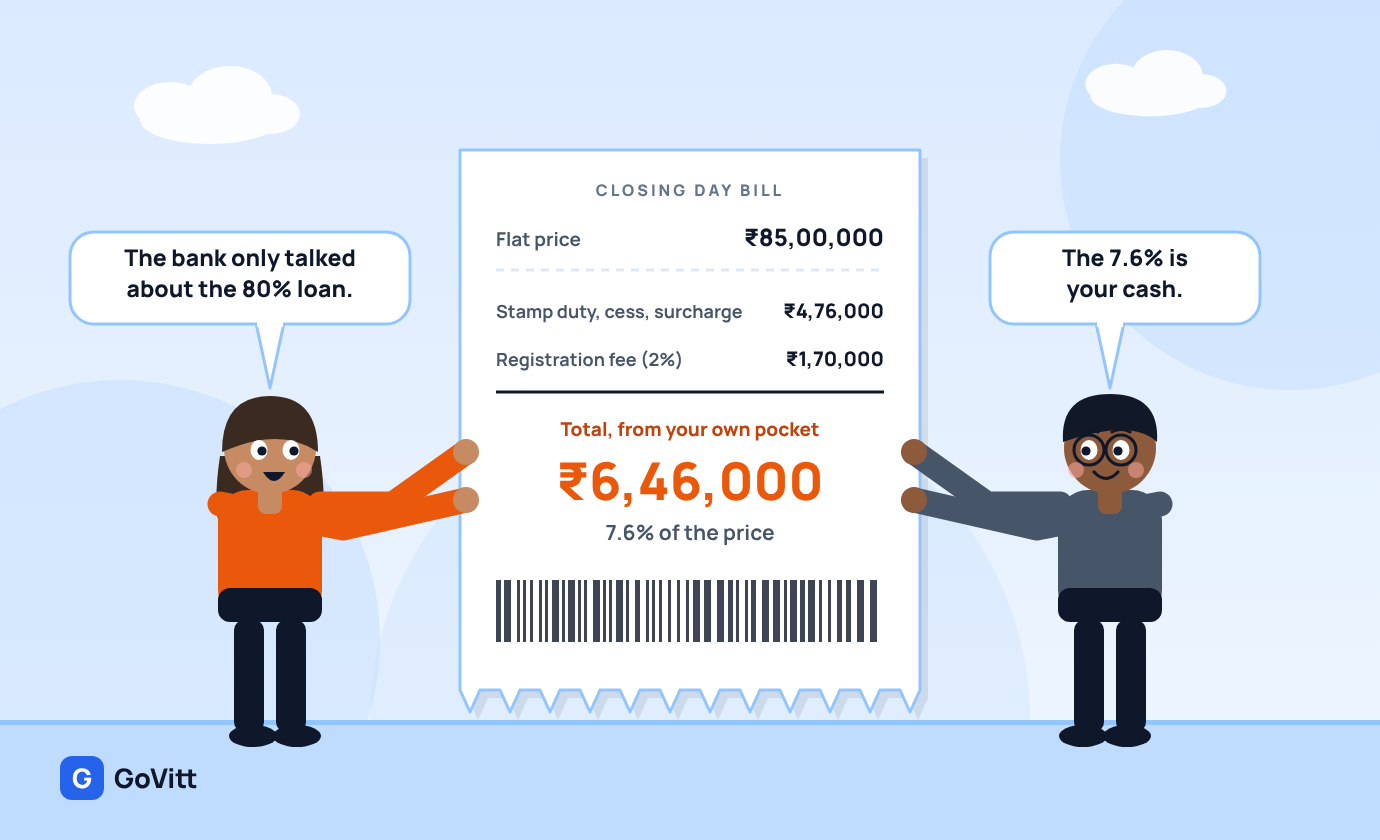
Stamp duty in Karnataka is 2%, 3% or 5% of the property's value depending on the price, with a cess and a surcharge on top, and the registration fee since 31 August 2025 is 2%. On a ₹85 lakh flat in Bengaluru that adds up to ₹6.46 lakh, which is 7.6% of the price. And no bank will lend you that money.
That is the number buyers miss. They work out the EMI, check their savings against the down payment and stop. The registration charges in Bangalore and the duty come out of your own pocket before the keys do. So below: the slabs, what they cost at the prices people actually buy at, what the loan does and doesn't cover, and how much cash to hold back.
First, the honest part
Karnataka's Kaveri portal blocks automated readers, so I couldn't read the official rate schedule today. The slabs, the cess, the surcharge and the registration fee below come from law firm notes and news reports, which agree with each other. Treat them as what I'd expect to see, and confirm each on Kaveri before you sign. If any figure differs, the Kaveri one wins.
See your real payoff date in 60 seconds
Banks calculate remaining EMIs by simple subtraction. See your actual payoff date and discover how much interest a balance transfer can save.
The short answer
| Part | What it is | Rate |
|---|---|---|
| Stamp duty | A slab on the whole value of the property | 2% up to ₹20 lakh, 3% from ₹20 lakh to ₹45 lakh, 5% above ₹45 lakh |
| Cess | On the duty | 10% of the duty |
| Surcharge | On the duty, urban areas such as Bengaluru city limits | 2% of the duty (3% in rural areas) |
| Registration fee | On the value | 2% since 31 August 2025 (earlier 1%) |
| GST | Only if the flat is under construction | 1% for affordable homes, 5% for the rest, no input credit |
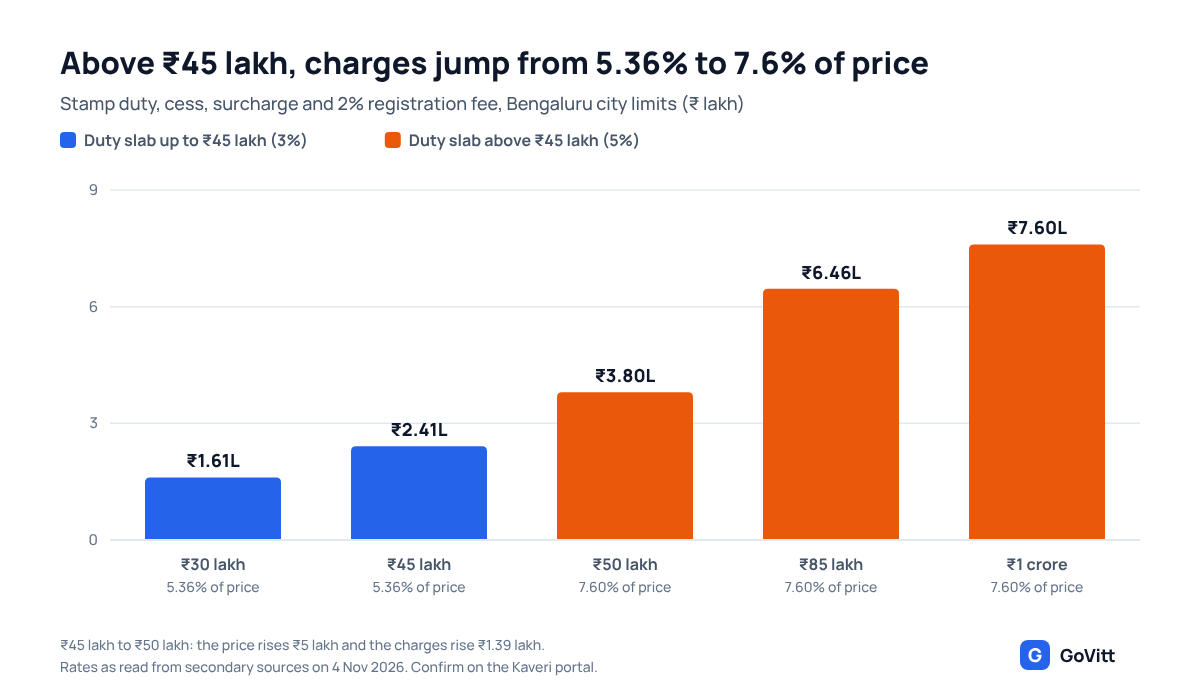
The three duty lines come to 2.24%, 3.36% or 5.60% of the value. Add the 2% registration fee and your total is 4.24%, 5.36% or 7.60%.
What it costs in rupees
Duty and fee are charged on the higher of the price in your agreement and the government's guidance value for that property. The table assumes the price is the higher one, a property inside Bengaluru city limits, and the slab applying to the whole value, as the sources I read describe.
| Price | Slab | Stamp duty, cess and surcharge | Registration fee | Total | Share of price |
|---|---|---|---|---|---|
| ₹30 lakh | 3% | ₹1,00,800 | ₹60,000 | ₹1,60,800 | 5.36% |
| ₹45 lakh | 3% | ₹1,51,200 | ₹90,000 | ₹2,41,200 | 5.36% |
| ₹50 lakh | 5% | ₹2,80,000 | ₹1,00,000 | ₹3,80,000 | 7.60% |
| ₹75 lakh | 5% | ₹4,20,000 | ₹1,50,000 | ₹5,70,000 | 7.60% |
| ₹85 lakh | 5% | ₹4,76,000 | ₹1,70,000 | ₹6,46,000 | 7.60% |
| ₹1 crore | 5% | ₹5,60,000 | ₹2,00,000 | ₹7,60,000 | 7.60% |
| ₹1.5 crore | 5% | ₹8,40,000 | ₹3,00,000 | ₹11,40,000 | 7.60% |
Two things stand out:
- The ₹45 lakh line is a cliff, not a ramp. At ₹45 lakh you pay ₹2,41,200. At ₹45.01 lakh, which is ₹1,000 more in price, you pay ₹3,42,076. That is ₹1,00,876 more for ₹1,000. If the slab applies to the whole value, as the sources describe, this is the most expensive ₹1,000 in your purchase. It's a reason to know exactly which side of ₹45 lakh your agreement value falls on, and not a reason to under-declare. More on that below.
- The August 2025 doubling is worth ₹85,000 on an ₹85 lakh flat. At the old 1% registration fee the total would have been ₹5,61,000. Some calculators and bank pages still use 1%. If your budget came from one of them, add 1% of the price.
What the loan covers, and what it doesn't
Lenders finance a percentage of the agreement value. They don't finance stamp duty or registration. I checked two lender explainers, Bajaj Housing Finance's of 12 September 2025 and Housing.com's, and both say the same. Ask your own lender whether any part of these charges can be included, but plan as if none can.
RBI's limits for individual housing loans are 90% for loans up to ₹30 lakh, 80% for loans of ₹30 lakh to ₹75 lakh, and 75% for loans above ₹75 lakh. Those are caps, and a lender can lend less. On a ₹1 crore flat, 80% would be ₹80 lakh, which is over ₹75 lakh, so the 75% limit applies. Here is the cash you bring at the cap, with the duty, the fee and (for an under-construction flat that isn't affordable housing) 5% GST:
| Price | Loan at the cap | Your margin | Duty and registration | Cash needed, ready flat | Cash needed, under construction (with 5% GST) |
|---|---|---|---|---|---|
| ₹50 lakh | ₹40,00,000 | ₹10,00,000 | ₹3,80,000 | ₹13,80,000 (27.6%) | ₹16,30,000 (32.6%) |
| ₹85 lakh | ₹68,00,000 | ₹17,00,000 | ₹6,46,000 | ₹23,46,000 (27.6%) | ₹27,71,000 (32.6%) |
| ₹1 crore | ₹75,00,000 | ₹25,00,000 | ₹7,60,000 | ₹32,60,000 (32.6%) | ₹37,60,000 (37.6%) |
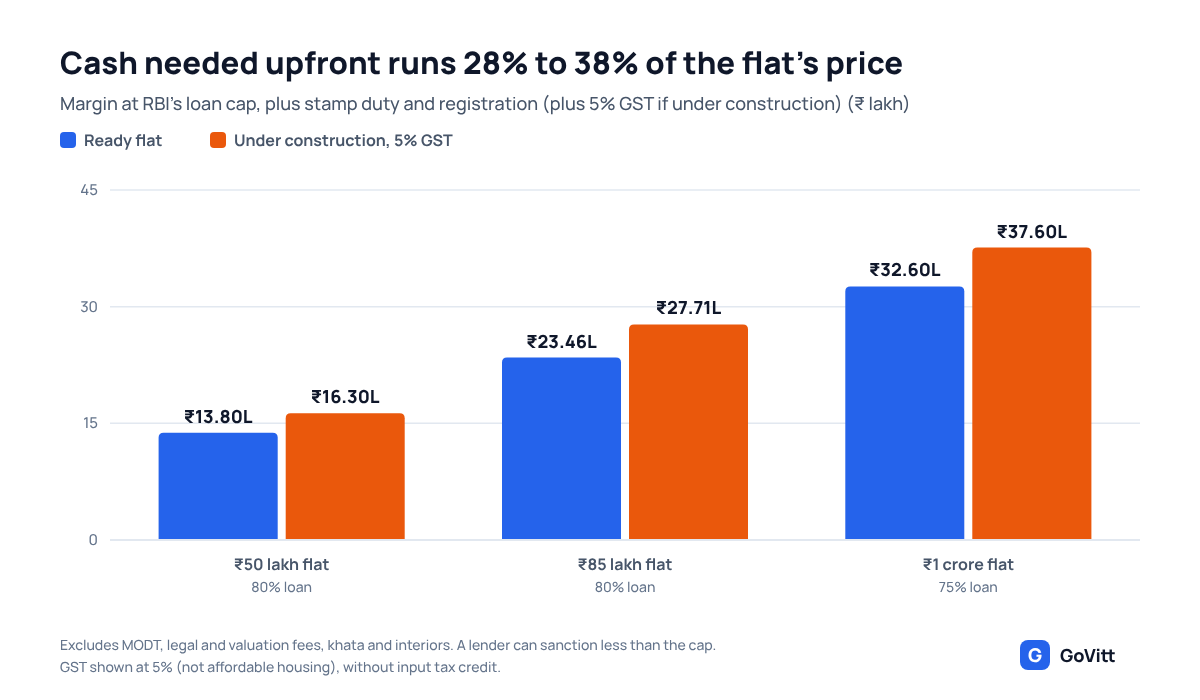
So on an ₹85 lakh flat, the bank's 80% leaves you ₹17 lakh to find, and the state's duty and fee take another ₹6.46 lakh. That is ₹23.46 lakh, or 27.6% of the price, before a rupee of legal fee, MODT or interior work. For an under-construction flat, the 5% GST adds ₹4.25 lakh, and the cash goes to ₹27.71 lakh. I go through the booking-stage traps in before you pay that booking amount.
On GST: the 34th GST Council set 1% for affordable homes (up to ₹45 lakh and 60 square metres carpet area in metros) and 5% for the rest, both without input tax credit. Its release says nothing about completed flats. Ask the builder what GST applies to yours, and get it written on the cost sheet.
Why the price in your agreement matters
Duty and fee are charged on the higher of the agreement price and the guidance value. The guidance value is the government's floor rate for that area, and it is set by location, not by the deal you negotiated. Two things follow:
- A cheap deal doesn't cut the duty. If you buy below guidance value, you still pay on the guidance value.
- Guidance values move. A revision of Bengaluru's values was reported for February 2026, and a statewide revision was still waiting for notification in September, according to a property news site. I couldn't confirm either on Kaveri. Look up the value for your exact street on the portal before you agree a price.
Don't be tempted to under-declare to dodge the slab. The duty falls on the higher of the two values anyway, the lender values the property independently, and a lower recorded price cuts your own loan and leaves a weak paper trail for resale. If a seller offers a "cash component", walk away.
What else you'll pay on closing day
Duty and registration are the big two. These are separate, and I've covered each:
- MODT on the loan. The mortgage deed costs its own stamp duty and registration. The rate, and why you pay it again when you switch banks, is in MODT charges in Karnataka.
- Khata. A resale flat with the wrong khata can stall your loan. I wrote up what to check in buying a resale flat in Bengaluru: check the khata before you check the EMI.
- Legal check, valuation and the lender's processing fee. Ask for each in writing.
- Interiors, movers and the first society deposit. They come after registration, and people forget them.
The local paperwork that trips borrowers in the city is in home loan in Bangalore: which banks lend easiest here, and the usual application mistakes are in top mistakes to avoid when applying for a home loan.
My rule for how much to set aside
On any flat above ₹45 lakh, I hold back 8% of the price for duty, registration and the small charges that follow. On an ₹85 lakh flat that is ₹6.8 lakh, against the ₹6.46 lakh of duty and fee. Add 5% of the price if the flat is under construction and isn't affordable housing. And put that money aside before you pay a token amount, not after. Then use the EMI calculator on the loan you will actually take, which is smaller than the price.
What I'd do this week
- Fix the price. Get the final agreement value, and the guidance value for the street, in writing.
- Open Kaveri and confirm the rates. Use its calculator for your exact property, and compare it to the tables above.
- Work out your loan at the cap. Take 90%, 80% or 75% of the value, depending on the band, then ask the lender what it will actually sanction.
- Add up the cash. Margin, duty, registration, GST if it applies, and a buffer for the small charges.
- Check that your savings cover it before the token amount, not after.
FAQ
What is the stamp duty in Karnataka? As far as I could confirm, 2% up to ₹20 lakh, 3% for ₹20 lakh to ₹45 lakh and 5% above ₹45 lakh, charged on the whole value. A 10% cess and a 2% surcharge on the duty apply in urban areas such as Bengaluru, which makes the effective duty 2.24%, 3.36% or 5.60%. Confirm on the Kaveri portal.
What are the registration charges in Bangalore? 2% of the value since 31 August 2025, up from 1%. On an ₹85 lakh flat that is ₹1,70,000. With stamp duty, cess and surcharge, the total is ₹6,46,000, or 7.6% of the price.
Does a home loan cover stamp duty and registration? Usually no. Lenders finance a percentage of the agreement value, up to RBI's limits of 90%, 80% or 75% by loan size. Stamp duty and registration come from your own funds. Ask your lender if any part can be included.
Is stamp duty charged on the guidance value or the agreement value? On whichever is higher. If you buy below the guidance value, you pay on the guidance value.
Do I pay GST on top of stamp duty? Only on an under-construction flat, at 1% for affordable housing and 5% for the rest, without input tax credit. The GST Council's release doesn't cover completed flats, so ask the builder.
Planning the cash for a flat? Put your loan amount, rate and tenure into the EMI calculator and see the EMI before you commit. GoVitt compares 50+ banks and charges you 0% commission.
Rates as I could confirm them on 4 November 2026 from law firm notes (K&S Partners on the 29 August 2025 notification), news reports (Deccan Herald, 30 August 2025) and lender explainers. The Kaveri portal blocked automated reading, so confirm every rate on Kaveri on the day you sign. The tables assume a property inside Bengaluru city limits, a price at or above the guidance value, and the slab applying to the whole value. Loan amounts use RBI's maximum limits, and a lender can sanction less. GST is shown at 5% for an under-construction flat that is not affordable housing. Your property, area and builder terms can change the numbers. This is information, not legal or tax advice.
Ready to take the next step?
Find out your loan options and check your eligibility with GoVitt today.