
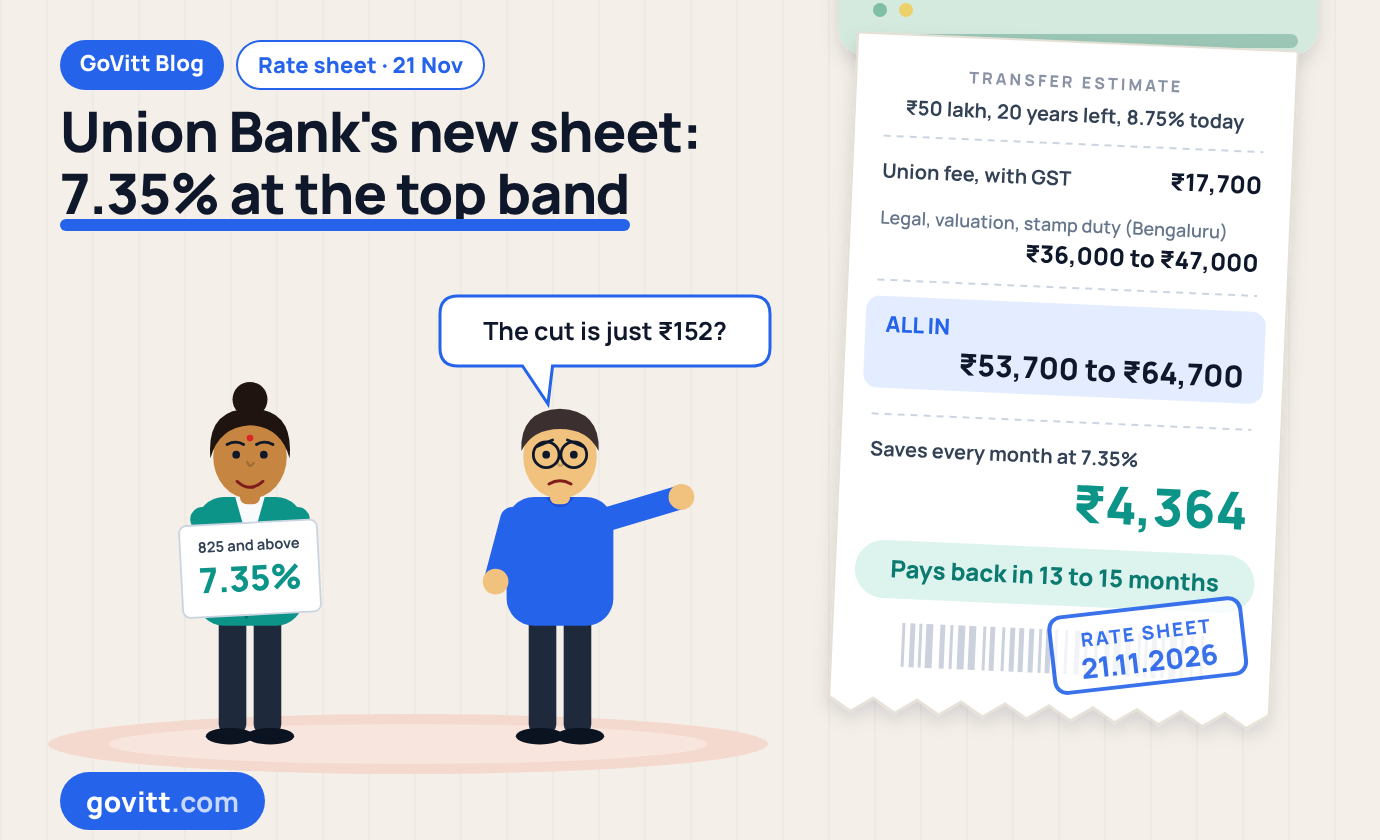
The Union Bank home loan balance transfer interest rate runs from 7.35% to 9.60% on the rate sheet Union Bank of India updated on 21 November 2026, and its two best bands got 0.05% cheaper than on the 8 October sheet I read in October. On ₹50 lakh at 8.75% with 20 years left, the 7.35% band saves ₹4,364 a month. The cut itself is worth ₹152 a month. Your CIBIL band is worth up to ₹7,112.
The short version: the cut is real and tiny. Your band is what matters. The sheet prints no takeover rate and no fee, so I've used the grid for new loans and a fee from Union's older charges schedule: 0.50% capped at ₹15,000, which is ₹17,700 with GST. With the Bengaluru legal, valuation and stamp charges that is ₹53,700 to ₹64,700 all in. At 7.35% it pays back in 13 to 15 months. At 7.95% it takes 22 to 26 months, which is right on my 24 month limit. At 9.10% and 9.60% Union costs more than the 8.75% most readers are paying now.
Below: what the sheet says, what changed since 8 October, your rate and saving by band, the fee, the fixed rate switch on the same sheet, what 4 December could do to it, what I couldn't verify, and what I'd do.
See your real payoff date in 60 seconds
Banks calculate remaining EMIs by simple subtraction. See your actual payoff date and discover how much interest a balance transfer can save.
What Union Bank's 21 November sheet says
I read the PDF on 25 November 2026. Its heading is "Rate of Interest for Retail Lending Schemes w.e.f. 21.11.2026" and every page says "Updated on 21.11.2026".
| Item | What the sheet says |
|---|---|
| Benchmark | EBLR 8.25%, which is repo at 5.50% plus a spread of 2.75% |
| Union Home, score 825 and above | EBLR minus 0.90%, which is 7.35% |
| Union Home, score 800 to 824 | EBLR minus 0.85%, which is 7.40% |
| Union Home, score 600 to 649 | EBLR plus 1.35%, which is 9.60% |
| Government and PSU staff, 750 and above | EBLR minus 0.90%, which is 7.35% |
| Switch from floating to fixed | Once, after 12 EMIs. Fixed rate is the floating rate plus 1.00%. ₹10,000 plus GST up to ₹50 lakh, ₹15,000 plus GST above |
| Processing fee, takeover terms, prepayment | Not on the sheet |
The text came out of the PDF flattened. I can tie each row to a rate and a spread, but not always to a column: salaried or non-salaried, man or woman. Where a band shows more than one rate I give the first one and the range.
What changed since 8 October
My October post read the 8 October sheet. Here is that sheet against this one.
| Band | 8 October sheet | 21 November sheet | EMI change on ₹50 lakh |
|---|---|---|---|
| 825 and above | 7.40% (EBLR minus 0.85%) | 7.35% (EBLR minus 0.90%) | ₹152 less |
| 800 to 824 | 7.45% (EBLR minus 0.80%) | 7.40% (EBLR minus 0.85%) | ₹153 less |
| Government and PSU staff, 750 and above | 7.40% | 7.35% | ₹152 less |
| Every other band | Same | Same | No change |
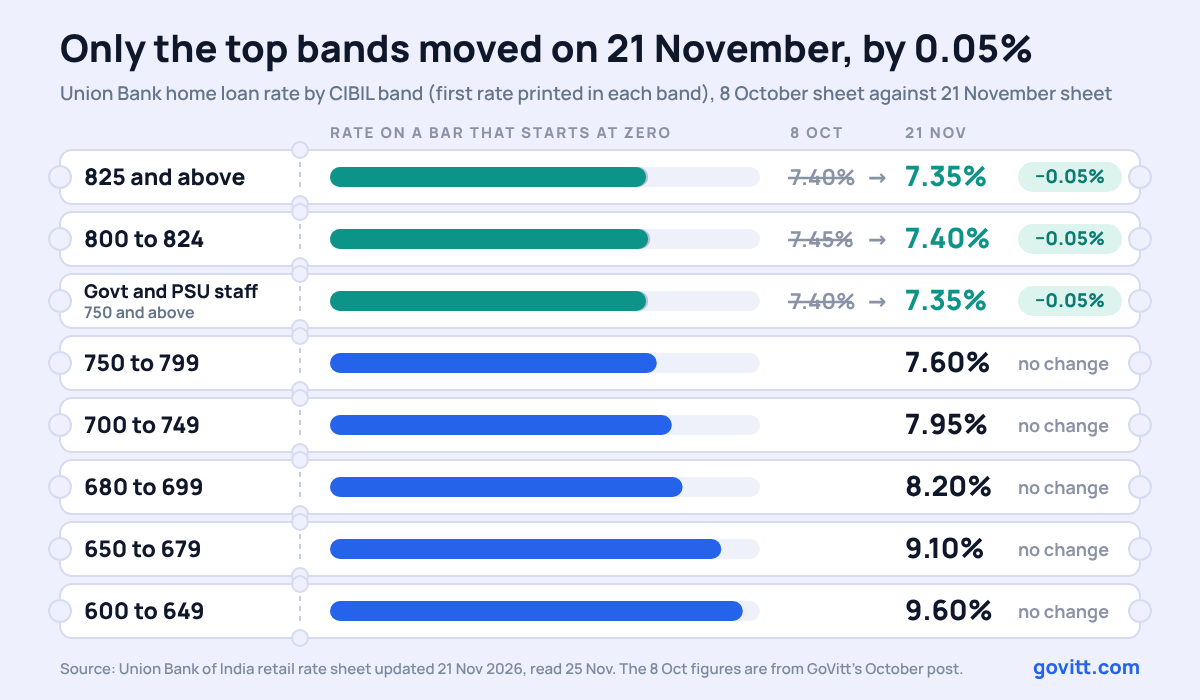
Only the top bands moved. The EBLR is still 8.25%, so Union lowered the spread for strong scores and left the benchmark alone. If you're at 750 to 799 or below, nothing changed for you. I can't see why Union did it and I won't guess.
If you're a Union borrower with a score of 800 or more, ask whether your rate follows the new band. I couldn't find a published fee for repricing a loan already on the EBLR, so get the number in writing. My October post on Union Bank's home loan rates has the rest of the sheet as it stood then.
Your rate and saving by band
Same base case as my other transfer posts: ₹50 lakh outstanding, 20 years left, 8.75% today, EMI ₹44,186. EMIs are monthly reducing balance, rounded to the rupee. The payback is the all-in cost of ₹53,700 to ₹64,700 divided by the monthly saving, rounded up, and it uses the lowest and highest figure in each band.
| Score band | Rate | EMI on ₹50 lakh | Saving a month against 8.75% | Payback |
|---|---|---|---|---|
| 825 and above | 7.35% | ₹39,822 | ₹4,364 | 13 to 15 months |
| 800 to 824 | 7.40% | ₹39,974 | ₹4,212 | 13 to 16 months |
| 750 to 799 | 7.60% to 7.65% | ₹40,586 to ₹40,739 | ₹3,600 to ₹3,447 | 15 to 19 months |
| 700 to 749 | 7.95% to 8.10% | ₹41,667 to ₹42,134 | ₹2,519 to ₹2,052 | 22 to 32 months |
| 680 to 699 | 8.20% to 8.35% | ₹42,446 to ₹42,918 | ₹1,740 to ₹1,268 | 31 to 52 months |
| 650 to 679 | 9.10% | ₹45,308 | Costs ₹1,122 more | Never |
| 600 to 649 | 9.60% | ₹46,934 | Costs ₹2,748 more | Never |
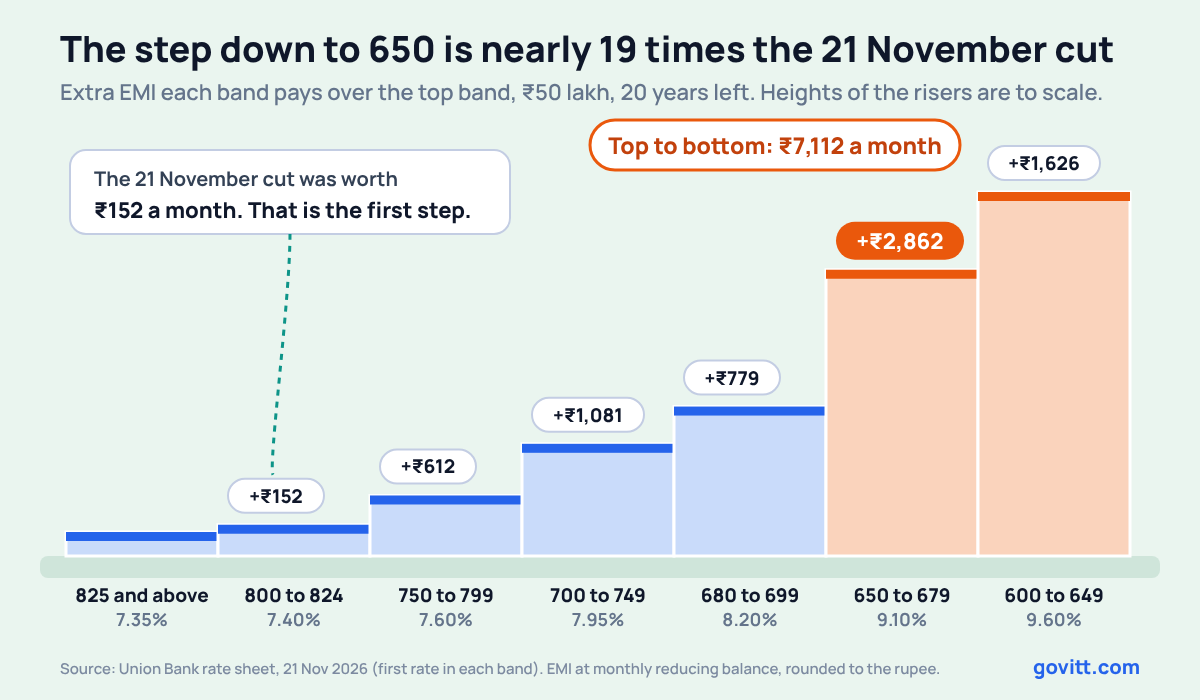
The chart shows how much more EMI each band pays than the top band, using the first rate printed in each band. From 825 and above to 600 to 649 the EMI climbs ₹7,112 a month. The step from 825 to 800 is ₹152, which is the same size as the cut. The step from 680 to 699 down to 650 to 679 is ₹2,862 a month, nearly 19 times the cut. If you use the top of the 680 band's range, 8.35%, that step is ₹2,390, and it is still the biggest on the sheet. The other steps are ₹612 from 800 to 750, ₹1,081 from 750 to 700, ₹779 from 700 to 680 and ₹1,626 from 650 to 600.
So a 0.05% cut matters if you're on the edge of a decision and nothing else. If your score is 670, getting to 680 is worth more than any bank's cut. My post on a 650 CIBIL score has the fixes, and the CIBIL 1.80% post shows how far a score can move a rate across banks.
The fee, and what a transfer costs
The sheet has no processing fee. Union's schedule of service charges for advances lists Union Home at 0.50% of the loan, maximum ₹15,000. The document is undated and headed "excluding GST", and I couldn't find a takeover or balance transfer line in it. I've added GST at 18%.
| Loan outstanding | Fee before GST | With GST | Share of the loan |
|---|---|---|---|
| ₹10 lakh | ₹5,000 | ₹5,900 | 0.59% |
| ₹20 lakh | ₹10,000 | ₹11,800 | 0.59% |
| ₹30 lakh | ₹15,000 | ₹17,700 | 0.59% |
| ₹50 lakh | ₹15,000 | ₹17,700 | 0.35% |
| ₹75 lakh | ₹15,000 | ₹17,700 | 0.24% |
| ₹1 crore | ₹15,000 | ₹17,700 | 0.18% |
The cap is why Union's fee gets smaller as a share of the loan from ₹30 lakh up. On ₹50 lakh the all-in cost is ₹17,700 plus ₹36,000 to ₹47,000 of legal, valuation, stamp duty, registration and small charges in Bengaluru, which I broke down line by line in the balance transfer charges post. That is ₹53,700 to ₹64,700. Karnataka's mortgage stamp duty is in the MODT post.
At 7.35% my rule, that all-in cost should come back within 24 months, allows ₹1,04,736 in total. After the ₹36,000 to ₹47,000 of non-fee charges, a fee of up to ₹57,736 to ₹68,736 with GST would still pass. Union's cap leaves a lot of room. For a five year hold at 7.35%, the lower EMIs and the lower balance together come to a net saving of ₹2,82,536 to ₹2,93,536 after every cost.
The fixed rate switch on the same sheet
This line is easy to skip and expensive to use. Union lets a borrower move from floating to fixed once, after 12 EMIs, at the floating rate plus 1.00%. The charge is ₹10,000 plus GST up to ₹50 lakh, which is ₹11,800, and ₹15,000 plus GST above that, which is ₹17,700.
On ₹50 lakh at 7.35% with 20 years left, the EMI goes from ₹39,822 to ₹42,918. That is ₹3,096 a month more, and over five years ₹1,97,560 with the fee. The floating rate has to rise by a full 1.00% before the fixed rate breaks even, and RBI's last move on 7 October was 0.25%. I'd pay that premium only if a floating rate keeps me awake at night. I covered the argument in should you switch to a fixed rate.
What 4 December can do to this sheet
Union's own line reads "RBI Repo Rate (5.50%) + Spread (2.75%)". If RBI moves the repo by 0.25% on 4 December and Union passes it on as that formula says, every rate on the sheet moves by 0.25%. The 7.35% band becomes 7.60%, and the EMI on ₹50 lakh is ₹764 higher. That is a scenario, not a forecast.
What others expect, as their views and not mine. The Reuters poll of 20 November (read through a syndicated copy) found 56 of 61 economists expecting a 0.25% hike on 4 December. SBI Research cut its December call from 0.50% to 0.25% on 12 November, and Moneycontrol reported on 13 November that at least six economists expect 0.25% (both through Pocketly's report of 13 November). My RBI 4 December post walks through the outcomes. What happens to a sanction made on this sheet if the repo moves before your loan is disbursed isn't on the sheet. Ask Union to say it in writing.
What I couldn't verify
- Which column. The top two rows show one value each. I've treated them as covering every column. Open the PDF to confirm.
- The 8 October comparison. It rests on my 28 October read of the old sheet, not a fresh read of the old file.
- A takeover rate or fee. Neither is on the sheet. I've used the new loan grid and the older fee schedule.
- GST on the fee. The schedule is headed "excluding GST", so I've added 18%.
- Why Union moved. The sheet doesn't say.
- The older table in the same PDF. It is headed "Quarter Ended Sept 2026" with an EBLR of 8.00%. I've ignored it.
What I'd do this week
- Find your band. Check your CIBIL score on the bureau's own site before any lender does a hard enquiry. My post on whether a transfer hurts your score covers the enquiry.
- Ask Union for a written quote with the EBLR, the spread, the fee in rupees with GST and the top-up terms.
- Get one more quote from another bank. The top bands of five public sector banks sat within ₹306 a month of each other on ₹50 lakh when I read them.
- Add the all-in cost and divide by your monthly saving. Under 24 months, go. Over 36, read when a transfer is not worth it.
- If you're at 700 to 749, check the payback twice. At 7.95% it is 22 to 26 months, and at 8.10% it is 27 to 32.
- If you're below 680, fix the score first. At 9.10% and 9.60% a transfer to Union costs you money.
- Watch the processing fee waivers that end on 31 December, which I covered in the fee waiver post. I found no waiver on Union's sheet or its fee schedule.
FAQ
What is the Union Bank home loan balance transfer interest rate? Union Bank's rate sheet, updated on 21 November 2026, shows 7.35% to 9.60% for Union Home, depending on your CIBIL band. That is its EBLR of 8.25% minus 0.90% at the best band and plus 1.35% at the worst. The sheet prints no separate rate for a transfer, so I've used the new loan grid.
Did Union Bank cut its home loan rates on 21 November 2026? For the top two bands, yes, by 0.05%. On my reading, 825 and above went from 7.40% to 7.35%, 800 to 824 went from 7.45% to 7.40%, and government and PSU staff at 750 and above went from 7.40% to 7.35%. The EBLR stayed at 8.25%.
What is Union Bank's processing fee for a home loan transfer? Union's schedule of service charges lists 0.50% of the loan with a maximum of ₹15,000, which is ₹17,700 with GST at 18%. It has no separate takeover fee that I could find, and the document is undated.
What CIBIL score do I need for Union Bank's lowest home loan rate? 825 for 7.35% and 800 for 7.40%. At 750 to 799 the sheet shows 7.60% to 7.65%, and at 700 to 749 it shows 7.95% to 8.10%. Below 680 the rate is 9.10% or more.
Is it worth moving to Union Bank for a 7.35% rate? On ₹50 lakh at 8.75% with 20 years left, it saves ₹4,364 a month and pays back the ₹53,700 to ₹64,700 all-in cost in 13 to 15 months. If your loan is already at 7.60% or lower, the extra saving is small and I'd stay.
Can I switch my Union Bank loan to a fixed rate? Once, after 12 EMIs, at the floating rate plus 1.00%, with a charge of ₹10,000 plus GST up to ₹50 lakh and ₹15,000 plus GST above. On ₹50 lakh at 7.35% that is ₹3,096 a month more on the EMI.
Want your own payback at Union's 7.35% or your band's rate? Run the Payoff & Transfer Calculator with your outstanding amount, rate and years left. GoVitt compares 50+ banks and charges you 0% commission.
Figures are for ₹50 lakh outstanding, 20 years left and 8.75% today, with EMIs on the monthly reducing balance method, rounded to the rupee. Union Bank's rates are from its retail rate sheet updated 21 November 2026, read on 25 November 2026 as extracted text with some columns not identifiable. The 8 October figures are from GoVitt's October post. The fee is from Union's undated schedule of service charges, shown without GST, so GST at 18% is my assumption. Bengaluru costs are the illustrative ranges from GoVitt's charges post (16 October 2026). The 4 December figures are a scenario, not a forecast, and the economists' views are theirs. Confirm every figure in writing with the lender before you act. This is general information, not financial advice.
Ready to take the next step?
Find out your loan options and check your eligibility with GoVitt today.