
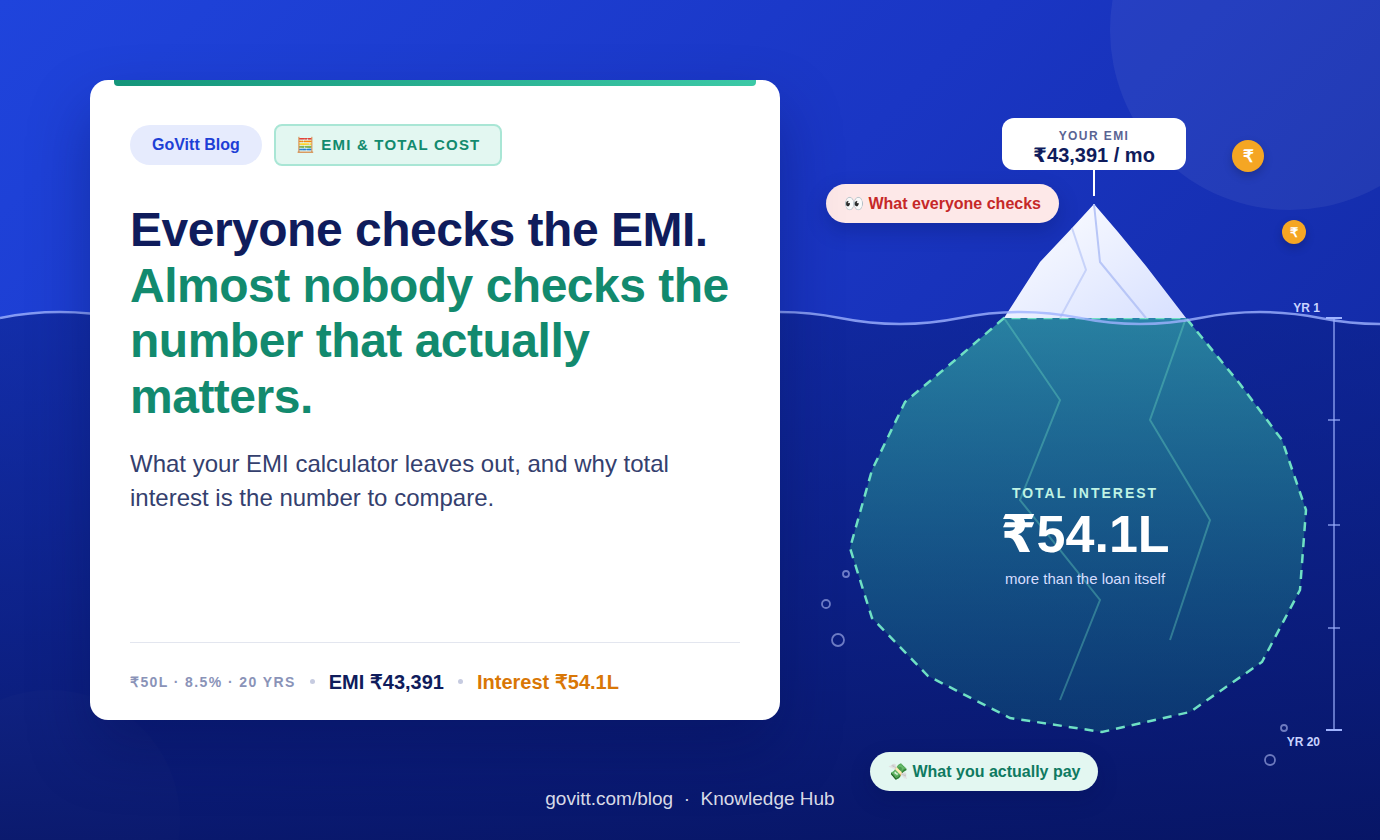
Before anyone buys a house, they open an EMI calculator. Loan amount, rate, tenure, done. ₹50 lakh at 8.50% for 20 years gives you ₹43,391 a month, and that number becomes the whole basis of the decision. Can I afford ₹43,391? Yes. Okay, let's do it.
The number is correct. I want to be clear about that, because this isn't a post about calculators being wrong. The formula is the same everywhere, it's been the same for decades, and GoVitt's calculator will give you the identical figure to HDFC's or SBI's or the one on any property portal. Stop shopping around for a calculator that gives you a better EMI. There isn't one.
The problem is what happens after you get the number. Most people stop there. And the EMI, sitting alone with no context around it, is close to the least useful output of that whole calculation.
See your real payoff date in 60 seconds
Banks calculate remaining EMIs by simple subtraction. See your actual payoff date and discover how much interest a balance transfer can save.
If you want the basics of how the formula works, we already wrote that one, it's here. This post is about everything the calculator quietly leaves out.
The rate you typed is not the rate you'll get
This is the first gap and it's a big one.
When you use a calculator, you type in whatever rate you last saw advertised. Maybe 7.75%. Maybe 8%. That number came from a bank's homepage or a comparison site, and it's almost always the lender's best rate, offered to their best borrowers.
Look at what HDFC Bank actually publishes on their own rates page. Home loans start at 7.75% a year. But the band they disclose runs from repo plus 2.50% all the way to repo plus 7.95%, which at today's repo rate of 5.25% works out to a range of 7.75% to 13.20%.
That's not HDFC being sneaky. They're being more transparent than most by publishing the full band at all. Nearly every lender prices this way. But look at what that spread does on a ₹50 lakh, 20 year loan:
| Rate you get | Your EMI | Total interest over the loan |
|---|---|---|
| 7.75% | ₹41,047 | ₹48.51 lakh |
| 8.50% | ₹43,391 | ₹54.14 lakh |
| 9.25% | ₹45,793 | ₹59.90 lakh |
| 10.50% | ₹49,919 | ₹69.81 lakh |
| 13.20% | ₹59,293 | ₹92.30 lakh |
Same house. Same loan. The difference between the top and the bottom of that band is ₹18,245 every month and ₹43.79 lakh over the life of the loan.
Where you land inside that band depends on your credit score, your income profile, whether you're salaried or self employed, the property itself, and your relationship with that lender. If your CIBIL is around 650 rather than 780, you are not getting the advertised rate, and we've written separately about what a 650 score does to a home loan application.
So before you trust any EMI figure, find out your actual sanctioned rate. Not the website rate. Yours. Everything downstream of that number is only as good as that one input.
The calculator assumes your rate never changes. It will.
Type 8.50% into any EMI calculator and it quietly assumes 8.50% for all 240 months. Two decades of a completely flat interest rate.
That has never once happened to anybody.
Your loan is almost certainly floating, tied to the repo rate or to your lender's own benchmark. RBI moved the repo rate up by 2.50% between 2022 and 2023, then cut it by 1.25% through 2025. Right now analysts are expecting it to go back up in October and December.
When the rate moves, something has to give. Either your EMI goes up, or your tenure stretches. Most lenders pick the tenure, because you don't notice it. A higher EMI you spot on the first of the month. Four extra years of payments you might not spot for a decade.
That's how someone ends up five years into a twenty year loan with more than eighteen years still left. We did the full arithmetic on that in this post about your real payoff date, and it's the single most common shock we see when people actually check.
A half percent move, for reference. On our ₹50 lakh loan at 8.50%, going to 9% adds ₹1,595 a month, or ₹3.83 lakh across the loan if you take it on the EMI instead of the tenure.
The tenure trick, and why lower EMI is often the worse deal
Here's where calculators do real damage, because they make it so easy.
Your EMI comes out higher than you'd like. So you drag the tenure slider to the right. The EMI drops. Problem solved.
Except:
| Tenure | EMI | Total interest |
|---|---|---|
| 15 years | ₹49,237 | ₹38.63 lakh |
| 20 years | ₹43,391 | ₹54.14 lakh |
| 25 years | ₹40,261 | ₹70.78 lakh |
| 30 years | ₹38,446 | ₹88.40 lakh |
Going from 15 years to 30 saves you ₹10,791 a month. It also costs you an extra ₹49.78 lakh in interest. You'd be paying almost double the interest to make the monthly number look comfortable.
That final stretch is particularly poor value. Moving from 25 years to 30 drops the EMI by ₹1,816 and adds ₹17.62 lakh of interest. Nobody would agree to that if it were presented as a sentence instead of a slider.
I'm not saying take the 15 year loan. A longer tenure can be exactly right if it's the difference between comfortably servicing the loan and being stretched thin every month, and there's a genuine argument for the flexibility. But make that call knowing the price of it, which the calculator will never show you unless you go looking.
Total interest is the number to compare
If I could change one thing about how people use EMI calculators, it would be this. Compare loans on total interest, not on EMI.
EMI tells you whether you can afford the loan this month. Total interest tells you what the loan actually costs. They're different questions and the second one is worth far more money.
Two offers with nearly identical EMIs can be lakhs apart in total cost once tenure and rate differ. And the EMI alone will never reveal it.
Every decent calculator shows total interest somewhere, usually below the fold or in smaller text under the EMI. Go find it. That's the number worth writing down.
Run it three times, not once
Most people use a calculator once, get a number and close the tab. Ninety seconds more and you get something far more useful.
Run it at your rate plus 0.5%. That's your stress test. If the loan only works at today's rate, it's not a loan you can afford, because rates will move.
Run it at two or three tenures and write down the total interest for each, not the EMI. Now you're comparing the actual cost of the options rather than the comfort of them.
Run it with a prepayment. Most calculators let you add one. On that same ₹50 lakh at 8.50%, paying one extra EMI a year, just ₹43,391 once a year out of a bonus, clears the loan in 16 years 9 months instead of 20 and saves ₹10.29 lakh in interest. One payment a year. That's the highest return decision available to most borrowers and it takes a minute to model.
Floating rate home loans taken by individuals carry no prepayment charges, so nothing is stopping you.
Where our calculator is different
Everything above applies to a loan you haven't taken yet. Most of the people who write to us are already five, eight, ten years in, and a standard EMI calculator is genuinely not much help to them. It's built to answer "what will my EMI be," which is a question they answered years ago.
So the Home Loan Payoff Calculator on our site works from the other end. You put in your outstanding balance, your current EMI and your current rate, three numbers that are all sitting on your latest loan statement, and it tells you when the loan actually finishes based on where you are now rather than what your sanction letter said on day one.
It also shows what a lower rate would do from this point, and what prepaying would do. No documents, and you don't have to speak to anyone.
Two minutes, and most people find their real payoff date sits somewhere they weren't expecting.
The short version
The EMI is an affordability check, and that's all it is. Get your actual rate before you trust any of the maths. Compare on total interest. Treat the tenure slider as something that costs money rather than something that saves it. And stress test at half a percent higher, because your rate is not staying where it is.
If you want to see where your existing loan really stands, run it through our Payoff Calculator, or if you'd rather just send us the numbers, WhatsApp your outstanding balance, rate and EMI to +91 70194 17854 and we'll come back with your real payoff date and whether a better rate is available to you. You can also see what 50+ lenders are currently offering. GoVitt doesn't charge you a commission.
All figures assume a ₹50 lakh loan on monthly reducing balance and are for illustration. Your rate, charges and lender policies decide your actual numbers. Rates quoted are as published in September 2026 and change often.
Questions people usually ask
Is a home loan EMI calculator accurate? The arithmetic is exact, and every calculator uses the same formula, so they all return the same EMI for the same inputs. What makes the output unreliable is the inputs, mainly the interest rate, since most people enter the advertised rate rather than the rate they'll actually be sanctioned.
Why is my actual EMI higher than what the calculator showed? Usually because your sanctioned rate is higher than the advertised rate you typed in. Lenders price within a band based on credit score, income profile and employment type. It can also happen if insurance or other charges were bundled into the loan amount.
Should I choose a longer tenure to reduce my EMI? It lowers the monthly outgo but raises the total cost substantially. On a ₹50 lakh loan at 8.50%, stretching from 20 years to 30 saves ₹4,945 a month and adds roughly ₹34 lakh in interest. Worth it if it's the difference between affordable and not, expensive if you're only chasing a smaller number.
What is more important, EMI or total interest? EMI tells you whether you can service the loan each month. Total interest tells you what the loan costs you overall. Use EMI to check affordability, then compare your options on total interest.
Does an EMI calculator account for interest rate changes? No. It assumes your rate stays fixed for the entire tenure, which almost never happens on a floating rate loan. Run the calculation again at half a percent higher to see how much room you actually have.
How much does one extra EMI a year save? On a ₹50 lakh loan at 8.50% over 20 years, paying one additional EMI each year clears the loan in about 16 years and 9 months and saves roughly ₹10.29 lakh in interest. Floating rate home loans for individuals have no prepayment charges.
Which calculator should I use if I already have a home loan? A standard EMI calculator won't help much, since it's designed for loans you haven't taken yet. Use a payoff calculator instead, which works from your outstanding balance, current EMI and current rate to show when the loan actually ends.
Ready to take the next step?
Find out your loan options and check your eligibility with GoVitt today.