
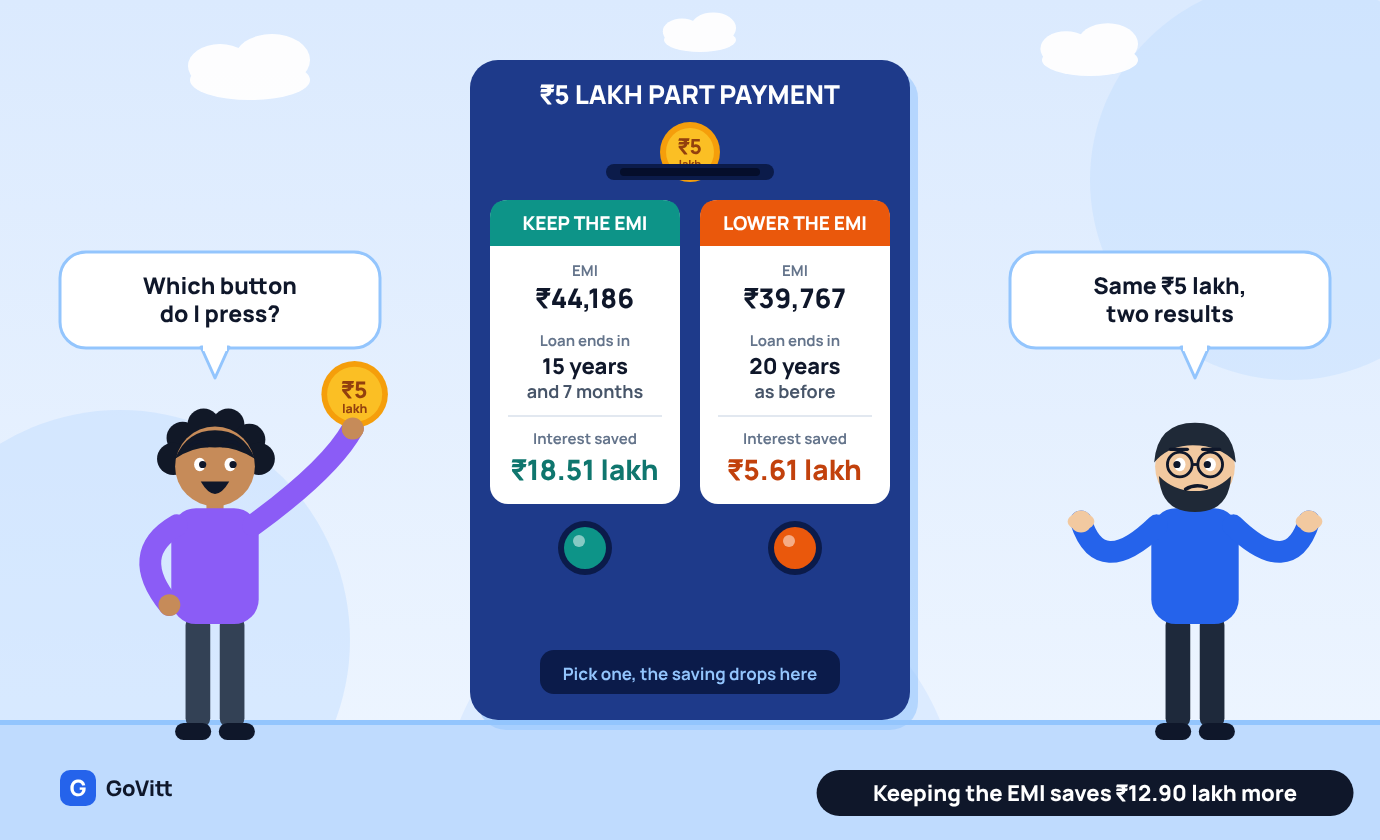
On home loan prepayment, reduce EMI or tenure? Reduce the tenure. Keep paying the EMI you pay today and let the loan end sooner. Take ₹50 lakh at 8.75% with 20 years left and put ₹5 lakh against it. Keep the EMI at ₹44,186 and the loan ends in 15 years and 7 months, with ₹18.51 lakh less interest. Take the lower EMI of ₹39,767 and you save ₹5.61 lakh.
Same ₹5 lakh. A gap of ₹12.90 lakh. Below: why the gap is that wide, the three cases where the lower EMI is still the right call, how to ask your bank for either, and why the month you pay matters more than the option you pick.
Reduce tenure or reduce EMI: the numbers (checked 31 October 2026)
Base case for the whole post: ₹50 lakh outstanding, 8.75%, 20 years left, an EMI of ₹44,186 and ₹56.05 lakh of interest still to pay. You make a ₹5 lakh part payment today.
See your real payoff date in 60 seconds
Banks calculate remaining EMIs by simple subtraction. See your actual payoff date and discover how much interest a balance transfer can save.
| Keep the EMI, shorten the loan | Lower the EMI, keep the loan | No prepayment | |
|---|---|---|---|
| EMI | ₹44,186 | ₹39,767 | ₹44,186 |
| Loan ends in | 15 years and 7 months | 20 years | 20 years |
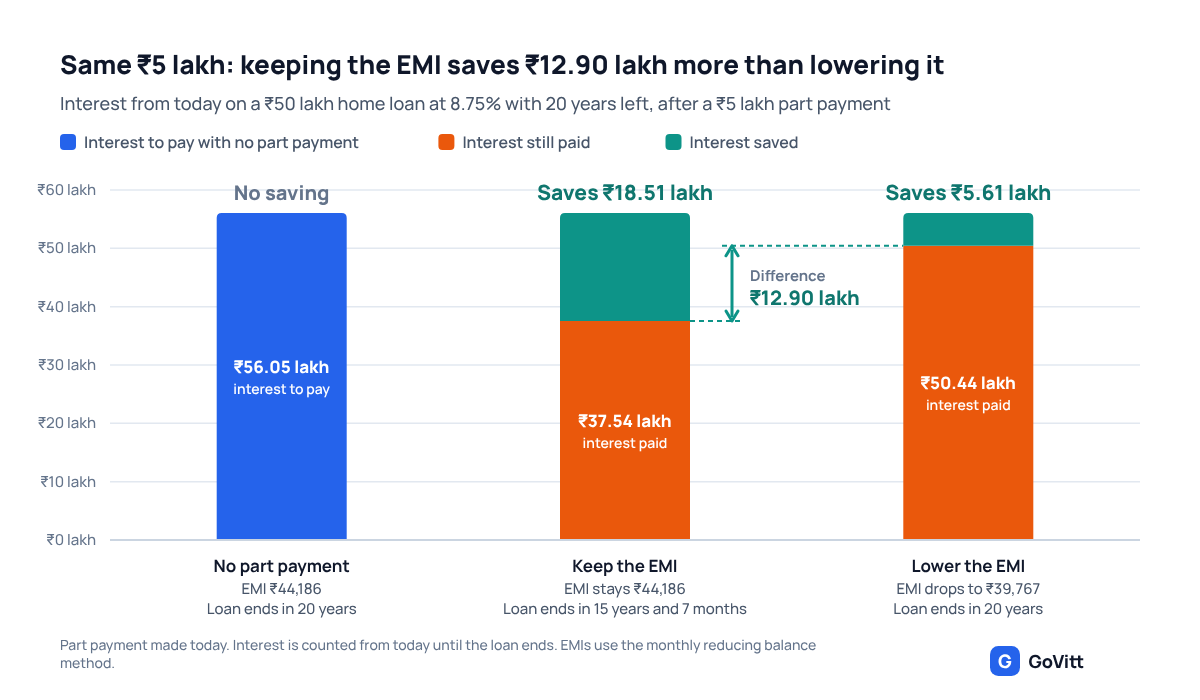
| Interest from today | ₹37.54 lakh | ₹50.44 lakh | ₹56.05 lakh |
| Interest saved | ₹18.51 lakh | ₹5.61 lakh | Nothing |
| Cash freed each month | Nothing | ₹4,419 | Nothing |
Why the shorter loan wins by so much
Interest is charged every month on what you still owe. If you keep the EMI, the balance falls faster from the first month, so each later month carries less interest and more of your ₹44,186 goes to principal. The loan snowballs towards zero.
If you cut the EMI, you get a loan that is exactly 10% smaller than the old one, over the same 20 years. It saves exactly 10% of the interest, because you've cleared 10% of the principal. That is ₹5.61 lakh out of ₹56.05 lakh. Nothing speeds up.
Here is the test I use. Choosing the lower EMI is the same as handing the bank ₹5 lakh and asking for ₹4,419 back every month. You keep that cash for 15 years and 7 months, then pay ₹39,767 a month for another 4 years and 5 months. For that to beat the shorter loan, the ₹4,419 a month has to earn more than 8.75% a year after tax, every month, with no gaps. I ran the two cash flows against each other, and the break-even return is exactly the loan rate: 8.75%.
For scale, in Got a bonus coming? I put an SBI fixed deposit at 6.60%, which pays 4.54% after tax in the 30% slab. Shortening the tenure earns your loan rate, with no market risk, and you don't have to remember to invest anything.
Part payment on a home loan: what each size saves
Same loan, four sizes:
| Part payment | Keep EMI: loan shortens by | Keep EMI: interest saved | Lower EMI: new EMI | Lower EMI: interest saved |
|---|---|---|---|---|
| ₹1 lakh | 1 year | ₹4.49 lakh | ₹43,302 | ₹1.12 lakh |
| ₹2 lakh | 1 year and 11 months | ₹8.52 lakh | ₹42,418 | ₹2.24 lakh |
| ₹5 lakh | 4 years and 5 months | ₹18.51 lakh | ₹39,767 | ₹5.61 lakh |
| ₹10 lakh | 7 years and 7 months | ₹30.42 lakh | ₹35,348 | ₹11.21 lakh |
Each ₹1 lakh you prepay saves about ₹4.5 lakh when the EMI stays, and about ₹1.1 lakh when it doesn't. Even a ₹1 lakh part payment takes a full year off the loan.
When the lower EMI is the right call
There are three cases.
- The EMI is more than you can carry. If your EMIs take more than half your take-home, ₹4,419 a month is breathing room, and a missed EMI costs more than the interest you gave up.
- Your income swings. Commission, business income or contract work: a lower fixed EMI protects you in a bad month. The saving from the shorter loan is a number on a statement, and it doesn't pay rent.
- You have costlier debt. Freed cash only helps if it clears a loan that costs more than 8.75%, and it should go straight to that loan. If you have a personal loan or card dues, they go first, before any part payment on the home loan.
If none of these is you, don't cut the EMI.
The middle path: lower EMI on paper, old EMI in practice
Ask for the lower EMI of ₹39,767, then keep paying ₹44,186 through a standing instruction. The extra ₹4,419 clears principal every month and you finish in 15 years and 7 months, with the same ₹18.51 lakh saved. If a bad month comes, you drop back to ₹39,767 without a missed EMI.
Two limits. The lender has to apply the extra to principal, and lenders handle it differently, so ask whether you can keep paying the old EMI and check your statement after the first two months. And it takes discipline. If you know you'll spend the ₹4,419, take the shorter loan and be done with it.
The month you pay matters more than the option you pick
Interest is front-loaded. In the first month after a part payment made at the end of year 1, 81% of your EMI (₹35,754 of ₹44,186) is interest. After year 10 it is 58%, and after year 15 it is 35%. So the same ₹5 lakh does very different work depending on when it arrives, even if you keep the EMI every time.
| ₹5 lakh paid after | Balance then | Loan shortens by | Interest saved |
|---|---|---|---|
| Year 1 | ₹49,03,463 | 4 years and 1 month | ₹16.86 lakh |
| Year 3 | ₹46,83,205 | 3 years and 6 months | ₹13.84 lakh |
| Year 5 | ₹44,20,991 | 3 years | ₹11.19 lakh |
| Year 8 | ₹39,31,108 | 2 years and 5 months | ₹7.83 lakh |
| Year 10 | ₹35,25,627 | 2 years | ₹5.95 lakh |
| Year 15 | ₹21,41,059 | 1 year and 4 months | ₹2.30 lakh |
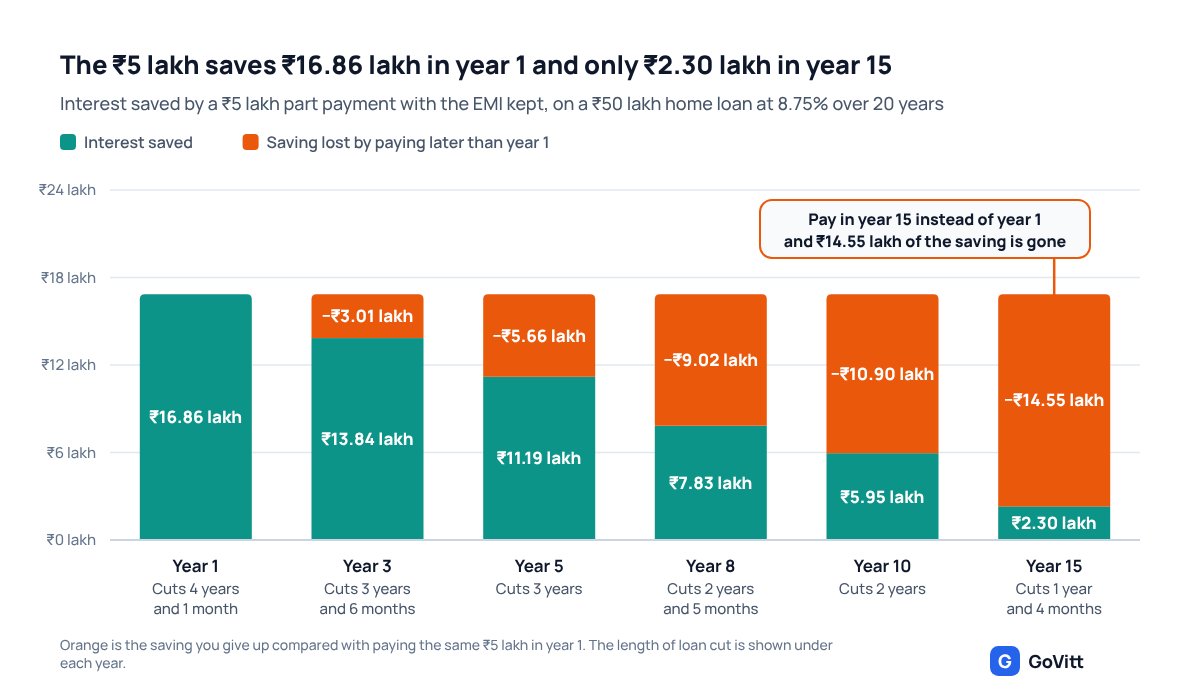
The same ₹5 lakh is worth ₹3.01 lakh less if it arrives after year 3 instead of year 1. If you have idle money and a young loan, don't wait for a round-number month.
After the 7 October hike, your payoff date may have moved
RBI took the repo rate to 5.50% on 7 October. Lenders commonly hold the EMI when a floating rate changes and let the tenure move instead. Say your EMI was ₹43,391 on ₹50 lakh at 8.50%, and the rate moves to 8.75%. If the EMI stays put, the loan now runs 21 years and 1 month, which is 13 months longer. A part payment of ₹89,909 puts the end date back. How to read your own statement for this is in you think 15 years are left on your home loan? The math says 18.
Part payments are free on a floating rate home loan
RBI barred prepayment charges on floating rate loans to individuals for non-business purposes in a 2014 circular. Its Pre-payment Charges Directions, 2025, issued on 2 July 2025, repeat the rule for loans sanctioned or renewed on or after 1 January 2026, and apply it to banks and housing finance companies alike. It covers part and full prepayment, from any source of funds, with no lock-in period. A fixed rate loan can still carry a charge, and the lender has to state it in your sanction letter, loan agreement and Key Fact Statement. The full reading is in your bank can't charge you for prepaying a floating rate home loan.
Free doesn't mean unlimited. I found no RBI minimum for a part payment, but lenders can set their own, so ask yours.
How to ask your bank for a part payment
- Confirm the rate type. Floating means no charge. Look at your sanction letter.
- Pay the amount through your lender's part payment option. It sits in net banking, the app or the branch. Only the amount that goes against the loan counts. Insurance premiums and other deductions aren't part of the repayment.
- Say which option you want, in writing. Some lenders default to shortening the tenure and others ask you afterwards, by message or call. If the lender picks for you, write back asking for the change.
- Check the account in a few days. The lender should update the loan account with the new EMI or tenure, usually within a few days. Look at the outstanding balance, the EMI and the end date on the new statement.
- Keep the confirmation. Keep the SMS, email or letter that shows the option you chose.
What prepaying does to your tax deduction
The interest deduction on a self-occupied home is capped at ₹2 lakh a year and only in the old tax regime (Section 22 of the Income-tax Act, 2025). In the first year of this loan you pay ₹4,33,689 in interest. After a ₹5 lakh part payment it is ₹3,88,141. Both are above the cap, so the part payment doesn't shrink your deduction at all in the early years.
Later, when your yearly interest falls below ₹2 lakh, a ₹1 deduction is worth 31.2 paise in the 30% slab with cess. So you keep about 69 paise of every rupee of interest you save. It's a summary, not tax advice. Ask your CA if it matters to you.
Home loan prepayment calculator: what to enter
Whichever calculator you use, three numbers must come from your latest loan statement, not from your sanction letter:
- Outstanding principal. What you owe today, not the original loan.
- Current rate. The one on the statement now, after the October hike.
- Months left. The remaining tenure, which may be longer than you expect.
Then enter the part payment and compare the end date or the EMI. The Payoff & Transfer Calculator shows your payoff date, and the EMI calculator gives the new EMI for any balance and tenure.
Before you prepay
- Keep six months of expenses and EMIs in cash. A part payment can't be taken back. Getting the money out again means a top-up, which is a fresh application at a fresh rate.
- Clear costlier debt first. Cards and personal loans cost more than your home loan.
- Keep money you'll need within a year or two out of the loan. The saving is real, but so is the need.
- Check your rate. At 8.75% or more, a transfer may save more than a part payment. I worked through it in still paying 8% or more? I did the math on shifting ₹50 lakh to 7.20%, and a loan with an overdraft facility changes the math too, as in can a home loan overdraft actually save you interest?
What I'd do this week
- Pull your latest loan statement. Note the outstanding principal, the rate and the end date.
- Decide the amount. Leave your six month cash cushion alone. Put in everything above it that you won't need for two years.
- Choose the shorter loan unless you fit one of the three cases above.
- Pay in one lump. Don't hold the money for a better month. The timing table shows what a year costs.
- Write to the lender with your choice, or ask for the lower EMI with a standing instruction for the old one.
- Check the statement after a week. The end date should have moved. If it hasn't, chase it.
FAQ
Home loan prepayment: reduce EMI or tenure, which is better? Reducing the tenure, in most cases. On ₹50 lakh at 8.75% with 20 years left, a ₹5 lakh part payment saves ₹18.51 lakh and ends the loan 4 years and 5 months early if you keep the EMI. If you take the lower EMI of ₹39,767, it saves ₹5.61 lakh.
Is there a prepayment charge on a home loan? Not on a floating rate loan taken by an individual for non-business use. RBI barred the charge, and its 2025 Directions apply to loans sanctioned or renewed on or after 1 January 2026. A fixed rate loan can carry one, and the sanction letter must say so.
What is the minimum part payment on a home loan? I found no RBI minimum. Each lender sets its own, so ask yours before you plan the amount.
Can I make a part payment on a home loan every year? Yes. I found nothing in RBI's rule that limits how often, and it sets no lock-in period. Check with your lender for a minimum amount per payment.
How much does a ₹5 lakh part payment save? On the base case above, ₹18.51 lakh if you keep the EMI and ₹5.61 lakh if you cut it. Paid after year 1 instead of year 10, the same ₹5 lakh saves ₹16.86 lakh instead of ₹5.95 lakh.
Does prepaying my home loan reduce my tax benefit? Only once your yearly interest falls below the ₹2 lakh cap, and only in the old regime. In the early years of a ₹50 lakh loan, your interest is above the cap either way.
Run your own numbers. Run the Payoff & Transfer Calculator to see the end date of your loan after a part payment. Our home loan balance transfer page shows what a move would change. GoVitt compares 50+ banks and charges you 0% commission.
Examples use ₹50 lakh outstanding at 8.75% with 20 years left, standard monthly reducing balance, EMIs rounded to the nearest rupee. They assume the rate stays at 8.75% and that the EMI is unchanged after a part payment unless stated. Your lender's rate, statement and process will differ. Rules checked on 31 October 2026. Tax points are a summary for the old tax regime, not tax advice. Check your sanction letter before you act.
Ready to take the next step?
Find out your loan options and check your eligibility with GoVitt today.