
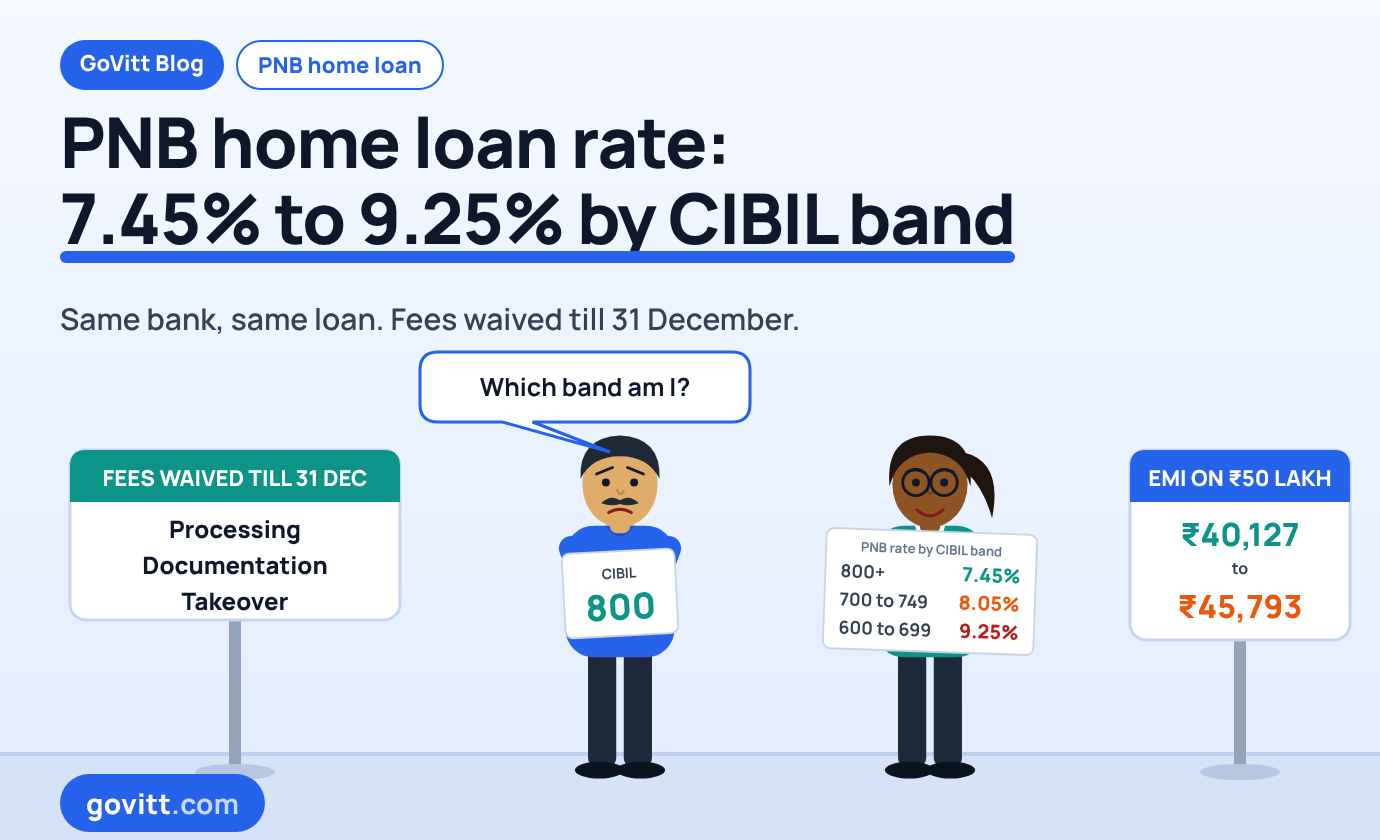
The PNB home loan interest rate on PNB's own page is 7.45% if your CIBIL score is 800 or higher and the loan is above ₹30 lakh. At 700 to 749 it is 8.05%, and at 600 to 699 it is 9.25%. On ₹50 lakh over 20 years, that is an EMI of ₹40,127, ₹41,978 or ₹45,793. Same bank, same loan, same tenure.
The short version: PNB is a strong place to move a loan to if your score is 750 or higher and you can close before 31 December, because PNB has waived its upfront, documentation and takeover fees until then. Below 700 the headline rate isn't yours, and at 600 to 699 PNB's 9.25% is higher than the 8.75% I use below as a typical current rate.
Below: the grid as PNB prints it, what each band costs in rupees, the fees, and the switch math from the rate you pay now.
See your real payoff date in 60 seconds
Banks calculate remaining EMIs by simple subtraction. See your actual payoff date and discover how much interest a balance transfer can save.
PNB's grid, as printed on its rate page
The 7.45% in PNB's headline is the rate under its "PNB Utsav Festivities 2026" campaign, which runs from 1 October to 31 December 2026. I read the grid on 19 November. Floating rates are RLLR plus a spread, and the "presently" column is what PNB shows today.
| Loans above ₹30 lakh, LTV up to 80% | CIBIL band | Spread | Floating rate now | Fixed, up to 10 years | Fixed, above 10 years | |
|---|---|---|---|---|---|---|
| 800 and above | RLLR+BSP - 0.90% | 7.45% | 8.45% | 8.95% | 750 and above (any amount) | RLLR+BSP - 0.85% |
| 7.50% | 8.50% | 9.00% | 700 to 749 | RLLR+BSP - 0.30% | 8.05% | 9.05% |
| 9.55% | 600 to 699 | RLLR+BSP + 0.90% | 9.25% | 10.25% | 10.75% | Loans up to ₹30 lakh, LTV above 80% and up to 90% |
| CIBIL band | Spread | Floating rate now | Fixed, up to 10 years | Fixed, above 10 years | 750 and above | |
| RLLR+BSP - 0.75% | 7.60% | 8.60% | 9.10% | 700 to 749 | RLLR+BSP - 0.20% | 8.15% |
| 9.15% | 9.65% | 600 to 699 | RLLR+BSP + 1.00% | 9.35% | 10.35% | 10.85% |
Three things the grid shows. There is no 800+ row in the high-LTV slab, so there a 790 score and an 810 score both get 7.60%. PNB Pride, which covers central and state government employees, paramilitary personnel, pensioners and PSU employees, gets 7.50% on the larger slab and 7.60% on the smaller one. And PNB's own page says no further concession is available to women borrowers on these rates, which matches what I found in my post on the real home loan discount for women.
The page doesn't state the RLLR. The "presently" column implies 8.35% in every row (7.45% plus 0.90%), and Ambak, which tracks rate pages, reports PNB's RLLR as 8.35% from 8 October 2026, the day after the RBI hike. PSU Connect carried the same revision.
What each band costs a month
Base case: ₹50 lakh, 20 years, monthly reducing balance, EMI rounded to the rupee, using the larger-loan slab.
| CIBIL band | Rate | EMI on ₹50 lakh | Over the 800+ EMI |
|---|---|---|---|
| 800 and above | 7.45% | ₹40,127 | 0 |
| 750 to 799 | 7.50% | ₹40,280 | ₹153 |
| 700 to 749 | 8.05% | ₹41,978 | ₹1,851 |
| 600 to 699 | 9.25% | ₹45,793 | ₹5,666 |
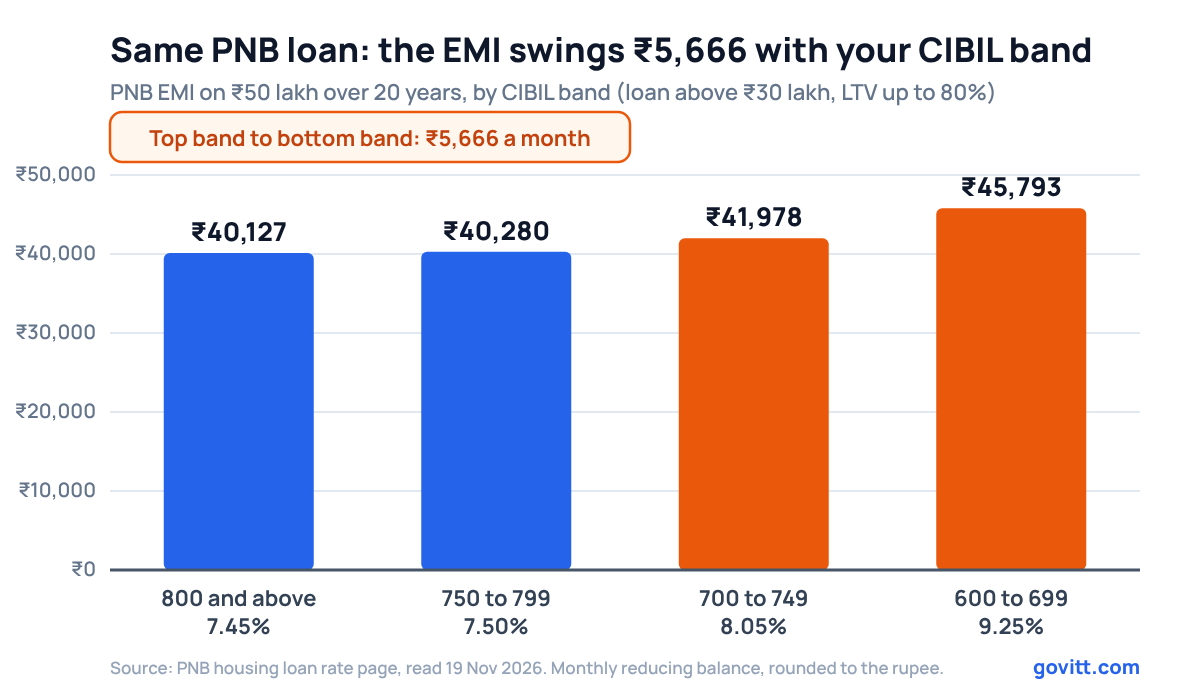
The drop below 750 is where the money goes. Falling from the top band to 700 to 749 costs ₹1,851 a month, which is ₹4.44 lakh over 20 years. If you are at 690 and a few months from 700, waiting to apply is worth more than shopping banks. My CIBIL post covers what 750 against 800 changes.
On a ₹30 lakh loan in the smaller slab, the EMIs at 20 years are ₹24,352 at 7.60%, ₹25,374 at 8.15% and ₹27,671 at 9.35%.
The fees, and why 31 December matters
PNB's standard housing loan charges, before GST:
| Charge | Standard | During Utsav (1 Oct to 31 Dec 2026) |
|---|---|---|
| Processing fee, new loan | 0.35% of the loan, minimum ₹2,500, maximum ₹15,000 | Waived |
| Documentation charges | ₹1,350 | Waived |
| Takeover (transfer): processing fee | ₹2,500 | Waived |
| Takeover: documentation charges | ₹1,350 | Waived |
| Legal and valuation on a takeover of ₹25 lakh and above | Not stated on the page | Borne by PNB, capped at ₹15,000 before GST |
So on a ₹50 lakh takeover the waiver saves ₹3,850 plus GST, which is ₹4,543. On a fresh ₹50 lakh purchase loan the standard fees are the ₹15,000 cap plus ₹1,350, which is ₹16,350 plus GST, or ₹19,293. PNB Pride borrowers pay nil on both in any case.
Two honest limits. First, the waiver removes PNB's own fees only. Your Bengaluru transfer still has MODT stamp duty, your old bank's charges and other lines. My balance transfer charges breakdown lists every one, and the MODT postexplains why you pay it again. Second, PNB's page doesn't say whether the waiver is judged by your application date, your sanction date or your disbursal date. Ask, in writing, before you plan around 31 December.
Sarkaritel and Hellobanker also report a 5 basis point rate concession under Utsav. That is not on PNB's grid. If a PNB officer quotes it, ask whether it is already inside the 7.45% or on top of it.
Does moving to PNB pay? The math from your current rate
Assume ₹50 lakh outstanding, 20 years left, and you pay 8.75% today.
| Your PNB band | PNB rate | Monthly saving vs 8.75% | Verdict |
|---|---|---|---|
| 800 and above | 7.45% | ₹4,059 | Move |
| 750 to 799 | 7.50% | ₹3,906 | Move |
| 700 to 749 | 8.05% | ₹2,208 | Borderline, check the fees |
| 600 to 699 | 9.25% | Costs ₹1,607 more | Stay |
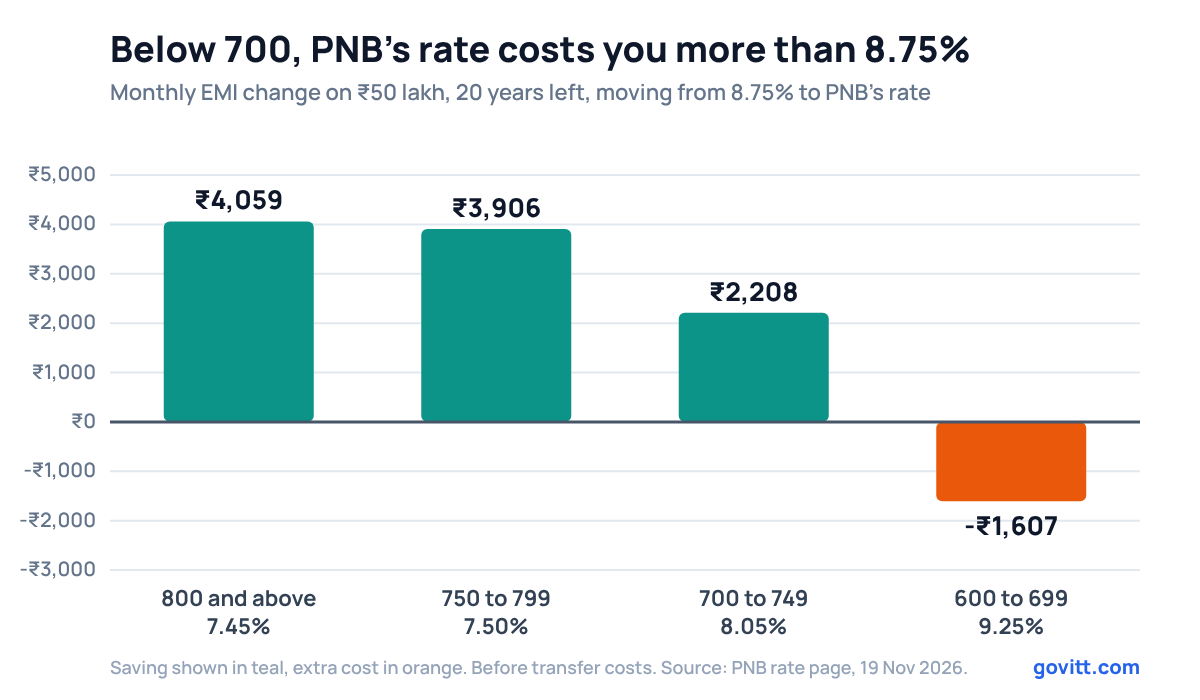
If you currently pay 9.25%, a move to PNB at 7.50% saves ₹5,513 a month. The bigger your current rate, the more a good PNB band is worth.
How long it takes to recover your cost depends on that cost. I'll show three, since Bengaluru costs ran ₹53,700 to ₹76,500 on ₹50 lakh in my breakdown before any waiver.
| Gap to PNB's rate | Monthly saving | Months to recover ₹30,000 | ₹60,000 | ₹80,000 |
|---|---|---|---|---|
| 0.50% | ₹1,583 | 19 | 38 | 51 |
| 0.75% | ₹2,364 | 13 | 26 | 34 |
| 1.00% | ₹3,139 | 10 | 20 | 26 |
| 1.25% | ₹3,906 | 8 | 16 | 21 |
My rule is 24 months or less. At a 0.70% gap, the 700 to 749 case, the saving is ₹2,208 a month, and ₹60,000 comes back in 28 months. That is why I call it borderline. My post on when a transfer is not worth it has the five cases where I'd tell you to stay.
The 4 December risk
PNB is repo-linked. After the RBI's 7 October hike, PNB revised its rate within a day. RBI decides again on 4 December. If it hikes, expect PNB's quote to rise by the same amount quickly, and your sanction should be in a form you've checked: a spread over RLLR, with the reset period in writing. My post on how banks passed on the October hike shows how to check. A hike moves your current rate and PNB's quote together, so the saving above barely changes. I'll cover that decision separately.
What I'd ask PNB, in writing
- My rate at my CIBIL score, loan size and LTV, stated as RLLR plus spread.
- Which date the Utsav waiver uses, and whether it covers my takeover.
- Whether the 5 bps concession exists and whether it is inside the quoted rate.
- Who pays legal and valuation on my takeover, and the cap.
- The reset period and what the rate becomes on 1 January if I am sanctioned in December.
- Foreclosure charges on my floating loan. Floating-rate loans to individuals should carry none, but PNB's fees page doesn't state it, so get it in the sanction letter.
If you also want to compare with the other big PSU quotes, my SBI rate post and Union Bank rate post use the same layout. For all the banks in one place, see the best banks for a balance transfer in 2026.
FAQ
What is the PNB home loan interest rate in November 2026? PNB's page shows 7.45% for CIBIL 800 and above on loans above ₹30 lakh with LTV up to 80%, rising to 9.25% for 600 to 699. The headline rate is under the Utsav campaign running to 31 December 2026.
What CIBIL score do I need for PNB's lowest rate? 800 or higher on a loan above ₹30 lakh. A score of 750 or higher gets 7.50%. On a loan of up to ₹30 lakh with LTV above 80%, 750 and above gets 7.60%, and there is no separate 800+ row.
Does PNB charge a processing fee for a home loan balance transfer? The standard takeover charges are ₹2,500 processing plus ₹1,350 documentation, before GST. PNB has waived both from 1 October to 31 December 2026. Your MODT stamp duty and other costs are separate.
Is the PNB home loan rate fixed or floating? PNB lists both. Floating is RLLR plus a spread and moves at its reset date. The fixed rates on its page are 1.00% above the floating rate in the same band, from 8.45% for the top band.
Will PNB's rate change after the RBI meeting on 4 December? It can. PNB revised its RLLR the day after the October hike. If RBI hikes on 4 December, expect new quotes to move up within a day or two.
Want to see what PNB's band does to your own loan? Run the Payoff & Transfer Calculator with your outstanding amount, rate and years left. GoVitt compares 50+ banks and charges you 0% commission.
Figures are for ₹50 lakh with 20 years left, monthly reducing balance, EMI rounded to the rupee, at the rates in each table. Fees exclude GST unless stated. Transfer costs of ₹30,000, ₹60,000 and ₹80,000 are illustrations. Rates, fees and dates are as shown on PNB's pages on 19 November 2026 and can change. Confirm everything in your sanction letter. This is general information, not financial advice.
Ready to take the next step?
Find out your loan options and check your eligibility with GoVitt today.