
There is no single minimum CIBIL score for home loan approval in India. Bank of Baroda lists a score below 650 among its reasons for rejection, and Kotak says a score below 700 keeps you at higher risk. Yet LIC Housing Finance, PNB and Union Bank of India all publish a rate for scores in the 600s or lower. What changes with your score is mostly the price.
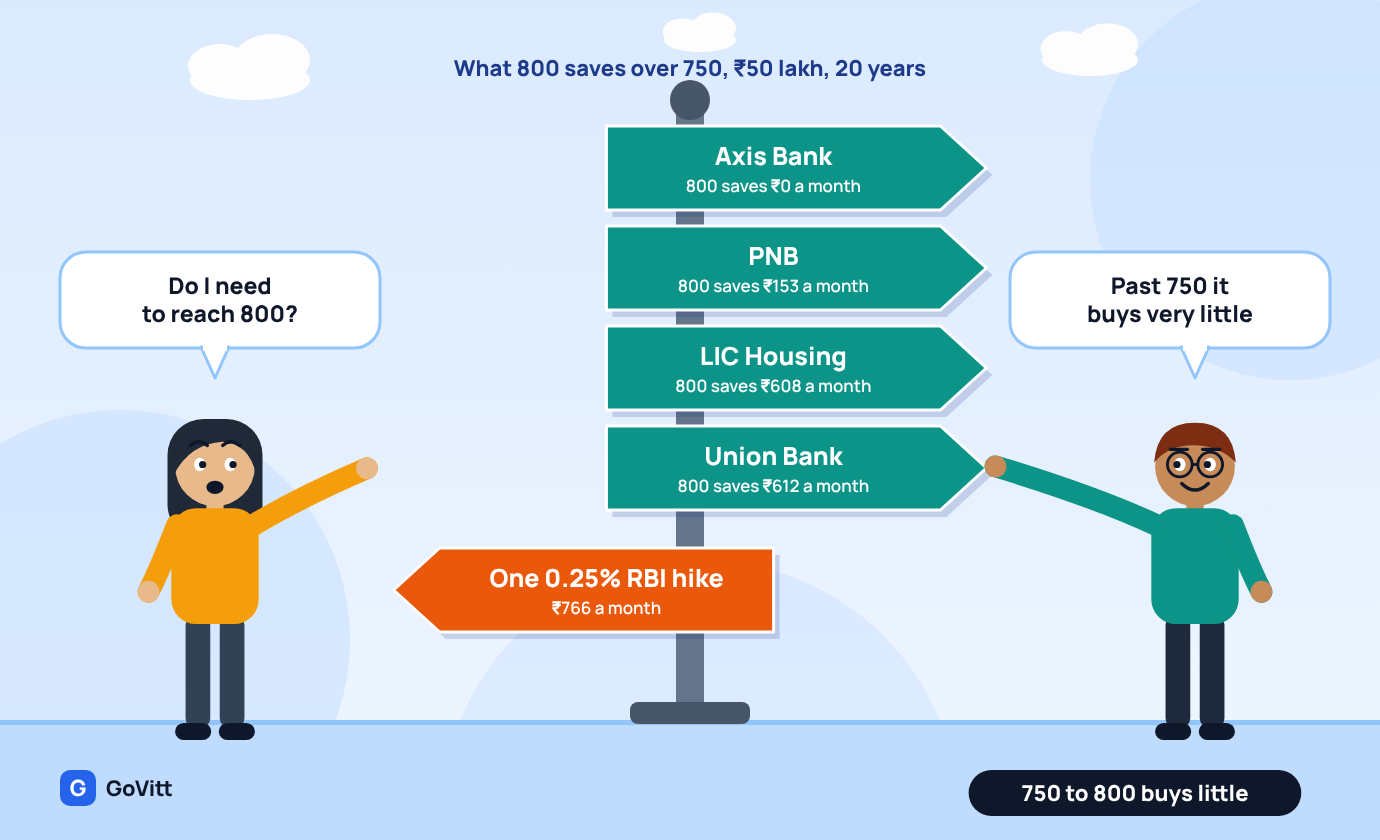
On a ₹50 lakh, 20 year loan at PNB, a score of 800 instead of 750 saves ₹153 a month. A score of 750 instead of one in the 600s saves ₹5,513 a month. So 750 is the line that matters, and 800 is a small prize at most lenders.
Below: where the sources draw the minimum, what 750 vs 800 is worth at four lenders, what slipping below 750 costs, and what I'd do at your score. Rates are from each lender's published pages, checked 22 to 28 October 2026. PNB's are festive campaign rates that run to 31 December.
See your real payoff date in 60 seconds
Banks calculate remaining EMIs by simple subtraction. See your actual payoff date and discover how much interest a balance transfer can save.
The minimum CIBIL score for a home loan, by what each source says
| Source | What it says | Date |
|---|---|---|
| Bank of Baroda | A score below 650 is on its list of rejection reasons; above 701 is treated as creditworthy | Page dated 10 June 2022 |
| Kotak Mahindra Bank | A score below 700 keeps you at higher risk | Page dated 25 June 2026 (its disclaimer says July 2025) |
| PNB | Publishes 9.25% for 600 to 699 | Checked 27 October 2026 |
| Union Bank of India | Publishes 9.60% for 600 to 649 | Sheet updated 8 October 2026 |
| LIC Housing Finance | Publishes 9.55% for below 600 | Checked 22 October 2026 |
| Union Bank of India | Prices "no credit history" (a score of -1, or 1 to 5) at 7.65% to 7.75% | Sheet updated 8 October 2026 |
A published rate is not an approval. Each lender's credit policy decides who gets a sanction, and none of them publishes it. So I treat 650 as the point where a yes gets harder and 750 as the point where the price stops improving much. How a score fits into the wider decision is part of the seven checks banks run, which I've set out in one place.
What 750 vs 800 is worth, lender by lender
Same loan everywhere: ₹50 lakh over 20 years, moving from a 750 band to a band at 800 or above.
| Lender | Rate at about 750 | Rate at 800 and above | Extra EMI at 750 | Extra interest over 20 years |
|---|---|---|---|---|
| Axis Bank | 8.00% (751 and above) | 8.00% | ₹0 | Nil |
| PNB | 7.50% (750 to 799) | 7.45% (800 and above) | ₹153 | ₹0.37 lakh |
| LIC Housing Finance | 7.45% (750 to 774) | 7.25% (800 to 824) | ₹608 | ₹1.46 lakh |
| Union Bank of India | 7.60% to 7.65% (750 to 799) | 7.45% (800 to 824) | ₹459 to ₹612 | ₹1.10 to ₹1.47 lakh |
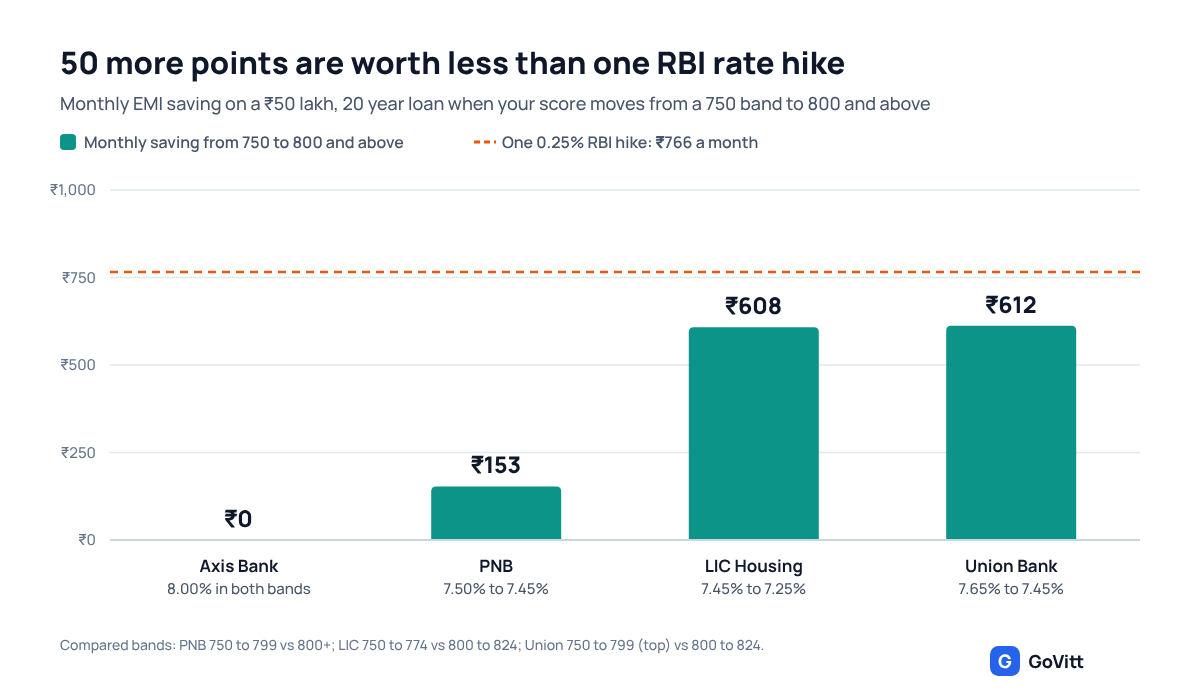
So 50 extra points are worth ₹0 to ₹612 a month on ₹50 lakh. For scale, RBI's October rate rise of 0.25% adds ₹766 a month on the same loan. The whole climb from 750 to 800 is worth less than one rate hike at all four lenders. On a bigger loan it scales: PNB's ₹153 becomes ₹305 a month on ₹1 crore.
Two details. Axis puts its line at 751, not 750, so a score of exactly 750 falls in its dearer band (8.20% to 9.10%). And LIC is the exception to "800 is a small prize". Its grid moves in steps of 0.10% to 0.30% right up to 825. At 825 and above it's 7.15%, which is ₹911 a month and ₹2.19 lakh over 20 years below the 750 to 774 band. The full LIC grid is in LIC Housing Finance home loan interest rate, and the Union Bank grid is in Union Bank home loan interest rate.
What slipping below 750 costs
This is where the money is. Same loan, ₹50 lakh over 20 years, versus each lender's 750 band:
| Move | New rate | Extra EMI | Extra interest over 20 years |
|---|---|---|---|
| LIC: 750 to 774 down to 700 to 724 | 7.95% | ₹1,540 | ₹3.70 lakh |
| PNB: 750 to 799 down to 700 to 749 | 8.05% | ₹1,698 | ₹4.08 lakh |
| LIC: 750 to 774 down to 600 to 699 | 8.75% | ₹4,059 | ₹9.74 lakh |
| PNB: 750 to 799 down to 600 to 699 | 9.25% | ₹5,513 | ₹13.23 lakh |
| LIC: 750 to 774 down to below 600 | 9.55% | ₹6,643 | ₹15.94 lakh |
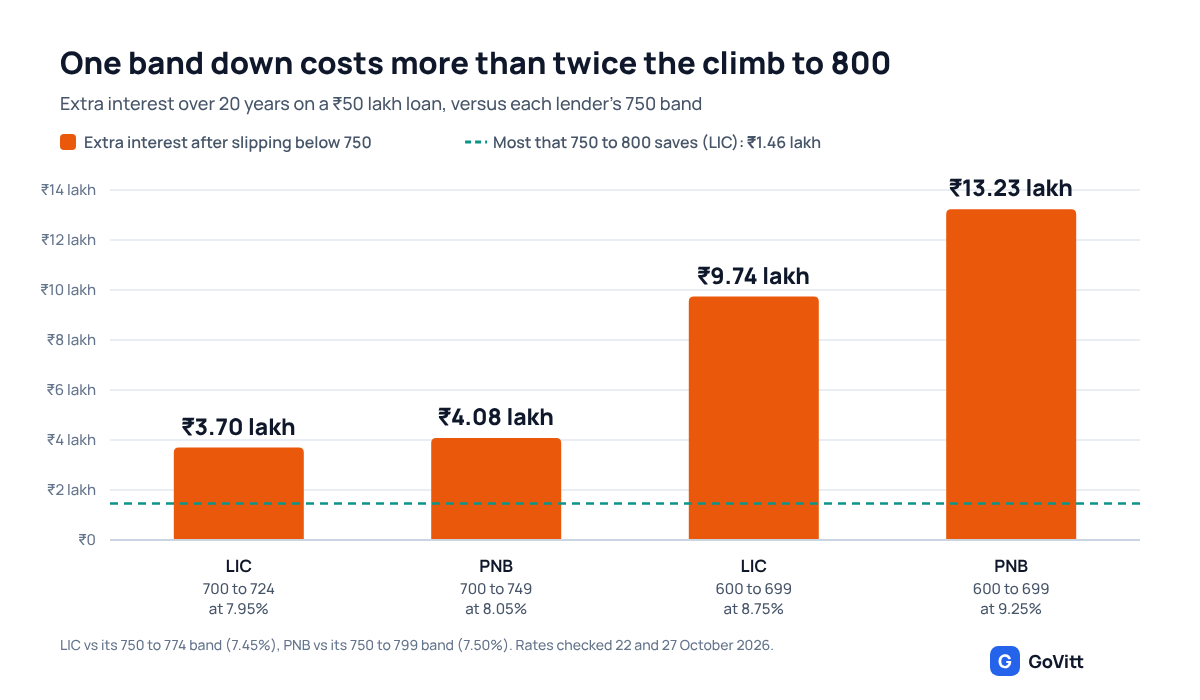
One step below 750 costs more than twice what the whole climb from 750 to 800 saves. The cliffs are lender specific, too. Union prices a score of 679 at 9.10% and 680 at 8.35% at the most, which is ₹2,390 a month and ₹5.74 lakh over 20 years on the same loan. Axis charges 8.20% to 9.10% at 750 and below against 8.00% at 751 and above, which is ₹624 to ₹3,486 a month, and its grid is in Axis Bank home loan interest rate. Compare lenders at your own band, not at the headline. Why your home loan rate is higher than what the bank advertises explains the gap, and RBI moved your home loan rate by 0.25%. Your CIBIL score can move it by 1.80% shows the scale.
What I'd do at your score
800 and above. You're already past the point where the grid pays you much. Use the score to negotiate the spread inside your band and the processing fee, in writing. Union's sheet is the example: the best band is EBLR minus 0.85%, and your spread is set on the sanction day.
750 to 799. Apply. Don't wait for 800 unless LIC is your lender, because the gain is ₹0 to ₹612 a month and rates can move while you wait. The next RBI decision is on 4 December, and I won't guess it.
700 to 749. Fix it first if you can wait a few months. The first step down costs ₹1,540 to ₹1,698 a month on ₹50 lakh, which is ₹3.70 to ₹4.08 lakh over the loan. That is the biggest return on effort in this post.
650 to 699. You'll get quotes, at 8.75% to 9.25% on the grids above. If the purchase can wait, spend the time on your report. If it can't, go in with a smaller loan, a bigger down payment and a lender whose grid you've read. The steps are in can I get a home loan with a 650 CIBIL score.
Below 650. Expect rejections at some lenders and 9% or more at others. Fix the report before you apply anywhere, because each rejected application is another enquiry.
How long a score takes to move
CIBIL lists five factors: payment history, credit utilisation, length of credit history, credit mix and new credit. Payment history is the one you control fastest, by paying every EMI and card bill on time.
The reporting speed is where the sources disagree, so I won't promise a number. RBI's January 2025 directions, as reported, moved lenders to a fortnightly cycle, as of the 15th and the last day of the month, with 7 days to send the data to the bureaus. Some sites say weekly reporting started in 2026. One says 1 April, another says 1 July, and a third reported weekly reporting only as a draft in November 2025. I couldn't open RBI's own document, so I can't tell you which is in force. Plan on 30 to 45 days between paying something off and seeing it on your report, the same window I use in does a home loan balance transfer hurt your CIBIL score. That post also has the dispute steps for a wrong entry.
Enquiries are the other thing people worry about. CIBIL calls their impact minimal, and no bureau publishes a points-per-enquiry figure, so I won't invent one. How long an enquiry stays visible differs by source: up to 2 years at some lenders, up to 36 months at another. The effect fades after about 12 months by Paisabazaar's account, with a full return to normal in 12 to 18 months. Two lenders in the same week is a reasonable test of the market. Five is a signal you're shopping in a panic.
Pull your own report before you apply. RBI's directive of 1 September 2016, in force from 1 January 2017, says each credit bureau must give you one free full report, with the score, in a calendar year.
Before you apply
- Get your free report and read every line. Look for loans that are closed but show as open, and dues that aren't yours.
- Check your band at the lender, not the headline. Use the grids above, and the lender posts linked here.
- Don't open new credit in the months before you apply. New credit is one of the five factors.
- Apply to two lenders in the same week. Ask each which score it prices on if there are two applicants.
- Ask for the lower end of your band in writing. On a ₹50 lakh loan, 0.10% is about ₹306 a month.
- Know your eligibility before you pick a loan size. The way banks size the loan is in how much home loan you can get on your salary.
FAQ
What is the minimum CIBIL score for home loan approval? There is no single minimum. Bank of Baroda lists a score below 650 among its reasons for rejection and Kotak says below 700 keeps you at higher risk, but LIC Housing Finance, PNB and Union Bank publish rates for scores in the 600s and below. Each lender's credit policy decides, and none publishes it.
What is the CIBIL score required for a home loan at the best rate? It depends on the lender. PNB's best rate, 7.45%, starts at 800. LIC's starts at 825 (7.15%). Axis's 8.00% starts at 751. Union's best band, 7.40%, starts at 825.
Is a 750 CIBIL score good for a home loan? Yes, in most cases. 750 is where the price stops improving much. At PNB, 750 to 799 is 7.50% against 7.45% for 800 and above, a gap of ₹153 a month on ₹50 lakh over 20 years. Axis is the one to watch, because its best rate starts at 751.
Is 800 better than 750 for a home loan? Slightly, at most lenders. Moving from a 750 band to 800 or above saves ₹0 to ₹612 a month on ₹50 lakh over 20 years across Axis, PNB, LIC and Union. That is less than one 0.25% RBI hike, which adds ₹766 a month.
Can I get a home loan with a 650 CIBIL score? Possibly, but expect a higher rate. At PNB, 600 to 699 is 9.25% and at LIC, 600 to 699 is 8.75%. Union prices 650 to 679 at 9.10%. Our post on a 650 score has the steps.
Can I get a home loan with no credit history? Some lenders price it kindly. Union Bank prices a score of -1, or 1 to 5, at 7.65% to 7.75%, close to its 750 band. Others may ask for more proof of income. Ask each lender how it treats a first-time borrower.
Want to know which band you're in? Talk to an advisor (free, WhatsApp) and we'll compare lenders at your score. GoVitt compares 50+ banks and charges you 0% commission.
EMIs use the standard monthly reducing balance method and are rounded to the nearest rupee. Examples are for a ₹50 lakh loan over 20 years. Rates are the lowest published for each band and your offer can be higher. PNB's rates are for loans above ₹30 lakh up to 80% of value. Rates were checked between 22 and 28 October 2026 and can change.
Ready to take the next step?
Find out your loan options and check your eligibility with GoVitt today.