
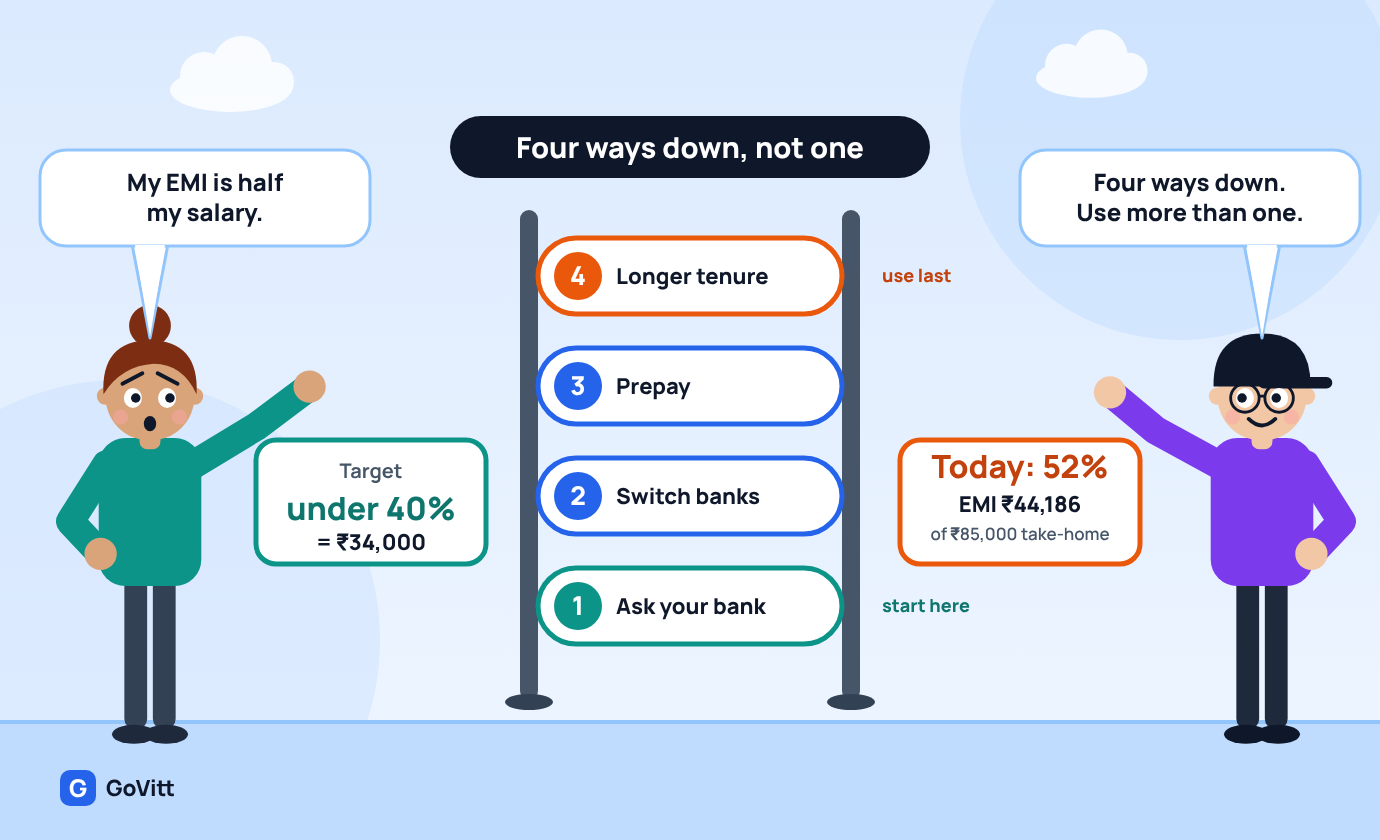
Home loan EMI stress starts when the instalment takes more than half of what lands in your account. Take a Bengaluru borrower with ₹50 lakh left on a home loan, 20 years to go, at 8.75%. The EMI is ₹44,186. On a take-home of ₹85,000, that is 52%.
You have four ways down: ask your own bank for a lower rate, move the loan to another bank, stretch the tenure, or prepay a lump sum. Switching banks is only one of them. On these numbers no single move takes the EMI below 46% of take-home unless you can prepay ₹10 lakh. Three stacked take it to ₹33,255, which is 39%.
Below: the ratio and where the line sits, two checks before you do anything, each move with its EMI and its cost, how they stack, and the order I'd use them in.
See your real payoff date in 60 seconds
Banks calculate remaining EMIs by simple subtraction. See your actual payoff date and discover how much interest a balance transfer can save.
The short version
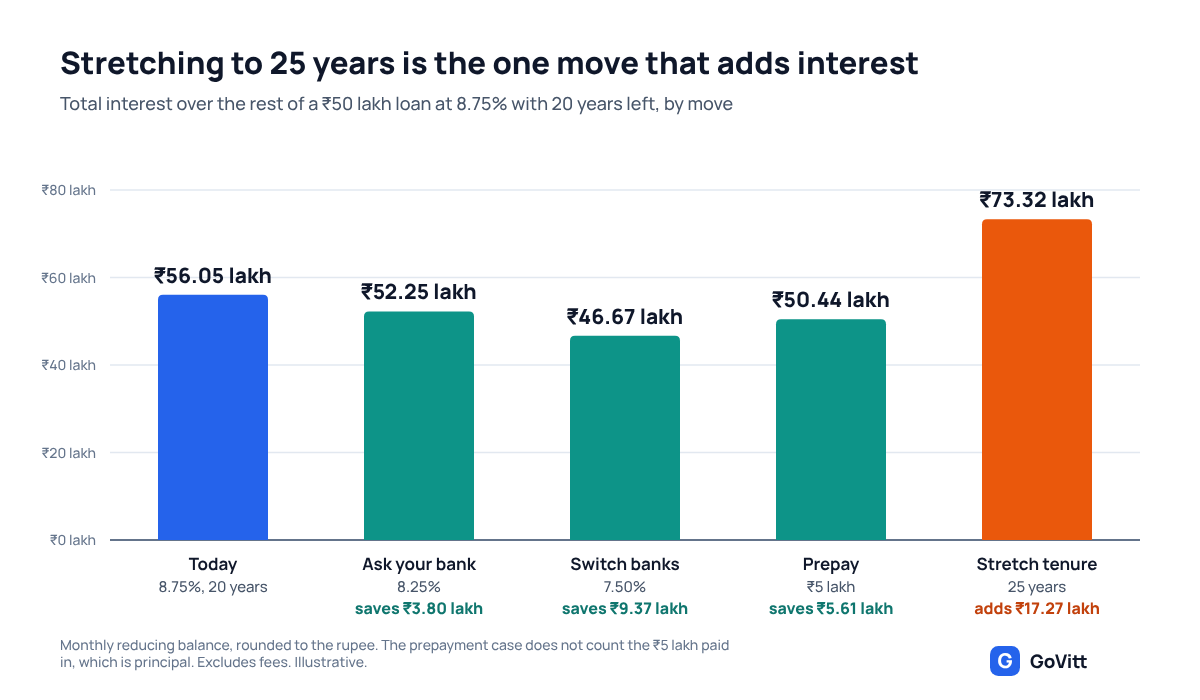
Fix the rate first, because it costs least. Prepay next, if you have cash beyond six EMIs. Use the tenure last, and only as a bridge: stretching to 25 years adds ₹17.27 lakh of interest on this loan.
First, get the number right
The number is your EMI divided by your take-home, the money that reaches your account after tax and PF. Not your CTC. On ₹85,000 a month:
| Share of ₹85,000 take-home | The EMI that equals it |
|---|---|
| 35% | ₹29,750 |
| 40% | ₹34,000 |
| 45% | ₹38,250 |
| 50% | ₹42,500 |
| 55% | ₹46,750 |
Banks allow roughly 40% to 55% of take-home for EMIs when they approve a loan, as I set out in home loan eligibility: the 7 checks banks run before they say yes. Being approved at 52% doesn't make 52% safe. The ceiling I use is 35% to 40%, so one bad month doesn't turn into a missed EMI.
This EMI is ₹1,686 over 50% and ₹10,186 over 40%. Count every EMI, not just the home loan. Add a ₹10,000 car or personal loan EMI and the real ratio is 64%.
Home loan EMI struggles in Bengaluru often get blamed on the 7 October repo hike. Look at how small the hike was. RBI took the repo rate to 5.50%, and on this loan that added ₹795 a month. The gap that hurts is the one between your rate and a new borrower's rate, and between your EMI and your budget.
Two checks before the four moves
- Are you about to miss an EMI? Don't wait for the due date to pass. Call your bank's home loan service team before it and ask, in writing, what it can offer. I couldn't find a current RBI scheme that obliges a lender to restructure an individual's home loan on request, so any relief is the lender's call. Ask what it would report to the credit bureau before you accept anything.
- Is there costlier debt in the same ratio? Card balances and personal loan EMIs sit inside the same 50%. They usually cost more than a home loan, so a rupee freed there often does more than a rupee freed here. Clear those first if you can.
The four moves at a glance
Base case: ₹50 lakh outstanding, 240 EMIs left, 8.75%, take-home ₹85,000.
| Move | New EMI | Share of take-home | Monthly relief | What it costs to do | Interest over the rest of the loan |
|---|---|---|---|---|---|
| Today | ₹44,186 | 52.0% | Nil | Nil | ₹56.05 lakh |
| 1. Ask your bank for 8.25% | ₹42,603 | 50.1% | ₹1,583 | About ₹5,900 | ₹52.25 lakh |
| 2. Switch to a bank at 7.50% | ₹40,280 | 47.4% | ₹3,906 | ₹53,700 to ₹76,500 | ₹46.67 lakh |
| 3. Stretch to 25 years | ₹41,107 | 48.4% | ₹3,079 | Ask your bank | ₹73.32 lakh |
| 4. Prepay ₹5 lakh | ₹39,767 | 46.8% | ₹4,419 | ₹5 lakh of cash | ₹50.44 lakh |
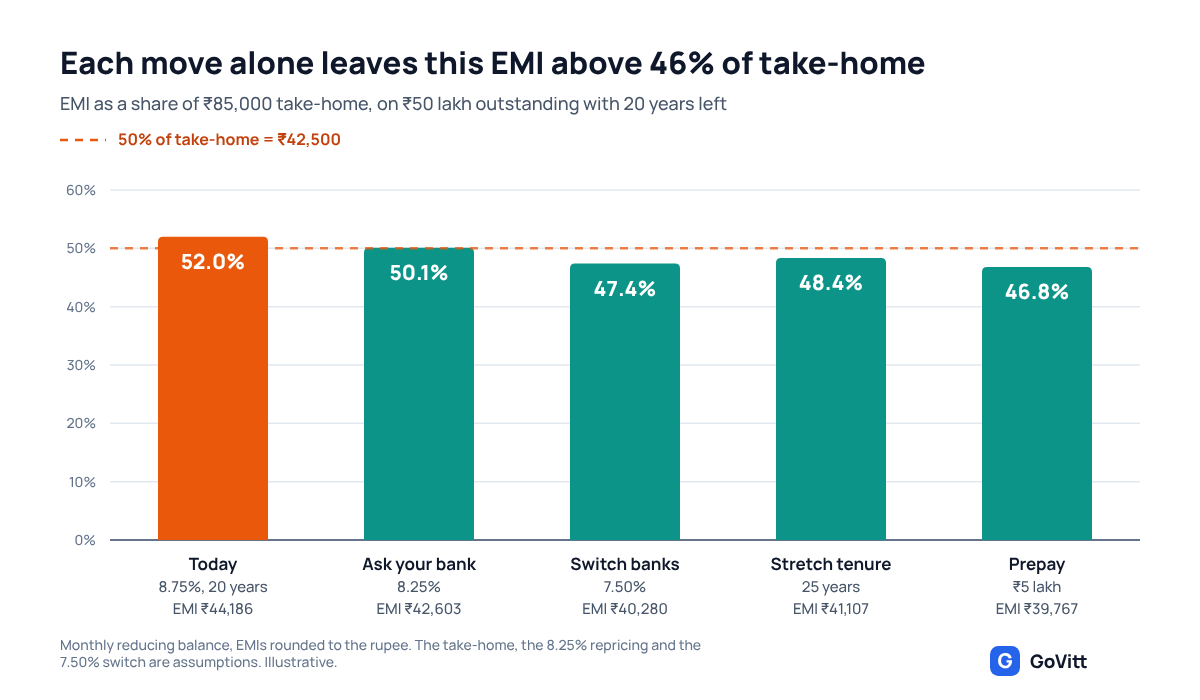
Move 3 is the only one that costs you more over the loan. Move 4 saves the most interest but uses up cash. Move 1 is the cheapest and moves the least.
Move 1: ask your own bank for a lower rate
Banks often price a new borrower below the spread in your sanction letter. Most have a published fee to move an existing borrower to the current rate. SBI lists ₹5,000 plus GST, HDFC Bank the lower of 0.25% of the principal or ₹5,000, and ICICI Bank ₹3,000 plus GST (pages read 15 to 21 October 2026). On ₹50 lakh that is ₹3,540 to ₹5,900 with GST.
If your bank's current rate for your score is 8.25%, you move from 8.75% and the EMI drops to ₹42,603. That saves ₹1,583 a month, and the ₹5,900 comes back in 4 months. It also moves the ratio from 52.0% to 50.1%. That is a small move, and it is the cheapest one on the list. Why the gap exists, and how to find yours, is in why your home loan rate is higher than what the bank advertises. Send the request in writing, and ask for the new spread and the date it applies from.
Move 2: switch to a cheaper bank
A home loan balance transfer to a lender at 7.50% takes the EMI to ₹40,280, which is ₹3,906 less and 47.4% of take-home. SBI's lowest published rate is 7.50%, and it needs a top score, so check your slab before you plan on it.
The cost is real. In Bengaluru, moving a ₹50 lakh loan costs ₹53,700 to ₹76,500 all in, because the new lender's processing fee, legal and valuation charges come on top of a new mortgage in Karnataka (stamp duty of 0.5% plus about 0.1% registration, ₹30,000 on ₹50 lakh). The line-by-line is in home loan balance transfer charges: every fee you'll pay. At ₹3,906 a month, the cost comes back in 14 to 20 months.
If your own bank has already agreed to 8.25%, the extra gain from moving to 7.50% is ₹2,323 a month, and the cost takes 24 to 33 months to come back. Do Move 1 first and re-run the numbers. A transfer for a gap of 0.25% rarely pays, which I worked through in rates just went up: does switching your home loan still make sense?. Banks and housing finance companies price differently; best banks for home loan balance transfer in 2026 compares them.
Move 3: stretch the tenure
Of the four moves, this one gives the relief fastest and costs the most.
| Tenure left | EMI | Share of take-home | Monthly relief | Total interest | Extra interest vs 20 years |
|---|---|---|---|---|---|
| 20 years (today) | ₹44,186 | 52.0% | Nil | ₹56.05 lakh | Nil |
| 25 years | ₹41,107 | 48.4% | ₹3,079 | ₹73.32 lakh | ₹17.27 lakh |
| 30 years | ₹39,335 | 46.3% | ₹4,851 | ₹91.61 lakh | ₹35.56 lakh |
RBI's August 2023 framework on floating rate resets covers floating rate home loans. At each reset, a lender has to offer you a choice: switch to a fixed rate, change the EMI, the tenure or both, or prepay part or full. Your bank also sets a default that applies if you say nothing. After a hike that default is often a longer tenure, which is how a loan you thought had 15 years left ends up with 18. I covered how to check yours in you think 15 years are left on your home loan, the math says 18 and banks took one day to pass on RBI's rate hike.
Your age caps the tenure the bank will give you, so ask for its maximum age at maturity before you plan on 30 years. If you do stretch, take the longer tenure on paper and keep paying the old EMI whenever you can. The difference goes straight to principal.
Move 4: prepay a lump sum
Floating rate home loans to individuals carry no prepayment charge, as I explained in your bank can't charge you for prepaying a floating rate home loan. So the only cost is the cash.
| Lump sum | New EMI | Share of take-home | Monthly relief | Interest saved |
|---|---|---|---|---|
| ₹2 lakh | ₹42,418 | 49.9% | ₹1,768 | ₹2.24 lakh |
| ₹5 lakh | ₹39,767 | 46.8% | ₹4,419 | ₹5.61 lakh |
| ₹10 lakh | ₹35,348 | 41.6% | ₹8,838 | ₹11.21 lakh |
These figures assume the bank re-works the EMI over the same 240 months. Say in writing that you want the EMI lowered, not the tenure shortened. The trade-off between the two is in part-prepaying your home loan: reduce the EMI or the tenure.
Don't empty your cash to do it. Six EMIs here is ₹2.65 lakh, and I wouldn't take your savings below that. And don't fund a prepayment from a card or a personal loan. That swaps a cheaper debt for a dearer one.
Stacking the moves
One move rarely gets you where you need to be. Stacked, they do:
| Combination | New EMI | Share of take-home | Monthly relief | Interest over the rest of the loan |
|---|---|---|---|---|
| Ask your bank (8.25%) + 25 years | ₹39,423 | 46.4% | ₹4,763 | ₹68.27 lakh |
| Switch (7.50%) + 25 years | ₹36,950 | 43.5% | ₹7,236 | ₹60.85 lakh |
| Switch (7.50%) + 30 years | ₹34,961 | 41.1% | ₹9,225 | ₹75.86 lakh |
| Switch (7.50%) + prepay ₹5 lakh | ₹36,252 | 42.6% | ₹7,934 | ₹42.00 lakh |
| Switch (7.50%) + prepay ₹5 lakh + 25 years | ₹33,255 | 39.1% | ₹10,931 | ₹54.77 lakh |
The last row is the only one under 40%. It costs ₹53,700 to ₹76,500 in fees and ₹5 lakh of cash. Over the rest of the loan it pays ₹54.77 lakh of interest against ₹56.05 lakh today. The ₹5 lakh you pay in is principal, not a cost. Add the fees and the stack still comes out about ₹0.52 lakh to ₹0.74 lakh cheaper in interest and charges, with an EMI ₹10,931 lower. The prepayment and the lower rate carry the longer tenure.
What I wouldn't do
- Take a personal loan to pay the EMI. It moves the problem to a higher rate.
- Switch banks for 0.25%. The cost won't come back before the next rate move.
- Let the tenure drift. Check your statement for the months left, not just the EMI.
- Go quiet. A missed EMI shows up on your credit report. A call before the due date doesn't.
What I'd do this week
- Write down your real ratio. Home loan EMI plus every other EMI, divided by take-home.
- Ask your own bank, in writing, for the current rate for your score, the fee and the date it applies from.
- Get one competing offer. Without a real number, your bank has no reason to move.
- Decide the lump sum you can spare after six EMIs of cash.
- Use the tenure last, and keep paying the old EMI when you can.
- Re-run the numbers after 4 December, when RBI next meets.
FAQ
What is home loan EMI stress, and how do I know I have it? There is no official line. Banks approve EMIs of roughly 40% to 55% of take-home, and I use 35% to 40% as a safe ceiling. At 52%, as in this example, one unplanned bill can push you into a missed EMI. Divide your EMI plus all other EMIs by your take-home.
How much of my salary should go to home loan EMI? My ceiling is 35% to 40% of take-home. On ₹85,000 that is ₹29,750 to ₹34,000. Banks will often approve more, up to about 50% or 55%, but approval isn't the same as comfort.
Home loan EMI too high: what to do? Four moves: ask your bank for its current rate, switch to a cheaper lender, stretch the tenure, or prepay a lump sum. On ₹50 lakh at 8.75% with 20 years left, they take the EMI to ₹42,603, ₹40,280, ₹41,107 and ₹39,767. Stacked, three get you to ₹33,255.
Is it better to extend the tenure or prepay? Prepaying costs cash and saves interest: ₹5 lakh cuts the EMI by ₹4,419 and the interest by ₹5.61 lakh. Extending costs nothing now and adds interest: 25 years adds ₹17.27 lakh. Prepay if you have cash beyond six EMIs. Extend only as a bridge.
What if I can't pay my EMI this month? Call the bank before the due date and put your request in writing. I couldn't find a current RBI scheme that makes a lender restructure on request, so any relief is the lender's call. Ask what it will report to the credit bureau.
Will a balance transfer reduce my EMI? Yes, if the new rate is lower. Moving ₹50 lakh from 8.75% to 7.50% cuts the EMI by ₹3,906 and costs ₹53,700 to ₹76,500 in Bengaluru, which comes back in 14 to 20 months.
Want your own numbers? Run the Payoff & Transfer Calculator to see your payoff date and what a switch would save. Or see how the moves work in the home loan EMI calculator. GoVitt compares 50+ banks and charges you 0% commission.
Method: monthly reducing balance, EMIs rounded to the nearest rupee, ₹50 lakh outstanding with 240 EMIs left. The ₹85,000 take-home, the 8.25% repricing and the 7.50% switch are assumptions, not quotes. Fees are lender published figures read between 15 and 21 October 2026, with 18% GST. The Bengaluru switching cost of ₹53,700 to ₹76,500 is from GoVitt's balance transfer charges post. In the prepayment case, interest saved does not count the lump sum you paid in. Your lender's rates, fees and rules will differ, so check your sanction letter. This is information, not financial advice.
Ready to take the next step?
Find out your loan options and check your eligibility with GoVitt today.