
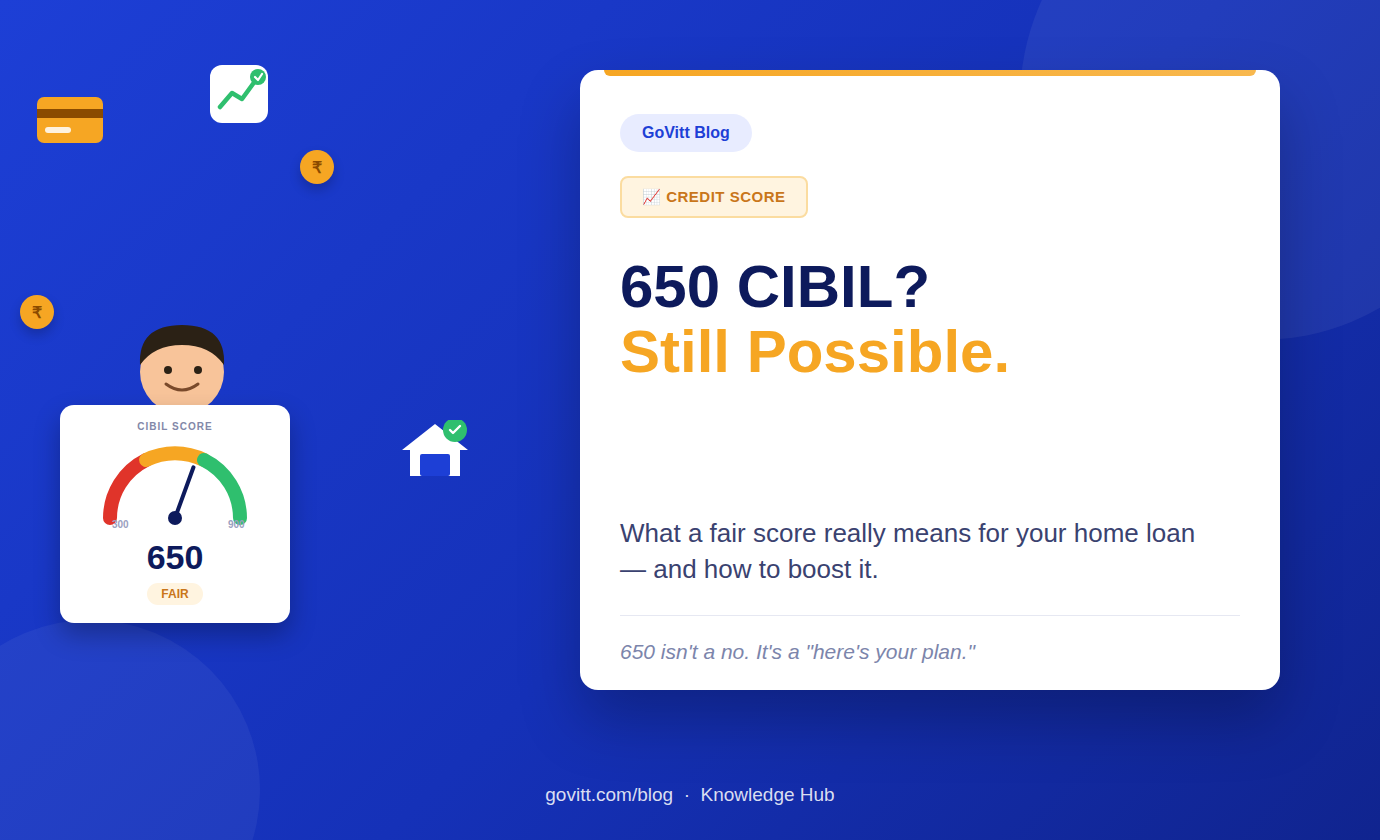
If your CIBIL score is sitting around 650, you've probably already had the slightly sinking feeling that comes with reading those "750+ recommended" articles. Most home loan content online is written for people with sparkling credit, which isn't very useful when your score is somewhere in the middle.
Here's the short version: yes, you can usually still get a home loan with a 650 score. It's not the easiest path, you won't get the lowest rate on the market, and the approval will probably involve more questions than someone with a higher score would face. But the doors aren't shut.
Banks look at a lot more than just that three-digit number. Your salary, how stable your job is, what other EMIs you're already paying, the property you're buying, your repayment track record — all of it goes into the decision. A 650 score with strong income and clean repayment behaviour often beats a 720 score with a messy debt situation.
See your real payoff date in 60 seconds
Banks calculate remaining EMIs by simple subtraction. See your actual payoff date and discover how much interest a balance transfer can save.
Let's get into what actually matters when you apply.
What's a "good" CIBIL score for a home loan, really?
CIBIL scores range from 300 to 900, and lenders roughly slot borrowers into buckets based on where they fall:
| CIBIL Score | What lenders typically think |
|---|---|
| 750+ | Excellent - best rates, fast approval |
| 700–749 | Good - standard rates, usually smooth |
| 650–699 | Moderate - possible, but expect scrutiny |
| 600–649 | Difficult - possible with the right profile |
| Below 600 | High rejection risk |
A score of 650 lands you in the "moderate" zone. In practice that means:
- You're not auto-rejected the moment your application is opened
- The lender will look at your file more closely than they'd look at someone with 780
- You might be quoted a slightly higher rate than the headline number
- Some banks may ask for additional documents or want a co-applicant
It's a workable starting point, not a death sentence.
So can you actually get the loan?
Most of the time, yes. Several banks and pretty much every NBFC will entertain your application at 650, but whether they say yes depends on a handful of other things working in your favour.
1. Your income, and how steady it is
A solid salary genuinely matters here, sometimes more than the score itself.
Picture two borrowers, both with a 650:
- One earns ₹80,000 a month from a known company, has been there four years, and pays ₹8,000 in existing EMIs
- The other earns ₹45,000 from a small firm, switched jobs twice in two years, and pays ₹15,000 in EMIs
Same score, completely different outcomes. The first one will likely get approved without much drama. The second is going to face a much harder time, possibly a rejection.
2. How much you already owe
Banks calculate your debt-to-income ratio, basically, what share of your monthly income is already going towards EMIs. Add up your car loan, any personal loan, your credit card minimums, and whatever else you're paying.
The general comfort zone for lenders is total EMIs (including the new home loan) staying under 40 to 50% of your monthly income. Cross that and the bank starts getting nervous, regardless of your score.
If you're close to that ceiling, paying off a small loan or two before applying can free up enough room to push your application through.
3. Job stability
Lenders quietly love boring, predictable employment.
- Same company for 3+ years? They like that.
- Recent job change? They'll ask why.
- Three job changes in two years? They'll wonder if you can hold one down through a 20-year loan.
- Probation period? Many will ask you to wait it out.
Working at a known, established employer also helps. Some banks have internal employer "tiers," and you'll get more favourable treatment if your company is on the better lists.
4. The property itself
This is the part borrowers underestimate. The bank isn't just lending to you, they're lending against the property. If the property is sketchy, even a perfect borrower gets rejected.
Banks are most comfortable with:
- Properties with clean, verified legal documentation
- Builders they already approve
- Ready-to-move flats over under-construction ones
- Properties in pockets they're familiar with financing
A disputed title, a builder with a chequered history, or an unapproved layout can sink your application even if your finances look fine.
5. How much you're putting down
A bigger down payment changes the lender's math entirely. If you're putting in 25 to 30% upfront instead of the bare minimum 10 to 15%, the bank is taking on much less risk, and they'll often approve a 650-score borrower they would've turned away otherwise.
It's also one of the few levers you fully control going into the conversation.
Why is your score 650 in the first place?
This question matters more than people realise. Banks don't just look at the number, they pull your full credit report and read it. A 650 caused by one missed payment three years ago tells a very different story than a 650 caused by ongoing high credit card balances and recent defaults.
Common reasons scores end up around 650:
- A few late EMI payments somewhere in your history
- Credit cards regularly running close to their limits
- A loan that got "settled" in the past instead of fully repaid
- Multiple loan applications in a short window (each one is a hard enquiry)
- A skipped credit card bill that's still showing
- Just a short overall credit history and not enough track record yet
Some borrowers damage their score without realising it. Using 80–90% of your card limit every month, even if you pay it off, can drag the score down. Applying to several lenders to "see who gives the best offer" creates multiple hard enquiries that all hurt. Even one missed EMI can knock 50 to 70 points off, depending on your starting point.
If you can pull your full credit report and figure out the why, you'll know whether you're looking at a quick fix (an error to dispute, a card to pay down) or a longer rebuild.
What rate will you actually pay?
Honestly, slightly higher than someone with a higher score. That's the whole logic of risk-based pricing, if the lender thinks there's a higher chance of default, they charge more to compensate.
Rough idea of how rates shake out:
| CIBIL Score | What you can expect |
|---|---|
| 750+ | The lowest available rates |
| 700–749 | Standard rates, no premium |
| Around 650 | A slight premium over standard |
That premium might only be 0.25 to 0.75 percentage points, which doesn't sound like a lot. But play it out:
On a ₹40 lakh loan over 20 years, even a half-percent rate difference can add up to several lakh rupees in extra interest by the time you're done. So if you can push your score from 650 to 700 over a few months before applying, that's not a vanity exercise, it's real money.
Practical things you can do to improve your odds
Pay everything on time, religiously, for the next few months
This is the simplest lever and also the most powerful. Three to six months of clean, on-time payments on every existing loan and credit card can move the needle visibly. Lenders also pay attention to recent behaviour, not just the cumulative score.
Bring credit card usage down
Aim to keep utilisation under 30% of your total credit limit. So if your cards collectively give you ₹2 lakh in limit, try not to carry balances above ₹60,000 at any point.
High utilisation flags financial stress, even if you pay in full every month. The score is calculated on what's reported to the bureau on the statement date, not after you pay.
Don't apply to ten banks at once
This is the mistake that quietly tanks scores. Every formal application creates a hard enquiry. A handful of those in a short window can drag your score down by 30 to 50 points and make lenders think you're desperate for credit.
Instead of running between banks, platforms like GoVitt let you compare loan options across multiple lenders without each comparison triggering a hard enquiry. You see what fits your profile before you commit to a formal application.
Add a co-applicant if you can
Roping in a spouse, parent, or earning sibling, especially one with a stronger credit score, changes how the application looks to the lender. Their income gets added in, their credit profile balances yours, and your eligibility goes up.
Just remember: a co-applicant is jointly responsible for the loan. If you miss payments, it shows up on their credit report too. Have the conversation properly before pulling them in.
Bring more cash to the down payment
Already covered above, but worth saying again. A bigger down payment is the single fastest way to make a 650-score profile look more attractive without actually waiting to fix the score.
Should you just wait it out and apply later?
This is the question that depends entirely on your specific situation.
Apply now if:
- You've found a property that's unlikely to wait around
- Your income is steady and your existing EMIs are manageable
- Your repayment behaviour over the last few months has been clean
- You can comfortably afford the EMI even at a slightly higher rate
Consider waiting if:
- You've missed a payment in the last few months
- You're carrying heavy credit card balances right now
- Your score is still trending down rather than recovering
- You realistically think you can get to 700+ in 6 to 12 months
Going from 650 to 700 isn't a small jump in lender perception. It can unlock noticeably better rates, larger loan amounts, and a much smoother approval. If you have the luxury of time, that improvement is often worth the wait.
If you don't have the luxury, the property is moving, your rent is rising, life is happening — then apply now and accept the slight rate premium as the cost of doing business.
Mistakes to avoid before applying
Not checking your credit report for errors first. This happens more than you'd think. Closed loans showing as still open, duplicate entries, late payments wrongly recorded against you. Pull your report, read it carefully, and dispute anything that's wrong. A successful dispute can bump your score in a few weeks.
Taking a personal loan right before applying. People sometimes take a personal loan to fund the down payment. The bank sees the new EMI and immediately reduces your home loan eligibility, sometimes by quite a lot. If you're thinking of doing this, talk to a consultant or comparison platform first — there are usually better ways.
Closing old credit cards out of habit. Older accounts contribute to your credit history length, which is one of the factors in your score. Closing a card you've had for eight years to "tidy up" can actually drop your score. Keep old cards open, even if you barely use them.
Applying without checking eligibility first. A lot of people fill out applications hoping for the best and end up rejected. Each rejection sits on your record and hurts the next application. Use eligibility checkers (which are soft enquiries, no impact) to see where you actually stand before formally applying anywhere.
Are NBFCs easier than banks at 650?
Often, yes. NBFCs and housing finance companies tend to be more flexible than banks for borrowers in the 650–700 range. They'll look at things banks sometimes won't, alternative income patterns, stronger property collateral, overall financial behaviour rather than just the score.
The trade-off is rate. NBFCs typically charge a bit more than banks, and processing fees can be steeper too. Sometimes that's a fair price to pay for getting the loan you actually need. Other times, working on the score for a few months and going to a bank is the cheaper play.
The honest answer is: try the banks first. If they don't work out, NBFCs are your fallback. Don't default to an NBFC out of convenience, you'll feel that rate difference every month for the next 20 years.
Key takeaways
- Yes, a home loan at 650 CIBIL is realistic for most borrowers
- Approval hinges on income, existing EMIs, property quality, and repayment history more than the score alone
- Expect a slightly higher rate than someone with a 750
- Cleaning up credit card utilisation and paying every EMI on time for a few months before applying can meaningfully change your offer
- A bigger down payment and a strong co-applicant both help noticeably
- Compare lenders before formally applying, multiple hard enquiries make the situation worse
Conclusion
A 650 score is a hurdle, not a wall. Plenty of borrowers with moderate credit successfully get home loans every year by being smart about how they approach the process, strengthening income proof, reducing existing debt, fixing credit report errors, picking the right property, and choosing the right lender for their profile.
The score is one input. Your overall financial story is what actually decides the outcome.
Before applying, take a few hours to look at your full picture, score, repayment history, debt-to-income ratio, down payment capacity. Then compare lenders properly. Platform like GoVitt let you weigh different home loan options against each other in one place, so you can see who's likely to approve your specific profile rather than going branch to branch hoping for a yes.
A bit of preparation now translates directly into a better rate and a more comfortable EMI for the next two decades. Worth the effort.
FAQs
Does checking my own CIBIL score reduce it?
No. Checking your own score is treated as a "soft enquiry" and has no impact on the score itself. Check it as often as you like, in fact, you should, just to know where you stand.
Can I get a home loan if I had a loan settlement in the past?
It's possible, but harder. A "settled" account is a flag, it tells lenders you didn't repay the loan in full and the lender accepted a partial amount to close it out. Banks treat that as a significant negative. Some will still approve you, possibly at a higher rate, often with a co-applicant or a bigger down payment. NBFCs tend to be more flexible on settlements than banks. Be honest about it on your application, they'll see it on the report anyway.
Do private banks and public sector banks treat CIBIL scores differently?
Yes, somewhat. Different lenders have different internal cutoffs and risk policies. Public sector banks tend to be stricter on the score itself, while some private banks and NBFCs are more willing to work with moderate scores if your other parameters are strong. There's no universal answer, it varies bank by bank.
Will a shorter loan tenure improve approval chances?
Not necessarily, and sometimes it hurts. A shorter tenure means a higher EMI, which means a worse debt-to-income ratio, which makes you less eligible. Lenders mostly care about whether your income comfortably covers the EMI, and a longer tenure with a smaller EMI is often easier to approve than a punchy short-tenure loan.
Can self-employed borrowers get approved with a 650 score?
Yes, but expect more digging. For self-employed applicants, lenders look closely at business stability, GST returns, the last 2–3 years of bank statements, and whether income is consistent or all over the place. A 650 score with two years of solid, growing business income is workable. The same score with erratic income across years is much harder.
Does renting a house affect home loan approval?
Renting on its own doesn't hurt anything. But the rent you pay does count as a monthly expense when the bank calculates how much EMI you can afford. So if your rent is high, your eligibility will be a bit lower than someone with the same salary but no rent.
Ready to take the next step?
Find out your loan options and check your eligibility with GoVitt today.