
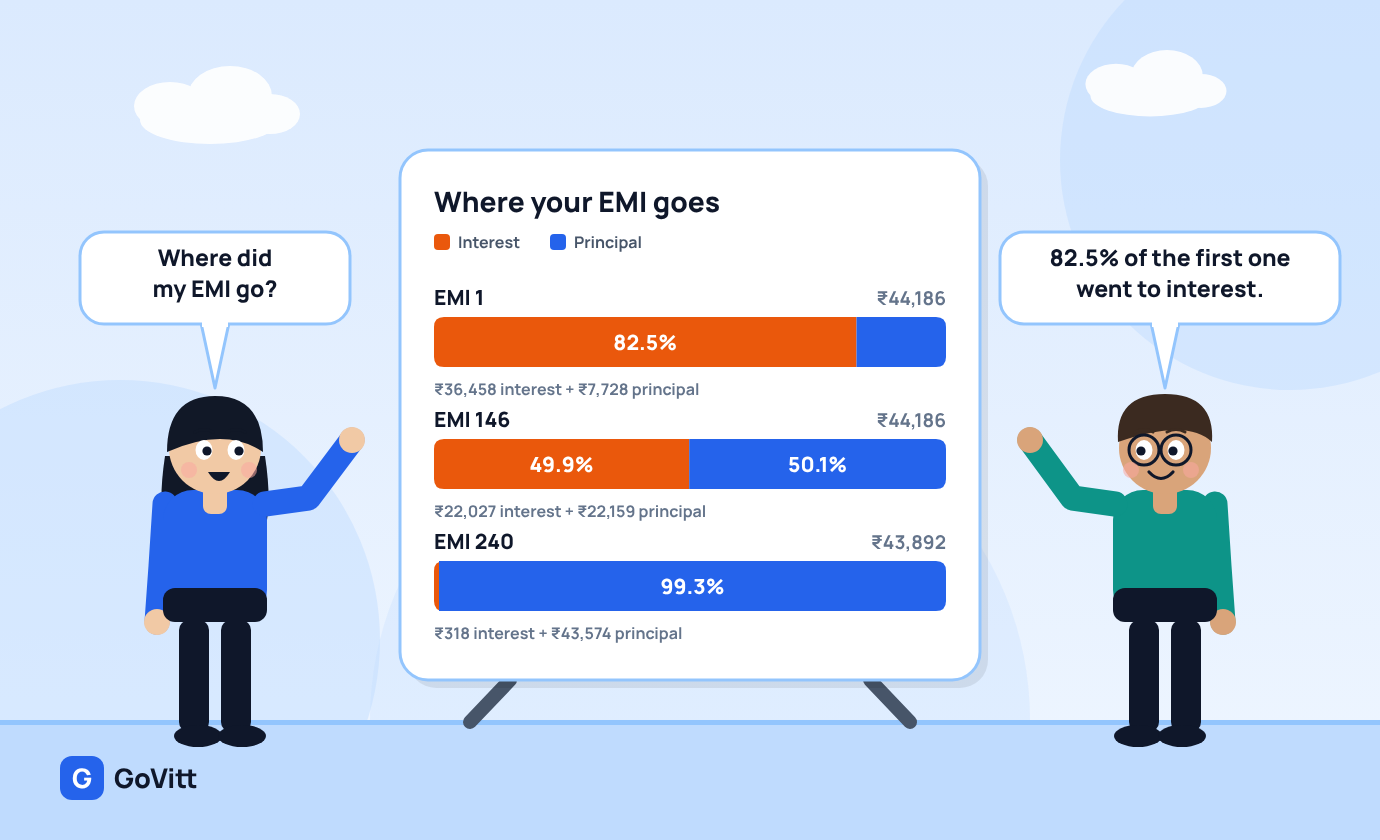
Your home loan amortization schedule is the table your bank can give you that splits every EMI into interest and principal, and shows what you still owe after each one. On a ₹50 lakh loan at 8.75% over 20 years, the first EMI of ₹44,186 is ₹36,458 interest and only ₹7,728 principal. That is 82.5% of your first payment gone to the bank, and almost nobody looks at the table that says so.
You can ask for it any time, and I'd use it twice: once when you sign, to see the true shape of the loan, and once after every rate change, to see whether your bank moved your EMI or your tenure. Below: how to read a home loan repayment schedule line by line, what the numbers look like at months 1, 60, 146 and 240, what a rate hike does to it, and the five things I check each time.
The short answer
A schedule has one row per EMI and five columns. Read it like this:
See your real payoff date in 60 seconds
Banks calculate remaining EMIs by simple subtraction. See your actual payoff date and discover how much interest a balance transfer can save.
| Column | What it tells you | What to check |
|---|---|---|
| Month (or date) | Which EMI this row is | That the count matches your tenure |
| EMI paid | The cash you pay | That it matches your last debit |
| Interest | The part that rents the money | That it is the balance times the monthly rate |
| Principal | The part that reduces the loan | That it grows each month |
| Balance | What you still owe after this EMI | That it matches your lender's statement |
The rule behind every row: interest = last month's balance × annual rate ÷ 12. Principal is the EMI minus that interest. The balance falls by the principal, and the next month's interest is lower.
What the schedule looks like on a ₹50 lakh loan
Take ₹50 lakh at 8.75% for 20 years (240 EMIs). The EMI is ₹44,186 and you pay ₹1,06,04,346 in all, of which ₹56,04,346 is interest. These are the rows that matter.
| EMI number | Interest | Principal | Interest share of the EMI | Balance after |
|---|---|---|---|---|
| 1 | ₹36,458 | ₹7,728 | 82.5% | ₹49,92,272 |
| 2 | ₹36,402 | ₹7,784 | 82.4% | ₹49,84,488 |
| 3 | ₹36,345 | ₹7,841 | 82.3% | ₹49,76,647 |
| 12 | ₹35,815 | ₹8,371 | 81.1% | ₹49,03,455 |
| 60 | ₹32,323 | ₹11,863 | 73.2% | ₹44,20,957 |
| 120 | ₹25,841 | ₹18,345 | 58.5% | ₹35,25,541 |
| 146 | ₹22,027 | ₹22,159 | 49.9% | ₹29,98,632 |
| 180 | ₹15,818 | ₹28,368 | 35.8% | ₹21,40,890 |
| 240 (last EMI, ₹43,892) | ₹318 | ₹43,574 | 0.7% | ₹0 |
Three things to notice:
- The early years are almost all interest. After 5 years you have paid ₹26,51,160 and reduced the loan by only ₹5,79,043. The balance is still ₹44,20,957.
- The crossover comes at 12 years. Principal overtakes interest only from EMI 146, which is 12 years and 2 months in. The balance doesn't fall below half until EMI 167, nearly 14 years in.
- The last EMI is different. EMI 240 is ₹43,892, not ₹44,186, because it clears the last rupees. That's normal, and it's the sort of row to expect.
Year by year
Banks usually show a yearly summary too. Here's the same loan, one line per year, for the years that tell the story:
| Year | Interest paid | Principal repaid | Interest share | Balance at year end |
|---|---|---|---|---|
| 1 | ₹4,33,687 | ₹96,545 | 81.8% | ₹49,03,455 |
| 2 | ₹4,24,895 | ₹1,05,337 | 80.1% | ₹47,98,118 |
| 5 | ₹3,93,407 | ₹1,36,825 | 74.2% | ₹44,20,957 |
| 10 | ₹3,18,645 | ₹2,11,587 | 60.1% | ₹35,25,541 |
| 15 | ₹2,03,042 | ₹3,27,190 | 38.3% | ₹21,40,890 |
| 20 | ₹24,275 | ₹5,05,663 | 4.6% | ₹0 |
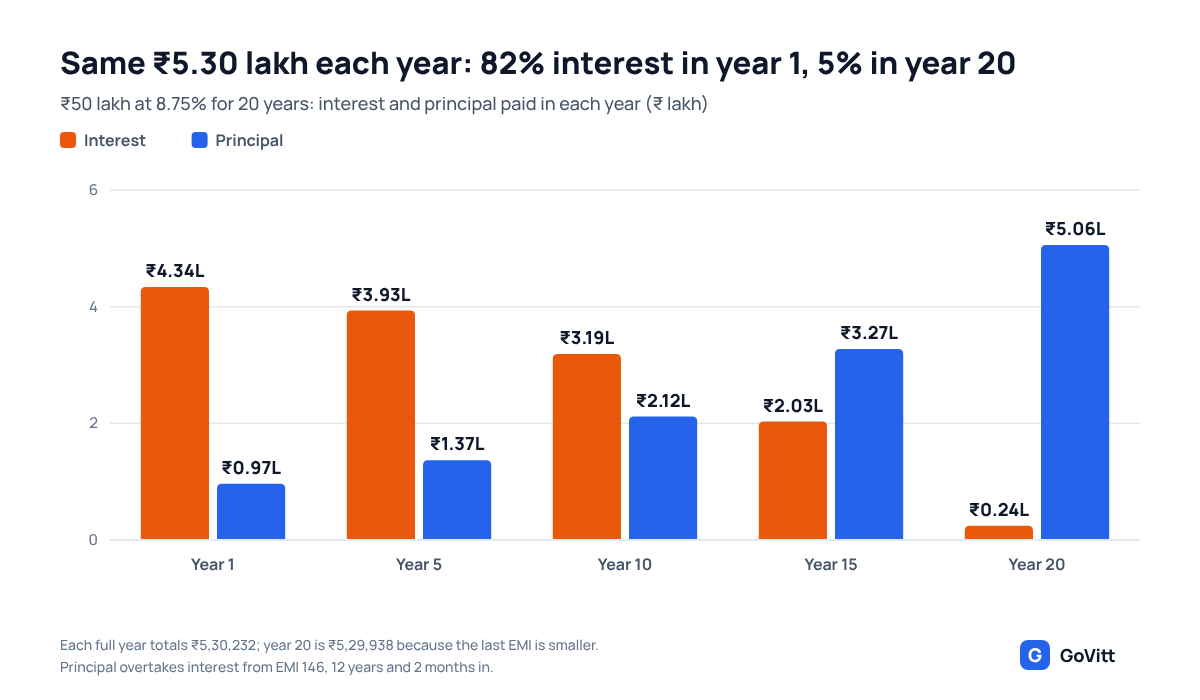
You pay ₹5,30,232 every year (₹5,29,938 in the last). What changes is where it goes: ₹4.34 lakh of interest in year 1, ₹24,275 in year 20. This is why prepaying early beats prepaying late, which I work through in part-prepaying your home loan: reduce the EMI or the tenure.
What a rate hike does to the schedule
Your schedule isn't fixed on a floating rate loan. When the benchmark moves, your bank recalculates it. RBI's August 2023 circular says the lender must tell you, at sanction, how a rate change can affect your EMI or your tenure. At each reset it has to let you choose a higher EMI, a longer tenure or both, and you can prepay in part or in full. Your loan can't be left in a state where the EMI doesn't cover the interest.
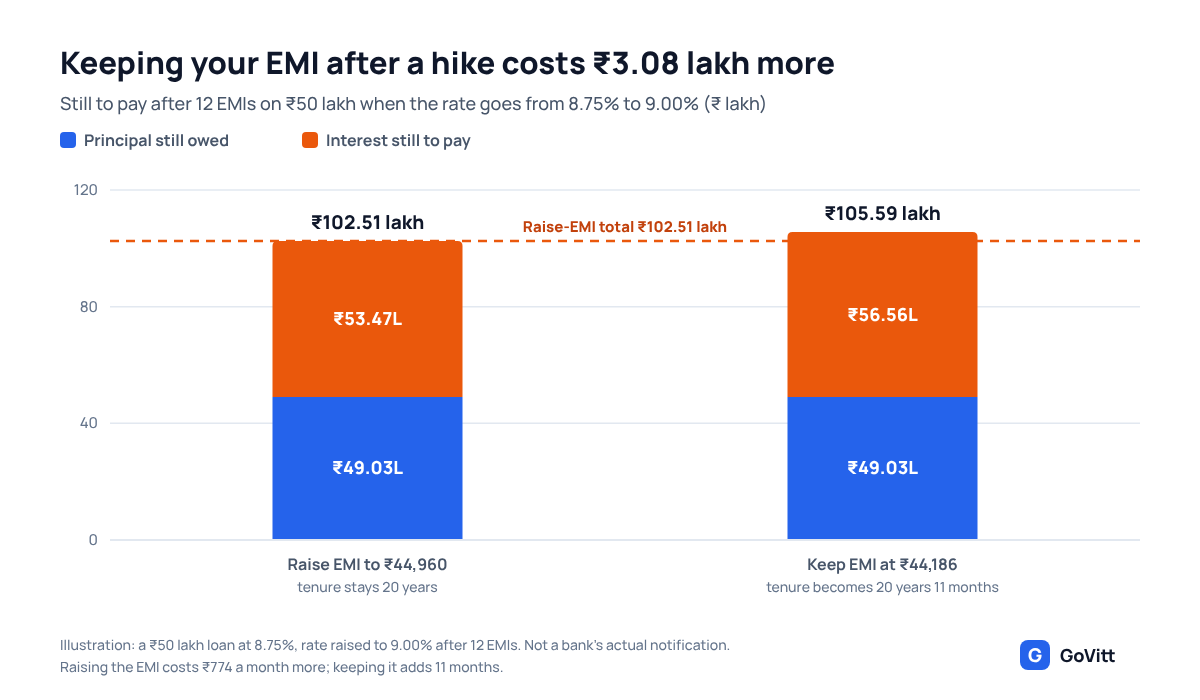
Here is the example I'd run. After 12 EMIs on the loan above (balance ₹49,03,455, 228 EMIs to go), the rate moves from 8.75% to 9.00%:
| What the bank does | New EMI | EMIs left | Total tenure | Interest from EMI 13 to the end |
|---|---|---|---|---|
| Raises the EMI, keeps the tenure | ₹44,960 (₹774 more) | 228 | 20 years | ₹53,47,195 |
| Keeps the EMI, stretches the tenure | ₹44,186 (same) | 239 | 20 years 11 months | ₹56,55,520 |
The second row costs ₹3,08,325 more in interest and adds 11 months, and your EMI doesn't move, which is why it is the one you don't notice. (The last EMI in that row is smaller, ₹42,707, because it clears the balance.) A 0.25% hike from 8.50% to 8.75% pushes the EMI from ₹43,391 to ₹44,186, which is ₹795 a month. I show how to check which one your bank chose, and when, in banks took one day to pass on RBI's rate hike and in you think 15 years are left on your home loan, the math says 18.
The five things I check on every schedule
- Does the first row follow the rule? Balance × rate ÷ 12 should give the interest. On ₹50 lakh at 8.75%, ₹50,00,000 × 8.75% ÷ 12 is ₹36,458.
- Does the rate match your sanction letter? Look at the benchmark, the spread and the date of the last reset. RBI's 2019 framework says the rate resets at least every three months.
- Did the tenure change? Count the EMIs left. If your EMI hasn't moved since a rate hike but the count has gone up, your bank stretched your tenure.
- Does the balance match the bank's last statement? If it doesn't, ask which payment or charge isn't in the schedule.
- Are your prepayments in it? A part-payment should cut either the EMI or the tenure, as you chose, and it should show in the balance straight away. RBI's directions also bar a prepayment charge on floating rate loans to individuals for non-business use, for loans sanctioned or renewed on or after 1 January 2026, which I explain in your bank can't charge you for prepaying a floating rate home loan.
What a ₹1 lakh part-payment does, and when
The schedule also tells you when your spare cash works hardest. On the same loan, a ₹1 lakh part-payment that reduces the tenure saves:
| Paid after year | Interest saved | EMIs cut |
|---|---|---|
| 1 | ₹4,04,442 | 11 |
| 5 | ₹2,60,224 | 8 |
| 10 | ₹1,35,341 | 5 |
| 15 | ₹53,209 | 3 |
The same ₹1 lakh saves ₹4.04 lakh of interest in year 1 and ₹53,209 in year 15, because in year 1 it clears principal that would otherwise run up interest for another 19 years, and in year 15 only for another 5. So if you're going to prepay, the earlier the better, and the schedule is how you'd see it.
How to get your schedule
- At sanction. RBI's April 2024 circular on Key Facts Statements, for new loans from 1 October 2024, says you must get one before you sign, with the APR including all charges, valid for at least three working days. As I read it, the KFS carries the repayment schedule. Check that yours does.
- During the loan. Your lender's app or portal usually has it. Lenders are required to send a statement every quarter with the principal and interest recovered so far, the EMI, the number of EMIs left and the annualised rate. That is a summary, not the full schedule, so ask for the schedule in writing.
- To build your own. The EMI calculator gives the EMI and the interest and principal split, and the formula in the first section lets you check any row.
I explain why the EMI itself isn't the number to watch in everyone checks the EMI, almost nobody checks the number that actually matters.
What I'd do this week
- Ask your bank for the full schedule. Say "full repayment schedule, month by month", not "statement".
- Check three rows: the next EMI, the last reset date and the balance. Do the interest sum yourself.
- Count the EMIs left. Compare to your tenure at sanction.
- If the tenure grew, decide whether to raise the EMI. The gap on a ₹50 lakh loan is about ₹774 a month, and 11 months of tenure is worth ₹3,08,325.
- If you have spare cash, run it through the Payoff & Transfer Calculator and compare a part-payment, a rate cut and a switch.
FAQ
What is a home loan amortization schedule? It's a table with one row per EMI, showing how much of each payment is interest, how much is principal and what you still owe. On a ₹50 lakh loan at 8.75% over 20 years, the first EMI of ₹44,186 is ₹36,458 interest and ₹7,728 principal.
How do I get my home loan repayment schedule? Ask your lender for it, in writing, or look in its app or portal. For new loans from 1 October 2024, RBI requires a Key Facts Statement before you sign, and as I read it, that carries the repayment schedule. Your quarterly statement gives a summary but not every row.
Why is so much of my EMI interest in the early years? Because interest is charged on the balance, and the balance is highest at the start. On ₹50 lakh at 8.75%, the first EMI is 82.5% interest. Principal overtakes interest only from EMI 146, about 12 years in.
What happens to my schedule when RBI changes the repo rate? Your bank recalculates it at the next reset. Under RBI's 2023 circular, it must offer you a higher EMI, a longer tenure or both. On ₹50 lakh at 8.75% moving to 9.00%, keeping the EMI adds 11 months and ₹3,08,325 of interest.
Can I prepay without a penalty? On a floating rate loan to an individual for non-business use, yes, for loans sanctioned or renewed on or after 1 January 2026. Fixed rate and business loans follow different rules.
See what your loan would cost under a different rate. Run the Payoff & Transfer Calculator and compare staying, prepaying and switching. GoVitt compares 50+ banks and charges you 0% commission.
Examples use a ₹50 lakh loan at 8.75% for 20 years with a standard monthly reducing balance EMI, rounded to the nearest rupee. The rate-hike example (8.75% to 9.00% after 12 EMIs) is an illustration, not a bank's notification. The last EMI is slightly lower because it clears the final balance. Your lender's rounding and dates may differ by a few rupees. RBI rules are as I read them on 4 November 2026. This is information, not financial advice.
Ready to take the next step?
Find out your loan options and check your eligibility with GoVitt today.