
Your bank has been messaging you about a pre-approved top-up. The rate looks close to your home loan rate. The money would land in your account in a day or two. Why not?
A home loan top-up is extra money your lender gives you against the house you already have a loan on. It's a good product when you use it for the right thing and repay it fast. It's an expensive one when you don't.
See your real payoff date in 60 seconds
Banks calculate remaining EMIs by simple subtraction. See your actual payoff date and discover how much interest a balance transfer can save.
Three things decide which one you get: the rate, how much you'll really be given, and what the tax department does with the interest. The last one catches most people. If you spend a top-up on renovation, only ₹30,000 of the interest a year is deductible, and only in the old tax regime.
As of 23 October 2026, top-up rates start at 7.65% at LIC Housing Finance, 8.00% at SBI and 8.25% at HDFC Bank (for a top-up taken with a transfer). Below are the numbers by lender, how eligibility really works, and the tax rule with a worked example.
What a top-up is, and what it isn't
A top-up is an additional loan on the same property, from the same lender, on top of your home loan. Many lenders give it its own EMI and tenure.
It isn't a fresh home loan, because you're not buying anything. It isn't a balance transfer either, though if you move your loan to a new bank and take extra money in the same go, that's a transfer with a top-up. I covered that case, including how it can quietly stretch a 15 year loan to 20, in home loan balance transfer and top-up. This post is about a top-up with the lender you already have.
Top up loan on home loan: interest rate by lender
| Lender | Home loan rate from | Top-up rate | What to know |
|---|---|---|---|
| SBI | 7.50% | 8.00% to 10.75% | Listed after SBI's 15 October rate change. Processing fee 0.35% (₹2,000 to ₹10,000) plus GST |
| HDFC Bank | 8.00% | 8.25% to 13.95% (top-up taken with a transfer) | Up to 15 years. HDFC's own page shows two different caps, ₹50 lakh and ₹1 crore, so get the limit in writing. The rate table for existing customers isn't published. |
| ICICI Bank | 8.75% | Not published | Up to 100% of your original sanctioned amount, for up to 20 years |
| LIC Housing Finance | 7.15% | From 7.65% | LIC puts its average top-up rate at 8.27% |
Your top-up will usually sit 0.25% to 0.50% above the same lender's lowest home loan rate. SBI's gap is 0.50% and HDFC Bank's is 0.25%. Ask for both rates before you sign, and make sure the top-up rate is in your sanction letter and Key Fact Statement.
The "from" rates are for the best credit profiles. At SBI, top-up rates run all the way to 10.75%, so your CIBIL score matters here as much as it does for the home loan. If you want to see where your own score lands, the bank posts are SBI, HDFC Bank, ICICI Bank and LIC Housing Finance.
The real cost of a top-up, by tenure
A low rate isn't the same as a low cost. Interest is the rate multiplied by time. Say you need ₹12 lakh for a renovation, and your top-up rate is 8.50%. Here's what it costs depending on how long you take to repay:
| How you borrow ₹12 lakh | EMI | Total interest |
|---|---|---|
| Top-up at 8.50% over 5 years | ₹24,620 | ₹2.77 lakh |
| Top-up at 8.50% over 7 years | ₹19,004 | ₹3.96 lakh |
| Personal loan at 12% over 5 years (assumed rate) | ₹26,693 | ₹4.02 lakh |
| Top-up at 8.50% over 10 years | ₹14,878 | ₹5.85 lakh |
| Top-up at 8.50% over 15 years | ₹11,817 | ₹9.27 lakh |
Over 5 years, the top-up saves ₹1.24 lakh against a personal loan. Stretch it to 7 years and the saving is gone. At 10 years, it costs ₹1.84 lakh more than the personal loan. So the cheap rate only helps if you repay quickly. I compared the two options for a small, short need in before you tap that pre-approved personal loan.
Home loan top up eligibility: what lenders check
1. Your property's value today. Your outstanding loan plus the top-up must stay within RBI's loan to value limits: 90% of the property value for loans up to ₹30 lakh, 80% from ₹30 lakh to ₹75 lakh, and 75% above ₹75 lakh. The bank uses its own valuation of the property now, not what you paid.
2. Your income. The lender rechecks your total EMIs against your take-home pay. Most allow somewhere between 40% and 55%, which is the FOIR (fixed obligations to income ratio).
3. Your repayment record. Lenders look at how you've paid the loan so far. HDFC Bank, for example, asks for 12 months of regular repayment on your current loan before a transfer.
4. The lender's own cap and tenure. ICICI Bank allows up to 100% of your original sanctioned amount for up to 20 years. HDFC Bank's top-up with a transfer runs up to 15 years. Each lender sets its own rules, so ask for the limit in writing.
5. What the money is for. RBI has publicly flagged top-ups being used for speculation, and banks now check end use more closely. Don't plan to put a top-up into shares.
Which one limits you: your flat or your salary?
Here's a worked example. Say you have:
- A flat that a bank values at ₹90 lakh today
- ₹40 lakh outstanding at 8.50%, with 15 years left (EMI ₹39,390)
- Take-home pay of ₹1.2 lakh a month
- A top-up at 8.50% over 10 years, where every ₹1 lakh costs about ₹1,240 a month
The property limit: 80% of ₹90 lakh is ₹72 lakh. Minus the ₹40 lakh you owe, that leaves ₹32 lakh of room.
The income limit: 50% of ₹1.2 lakh is ₹60,000 for EMIs. Minus your current ₹39,390, that leaves ₹20,610 a month. At ₹1,240 per lakh, that supports a top-up of ₹16.62 lakh.
The smaller number wins: ₹16.62 lakh. Here's how it looks at three different salaries:
| Take-home pay | Allowed by property value | Allowed by income | You can get about |
|---|---|---|---|
| ₹1.0 lakh | ₹32.00 lakh | ₹8.56 lakh | ₹8.56 lakh |
| ₹1.2 lakh | ₹32.00 lakh | ₹16.62 lakh | ₹16.62 lakh |
| ₹1.5 lakh | ₹32.00 lakh | ₹28.72 lakh | ₹28.72 lakh |
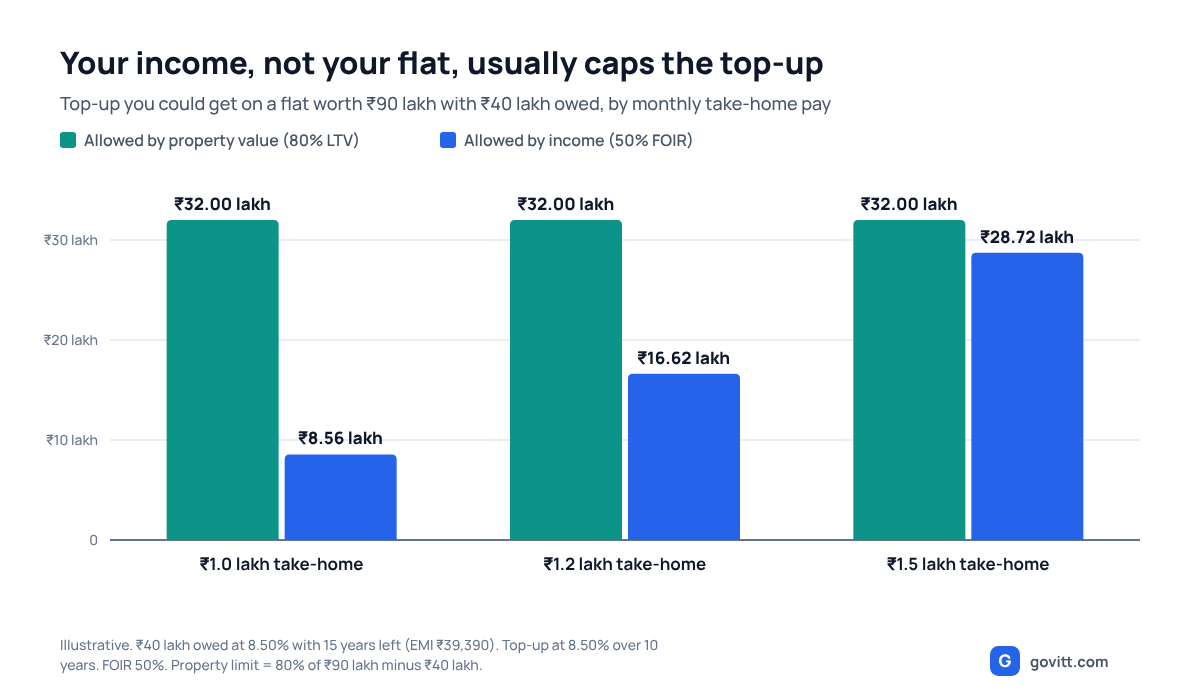
In all three cases it's your income, not your flat, that sets the limit. So before you ask a bank for a top-up, work out your EMI room first. Anything above 40% of your take-home is a stretch, even if the bank will approve 50%.
The tax rule most people get wrong
Because a top-up is secured on your house, most people assume the interest counts as home loan interest. It doesn't. What you spend the money on decides it, not what the loan is called.
| What you spend the top-up on | Old tax regime | New tax regime |
|---|---|---|
| Buying or building a house | Interest counts toward the ₹2 lakh cap on a self-occupied home | No deduction for a self-occupied home |
| Repairs or renovation of a self-occupied home | Interest up to ₹30,000 a year, inside the ₹2 lakh cap | No deduction |
| A house you let out | Interest is deductible against the rent | Interest is deductible against the rent |
| A wedding, education, a car, travel or medical bills | No deduction | No deduction |
Here is what that looks like in rupees. A ₹10 lakh top-up at 8.50% over 10 years costs ₹82,456 in interest in the first year. If you spend it on renovation, you can claim ₹30,000 of that. In the 30% slab, with cess, that's a tax saving of ₹9,360. The other ₹52,456 gets you nothing.
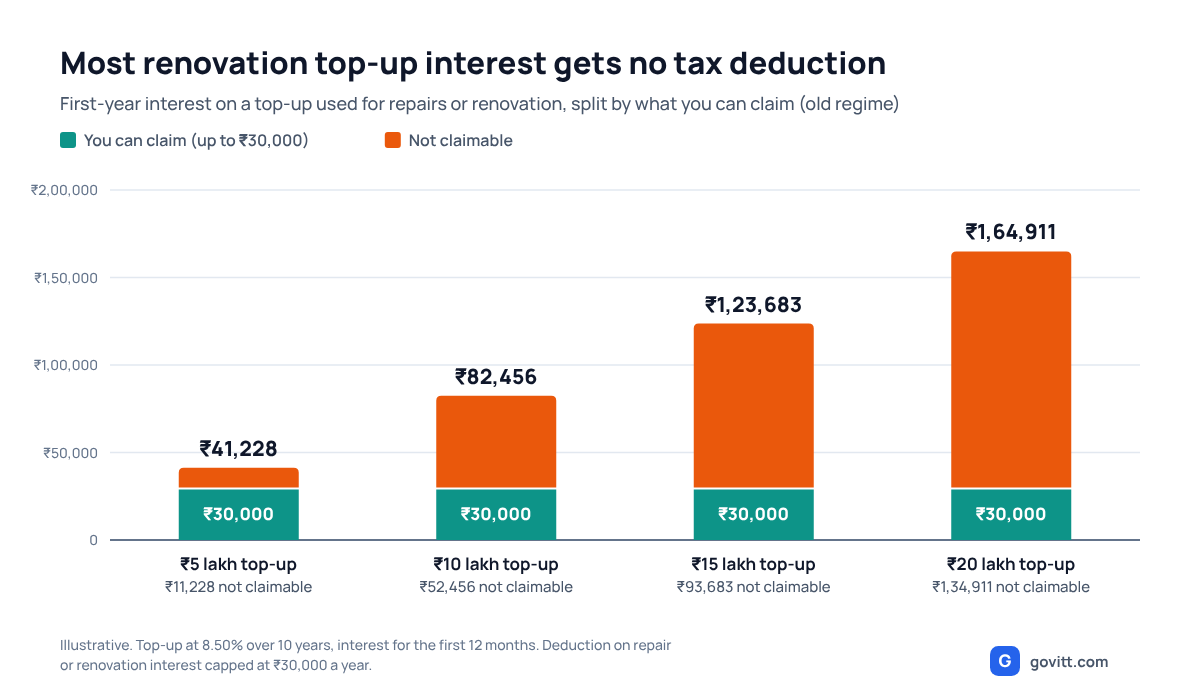
The size of the top-up doesn't change the deduction. ₹5 lakh or ₹20 lakh, it stops at ₹30,000. Three more catches:
- The ₹30,000 sits inside the ₹2 lakh cap, not on top of it. If you owe more than about ₹25 lakh at 8.50%, the interest on your existing home loan already crosses ₹2 lakh, and a renovation top-up adds no extra deduction.
- You need the bills. The deduction depends on how the money was used. Keep invoices and payment proof for every rupee.
- The new regime gives nothing on a self-occupied home. If you've moved to the new regime, treat the top-up as a loan with no tax benefit.
This is now Section 22 of the Income-tax Act, 2025, which replaced the old Section 24(b) from 1 April 2026. It's a summary, not advice for your case. Ask your CA before you count on the deduction.
Top-up, personal loan or loan against property?
| Home loan top-up | Personal loan | Loan against property | |
|---|---|---|---|
| Secured on | Your house | Nothing | Your property |
| Rate | Close to your home loan rate | Usually well above it | Usually above a top-up. Ask for a quote. |
| Tenure | Long, so keep it short | Shorter | Usually longer than a personal loan |
| Tax benefit | Only if spent on the house | None | None for personal use |
| What you risk if you can't pay | Your home | Your credit score | Your property |
A top-up is usually the cheapest of the three, as long as you already have a home loan with a good repayment record. A loan against property is for bigger amounts, or when you don't have a home loan to top up.
What a top-up adds in fees
Along with the processing fee (SBI charges 0.35%, between ₹2,000 and ₹10,000, plus GST), some lenders ask for a supplementary mortgage deed. In Karnataka, the stamp duty and registration figures from our balance transfer post come to about ₹6,000 on ₹10 lakh (0.5% stamp duty and about 0.1% registration). Ask your lender what applies to yours.
When a top-up makes sense, and when to say no
Say yes if all of these are true:
- You need the money for something real, such as a renovation, education, a medical bill, or clearing expensive debt like a credit card
- You'll repay it in 3 to 7 years, with a short tenure or hard prepayment
- The top-up rate is in writing and within about 0.50% of your home loan rate
- Your total EMIs stay at 40% of your take-home pay or less
Say no if:
- The lender offers to stretch your home loan's end date to keep your EMI the same
- You're borrowing to spend, not to need. A holiday on a 15 year loan is an expensive holiday
- The amount is small. Under ₹2 to ₹3 lakh, fees eat a big share of the saving
- The money is going into markets. Banks check end use, and it can be refused
What I'd do before asking
- Work out your EMI room. Take 40% to 50% of your take-home pay and subtract every EMI you pay today.
- Ask for a separate tenure for the top-up. 5 to 7 years, or as short as your budget allows.
- Keep your home loan's end date the same, and say so in writing.
- Get the rate, fees and tenure in the sanction letter and Key Fact Statement.
- Keep every bill if you're renovating and plan to claim the deduction.
- Compare the top-up rate with the rate other banks offer on a transfer. If your lender's top-up rate is far above the market, a transfer with a top-up may cost less. The full process is in what actually happens in a home loan transfer.
Check what you'd qualify for
WhatsApp us on +91 70194 17854 with your outstanding amount, EMI and city, and we'll tell you which lenders would give you a top-up and at what rate. GoVitt works with 50+ banks and housing finance companies, and we don't charge you any commission. If you're thinking of moving your loan too, see our home loan balance transfer page.
FAQ
What is the interest rate on a home loan top-up? It depends on the lender and your credit profile. As of October 2026, SBI lists top-ups at 8.00% to 10.75%, HDFC Bank at 8.25% to 13.95% when taken with a transfer, and LIC Housing Finance from 7.65%. ICICI Bank doesn't publish a rate. Your top-up rate is usually 0.25% to 0.50% above the same lender's lowest home loan rate.
Who is eligible for a home loan top-up? You need an existing home loan with a clean repayment record, a property whose current value keeps your outstanding loan plus the top-up within RBI's loan to value limits, and enough income for the new EMI. Lenders also check what the money is for.
How much top-up can I get on my home loan? The lower of two limits: what your property's value allows (90%, 80% or 75% of the value, depending on loan size, minus what you owe) and what your income allows after your current EMIs. Lenders also have their own caps, such as ICICI Bank's 100% of the original sanctioned amount.
Is the interest on a home loan top-up tax deductible? Only if you spend the money on buying, building, repairing or renovating a house, and you keep the bills. For repairs or renovation of a self-occupied home, the limit is ₹30,000 a year, inside the ₹2 lakh cap, and only under the old tax regime. For a wedding, education, a car or medical bills, there's no deduction.
Is a top-up cheaper than a personal loan? Only if you repay it fast. ₹12 lakh at 8.50% over 5 years costs ₹2.77 lakh in interest, against ₹4.02 lakh for a personal loan at 12% over 5 years. Stretch the top-up to 10 years and it costs ₹5.85 lakh.
Can I take a top-up from a different bank? Only by moving your home loan to that bank. The new lender pays off your old one and gives you the extra amount in one go. That's a balance transfer with a top-up.
Examples as of 23 October 2026. EMIs use the standard monthly reducing balance method and are rounded to the nearest rupee. Top-up rates come from each lender's published pages and change often. The personal loan rate of 12% is assumed. Tax rules are summarised, not advice for your case. Confirm everything in your sanction letter and Key Fact Statement before you sign.
Ready to take the next step?
Find out your loan options and check your eligibility with GoVitt today.