

Everyone's worried about the October rate hike. On a new flat, the bigger hit to your EMI has already happened.
If you're planning to buy a flat in Bengaluru this festive season, this week's news probably made you nervous.
RBI's monetary policy committee meets from October 5 to 7. Eight out of ten economists in a Business Standard poll expect it to raise the repo rate by 0.25%, from 5.25% to 5.50%, and a lot of them expect one more hike in December. Retail inflation has been above RBI's 4% target for three months in a row, crude is expensive and the rupee is weaker. So the "should I buy before rates go up" messages have started.
Then, on September 28, Anarock put out its numbers for July to September. Bengaluru sold 16,670 homes in the quarter, 12% more than a year ago. Average prices in the city went up 8% in a year.
See your real payoff date in 60 seconds
Banks calculate remaining EMIs by simple subtraction. See your actual payoff date and discover how much interest a balance transfer can save.
Put those two pieces of news together and do the maths on one flat. The answer surprised me a little.
The same flat, a year apart
Say you liked a flat that cost ₹1 crore in September last year. With prices up 8%, the same flat today costs ₹1.08 crore.
You take an 80% loan for 20 years. I've assumed the bank charges repo plus 2.50%, which is roughly where a decent borrower lands at a big bank right now.
| Loan | Rate | EMI | More than a year ago | |
|---|---|---|---|---|
| Bought in September 2025 (repo 5.50%) | ₹80 lakh | 8.00% | ₹66,915 | — |
| Buying today (repo 5.25%) | ₹86.4 lakh | 7.75% | ₹70,930 | ₹4,015 |
| If RBI hikes 0.25% on October 7 | ₹86.4 lakh | 8.00% | ₹72,268 | ₹5,353 |
| And another 0.25% in December | ₹86.4 lakh | 8.25% | ₹73,618 | ₹6,703 |
Now look at the rate column. If RBI does hike on October 7, the repo rate goes back to 5.50%. That's exactly where it was in September 2025. RBI cut it to 5.25% in December last year, and a hike just takes back that cut.
So if you compare a buyer from last September with a buyer after this hike, the interest rate is the same. The whole ₹5,353 jump in EMI comes from the flat being more expensive.
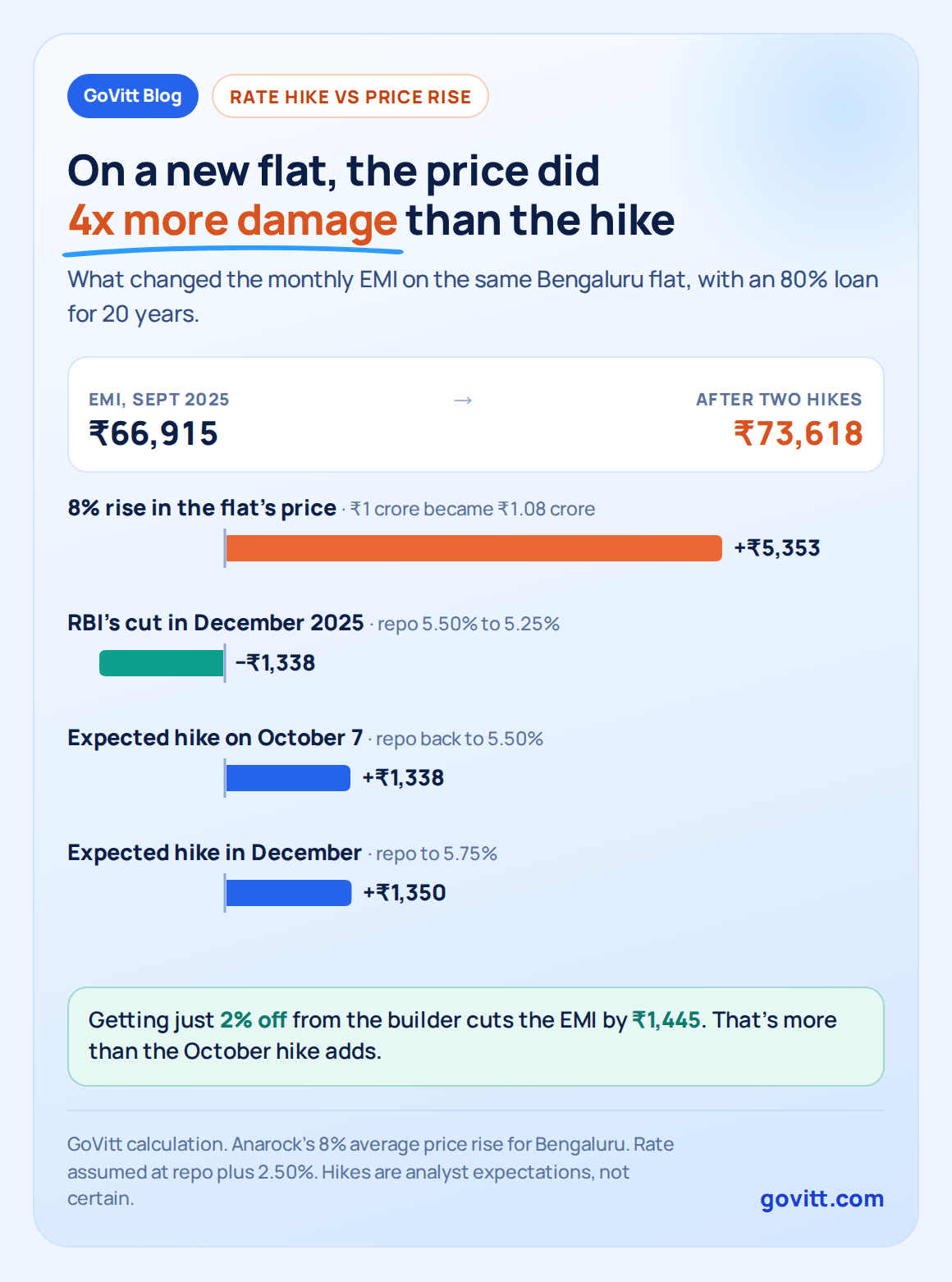
On the same flat, a year of price rise added four times more to the EMI than the October hike will.
Measured from today's price, the October hike adds ₹1,338 to your EMI. The 8% price rise over the year added ₹5,353. That's four times as much.
I'm not saying the hike doesn't matter. ₹1,338 a month is ₹3.2 lakh over 20 years. But if you're spending this week worrying about October 7, you're worrying about the smaller number.
The part you can actually change
You can't do anything about the repo rate. The price of the flat you can negotiate. And this is a better time to do that than the headlines suggest.
Sales went up, but supply went up faster. Across the seven cities Anarock tracks, builders launched 1,14,320 new homes in July to September, 18% more than a year ago. In Bengaluru, launches went up 17%. Unsold inventory across the seven cities is now 6.3 lakh homes, 12% higher than a year ago. PropEquity, which tracks things a bit differently, puts Bengaluru's sales growth at just 1%. Anuj Puri, Anarock's chairman, said it plainly: buyers are becoming more selective as prices rise.
That's not a market where you have to take the first price on the cost sheet.
On our ₹1.08 crore flat, getting just 2% off brings the EMI down by ₹1,445 a month. That's more than the October hike adds. It also saves you about ₹60,000 of cash upfront, because the down payment, stamp duty and registration are all worked out on the price.
And the festive season is when builders are most flexible. Some will offer a straight discount. Others will waive the floor rise or the parking charge, or throw in the club membership. Compare offers by the total cost, not the headline price. I've written about the charges that get added on top of the brochure price if you want the full list.
What the hike does to your loan eligibility
There's one place where the hike does bite, and buyers who are stretching their budget often miss it.
Banks decide how much to lend you based on how much EMI your income can carry. If your income can handle an EMI of ₹70,930, that gets you ₹86.4 lakh at 7.75%. At 8%, the same EMI gets you about ₹84.8 lakh. At 8.25%, about ₹83.2 lakh.
So a hike in October could cut your eligibility by about ₹1.6 lakh, and two hikes by about ₹3.2 lakh. If you're borrowing right up to your limit, that gap has to come from your own pocket, or you need a co-applicant.
If you already have a sanction letter, check whether it's still valid and whether the amount was worked out at the old rate.
Will getting my loan sanctioned before October 7 save me from the hike?
People ask me this every time a hike is coming.
No, not on a floating rate loan. Your rate is repo plus a spread. The sanction letter fixes the spread. The repo part moves for everyone, existing borrowers included. On a repo-linked loan, a hike reaches you within three months whether you got your sanction on October 6 or October 8.
What getting it done early does give you is this. You lock the spread the bank is offering today, before it decides to tighten its pricing for new customers. You might catch a festive offer on the processing fee before it ends. And you know your exact eligibility before you commit to a builder.
So, worth doing because it's useful anyway. Not worth panicking about because of October 7.
Other cash that went up
The EMI isn't the only number that moves with the price.
On the ₹1 crore flat a year ago, 20% down payment plus Karnataka stamp duty and registration came to about ₹27.6 lakh. On the ₹1.08 crore flat, it's about ₹29.8 lakh. That's ₹2.2 lakh more cash you need before the bank releases a rupee, and that's before GST if the flat is under construction, parking and the other charges.
What I'd do if I were buying this month
Get your loan sanctioned or pre-approved first, before you pay any booking amount. You'll know your real budget, and you'll be negotiating with the builder as someone who's ready to close.
Plan your budget at 8.25%, not today's rate. If the EMI still works at 8.25%, a couple of hikes won't hurt you. If it only works at 7.75%, you're buying too much flat for right now.
Negotiate harder than you think you need to. Rising inventory is on your side. Even 2% off does more for you than the October hike takes away.
Don't rush a booking to "beat the hike." On a floating loan you can't beat it. You can only buy the wrong flat in a hurry.
And keep a little room. If analysts are right, this cycle is two hikes and done. If they're wrong, you want your EMI to be something you can live with at 8.5% too.
Talk to us before you book
We work with 50+ banks and housing finance companies and don't charge you any commission. WhatsApp us the flat price, your monthly income and any existing EMIs on +91 70194 17854. We'll tell you how much you can borrow before and after a hike, and which lenders are offering the lowest spread this festive season. You can also run your own numbers on our EMI calculator or check what lenders are offering right now.
If you already have a home loan and want to know what a hike does to your existing EMI and tenure, we covered that here.
Price growth is Anarock's average for Bengaluru between July to September 2025 and July to September 2026. Your project may have moved more or less. The example assumes a rate of repo plus 2.50%, an 80% loan for 20 years, monthly reducing balance, and Karnataka stamp duty of 5% plus cess and surcharge with 2% registration. RBI's decision is due on October 7, 2026, and analysts' expectations are not certainties.
Questions people usually ask
Will RBI increase the repo rate on October 7, 2026? Nobody knows until the announcement. In a Business Standard poll, eight out of ten economists expected a 0.25% hike to 5.50%, and a Reuters poll found about 60% expecting the same. Many also expect another hike in December.
How much will my home loan EMI go up if RBI hikes by 0.25%? On an ₹86.4 lakh loan for 20 years, about ₹1,338 a month, going from 7.75% to 8%. As a rough rule, every 0.25% adds about ₹15 to ₹16 a month for each ₹1 lakh you borrow.
Should I buy a flat before the RBI rate hike? Don't rush for that reason alone. On a floating rate loan, a hike reaches you anyway, even if your loan was sanctioned earlier. Buy when the flat, the price and your budget are right, and plan your EMI at a rate about 0.50% higher than today's.
Does getting a home loan sanctioned early protect me from a rate hike? Not on a floating rate loan. The sanction fixes the spread over the repo rate, but the repo part changes for everyone. It does help you lock the bank's current spread and any festive offer on fees.
How much have property prices gone up in Bengaluru? Anarock's data shows average residential prices in Bengaluru up 8% between July to September 2025 and July to September 2026. Individual projects and localities can be quite different.
How does a rate hike affect home loan eligibility? At a higher rate, the same EMI supports a smaller loan. In our example, an EMI of ₹70,930 gets you ₹86.4 lakh at 7.75%, about ₹84.8 lakh at 8%, and about ₹83.2 lakh at 8.25%.
Is the festive season a good time to negotiate with builders? Usually, yes. Builders run offers during the festive season, and right now new launches and unsold inventory are both higher than a year ago. Compare offers by the total cost of the flat, including parking, floor rise and other charges, not the headline price.
Ready to take the next step?
Find out your loan options and check your eligibility with GoVitt today.