
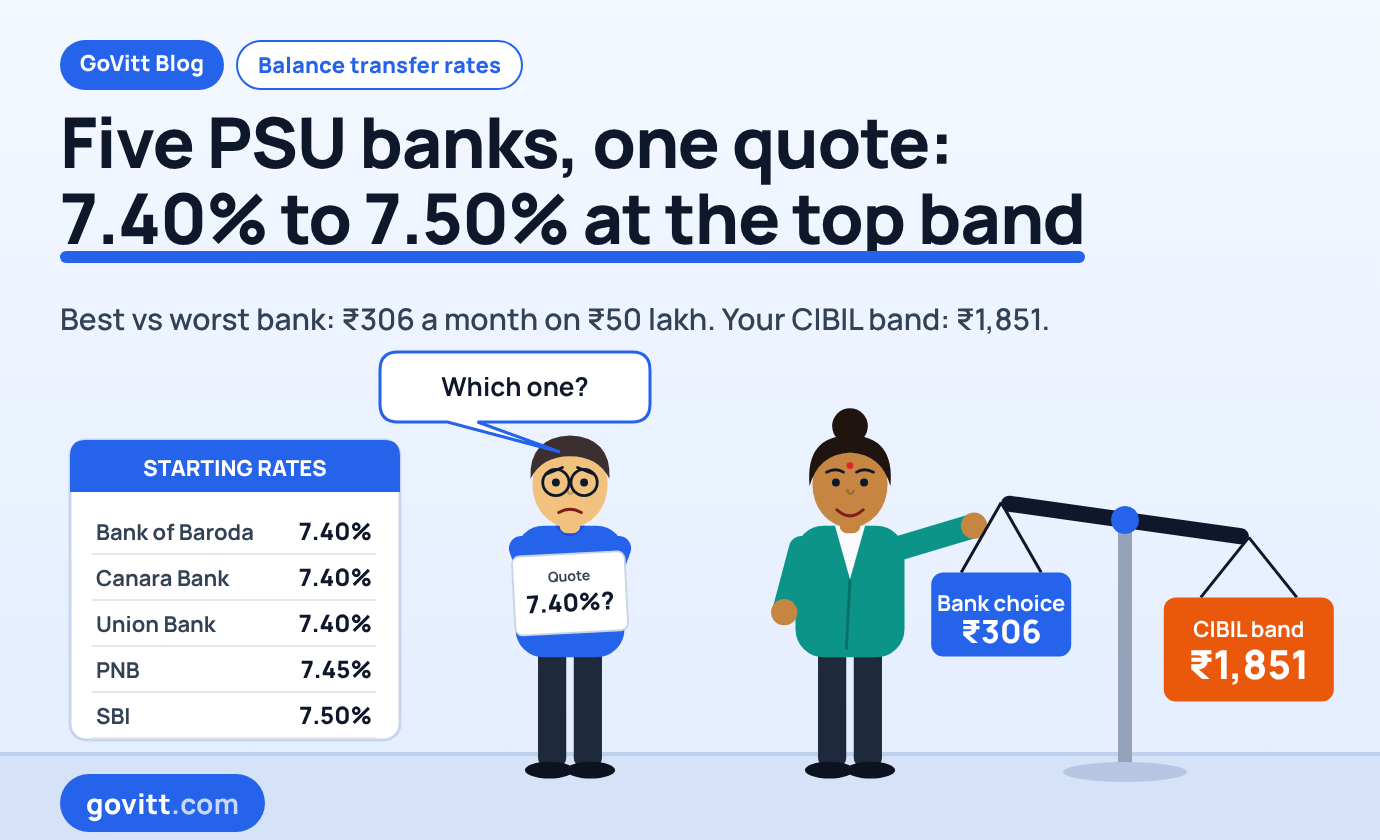
The home loan balance transfer interest rate at five of the biggest public-sector banks starts between 7.40% and 7.50% as of 19 November 2026. Bank of Baroda, Canara Bank and Union Bank of India start at 7.40%, Punjab National Bank at 7.45% and SBI at 7.50%. On ₹50 lakh over 20 years, the EMI runs from ₹39,974 to ₹40,280. That is ₹306 a month between the best and the worst bank.
The short version: those are the rates for the top credit band, and the five banks sit within 10 basis points of each other. Your CIBIL band moves your EMI about six times more than your choice of bank does. So don't spend a week chasing the 5 bps. Find your band's rate in writing, then compare fees.
Below: the five quotes with their sources, what the gap between banks costs in rupees, what the gap between bands costs, and what I'd ask before you sign.
See your real payoff date in 60 seconds
Banks calculate remaining EMIs by simple subtraction. See your actual payoff date and discover how much interest a balance transfer can save.
The five quotes
These are starting rates for new home loans, the best band each bank prints. I read each bank's own page on 19 November except where the table says otherwise.
| Bank | Starting rate | Who gets it | Benchmark and date | Source |
|---|---|---|---|---|
| Bank of Baroda | 7.40% (range to 9.15%) | BRLLR minus 0.75%. The page doesn't name the score | BRLLR 8.15% from 8 Oct 2026 | Bank's rate page |
| Canara Bank | 7.40% (range to 10.25%) | Set by Credit Risk Grade, not by CIBIL band | RLLR 8.25% from 9 Oct 2026 | Ambak, verified 10 Nov. I couldn't open Canara's current grid |
| Union Bank of India | 7.40% at CIC 825 and above, 7.45% at 800 to 824 | Top two bands | EBLR 8.25% from 8 Oct 2026 | Bank's rate card |
| Punjab National Bank | 7.45% | CIBIL 800 and above, loan above ₹30 lakh, LTV up to 80% | RLLR 8.35% (implied by the grid), 8 Oct 2026 | Bank's rate page |
| SBI | 7.50% onwards (regular home loans 7.50% to 8.80%) | Top band | EBLR-linked, effective 15 Oct 2026 | Bank's page headline, Business Today (18 Oct) |
One note on Canara. It prices by Credit Risk Grade (CRG), which uses more than your CIBIL score. Don't read CRG 1 as "CIBIL 750". I have a full post on each bank: Bank of Baroda, Canara, Union and SBI. Those are the October versions. This post is the side-by-side after the hike.
What the gap between banks costs
Assume ₹50 lakh outstanding with 20 years left, and you pay 8.75% today. EMI is monthly reducing balance, rounded to the rupee.
| Quote | EMI on ₹50 lakh | Monthly saving vs 8.75% | Saving over 20 years |
|---|---|---|---|
| 7.40% (Bank of Baroda, Canara, Union) | ₹39,974 | ₹4,212 | ₹10.11 lakh |
| 7.45% (PNB) | ₹40,127 | ₹4,059 | ₹9.74 lakh |
| 7.50% (SBI) | ₹40,280 | ₹3,906 | ₹9.37 lakh |
The "20 years" column assumes you keep the loan to the end at the same tenure and ignores the cost of moving. Treat it as an upper bound.
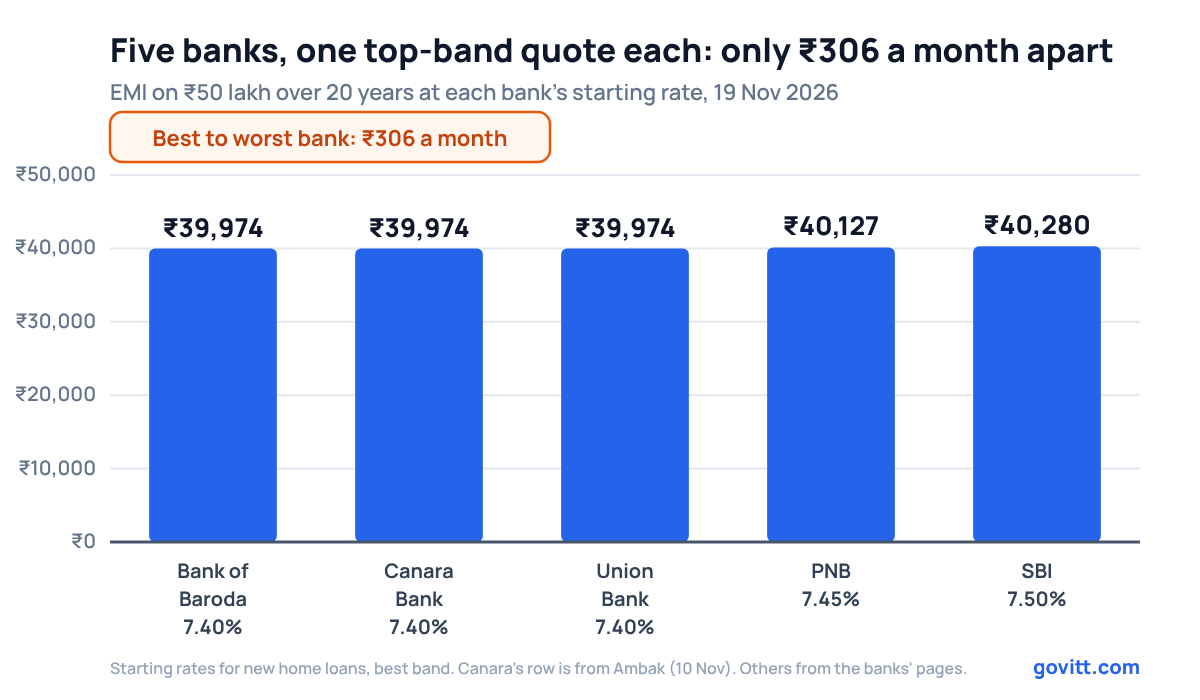
The best and worst quote differ by ₹306 a month, which is ₹73,440 over 240 months. That is real money, and it is small next to the ₹3,906 to ₹4,212 a month you save by leaving an 8.75% loan at all.
What the gap between bands costs
The bank's best rate is for the best band. Here is what PNB's own grid does to the same ₹50 lakh as your score falls.
| CIBIL band at PNB | Rate | EMI | Over the top-band EMI |
|---|---|---|---|
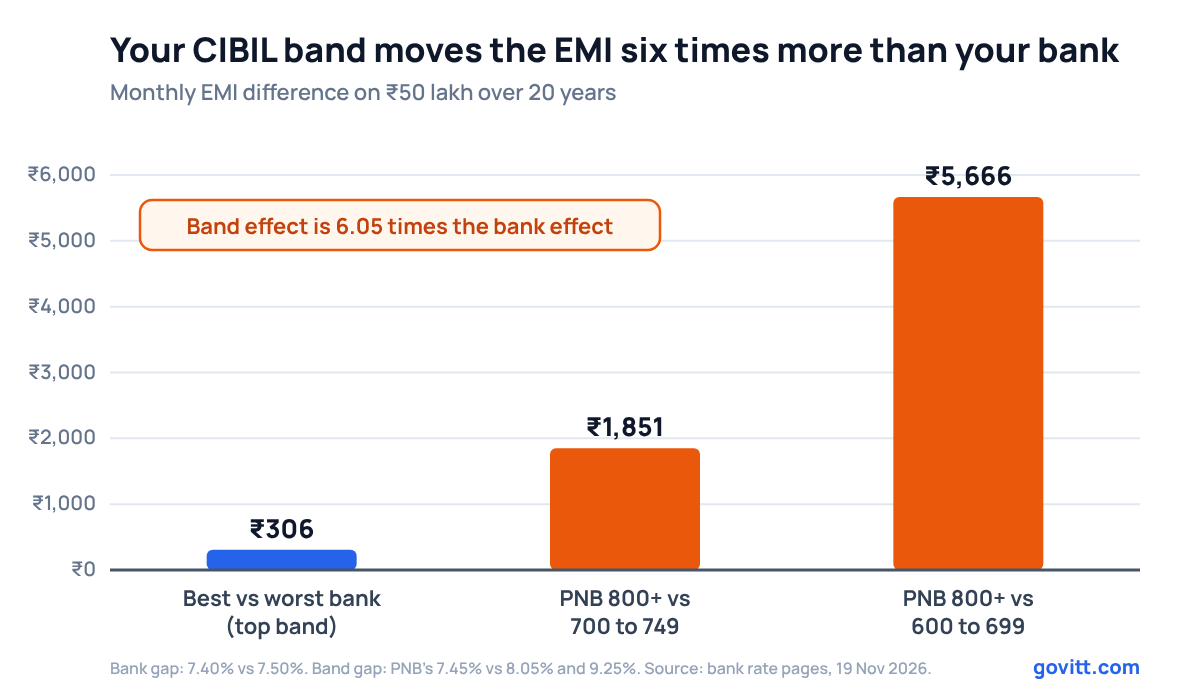
| 800 and above | 7.45% | ₹40,127 | 0 |
| 700 to 749 | 8.05% | ₹41,978 | ₹1,851 |
| 600 to 699 | 9.25% | ₹45,793 | ₹5,666 |
Falling from the top band to 700 to 749 costs ₹1,851 a month. The whole difference between the best and worst of the five banks is ₹306. So the band effect is 6.05 times the bank effect.
Banks agree on this at the band level. Union's 700 to 749 row lists 7.95% to 8.10% depending on borrower category, and PNB's 8.05% sits inside it. I haven't mapped Union's four columns to categories because the rate card doesn't label them in the version I read. My post on how a 0.25% RBI move compares with a CIBIL move has the same point for one bank. And a CIBIL hit from applying to many banks at once works against you, as I show in does a balance transfer hurt your CIBIL score.
What these quotes don't tell you
They are new-loan grids. None of the pages I read shows a separate takeover rate. PNB's page has no takeover terms at all. A bank can price a takeover differently, so ask for a takeover quote, not the website rate.
Fees aren't in the headline. PNB's own page gives its takeover charges: ₹2,500 processing plus ₹1,350 documentation before GST, both waived from 1 October to 31 December 2026 under its Utsav campaign. For the other four, I didn't find takeover fees on the pages I read. Ambak lists processing fees of 0.35% to 0.50% with caps of ₹10,000 to ₹15,000 where it states one, but I haven't confirmed that against the banks. A fee difference of ₹10,000 outweighs almost 33 months of the ₹306 gap. My transfer charges breakdown lists every line you'll pay in Bengaluru.
The rate moves with the benchmark. After the 7 October hike, Bank of Baroda, Union and PNB moved the next day, Canara the day after, and SBI on 15 October. RBI decides again on 4 December. If it hikes, all five quotes will rise, and the ₹306 gap between them won't change much. A quote you hold today is a quote for today.
The spread is what you keep. On a repo-linked loan the benchmark moves with RBI, and the spread is the part you can negotiate. Ask each bank for your rate written as benchmark plus spread, and ask when it resets. My post on rates going up and whether switching still makes sense shows the effect.
How I'd compare, in order
- Get your band's rate in writing from two banks, not five. Each application is a hard enquiry.
- Ask for a takeover quote, at your loan size, LTV and tenure, with the date it holds until.
- Add the fees: processing, documentation, legal, valuation, and MODT stamp duty on a fresh mortgage deed.
- Divide the total cost by your monthly saving. If it comes back inside 24 months, move.
- Check the process, because a slow takeover costs you EMIs on two loans. My transfer process post shows where it gets stuck, and the document checklist saves a second round.
If your score is 800 or higher and your gap to your current rate is 1% or more, any of the five is a sound choice. Pick the one with the lowest all-in cost. If you are at 700 to 749, the starting rate in the table doesn't apply to you, and the bank-to-bank gap in your band can be larger or smaller than ₹306. Ask each bank for your band. My best banks for a balance transfer post ranks the wider list.
FAQ
What is the home loan balance transfer interest rate at SBI, PNB, Bank of Baroda, Canara and Union Bank in November 2026? Their starting rates for new home loans are 7.50% at SBI, 7.45% at PNB, and 7.40% at Bank of Baroda, Canara and Union Bank. Those are for the best credit band, and each bank's range goes much higher. Ask for a takeover quote at your own band.
Is the balance transfer rate lower than the rate for a new home loan? On the pages I read, none shows a separate takeover rate, so assume the same grid applies and confirm it in your quote. Any difference will be small next to what your CIBIL band does.
Which bank is best for a home loan balance transfer? At the top band, the five are within ₹306 a month on ₹50 lakh. Choose by your band's rate, the total fees and how fast the bank closes a takeover, not by the 5 bps headline.
How much can I save by moving from 8.75% to 7.50%? On ₹50 lakh with 20 years left, the EMI falls from ₹44,186 to ₹40,280. That is ₹3,906 a month, before the cost of moving.
Will these rates change after the RBI meeting on 4 December? If RBI changes the repo rate, expect all five banks to reprice their quotes within days. After the October hike four moved within two days and SBI within eight.
Want your own quote, not the website rate? Run the Payoff & Transfer Calculator with your outstanding amount, rate and years left. GoVitt compares 50+ banks and charges you 0% commission.
Figures are for ₹50 lakh with 20 years left, monthly reducing balance, EMI rounded to the rupee, at the rates shown. Rates are starting rates for new home loans, not takeover quotes, and apply to the top band of each bank. They are as of 19 November 2026 and can change. Confirm everything in your sanction letter. This is general information, not financial advice.
Ready to take the next step?
Find out your loan options and check your eligibility with GoVitt today.