
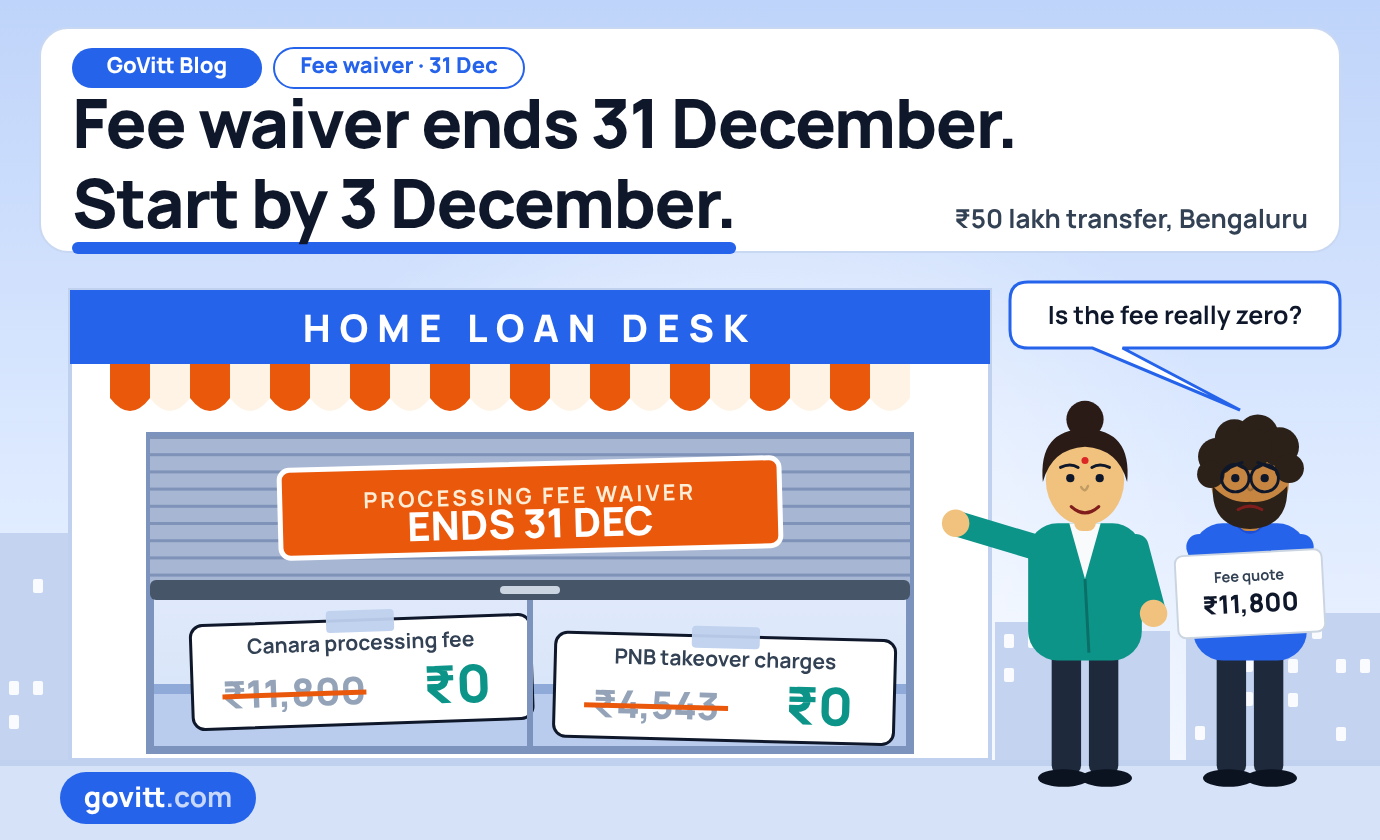
A home loan processing fee waiver is on at Canara Bank and Punjab National Bank until 31 December 2026, which is 40 days after 21 November. On a ₹50 lakh balance transfer, Canara's waiver is worth ₹11,800 and PNB's is worth ₹4,543. That's real money. It isn't the whole bill, though. Stamp duty, registration, legal and valuation fees stay, and in Bengaluru they come to ₹36,000 to ₹47,000 on ₹50 lakh.
The short version: don't move a loan just to catch a waiver. If the rate gap is big, the waiver makes a good transfer pay back a few months sooner. If the gap is small, it doesn't rescue anything. And if you were going to move anyway, the clock matters. A clean transfer in Bengaluru takes three to four weeks, so the last sensible day to start is about 3 December, one day before RBI's policy decision. Neither bank's page says which date the waiver counts, so ask for that in writing before you commit.
Below: what I could verify and what I couldn't, what each waiver saves in rupees, what it can't touch, the date maths, and what RBI's 4 December decision has to do with any of it.
See your real payoff date in 60 seconds
Banks calculate remaining EMIs by simple subtraction. See your actual payoff date and discover how much interest a balance transfer can save.
What I could verify, bank by bank
I read these on 21 November 2026. Where I could not confirm something on a bank's own page, the table says so.
| Bank | Waiver | Dates | What the page says |
|---|---|---|---|
| Canara Bank | 100% of processing charges | 1 October to 31 December 2026 | "Retail Loan Festival". Normal fee is 0.50%, minimum ₹1,500, maximum ₹10,000, plus GST |
| Punjab National Bank | Full waiver of processing fee, takeover charge and documentation charge on home loans | 1 October to 31 December 2026 | "PNB Utsav Festivities 2026". Takeover charge ₹2,500 and documentation charge ₹1,350, plus GST |
| SBI | Not confirmed | Not confirmed | Fee card: 0.35%, minimum ₹5,000, maximum ₹15,000 plus GST for salaried borrowers. No waiver text in the documents I could open |
| Union Bank of India | Nothing on the page | Not applicable | Its rate sheet (updated 8 October 2026) has no fee or waiver text |
| Bank of Baroda | Nothing on the page | Not applicable | The retail rate page has no fee or waiver text |
| Kotak Mahindra Bank | My 16 October charges post said 50% off | Not confirmed on 21 November | Its pages gave me no fee or end date |
Two notes on that table. PNB's waiver, as printed, doesn't extend to processing fees on loans against property or on top-ups for existing home loan borrowers. And a waiver I couldn't see isn't a waiver that doesn't exist. If your lender isn't on this list, ask the branch what is on offer this month and until when.
What the waiver saves, in rupees
Same base case as my other transfer posts: ₹50 lakh outstanding, 20 years left, moving from 8.75% to 7.50%. The EMI falls from ₹44,186 to ₹40,280, which is ₹3,906 a month. The last column turns each waiver into months of that saving.
| Lender | Normal fee on ₹50 lakh, with 18% GST | What the waiver saves | Equal to this many months of EMI saving |
|---|---|---|---|
| Canara Bank | ₹11,800 (0.50% would be ₹25,000, so the ₹10,000 cap applies) | ₹11,800 | 3.0 months |
| Punjab National Bank | ₹4,543 (₹2,500 takeover plus ₹1,350 documentation, plus GST) | ₹4,543 | 1.2 months |
| SBI, for comparison | ₹17,700 (0.35% would be ₹17,500, which is above the ₹15,000 cap, so ₹15,000 plus GST applies) | No waiver confirmed | 4.5 months if it applied |
Canara's capped fee is the reason its waiver is worth more than PNB's on a takeover. PNB charges a flat ₹2,500 for a takeover, which is a small number to waive.
One more thing about Canara. Its page also takes 0.05% off the rate for takeover proposals. On a loan up to ₹50 lakh, the best row I read for other borrowers is 7.55%, so with that concession it's 7.50%, if you land in Canara's top credit band (CS:1). The page doesn't map those bands to CIBIL scores, so I can't tell you which score that is.
What the waiver can't touch
A processing waiver removes one line. Here is the Bengaluru bill for ₹50 lakh from my balance transfer charges post (charges as of 16 October 2026, illustrative):
| Line | Amount | |
|---|---|---|
| Does a processing waiver remove it? | Processing fee, with GST | ₹17,700 to ₹29,500 |
| Yes, if your lender is waiving it | Legal and technical valuation | ₹5,000 to ₹15,000 |
| No | MODT stamp duty (0.5% in Karnataka) | ₹25,000 |
| No, it's a government charge | MODT registration (about 0.1%) | ₹5,000 |
| No | CERSAI, scanning, small charges | ₹1,000 to ₹2,000 |
| No | Total before any waiver | ₹53,700 to ₹76,500 |
| Left after a full processing waiver | ₹36,000 to ₹47,000 |
The processing fee is 33% to 39% of the total. The rest is still yours. I explain why you pay the MODT again in MODT charges in Karnataka, and the stamp duty side in stamp duty and registration charges in Karnataka.
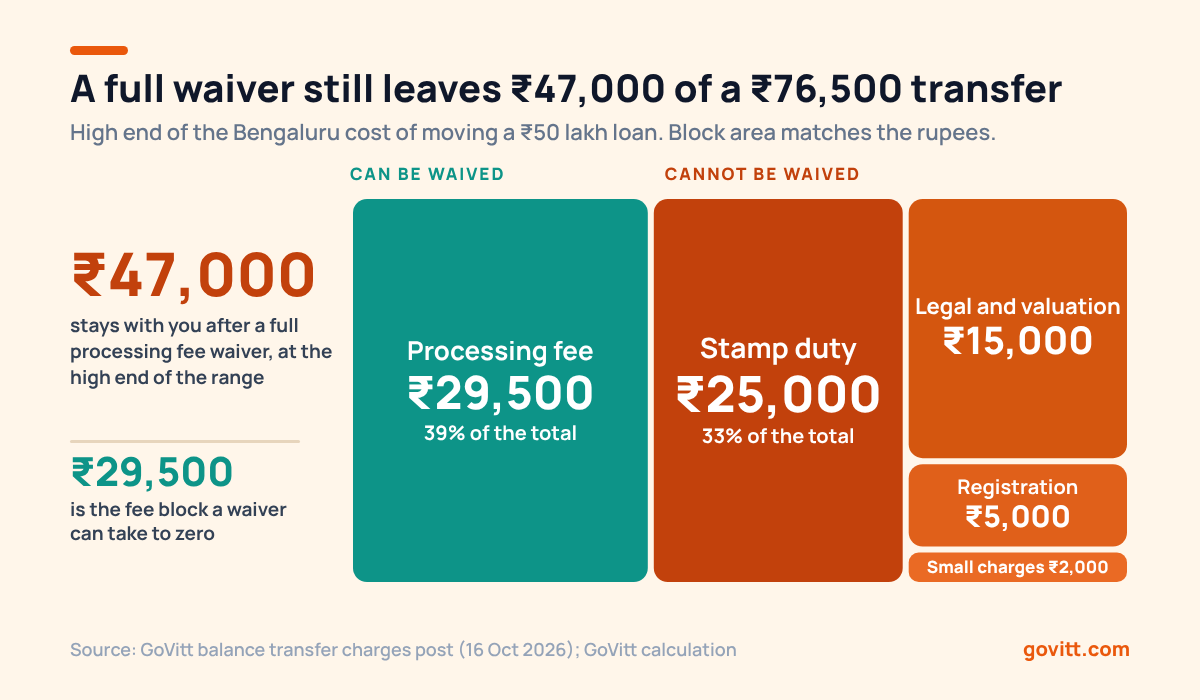
The low and high ends of my range assume an SBI-style fee (0.35%, capped) and a 0.50% fee with no cap. Canara and PNB sit lower than that high end, so here's the same bill at each of them, with the lender's own fee, before and after the waiver, and how long ₹3,906 a month takes to pay it back.
| Transfer to | All-in cost without the waiver | Paid back in | All-in cost with the waiver | Paid back in |
|---|---|---|---|---|
| Canara Bank | ₹47,800 to ₹58,800 | 13 to 16 months | ₹36,000 to ₹47,000 | 10 to 13 months |
| Punjab National Bank | ₹40,543 to ₹51,543 | 11 to 14 months | ₹36,000 to ₹47,000 | 10 to 13 months |
PNB's own page, as I read it, takes the processing fee, the takeover charge and the documentation charge to zero. My charges post also says PNB bears the legal, valuation and NEC charges up to ₹15,000 plus GST on takeovers of ₹25 lakh and above. I couldn't see that on the PNB pages I could read on 21 November, so don't count on it until you've seen it in writing.
So the waiver takes about three months off the payback at Canara and one at PNB. It's worth having. It's not a reason to transfer.
When a waiver doesn't rescue a transfer
Take a small gap. A loan at 8.75% moving to 8.60% saves ₹478 a month on ₹50 lakh. A full waiver still leaves ₹36,000 to ₹47,000 of costs, which takes 76 to 99 months to earn back. That's six to eight years. A free processing fee doesn't change the answer. I cover the cases like this one in when a home loan balance transfer is not worth it.
My rule hasn't changed. Add up what's left after the waiver, divide by your monthly saving, and if it comes back in 24 months or less and you'll hold the loan well past that, price the transfer.
The date maths
I'm writing this on Saturday, 21 November. The waivers end on Thursday, 31 December. That's 40 days, a bit under six weeks. In my balance transfer process post, a clean Bengaluru transfer takes three to four weeks from the first request to the first EMI with the new lender, with the legal and valuation checks taking about a week of it. A lender can be slower, especially with an independent house or a long chain of papers.
Work backwards from 31 December and the start dates look like this. The columns show when your first EMI with the new lender would land on a three week and a four week timeline.
| If you start on | First EMI on a 3 week timeline | First EMI on a 4 week timeline |
|---|---|---|
| Saturday, 21 November | 12 December | 19 December |
| Saturday, 28 November | 19 December | 26 December |
| Thursday, 3 December | 24 December | 31 December |
| Thursday, 10 December | 31 December | 7 January |
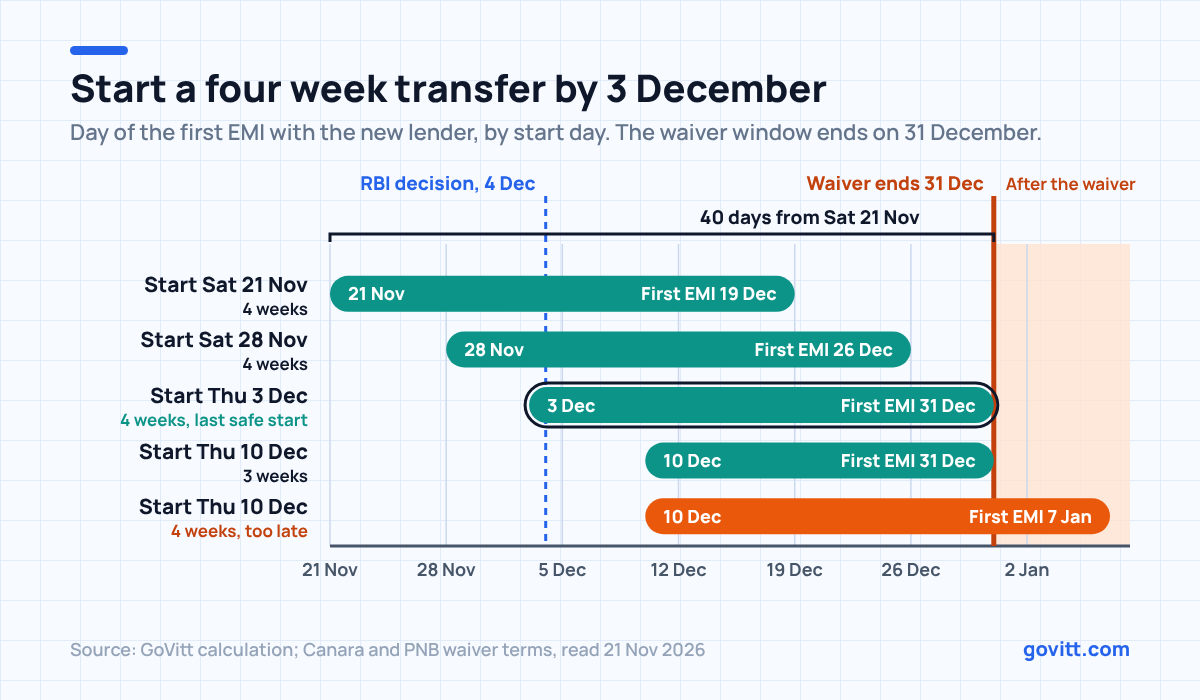
That puts the last day to start a four week transfer at Thursday, 3 December. A three week transfer can start on 10 December. After that you're relying on the lender to be quick, and a late-December year-end is not when I'd bet on that.
Here's the part I can't tell you. Both pages give the same window, 1 October to 31 December 2026. Neither says whether the date is when you apply, when the loan is sanctioned or when it's disbursed. Banks differ on this, and the difference decides whether 3 December is a safe date or a risky one. Ask in writing: "Which date decides the waiver, and does a sanction letter dated before 31 December protect it?"
RBI on 4 December, and why it isn't a reason to wait
The RBI policy decision is on Friday, 4 December, 13 days after 21 November. In a Reuters poll of economists taken from 13 to 20 November and published on 20 November, 56 of 61 expected a 0.25% hike to 5.75% on 4 December. Three expected no change and two expected 0.50%. For February, 34 of 46 expected a final 0.25% hike to 6%. Those are the economists' views, not mine. This isn't a forecast, and polls miss.
What I can do is the arithmetic. A 0.25% rise adds ₹767 a month on ₹50 lakh at 7.50%, and ₹800 at 8.75%. Repo-linked loans, old and new, feel a repo move at their next reset, so the gap between what you pay and what a new lender offers doesn't change just because RBI moves. I walked through that in rates just went up: does switching your home loan still make sense. So waiting for 4 December doesn't save you money on the switch. It does eat into your time before 31 December.
One thing to ask for. My process post says the sanction letter should show the spread over repo, and that the spread is what stays fixed while everything else moves with RBI. Ask whether the rate in the sanction letter holds until disbursal, or resets if RBI moves in between. Neither bank's page says.
What I'd do this week
- Find your gap. Take the rate on your latest loan statement and subtract the written quote you'd get elsewhere. If it's under 0.50%, stop here and ask your own bank to reprice.
- Ask your own bank first. A reprice or a rate conversion costs a fraction of a transfer and has no deadline.
- Get two written quotes that name the waiver, the date it ends and which date decides it. Ask for the spread over repo, not the headline rate.
- Add up what's left after the waiver, including stamp duty, registration, legal and valuation. Divide by your monthly saving.
- If the answer is 24 months or less, start by 3 December and ask for the foreclosure letter from your current lender the same day. That letter starts the clock. My process post has the order.
- If you start after 10 December, get the lender to confirm in writing that your file qualifies for the waiver. If it won't, treat the waiver as gone and decide on the rate gap alone.
For a ranking of lenders by rate and cost, see best banks for home loan balance transfer in 2026. If you're asking how soon after taking a loan you can move it, how soon can you transfer a home loan has the answer.
FAQ
What is the last date for the home loan processing fee waiver? At Canara Bank and Punjab National Bank, the waivers run until 31 December 2026, according to each bank's own pages as I read them on 21 November. Neither page says whether that date applies to your application, your sanction or your disbursal, so ask in writing.
Does the waiver cover stamp duty and MODT charges? No. A processing fee waiver removes the lender's processing fee, and on PNB's page also the takeover and documentation charges. Karnataka stamp duty on the MODT (0.5%, which is ₹25,000 on ₹50 lakh), registration, legal and valuation fees stay. In Bengaluru that's ₹36,000 to ₹47,000 on ₹50 lakh.
How much does Canara Bank's processing fee waiver save on a balance transfer? On ₹50 lakh it saves ₹11,800: 0.50% would be ₹25,000, but Canara caps the fee at ₹10,000, and GST at 18% takes it to ₹11,800. That's about three months of a ₹3,906 monthly saving. PNB's takeover waiver saves ₹4,543 on the same loan.
Does SBI waive its home loan processing fee in 2026? I couldn't confirm it. SBI's fee card shows 0.35% with a minimum of ₹5,000 and a maximum of ₹15,000 plus GST for salaried borrowers, which is ₹17,700 on ₹50 lakh with GST. It has no waiver text, and SBI's rate card image would not load for me. Ask the branch for any current offer in writing.
Should I wait for the RBI decision on 4 December before I transfer? Waiting doesn't improve the rate gap, because a repo move reaches old and new loans alike. It does use up days before 31 December. A transfer takes three to four weeks, so a start after about 3 December puts the waiver at risk.
Want to see your own saving before the deadline? Run the Payoff & Transfer Calculator with your outstanding amount, rate and years left. GoVitt compares 50+ banks and charges you 0% commission.
Figures are for ₹50 lakh outstanding, 20 years left, moving from 8.75% to 7.50%, monthly reducing balance, EMI rounded to the rupee. Bank waivers, dates and fees were read on 21 November 2026 from the banks' own pages, and one PNB figure came through a summary of a long page. Bengaluru costs are the illustrative ranges from GoVitt's charges post (16 October 2026) and differ by lender and property. The 7.50% rate is an example, not a quote. The Reuters poll is other people's views, not a forecast. Confirm every waiver, fee and date in writing with your lender before you act. This is general information, not financial advice.
Ready to take the next step?
Find out your loan options and check your eligibility with GoVitt today.